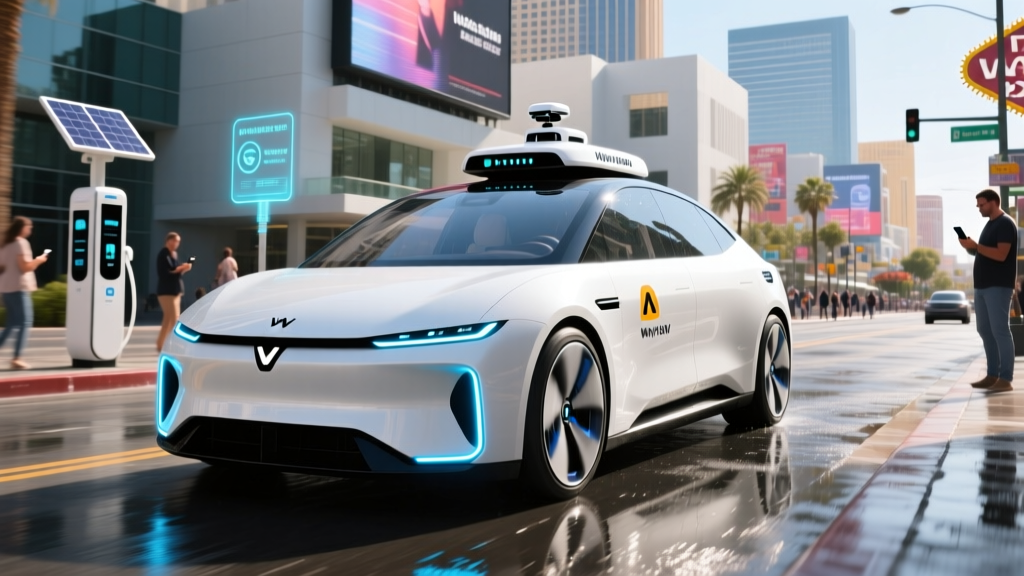
If you've visited Phoenix or San Francisco recently, you've likely spotted a white Jaguar I-PACE with a spinning lidar array on its roof gliding through traffic without anyone in the driver's seat. That's Waymo One, the only commercially operating Level 4 robotaxi service in the United States. But for travelers and residents asking is Waymo in Las Vegas, the answer requires a closer look at the company's expansion roadmap, regulatory approvals, and the hard geographic limits of driverless technology.
As of early 2026, Waymo operates its fully driverless Waymo One service in four major U.S. metros and is actively expanding. Here's what you need to know about whether Las Vegas is on the list, how the service actually works, and what separates a real robotaxi from the driver-assist systems you might already have in your own car.
Is Waymo in Las Vegas? The Short Answer
As of 2026, Waymo One does not operate a commercial driverless ride-hail service in Las Vegas. The city is not among Waymo's currently live service areas. However, Las Vegas has appeared on Waymo's longer-term expansion radar, and the city's relatively grid-like street layout and dry climate make it a theoretically strong candidate for future deployment.
Waymo has conducted limited testing and mapping operations in Las Vegas in prior years, but mapping and testing are not the same as open commercial service. For now, visitors to Las Vegas who want a driverless ride will need to look elsewhere or wait for future announcements.
The SAE International J3016 standard defines six levels of driving automation. Level 2 (Tesla Autopilot, GM Super Cruise, Ford BlueCruise) requires the human driver to remain engaged and supervising at all times — these are driver-assist systems, not self-driving cars. Level 4 means the vehicle handles all driving tasks within a defined operational design domain (geofenced area, specific conditions) with no human driver required. Waymo One operates at Level 4 within its approved service zones. There is no Level 5 (drive anywhere, any conditions) robotaxi operating commercially anywhere in the world.
Where Can You Actually Ride a Waymo Right Now?
Waymo One's commercial service footprint has grown steadily but deliberately. The company prioritizes geofenced areas where it has mapped every lane, intersection, and construction zone in high definition. Here is the current operational map as of 2026:
| City | Service Name | Status | Approximate Coverage Area |
|---|---|---|---|
| Phoenix, AZ | Waymo One | Fully open, 24/7 | ~225 sq mi (Tempe, Chandler, Mesa, Scottsdale, downtown Phoenix) |
| San Francisco, CA | Waymo One | Fully open, 24/7 | Most of SF proper, Daly City, parts of the peninsula |
| Los Angeles, CA | Waymo One | Fully open | Downtown LA, Hollywood, Santa Monica, Westside, expanding |
| Austin, TX | Waymo One | Launched / expanding | Central Austin, South Austin, airport corridor |
| Las Vegas, NV | — | Not available | No commercial service |
Waymo has also announced intentions to bring service to additional cities, and has previously tested in locations including Atlanta and Miami. But testing with safety drivers is a fundamentally different milestone than launching a driverless commercial service open to the public.
How to Use Waymo One (and What It Costs vs. Uber)
If you're in one of Waymo's live cities, the process is straightforward:
- Download the Waymo One app (iOS/Android) and create an account.
- Enter your pickup and dropoff — both must fall within the active geofenced service area.
- Confirm the ride — a vehicle (currently a Jaguar I-PACE EV) will be dispatched to your location.
- Verify your identity via the app at the vehicle, then the doors unlock.
- Start the ride by pressing the "Start Ride" button on the rear-seat screen. No one is in the driver's seat.
The experience is notably calm. The I-PACE accelerates smoothly, signals lane changes well in advance, and the in-car screen shows a real-time visualization of what the vehicle's sensors are detecting — pedestrians, other cars, cyclists, traffic cones.
Pricing: Waymo vs. Uber vs. Lyft
Waymo prices its rides to be competitive with UberX and Lyft standard rides in the same corridor. Based on sampled fares in Phoenix and San Francisco:
| Route (approx.) | Waymo One | UberX | Lyft Standard |
|---|---|---|---|
| Short trip (~3 mi, city center) | $10–$14 | $9–$15 | $9–$14 |
| Medium trip (~8 mi, cross-town) | $18–$26 | $16–$28 | $15–$27 |
| Airport trip (~15 mi) | $30–$45 | $28–$50 | $26–$48 |
Key difference: Waymo does not use surge pricing the way Uber and Lyft do. Fares are more predictable, though wait times can be longer during peak demand because the fleet size is finite. Tipping is not expected (there's no driver), though the app does offer an option.
Waymo's Safety Record: What the Data Actually Shows
Safety is the most scrutinized aspect of robotaxi operations, and rightly so. Waymo has accumulated over 40 million fully driverless miles across its operational cities as of late 2025, with that number continuing to climb through 2026.
- Total driverless miles: 40+ million
- Fatalities involving Waymo driverless vehicles: 0
- Police-reported injury crashes: Waymo published a study showing a ~85% reduction in police-reported injury crash rate compared to human benchmarks in comparable geographies
- Minor contact incidents: Dozens documented — mostly low-speed contacts with stationary objects (parked cars, bollards, construction barriers). These are reported to regulators as required.
- NHTSA Standing General Order: Waymo reports all crashes involving its ADS-equipped vehicles under federal reporting requirements
Sources: NHTSA AV safety data, Waymo safety reports
For context, human drivers in the U.S. experience roughly 1.3 fatalities per 100 million vehicle miles traveled (NHTSA FARS data). Waymo's 40+ million driverless miles with zero fatalities is statistically encouraging but not yet a large enough sample to declare definitive superiority. The more relevant metric is the injury-crash rate, where Waymo's published data shows a meaningful advantage — but independent third-party verification remains limited.
Notable incidents have occurred. In Phoenix, a Waymo vehicle struck a pedestrian who walked into the roadway from behind a parked truck, resulting in minor injuries. In San Francisco, a Waymo was involved in a collision with a cyclist. Each incident is investigated and reported. The pattern: Waymo vehicles are generally conservative and law-abiding but can struggle with edge cases involving unpredictable human behavior in complex urban environments.
The Technology Stack: How a Waymo Vehicle Sees the World
Waymo's approach is sensor-heavy and fundamentally different from camera-only systems like Tesla's FSD. The current 6th-generation Waymo Driver hardware suite includes:
Waymo 6th-Gen Sensor Suite (Jaguar I-PACE platform)
- Lidar: Multiple units providing 360° high-resolution 3D point clouds — effective to 500+ meters. Lidar works independently of ambient light, giving Waymo excellent night performance.
- Cameras: High-resolution surround cameras for color information, traffic-light state recognition, sign reading, and object classification.
- Radar: Imaging radar for velocity detection of moving objects and performance in rain/fog where lidar and cameras degrade.
- Audio sensors: External microphones to detect emergency vehicle sirens.
- HD Maps: Centimeter-precision pre-mapped routes within the geofence. The vehicle always knows exactly where it is relative to lane boundaries, stop lines, and crosswalks.
- Compute: Custom-designed onboard computers running Waymo's perception, prediction, and planning stack.
The reliance on lidar and HD maps is both Waymo's greatest strength and its greatest constraint. Lidar provides depth perception that cameras alone cannot match, and HD maps give the system a prior understanding of every intersection. But this approach means Waymo cannot simply drive into a new, unmapped city and operate. Each new service area requires weeks to months of mapping, validation, and regulatory approval before the first rider is picked up.
This is the core reason why Waymo expansion is measured in years, not months. Compare this to a camera-only system that theoretically could work anywhere — but in practice, Tesla's FSD (Supervised) remains a Level 2 system requiring driver engagement precisely because camera-only perception still struggles with depth estimation and edge cases.
Regulatory Landscape: Who Approves Robotaxi Operations?
Robotaxi operations in the U.S. require approval at both the state and local level, and the regulatory environment varies significantly by jurisdiction:
- Arizona: Among the most permissive. No specific state-level permit required for driverless testing or commercial operations. Waymo has operated freely in the Phoenix metro since 2020.
- California: The California Public Utilities Commission (CPUC) issues permits for commercial passenger service. The California DMV issues testing and deployment permits. San Francisco and LA operations required both.
- Texas: Austin has been relatively welcoming. State law (HB 2805, 2023) established a framework for autonomous vehicle operations.
- Nevada: Nevada was actually an early mover on AV legislation (AB 511, 2011), and the state has a framework for autonomous vehicle testing and operation. However, commercial robotaxi deployment requires coordination with local authorities, and Las Vegas has not yet seen a Waymo One launch.
The federal government, through NHTSA, sets vehicle safety standards and requires crash reporting (Standing General Order), but does not currently issue permits for robotaxi operations — that authority rests with states and municipalities.
Current Limitations: Where Robotaxis Can't Go (and Why)
Even within Waymo's live cities, the service has meaningful constraints that riders should understand:
Known Limitations of Waymo One (2026)
- Geofence boundaries: Both pickup and dropoff must be within the mapped service zone. You cannot ride from downtown Phoenix to Tucson — the vehicle will not accept a destination outside its operational design domain.
- Weather: Heavy rain, fog, and snow degrade lidar and camera performance. Waymo vehicles may pause service or pull over during severe weather events. Phoenix's dry climate is ideal; San Francisco fog occasionally causes slowdowns.
- Construction zones: Major road construction can confuse HD maps. Waymo may reroute or avoid areas with significant lane reconfiguration until maps are updated.
- Highway driving: Limited. Waymo vehicles can handle some highway segments within the geofence but are primarily optimized for urban and suburban surface streets.
- No intercity trips: These are point-A-to-point-B rides within a single metro. Think airport runs, not road trips.
- Accessibility: Current Jaguar I-PACE vehicles require passengers to enter a standard SUV. Wheelchair-accessible vehicles are in development but not widely deployed.
- No food/drink deliveries: Unlike some competitors testing delivery, Waymo One is passenger-only.
For Las Vegas specifically, the Las Vegas Strip presents unique challenges: extreme pedestrian density, constant construction, frequent road closures for events, and a chaotic mix of tourist behavior. These conditions would require extensive validation before any robotaxi operator could confidently deploy there.
What About Other Robotaxi Options in Las Vegas?
Las Vegas is not entirely devoid of autonomous vehicle activity. The city has hosted various AV pilot programs over the years, including:
- Motional (Hyundai/Aptiv): Previously tested Level 4 vehicles in Las Vegas and offered limited public rides through a Lyft partnership, but the program was paused and restructured as Motional shifted strategy.
- Zoox: Amazon's Zoox has tested its purpose-built robotaxi vehicle in Las Vegas. However, as of 2026, Zoox has not launched a broad commercial ride-hail service open to the general public in Vegas.
- Cruise (GM): Cruise previously operated in several cities but suspended operations nationwide in late 2023 after a serious incident in San Francisco. As of 2026, Cruise has been slowly resuming limited testing with safety drivers in select cities, but has not relaunched a commercial driverless service in Las Vegas.
The bottom line: if you're visiting Las Vegas and hoping to hail a fully driverless ride, your options remain extremely limited as of 2026. Traditional rideshare (Uber, Lyft) and taxis are the practical choices.
Frequently Asked Questions
Is Waymo coming to Las Vegas?
Waymo has not announced a specific launch date for Las Vegas. The city's grid layout and dry climate are favorable for robotaxi operations, and Nevada's regulatory framework is supportive. However, Waymo's expansion has been methodical — each new city requires extensive mapping, testing, and regulatory coordination. Las Vegas is a plausible future market, but there is no confirmed timeline.
How much does a Waymo ride cost compared to Uber?
Waymo One fares are generally in line with UberX and Lyft standard pricing — typically $10–$14 for a short 3-mile city trip, $18–$26 for a cross-town ride, and $30–$45 for airport runs. Waymo does not use surge pricing, so fares are more predictable, though wait times can increase during peak demand.
Is Waymo truly self-driving or is there a remote operator?
Waymo vehicles are Level 4 autonomous — there is no human driver in the vehicle, and no remote operator "driving" the car in real time. The vehicle's onboard AI handles all driving decisions. Remote support staff can assist with routing or edge-case resolution (similar to air traffic control), but they do not steer, brake, or accelerate the vehicle.
What happens if a Waymo vehicle encounters an emergency?
Waymo vehicles are programmed to execute a "minimal risk condition" — essentially pulling over safely to the side of the road and stopping. Passengers can contact Waymo support via an in-vehicle button at any time. Emergency services are contacted automatically if a collision is detected.
Can I use Waymo if I'm visiting from out of town?
Yes. Anyone can download the Waymo One app, create an account, and request a ride in any city where the service is live. No local residency is required. You'll need a valid payment method and a smartphone.
What vehicle does Waymo use?
Waymo's current fleet consists of Jaguar I-PACE all-electric SUVs equipped with the 6th-generation Waymo Driver sensor suite. The I-PACE has an EPA range of approximately 234 miles, a 90 kWh battery pack, and supports up to 100 kW DC fast charging. Waymo has also announced a partnership with Geely/Zeekr for a purpose-built robotaxi vehicle for future deployment.