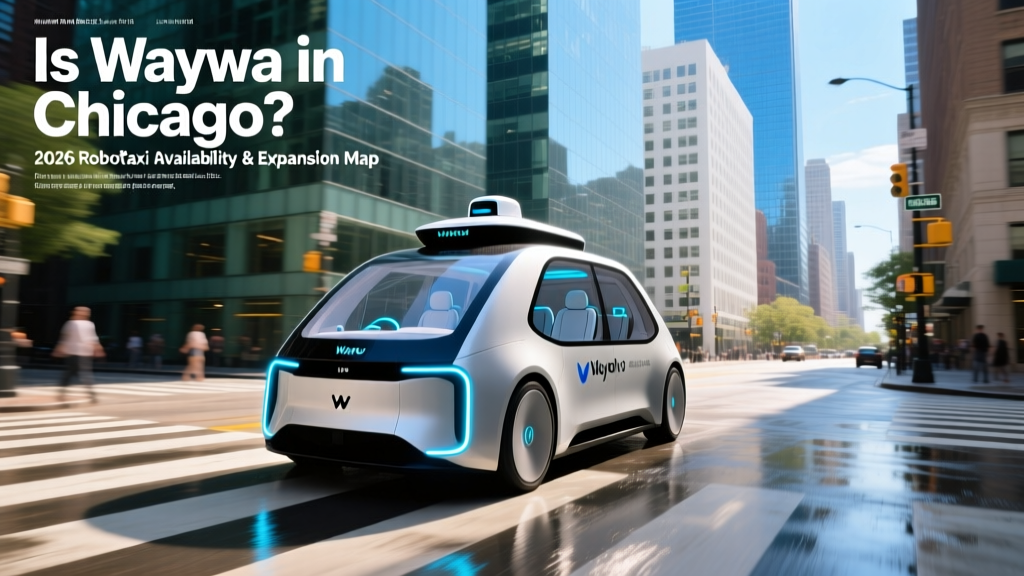
Is Waymo in Chicago? The Short Answer
As of early 2026, Waymo is not operating a commercial robotaxi service in Chicago. The city does not appear on Waymo's live service map, and no paid rider program is active in Illinois. If you open the Waymo One app in Chicago today, you won't be able to hail a ride.
That said, Waymo's expansion trajectory has accelerated significantly since its Phoenix launch. The company now operates fully driverless commercial service in multiple major metros, has tested in cold-weather environments, and has signaled interest in Midwest expansion. Chicago — the third-largest U.S. city — is a logical future target, but regulatory, weather, and mapping hurdles remain.
This guide covers exactly where Waymo operates right now, what it would take to reach Chicago, how the technology works, what rides cost, and the safety data behind Level 4 robotaxis.
Where Can You Actually Ride a Waymo Right Now?
Waymo One, the company's commercial ride-hailing service, is available to the general public in a growing but still limited set of cities. Below is the current operational footprint as of 2026.
| City | Status | Service Area Size | Hours |
|---|---|---|---|
| Phoenix, AZ (Metro) | Fully commercial, open to public | ~315 sq mi | 24/7 |
| San Francisco, CA | Fully commercial, open to public | ~55 sq mi (expanding) | 24/7 |
| Los Angeles, CA | Fully commercial, open to public | ~80+ sq mi | 24/7 |
| Austin, TX | Commercial service launched | Expanding geofence | Extended hours |
| Mountain View / Bay Area suburbs | Commercial (employee + waitlist expansion) | Variable | Variable |
Waymo has also conducted testing operations (not commercial rider service) in additional cities including Dallas, Atlanta, and Miami. Testing means Waymo vehicles are mapping roads and running autonomous miles with a safety operator or under restricted conditions — it does not mean you can download the app and hail a ride.
Why Chicago Isn't on the Map Yet
Chicago presents a specific set of challenges that explain why it hasn't been among Waymo's first-wave expansion cities:
- Winter weather: Chicago averages 36 inches of snowfall annually. Heavy snow, ice, and road-salt spray degrade lidar and camera sensor performance. Waymo's current commercial cities (Phoenix, LA, SF, Austin) rarely see snow.
- Regulatory approval: Illinois has not established a comprehensive regulatory framework for driverless commercial robotaxi operations the way Arizona and California have. State and city-level approval would be required.
- HD mapping requirements: Waymo relies on centimeter-precision high-definition maps of every road in its geofence. Mapping Chicago's 234+ square miles of dense, multi-level urban streets (including lower-level roads like Wacker Drive) is a substantial undertaking.
- Construction density: Chicago's year-round construction zones require real-time route adaptation that pushes the limits of current geofenced autonomy.
- Competitive rideshare market: Uber and Lyft are deeply entrenched, and Waymo typically enters markets where it can demonstrate clear differentiation before scaling.
Waymo has conducted cold-weather testing in locations like Buffalo, New York, and in northern Michigan, suggesting the company is working on the sensor and software adaptations needed for snow-belt cities. But testing is years ahead of commercial launch.
Understanding the Autonomy Level: This Is Not Driver-Assist
A critical distinction that gets blurred in media coverage: Waymo's robotaxi is a SAE Level 4 system. This is fundamentally different from the Level 2 driver-assistance systems you find in consumer vehicles.
| Level | Name | Who Drives | Example |
|---|---|---|---|
| 0 | No Automation | Human | Standard car |
| 1 | Driver Assistance | Human (system assists steering OR speed) | Adaptive cruise control |
| 2 | Partial Automation | Human (must supervise at all times) | Tesla Autopilot, GM Super Cruise, Ford BlueCruise |
| 3 | Conditional Automation | System in limited conditions; human on standby | Mercedes Drive Pilot (limited markets, <40 mph) |
| 4 | High Automation | System fully — no human needed in geofence | Waymo One, Zoox |
| 5 | Full Automation | System everywhere, all conditions | Does not exist commercially |
When you ride in a Waymo, there is no one in the driver's seat. The vehicle handles all aspects of the driving task — steering, braking, route planning, obstacle avoidance, traffic-signaling compliance — within its approved geofence. You cannot take a Waymo outside its mapped zone, and the vehicle will pull over safely if it encounters a scenario it cannot handle.
This is categorically different from Tesla's FSD (Supervised), which is a Level 2 system requiring the driver to remain attentive and ready to take over at any moment. NHTSA's automation framework makes this distinction clear, and it matters for liability, insurance, and rider expectations.
How Waymo's Technology Stack Works
Waymo's sixth-generation autonomous driving system (the hardware suite on its current Jaguar I-PACE fleet and upcoming Zeekr vehicles) uses a multi-sensor approach that differs sharply from camera-only systems.
- Lidar: Multiple roof-mounted and side-mounted lidar units providing 360° 3D point-cloud mapping up to 500+ meters. Lidar works in darkness and is less affected by glare than cameras.
- Cameras: High-resolution surround cameras for lane markings, traffic signals, signage, and object classification.
- Radar: Imaging radar for velocity detection of moving objects, particularly useful in rain and fog where lidar scatters.
- Audio detection: External microphones to detect emergency vehicle sirens and adjust behavior accordingly.
- HD Maps: Pre-built centimeter-accuracy maps of every lane, curb, crosswalk, and signal in the geofence. The car always knows exactly where it is.
This sensor-fusion approach (lidar + camera + radar + HD maps) provides redundancy that camera-only systems like Tesla's lack. If one sensor modality is degraded — say, camera washout from sun glare — lidar and radar maintain situational awareness. The trade-off is cost: each Waymo vehicle's sensor suite is estimated at $100,000–$150,000+, though per-unit costs have dropped with each generation.
The system is geofenced: Waymo vehicles will only operate within areas that have been exhaustively mapped and approved. They cannot simply drive anywhere. This is both a limitation and a safety feature — the car never encounters an unmapped road in commercial service.
Pricing: Waymo vs. Uber and Lyft
One of the most common questions from prospective riders: how does a robotaxi fare compare to a traditional rideshare? Based on rider reports and Waymo's published pricing structure in active markets:
| Factor | Waymo One | UberX / Lyft |
|---|---|---|
| Base fare | Comparable to UberX | Standard |
| Per-mile rate | ~$1.00–$1.50/mi | ~$0.90–$1.40/mi |
| Per-minute rate | ~$0.25–$0.40/min | ~$0.20–$0.35/min |
| Surge pricing | No surge multiplier | 1.5x–3x during peak |
| Tips | Not expected (no driver) | 15–20% customary |
| Wait time | 3–8 min average | 2–6 min average |
| 5-mile trip estimate | $10–$16 | $9–$18 (with surge, higher) |
The key differentiator is pricing consistency. Waymo does not use surge pricing algorithms, so a ride at 5 PM on a Friday costs the same as one at 2 AM on a Tuesday. For regular commuters in Waymo cities, this predictability can make robotaxis cheaper than Uber during peak hours, even if the base rate is slightly higher.
To use Waymo One, you download the app, enter your destination, and a vehicle arrives. You unlock it via the app, buckle up, and the ride begins. In-app controls let you adjust climate, add stops, or pull over early. It's functionally identical to Uber — just without a driver.
Safety Data: What the Numbers Actually Show
Safety is the most scrutinized aspect of robotaxi operations, and Waymo has published more real-world data than any competitor. Here's what the record shows:
- Autonomous miles driven: Over 40 million fully driverless miles across commercial operations.
- Injury-critical crash rate: Waymo's published data shows a 85% reduction in injury-causing crashes compared to human benchmarks in equivalent urban environments, per NHTSA-referenced studies.
- Contact rate: Waymo reports significantly lower contact rates (any physical contact with another object) per million miles than human drivers in the same cities.
- No fatalities: As of this writing, no passenger or pedestrian fatality has been attributed to a Waymo vehicle operating in autonomous mode.
Context matters. Waymo's record is not spotless — the company has faced scrutiny for NHTSA-reported incidents including vehicles briefly entering construction zones and a recall of its software following incidents in San Francisco in late 2023 where two vehicles collided with a towed pickup truck. Waymo issued an over-the-air software update to address the issue, and the recall was closed.
The broader comparison is instructive: U.S. human drivers experience approximately 1.35 fatalities per 100 million vehicle miles traveled (NHTSA, 2022 data). At 40+ million autonomous miles, statistical parity with human fatality rates would predict roughly 0.5 fatalities. Waymo's zero-fatality record, while still a limited sample, is directionally encouraging.
IIHS and independent researchers continue to monitor robotaxi safety, and the data set is growing rapidly as autonomous miles accumulate.
The Regulatory Landscape: Who Approves Robotaxis?
Robotaxi operations in the U.S. require a patchwork of approvals:
- State level: Each state sets its own rules for autonomous vehicle testing and commercial deployment. Arizona (where Waymo launched) has among the most permissive frameworks. California requires permits from both the DMV (testing) and the California Public Utilities Commission (CPUC) (commercial passenger service). Illinois currently lacks a specific commercial robotaxi permitting framework.
- Federal level: NHTSA regulates vehicle safety standards but does not directly approve or ban autonomous driving software. Federal Motor Vehicle Safety Standards (FMVSS) were written for human-driven vehicles, and exemptions are sometimes needed for vehicles without steering wheels (like Zoox's purpose-built shuttle).
- City level: Local governments control road access, permitting for commercial operations on city streets, and can impose operational restrictions (hours, zones, fleet size caps).
For Chicago specifically, Illinois would need to pass or update legislation authorizing driverless commercial passenger service, and the City of Chicago would need to negotiate operating terms with Waymo. This is a multi-year process at minimum, even if Waymo prioritizes the market.
Current Limitations of Level 4 Robotaxis
Waymo's technology is impressive within its geofence, but significant limitations remain:
- Weather ceiling: Heavy rain, snow, fog, and ice degrade sensor performance. Waymo vehicles in San Francisco have been observed pulling over during heavy fog. Chicago winters would present frequent no-go conditions.
- Geofence rigidity: The car cannot drive to an unmapped address. If your destination is 200 feet outside the geofence, you'll be dropped at the nearest mapped point.
- Construction zones: While Waymo handles many construction scenarios, complex multi-stage detours with temporary signage and flaggers remain challenging edge cases.
- No highway driving (in most markets): Waymo's commercial service primarily covers surface streets. Highway-speed autonomous driving in mixed traffic adds complexity that isn't yet deployed in most cities.
- Fleet availability: Limited fleet sizes mean longer wait times during peak demand. Unlike Uber, which can surge-price to attract more drivers, Waymo's fleet is fixed.
- Accessibility: Current Waymo vehicles (Jaguar I-PACE) require riders to enter and exit independently. Wheelchair-accessible vehicles are in development but not yet standard.
When Might Waymo Come to Chicago?
There is no announced launch date for Waymo in Chicago. Based on the company's expansion cadence and the barriers outlined above, a realistic timeline would be:
- 2026–2027: Continued cold-weather testing in northern cities; possible Illinois legislation updates.
- 2028–2029: Potential mapping and limited testing in Chicago with safety operators.
- 2030+: Earliest realistic window for commercial Waymo One service in Chicago, contingent on regulatory approval and demonstrated winter-weather capability.
This is speculative — Waymo could accelerate or delay based on technology breakthroughs, regulatory changes, or business priorities. For now, Chicagoans looking for autonomous rides will need to visit Phoenix, San Francisco, Los Angeles, or Austin.
Frequently Asked Questions
Is Waymo in Chicago in 2026?
No. Waymo does not operate commercial robotaxi service in Chicago. The nearest Waymo One markets are in Arizona, California, and Texas.
Is Waymo truly self-driving or is there a safety driver?
Waymo One rides are fully driverless — SAE Level 4. There is no human in the driver's seat and no remote teleoperator controlling the vehicle in real time. The autonomous system handles all driving tasks within its geofenced area.
How much does a Waymo ride cost compared to Uber?
Waymo pricing is comparable to UberX at base rates, typically $10–$16 for a 5-mile trip. The key difference: Waymo doesn't surge-price, so costs are more predictable during peak hours. No tip is expected.
Has anyone been hurt in a Waymo robotaxi?
Waymo reports a significantly lower injury-critical crash rate than human drivers in equivalent environments. No passenger or pedestrian fatalities have occurred in Waymo autonomous mode. Minor incidents have been reported and addressed via software updates and NHTSA oversight.
Can Waymo drive in snow?
Not reliably in commercial service. Heavy snow, ice, and salt spray interfere with lidar and camera sensors. Waymo is conducting cold-weather R&D, but current commercial operations are in mild-climate cities. This is a major barrier to Chicago deployment.
What's the difference between Waymo and Tesla's self-driving?
Waymo is SAE Level 4 — fully driverless within a geofence, no human needed. Tesla's FSD (Supervised) is SAE Level 2 — a driver-assistance system that requires a licensed, attentive driver behind the wheel at all times. They are fundamentally different categories of automation.