What Tesla Full Self-Driving Actually Does (And Doesn't Do)
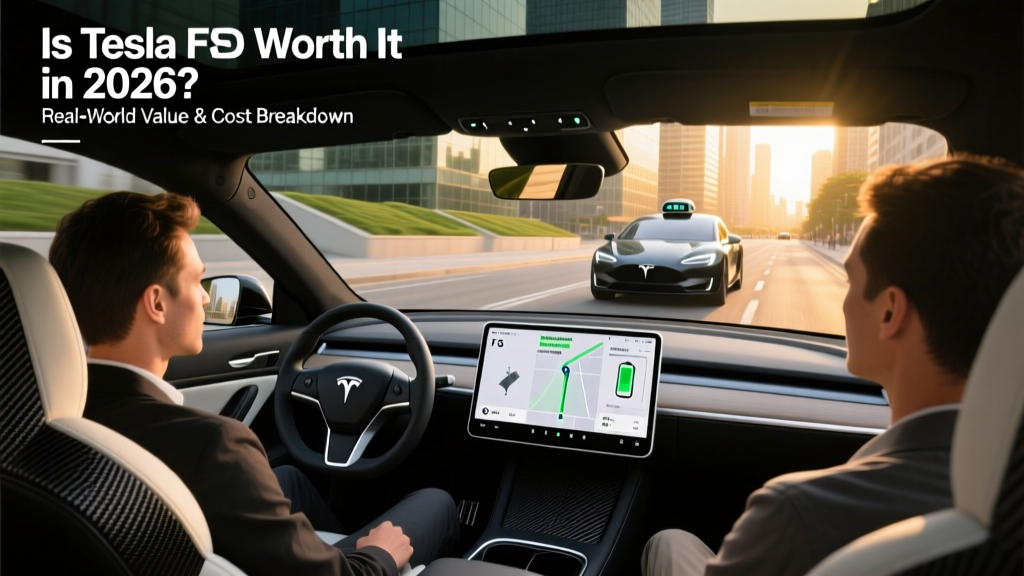
Tesla's Full Self-Driving (Supervised) is an advanced driver-assistance system that extends beyond the standard Autopilot bundled with every new Tesla. Where basic Autopilot handles adaptive cruise control and lane-centering on highways, FSD adds capabilities like automatic lane changes, navigation-based on-ramp-to-off-ramp routing, traffic-light and stop-sign recognition, and low-speed city-street steering. In 2026, Tesla's vision-only architecture relies on a suite of exterior cameras—typically eight on Model 3/Y and newer Model S/X—processed by the Hardware 4 (HW4) computer. There is no radar or lidar; Tesla removed ultrasonic sensors from production vehicles starting in late 2022.
The system uses neural networks trained on billions of miles of fleet driving data to interpret lane markings, obstacles, pedestrians, and traffic controls. FSD (Supervised) can execute turns at intersections, yield to cross traffic, and adjust speed based on posted limits. However, it remains a supervised system: Tesla's own owner manuals require the driver to keep hands on the wheel and eyes on the road at all times.
Tesla FSD (Supervised) is classified as SAE Level 2 driver assistance—not Level 4 or Level 5 autonomy. The driver is the fallback and must remain engaged. This puts it in the same automation category as Ford BlueCruise, GM Super Cruise, and Hyundai HDA2, despite the "Full Self-Driving" branding. True driverless operation (Level 4) currently exists only in geofenced robotaxi services like Waymo One.
How Much Does Tesla FSD Cost in 2026?
Tesla offers FSD through two pricing paths. Understanding the difference is essential before deciding whether the feature justifies the expense.
| Option | Price | Terms |
|---|---|---|
| One-Time Purchase | $8,000 | Tied to the vehicle; transfers if you sell the car. Previously $12,000 before Tesla cut the price in 2024. Non-refundable. |
| Monthly Subscription | $99/month | Cancel anytime. Tied to your Tesla account, not the vehicle. Best for drivers who want FSD for road trips but not daily commuting. |
| Free Trial | $0 (30 days) | Available on new Tesla deliveries. Requires HW4 hardware. Auto-expires unless you subscribe or purchase. |
Breakeven math: At $99/month, the subscription matches the $8,000 purchase price after roughly 81 months (6.75 years). If you plan to keep your Tesla longer than that and use FSD regularly, the one-time purchase saves money. If you trade vehicles every 3–4 years or only need FSD occasionally, the subscription is clearly the better financial choice—especially since the one-time purchase does not transfer to a new Tesla you buy later (a policy change Tesla implemented in 2024, ending the previous one-time transfer promotions).
Which Tesla Models and Trims Include FSD?
FSD is not standard on any Tesla. Basic Autopilot (Traffic-Aware Cruise Control + Autosteer) comes included with every new Model 3, Model Y, Model S, and Model X. FSD (Supervised) is an add-on available across the entire lineup:
- Model 3 (2026): All trims (RWD, Long Range, Performance) — FSD available as $8,000 purchase or $99/mo subscription. HW4 standard on all 2024+ builds.
- Model Y (2026): All trims — same FSD pricing. HW4 standard on all current-production units.
- Model S / Model X (2026): All trims including Plaid — FSD available as add-on. HW4 equipped.
- Cybertruck (2026): FSD available, though feature rollout has lagged slightly behind Model 3/Y due to the steer-by-wire architecture requiring additional validation.
Older Teslas with Hardware 3 (HW3, also called AP2.5 or earlier) cannot run the latest FSD software. Tesla offered a free HW4 upgrade for owners who had previously purchased FSD on HW3 vehicles, but that program has largely concluded. If you're buying a used Tesla, verify the hardware generation before expecting FSD functionality.
Real-World Capabilities: Where FSD Excels
After extensive use across highway, suburban, and urban environments, FSD (Supervised) demonstrates clear strengths in specific scenarios:
- Highway driving: On well-marked interstates, FSD handles lane changes, merges, and navigation-based exits smoothly. It reads speed-limit signs and adjusts accordingly, and its following-distance management is generally more consistent than human drivers in stop-and-go traffic.
- Suburban arterials: On divided roads with clear lane markings and moderate traffic, the system performs reliably—managing left turns across traffic and right turns into driveways with reasonable judgment.
- Traffic-light and stop-sign control: FSD detects red lights and stop signs, decelerating to a stop and proceeding when clear. In 2026 software builds, this function is noticeably more confident than in 2023–2024 versions, with fewer phantom stops at green lights.
- Parking assist: The updated parking function can identify parallel and perpendicular spots and execute the maneuver, though it sometimes takes multi-point turns that a human would complete in one move.
Real-World Limitations: Where You Must Intervene
FSD's weaknesses are not rare edge cases—they occur in everyday driving conditions. Understanding these limitations is critical for safety and for deciding whether the cost is justified.
- Construction zones: Cones, shifted lanes, and temporary barriers frequently confuse the system. Expect to take over in any active work zone.
- Faded or missing lane markings: Rural roads and older urban streets with worn paint cause FSD to wander or disengage abruptly.
- Heavy rain, snow, and fog: The vision-only system degrades significantly when camera visibility drops. FSD will issue a takeover warning and may disable itself in heavy precipitation.
- Unprotected left turns: Turning left across oncoming traffic at uncontrolled intersections remains a weakness. The system sometimes hesitates or initiates the turn with insufficient gap.
- Complex multi-lane roundabouts: Single-lane roundabouts are generally handled, but multi-lane circles with multiple exits produce unpredictable behavior.
- Phantom braking: The system occasionally brakes hard for shadows, overpasses, or roadside objects it misclassifies as obstacles. This remains a known issue documented in NHTSA complaint filings.
- Edge-case pedestrians: Pedestrians stepping out from between parked cars or crossing mid-block in low light may not be detected with enough lead time for the system to stop.
Cold-weather performance deserves special note. In freezing rain or when road spray coats the camera housings, FSD can become inoperative within minutes. Tesla's camera heaters help but don't fully resolve this. Drivers in northern climates should expect to use FSD less frequently from December through March.
Tesla FSD vs. Competing ADAS Systems
FSD is not the only advanced driver-assist on the market. Here's how it compares to the major Level 2 competitors available in 2026:
| Feature | Tesla FSD (Supervised) | Ford BlueCruise 1.4 | GM Super Cruise | Hyundai HDA2 |
|---|---|---|---|---|
| SAE Level | Level 2 | Level 2 | Level 2 | Level 2 |
| Hands-Free on Approved Roads | No (hands-on required) | Yes (130k+ mi mapped) | Yes (750k+ mi mapped) | No |
| City-Street Steering | Yes | Limited | No (highway only) | No |
| Auto Lane Change | Yes | Yes | Yes | Yes (confirm) |
| Traffic Light/Stop Sign | Yes | No | No | No |
| Cost | $8,000 or $99/mo | ~$2,100 (2-yr) then $75/mo | $2,500 + $25/mo after trial | Included in select trims |
| Driver Monitoring | Camera-based | IR camera (eyes) | IR camera (eyes) | Steering torque |
Key takeaway: Tesla FSD offers the broadest geographic coverage—it works on virtually any road, not just pre-mapped highways. That's its main advantage. However, Ford BlueCruise and GM Super Cruise allow genuine hands-off driving on their approved road networks, which Tesla does not permit anywhere. If your commute is primarily on mapped interstates, Super Cruise or BlueCruise may deliver a more relaxed experience at lower cost. If you want assistance on surface streets and unfamiliar roads, FSD is the only consumer system that attempts it at scale.
Is Tesla FSD Worth It? The Decision Framework
Choose to buy FSD ($8,000 one-time) if:
- You plan to keep your Tesla for 7+ years and drive 15,000+ miles annually
- Your commute includes a mix of highway and surface streets where FSD's city capabilities add value
- You value the navigation-based routing and automatic lane changes for long road trips
- You believe Tesla's software will continue improving and want to lock in at the current price
Choose the subscription ($99/month) if:
- You trade vehicles every 3–5 years
- You only want FSD for road trips (subscribe for those months, cancel otherwise)
- You're uncertain whether FSD's limitations will bother you and want to try before committing $8,000
- You want to avoid the depreciation hit—FSD adds minimal resale value to a used Tesla
Skip FSD entirely if:
- Your driving is mostly city-center or in heavy construction areas where you'd override the system constantly
- You live in a region with heavy snow/ice for 4+ months per year
- You expect "self-driving" and will be frustrated that you must remain fully attentive
- Standard Autopilot already covers your needs (highway cruise + lane centering)
The honest assessment: FSD is a capable and continuously improving Level 2 system, but it is not autonomy, and the $8,000 purchase price is difficult to justify on pure economic grounds. The subscription model makes far more sense for most buyers. Standard Autopilot handles the most tedious part of driving—highway monotony—at no extra cost. FSD's city-street capabilities are genuinely useful but demand enough supervision that the time savings are marginal. For many drivers, the $99/month subscription activated only for long trips is the optimal strategy.
Safety Context and Regulatory Standing
Tesla's Autopilot and FSD systems have been subject to multiple NHTSA investigations, including probes into crashes involving stationary emergency vehicles and the adequacy of Tesla's driver-monitoring system. In 2024, Tesla issued a recall (conducted via over-the-air software update) to increase the prominence of driver-engagement alerts. The IIHS has consistently rated Tesla's driver-monitoring as less robust than the infrared eye-tracking cameras used by Ford and GM, noting that Tesla's steering-wheel torque detection can be defeated with simple weights.
No ADAS system, including FSD, eliminates the driver's legal and moral responsibility for the vehicle. In every U.S. jurisdiction, the human behind the wheel is liable for traffic violations and crashes, regardless of whether an assist system was active. Insurance companies increasingly ask about ADAS usage, and some carriers factor it into premium calculations—though FSD does not currently qualify most drivers for discounts.
Frequently Asked Questions
Does FSD make my Tesla self-driving?
No. Tesla FSD (Supervised) is SAE Level 2 driver assistance. You must keep your hands on the steering wheel and your eyes on the road. The system can make errors in lane positioning, obstacle detection, and intersection navigation that require immediate human correction. The word "Supervised" in the product name reflects this legal and technical reality.
Can I transfer FSD to a new Tesla if I buy one?
As of 2026, the one-time FSD purchase is tied to the vehicle it was bought on, not to your account. If you sell your Tesla, FSD stays with the car. If you buy a new Tesla, you must purchase or subscribe to FSD again. Tesla previously offered limited-time transfer promotions, but these are no longer active.
Does FSD work in bad weather?
FSD performance degrades in rain, snow, and fog because it relies entirely on cameras. In heavy precipitation, the system will warn you to take over and may disable itself. Light rain is generally handled, but any condition that obscures the camera lenses—road spray, ice, mud—will impair or halt FSD operation.
How does FSD affect my Tesla's resale value?
Historically, FSD adds far less to resale value than its $8,000 purchase price. Third-party valuation data suggests FSD adds approximately $2,000–$4,000 to a used Tesla's trade-in value, meaning you absorb $4,000–$6,000 in depreciation on the feature. This is another reason the $99/month subscription is financially smarter for most owners.
Is the FSD monthly subscription available on used Teslas?
Yes, provided the used Tesla has Hardware 4 (or a Hardware 3 unit that has received Tesla's HW4 upgrade). You can activate the subscription through the Tesla app. Vehicles with older hardware that haven't been upgraded cannot run current FSD software.