The Hyundai Ioniq 5 has become one of the most recognizable vehicles in the autonomous-vehicle landscape — not because of anything you can buy at a dealership, but because Waymo selected it as the platform for its next-generation robotaxi fleet. If you've been searching for Ioniq 5 Waymo information, you've likely seen the custom-built, sensor-laden prototypes navigating Phoenix, San Francisco, and Los Angeles. But what does that actually mean for riders, and how does the service stack up against conventional rideshare in 2026?
This guide breaks down the Ioniq 5 Waymo robotaxi with the same data-driven rigor we apply to every EV on our site: exact service areas, pricing, safety metrics, technology architecture, and the hard limitations that still define Level 4 autonomy today.
SAE Automation Levels: Where the Ioniq 5 Waymo Actually Sits
Before discussing the service, it's critical to understand the distinction between the Ioniq 5 you can buy and the Ioniq 5 Waymo operates. The consumer Hyundai Ioniq 5 offers SAE Level 2 driver-assistance through its Highway Driving Assist 2 (HDA2) system — meaning the driver must remain engaged, hands on or near the wheel, at all times. That's fundamentally different from what Waymo deploys.
| Level | Description | Example |
|---|---|---|
| Level 0 | No automation | Basic cruise control |
| Level 1 | Driver assistance (steering OR speed) | Adaptive cruise or lane-keep alone |
| Level 2 | Partial automation (steering AND speed, driver supervises) | Tesla Autopilot, Hyundai HDA2, GM Super Cruise |
| Level 3 | Conditional automation (driver can disengage in limited scenarios) | Mercedes Drive Pilot (traffic jam, <40 mph, approved roads) |
| Level 4 | High automation — no driver needed within operational design domain | Waymo Ioniq 5 robotaxi, Zoox |
| Level 5 | Full automation — any condition, any road | Does not exist in production today |
The Waymo Ioniq 5 operates at SAE Level 4 within its defined operational design domain (ODD) — specific geofenced areas with mapped routes. There is no driver in the vehicle, no steering wheel input required from passengers, and no "supervision" expectation. The vehicle handles all driving tasks within its service area or, if it encounters a scenario it cannot handle, executes a safe stop. This is categorically different from the Level 2 HDA2 system in the retail Ioniq 5, and conflating the two is a mistake we see frequently in EV forums.
Where Can You Ride the Ioniq 5 Waymo Right Now?
Waymo has been progressively expanding its commercial service, branded Waymo One, since its initial Phoenix launch. As of early 2026, here's where the Ioniq 5 Waymo fleet is operational or in advanced testing:
| Metro Area | Status | Coverage Notes |
|---|---|---|
| Phoenix, AZ (Metro) | Fully commercial — open to all | Largest service area; covers 200+ sq mi including Tempe, Scottsdale, Chandler, Mesa, airport service |
| San Francisco, CA | Fully commercial — open to all | City-wide coverage including most neighborhoods; freeway trips to SFO approved |
| Los Angeles, CA | Commercial service — expanding zones | Downtown LA, Hollywood, Santa Monica, Westside; phased expansion ongoing |
| Austin, TX | Limited commercial / testing | Initial zones active; expansion expected through 2026 |
| Atlanta, GA | Testing / early access | Via Uber integration; limited invite-only rides |
Important: Waymo's service areas are geofenced. You cannot hail a ride that begins or ends outside the mapped operational zone, even if the distance is short. The Waymo One app will only confirm rides within the approved ODD. According to Waymo's official service page, coverage maps update regularly, and users should check the app for current boundaries.
Technology Stack: What Makes the Ioniq 5 Waymo Different
The Ioniq 5 Waymo isn't simply a retail Ioniq 5 with a software update. Waymo's custom 6th-generation Driver system integrates a sensor suite that far exceeds anything available in consumer vehicles. Here's the architecture:
- LiDAR: Multiple roof-mounted and bumper-integrated units providing 360° high-resolution 3D point clouds, effective at 500+ meters. LiDAR is the core perception modality — this is not a camera-only system.
- Cameras: High-resolution surround-view cameras (visible spectrum) for lane detection, traffic signal recognition, signage, and object classification.
- Radar: Imaging radar units for velocity detection of moving objects, performance in precipitation, and redundancy.
- Audio detection: External microphones to detect emergency vehicle sirens and trigger appropriate yielding behavior.
- Compute: Custom Waymo-developed computing platform mounted in the vehicle, processing sensor fusion in real time.
- HD Mapping: Centimeter-precision pre-mapped routes within the ODD, updated continuously. The vehicle doesn't navigate unknown roads.
This is a critical differentiator from Tesla's camera-only FSD (Supervised) approach, which remains SAE Level 2. Waymo's reliance on LiDAR and HD mapping provides redundant depth perception that cameras alone struggle to deliver in edge cases like direct sun glare, heavy shadow, or partially occluded objects. The tradeoff is cost and scalability — each Ioniq 5 Waymo unit carries significantly more hardware expense than a consumer vehicle, which is why robotaxi economics depend on high utilization rates rather than individual vehicle sales.
The retail Hyundai Ioniq 5, by contrast, uses a front-facing radar and windshield-mounted camera for its HDA2 system — capable hardware for Level 2 highway assistance, but not designed for unsupervised operation. For reference, the 2026 Ioniq 5 consumer model starts at approximately $42,500 MSRP for the SE Standard Range trim, features a 77.4 kWh NMC battery (Long Range), achieves an EPA-estimated 310 miles of range (RWD Long Range), and supports up to 240 kW peak DC fast charging (10–80% in approximately 18 minutes under optimal conditions), per fueleconomy.gov.
Pricing: Waymo One vs. Uber and Lyft
One of the most common questions from prospective riders: how does the Ioniq 5 Waymo compare in cost to traditional rideshare? The answer varies by market, time of day, and trip length, but here's a representative breakdown based on observed pricing in Phoenix and San Francisco:
| Scenario | Waymo One | UberX | Lyft Standard |
|---|---|---|---|
| 5-mile trip, off-peak | $12–$16 | $10–$14 | $10–$13 |
| 10-mile trip, off-peak | $20–$28 | $18–$24 | $17–$23 |
| Airport run (15+ mi) | $35–$50 | $30–$45 | $28–$42 |
| Surge / peak pricing | Minimal surge (capped) | 1.5x–3x surge common | 1.5x–2.5x surge common |
| Tipping | Not expected / optional | 15–20% typical | 15–20% typical |
Key takeaway: Waymo pricing is generally comparable to or slightly above standard UberX/Lyft fares during off-peak hours, but the advantage emerges during peak demand. Waymo's pricing model doesn't surge as aggressively because the fleet isn't constrained by human driver availability in the same way. For frequent riders in Phoenix and San Francisco, the consistency of Waymo pricing — plus no tipping expectation — can make the total cost competitive over time.
Waymo also offers promotional credits for new riders and has integrated with Uber's app in some markets, allowing users to select Waymo as a ride option within the Uber interface.
Safety Record: What the Data Actually Shows
Autonomous vehicle safety is the most scrutinized — and most misrepresented — topic in the EV space. Let's look at what we know from reported data.
- Total autonomous miles driven: Over 40 million fully driverless miles as of late 2025 (per Waymo's public disclosures).
- Injury-causing crash rate: Waymo reported its autonomous vehicles were involved in injury-causing crashes at a rate approximately 85% lower than human benchmark data from the same operating areas, based on a study published with insurer data.
- Police-reported crash rate: Approximately 57% lower than human benchmarks in comparable urban environments.
- Contact rate: The majority of reported incidents involved very low-speed contact (<10 mph), often with stationary objects or in complex construction-zone scenarios.
- NHTSA reporting: All Level 4 operators are required to report crashes under NHTSA's Standing General Order. Waymo's filings are publicly accessible.
These numbers are encouraging but require context. Waymo operates in geofenced, well-mapped urban areas with favorable weather conditions (Phoenix's dry climate, San Francisco's moderate temperatures). The comparison benchmarks matter — urban driving at 25–40 mph has different risk profiles than highway travel. Additionally, Waymo vehicles tend to drive more conservatively than human drivers, which reduces certain crash types but can increase rear-end incidents from following vehicles.
No fatalities have been attributed to Waymo's autonomous driving system in its commercial driverless operations as of early 2026. However, the sample size, while growing, remains small relative to the billions of human-driven miles annually. The IIHS autonomous vehicle research continues to track real-world outcomes as fleets scale.
Regulatory Landscape: Who Approves Robotaxi Operations
Robotaxi operations in the United States exist within a patchwork of state and local regulations. There is no single federal "robotaxi license." Here's how approval works:
- State-level authorization: Each state where Waymo operates has specific legislation or regulatory frameworks governing driverless testing and commercial deployment. Arizona (home to Waymo's Phoenix operations) has among the most permissive frameworks, established by executive order. California requires permits from both the California DMV (testing) and the California Public Utilities Commission (CPUC) (commercial passenger service).
- NHTSA oversight: The National Highway Traffic Safety Administration sets vehicle safety standards and mandates crash reporting for ADS-equipped vehicles, but does not currently "approve" or "certify" autonomous driving systems the way it certifies vehicle crashworthiness.
- Local permits: Cities may require additional operating agreements, curb-access rules, or data-sharing requirements. San Francisco, for example, has seen significant political debate over robotaxi expansion, including temporary restrictions and operational conditions.
- Federal Motor Vehicle Safety Standards (FMVSS): Waymo's Ioniq 5 fleet uses production vehicles modified with the Driver system, meaning the base vehicle already meets FMVSS requirements. Purpose-built vehicles without steering wheels (like the Zeekr concept or Zoox vehicle) face additional regulatory pathways.
The regulatory environment remains fluid. Expansion into new metros often requires months or years of testing permits, public comment periods, and phased commercial approvals before riders can book unrestricted trips.
Current Limitations: What the Ioniq 5 Waymo Cannot Do
Level 4 autonomy is powerful within its domain, but the domain is narrow. These are the hard limitations as of 2026:
- Geofencing: The vehicle operates only within pre-mapped zones. A trip that crosses the geofence boundary will not be confirmed, even if the destination is only a mile beyond the zone.
- Weather constraints: Heavy rain, fog, snow, and ice can trigger service suspension. Phoenix's dry climate is ideal; the system has not been validated for winter operations in snow-belt cities.
- Construction zones: Major unmapped road alterations, lane closures without proper signage, or temporary traffic-control scenarios can cause the vehicle to stop and request remote assistance.
- Unprotected left turns: Complex multi-lane unprotected left turns in heavy traffic remain challenging and may result in conservative (slow) maneuvers or rerouting.
- No highway intercity travel: While freeway operation has been approved in select corridors (e.g., SFO airport trips in San Francisco), long-distance highway travel between cities is not part of the service.
- Emergency vehicle interaction: While the system detects sirens and attempts to yield, complex emergency-scene navigation (accident sites, fire scenes) can cause extended stops.
- Passenger capacity: The Ioniq 5 Waymo accommodates up to 3 passengers in the rear seat. No front-seat passenger option, no car-seat installation for infants.
- No stops en route: You cannot ask the vehicle to make an intermediate stop (e.g., pick up a friend, grab a coffee). The trip is point A to point B.
These limitations are engineering realities, not temporary inconveniences. Expanding the ODD requires mapping new areas, validating sensor performance in new conditions, and obtaining regulatory approval — a process measured in years, not software-update cycles.
How to Use Waymo One: Practical Steps
- Download the Waymo One app (iOS/Android) or use the Waymo option within the Uber app where integrated.
- Enter your pickup and dropoff locations. The app will confirm whether both points fall within the active service area.
- Review the upfront price. Waymo shows the fare before you confirm — no meter, no surprise surge mid-ride.
- Meet the vehicle. The Ioniq 5 Waymo pulls to your pickup point. The app shows the vehicle's location, license plate, and a unique rooftop identifier. Unlock via the app when the vehicle arrives.
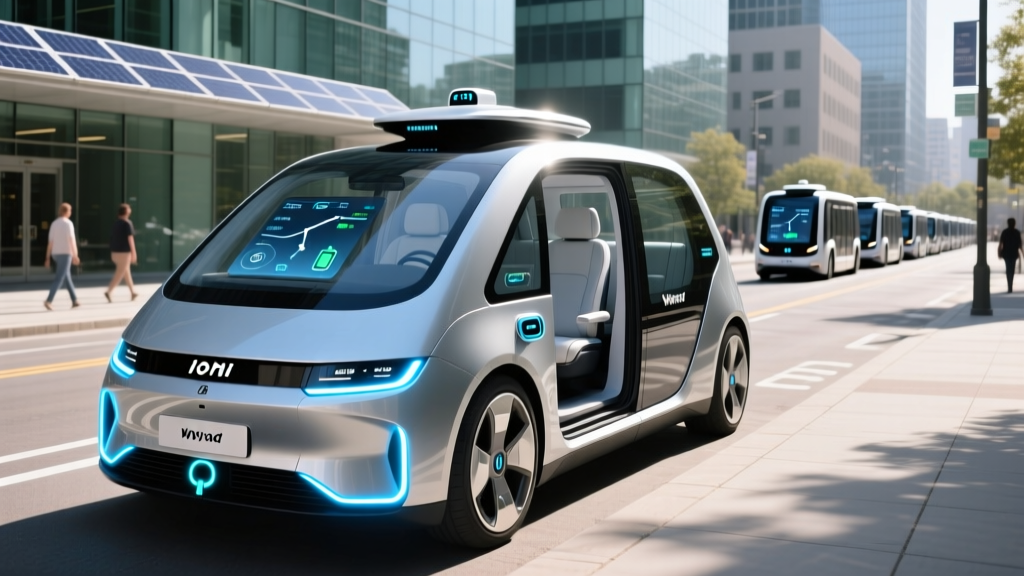
- Ride. Screens in the rear display the route, current speed, and detected objects (pedestrians, cyclists, other vehicles) in real time — a useful transparency feature.
- Exit at your destination. The vehicle waits until you confirm you've exited, then departs for the next ride.
The entire experience is designed to be frictionless. No driver interaction, no tipping prompt (optional in-app gratuity goes to fleet operations staff, not a driver), and no conversation required. For riders accustomed to rideshare, the biggest adjustment is the absence of a human who can handle edge cases — if something goes wrong, you use the in-app support or the in-vehicle help button to reach a remote assistance operator.
Frequently Asked Questions
Can I buy the Waymo version of the Ioniq 5?
No. The Waymo Ioniq 5 is a custom-built vehicle with Waymo's 6th-generation Driver hardware integrated at the factory level through a partnership with Hyundai. The sensor suite, compute platform, and software stack are proprietary to Waymo and are not available as a consumer option or aftermarket package. The retail Ioniq 5 you can purchase at a Hyundai dealer includes HDA2 (Level 2 driver-assist), which requires active driver supervision at all times.
Is the Ioniq 5 Waymo truly self-driving?
Within its geofenced operational domain, yes — the vehicle operates at SAE Level 4 with no driver present and no expectation of passenger intervention. Outside that domain (unmapped areas, severe weather, unapproved roads), the service simply will not operate. This is fundamentally different from Level 2 systems like Tesla FSD (Supervised) or Hyundai HDA2, which require constant driver attention everywhere they function.
How much does a Waymo ride cost compared to Uber?
Off-peak fares are typically comparable to or 10–20% above UberX/Lyft Standard for equivalent distances. The advantage appears during peak hours, when Waymo's pricing surges less dramatically than human-driver rideshare. No tipping is expected. A 5-mile off-peak trip typically costs $12–$16 on Waymo One versus $10–$14 on UberX, but a peak-hour airport run might be $45 on Waymo versus $60+ on UberX with surge.
What happens if the Ioniq 5 Waymo encounters a situation it can't handle?
The vehicle's default behavior is to execute a safe stop — pulling to the curb or stopping in place with hazard lights — and connect to a remote assistance operator. The operator can provide routing guidance or dispatch roadside support. The vehicle does not hand control to the passenger; there are no passenger-accessible driving controls.
Is Waymo available in my city?
As of early 2026, Waymo One is commercially available to the general public in Phoenix (metro-wide), San Francisco (city-wide), and Los Angeles (select zones, expanding). Austin and Atlanta are in earlier stages of deployment. Check the Waymo service page for current coverage maps, as these update regularly.
How does the Ioniq 5 Waymo handle rain and bad weather?
Light rain is generally manageable, and the system operates in San Francisco's fog and drizzle regularly. However, heavy downpours, standing water, snow, and ice can degrade LiDAR and camera performance enough to trigger service suspension. Waymo does not currently operate in cities with significant winter weather, and service interruptions during monsoon-season storms in Phoenix have been documented.
Does the Waymo Ioniq 5 have the same range as the consumer model?
The consumer Ioniq 5 Long Range achieves an EPA-estimated 310 miles on a full charge. The Waymo variant carries additional sensor and compute hardware that adds weight and draws continuous electrical load, which reduces effective range. Waymo has not published official range figures for the robotaxi variant, but fleet operations involve frequent opportunity charging, and vehicles are typically cycled through charging depots to maintain high state-of-charge throughout operating hours. The 800V architecture and ~240 kW peak DC fast-charge capability of the Ioniq 5 platform enable rapid turnaround.
Sources: Waymo, NHTSA Standing General Order, fueleconomy.gov, IIHS. Pricing estimates based on observed rider reports and may vary by market and time. Tax credit and vehicle pricing information reflects 2026 model-year data; consult IRS §30D guidelines for current eligibility rules on consumer EV purchases.