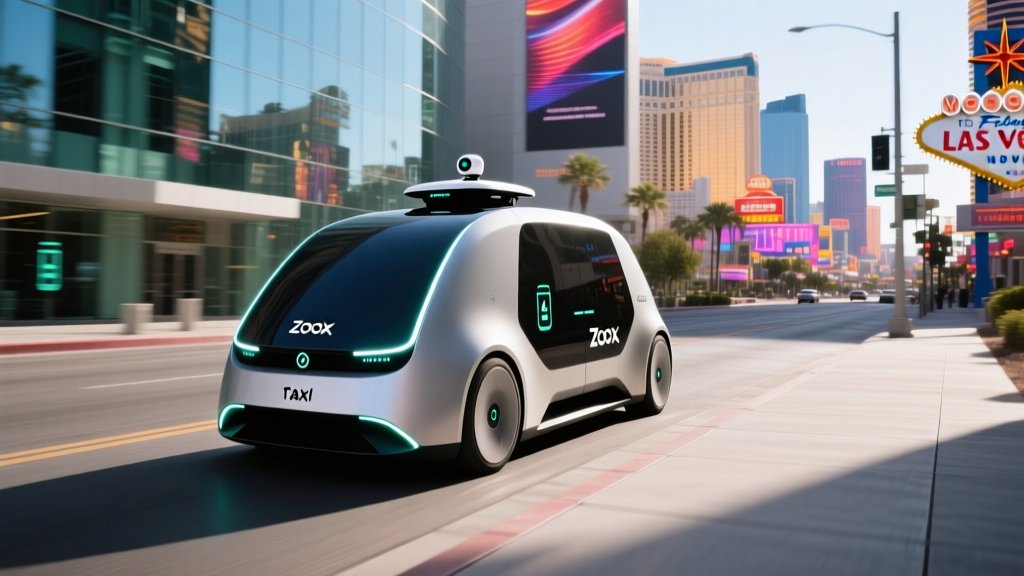
If you've visited the Las Vegas Strip recently, you may have spotted a compact, steering-wheel-free pod gliding through traffic with no one behind the wheel. That's Zoox — Amazon's autonomous vehicle subsidiary — operating one of the most visible Level 4 robotaxi services in the United States. But actually getting a ride involves more nuance than simply hailing one on the street.
This guide breaks down exactly how to ride Zoox in Las Vegas in 2026: where the service runs, how to request a ride, what it costs versus traditional rideshare, the safety data behind the technology, and the real-world limitations you should expect before you climb in.
Is Zoox Truly Self-Driving? Understanding the Autonomy Level
Zoox operates at SAE Level 4 autonomy — a critical distinction from the Level 2 driver-assistance systems found in consumer vehicles like Tesla's Autopilot or Ford's BlueCruise. At Level 4, the vehicle handles all driving tasks within its defined operational design domain (ODD) with no human driver present, no steering wheel, and no expectation of human takeover.
| Level | Description | Example |
|---|---|---|
| Level 2 | Driver assist — human must supervise at all times | Tesla Autopilot, GM Super Cruise, Ford BlueCruise |
| Level 3 | Conditional automation — human must be ready to take over | Mercedes Drive Pilot (limited markets) |
| Level 4 | High automation — no driver needed in defined area | Zoox, Waymo (geofenced zones) |
| Level 5 | Full automation — any road, any condition | Does not exist commercially |
Zoox is Level 4 — fully driverless within its approved Las Vegas and San Francisco geofences. Outside those zones, the vehicle cannot operate autonomously.
This matters because some consumers confuse robotaxi services with the driver-assist features available in cars they can buy. When you ride in a Zoox vehicle, there is no safety driver, no steering wheel, and no pedals accessible to passengers. The vehicle navigates, makes lane changes, handles intersections, and pulls over for emergencies entirely on its own.
Where Can You Ride Zoox Right Now?
As of early 2026, Zoox operates commercial robotaxi service in two U.S. cities, with a third in testing:
| City | Status | Service Area | Hours |
|---|---|---|---|
| Las Vegas, NV | Commercial service (public) | ~3–4 sq mi geofence covering parts of the Strip, downtown, and surrounding corridors | Limited hours, typically daytime/early evening |
| San Francisco, CA | Commercial service (public, waitlist) | Select neighborhoods, expanding gradually | Variable |
| Foster City / Bay Area, CA | Testing (not public ride-hail) | Mapped test corridors | N/A |
In Las Vegas, the Zoox geofence covers a compact but high-traffic zone. Expect coverage around the central Strip corridor, portions of Las Vegas Boulevard, and select downtown-adjacent streets. The service does not currently cover McCarran/Harry Reid International Airport, the full length of the Strip, or suburban areas. If your pickup or dropoff falls outside the geofence, the app will not let you complete the request.
Zoox has also announced plans to expand to additional cities, but as of this writing, those expansions have not launched commercial public service. Always check the Zoox ride page for the latest availability before planning a trip around the service.
How to Request a Zoox Ride in Las Vegas (Step by Step)
Getting into a Zoox robotaxi is not like hailing a cab or walking up to a vehicle. Here's the exact process:
- Download the Zoox app — Available on iOS and Android. You'll need to create an account with a valid phone number and payment method on file (even if rides are currently free in your area).
- Check service availability — The app will confirm whether you're inside the Las Vegas geofence and whether service is active at the current time. Zoox does not operate 24/7; hours are limited and can vary.
- Set your pickup and dropoff — Both must be within the approved service area. The app shows the geofence boundary on a map. Pickup points are typically at designated curb locations, not arbitrary addresses.
- Wait for your vehicle — Wait times in Las Vegas have ranged from 3–15 minutes depending on demand and fleet availability. Zoox's fleet is smaller than Uber or Lyft, so peak times (convention nights, weekends) may mean longer waits or unavailability.
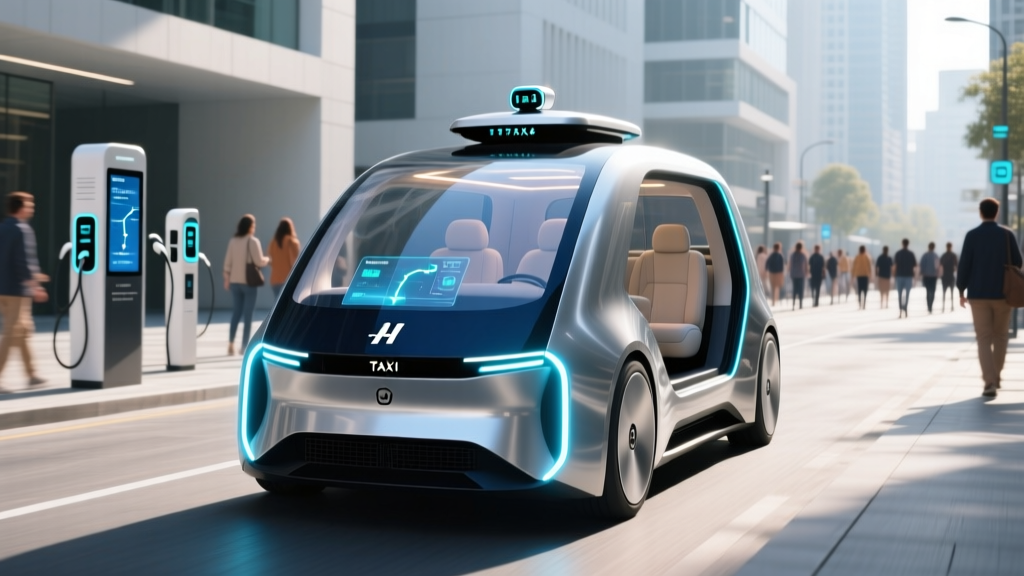
- Board the vehicle — The Zoox vehicle has no driver. You'll unlock it via the app when it arrives. The interior features two forward-facing and two rear-facing seats (four passengers max). There's no trunk space for large luggage.
- Enjoy the ride — The vehicle navigates autonomously to your destination. You can monitor the route on interior screens that show what the vehicle's sensors are detecting in real time.
One practical note: because Zoox vehicles are compact and purpose-built for urban trips, they work best for short hops — think hotel-to-restaurant or convention-center-to-hotel. They are not designed for long-distance or highway travel.
Zoox Pricing vs. Uber and Lyft in Las Vegas
One of the biggest questions riders have: how much does a Zoox ride cost compared to traditional rideshare?
| Factor | Zoox (Las Vegas) | Uber/Lyft (Las Vegas) |
|---|---|---|
| Base fare (short trip, ~2 mi) | Free during promotional period* | $8–$15 |
| Surge pricing | Not currently implemented | 1.5x–3x during peak |
| Tipping | No driver to tip | $2–$5 typical |
| Wait time | 5–15 min (smaller fleet) | 2–7 min |
| Availability | Limited hours, limited zone | 24/7, citywide |
| Passenger capacity | 4 max | 4 (standard), 6 (XL) |
*As of early 2026, Zoox has offered free rides during its initial public launch phases in Las Vegas and San Francisco. This is a promotional strategy to build ridership and gather real-world operational data. Zoox has not publicly announced its long-term per-mile pricing structure, but industry analysts expect it to be competitive with or slightly below Uber/Lyft once monetization begins — the value proposition of removing the driver from the cost equation is significant.
For context, a typical 2-mile Uber ride on the Las Vegas Strip costs $10–$15 before tip during normal demand, and can spike to $25–$40 during major conventions (CES, SEMA) or weekend nights. If Zoox maintains free or low-cost pricing as it scales, the savings on a multi-day Vegas trip could be substantial.
Zoox Safety Record: What the Data Shows
Autonomous vehicle safety data is reported to the National Highway Traffic Safety Administration (NHTSA) through Standing General Orders, which require operators to report crashes involving Level 2–5 systems. Zoox's public safety record as of early 2026 includes:
- Millions of autonomous miles driven across Las Vegas and San Francisco combined (exact cumulative figure not publicly disclosed in a single source).
- No reported passenger fatalities in Zoox robotaxi operations.
- Minor incidents have been reported to NHTSA, consistent with the low-speed urban environments where Zoox operates — typically low-speed contact events, not high-energy collisions.
- Zoox publishes periodic safety framework reports and participates in NHTSA reporting requirements.
For the most current crash data, check NHTSA's Standing General Order reports and Zoox's own safety publications. Robotaxi safety is an evolving dataset — early mileage numbers are small compared to the billions of human-driven miles annually.
It's worth comparing this to the broader context. Human drivers in the U.S. experience approximately 1.35 fatalities per 100 million vehicle miles traveled, according to NHTSA. Robotaxi fleets operate at far lower total mileage, making statistical comparison difficult — a fleet with 5 million miles driven cannot be said to be "safer than humans" with high statistical confidence. What the data does show is that Level 4 robotaxis operating in geofenced, low-speed urban environments have maintained strong safety records in their early commercial years.
Zoox's vehicle design includes some unique safety features: it is bidirectional (can drive equally well in either direction), has four-wheel steering for tight maneuvering, and includes airbags designed for all seating positions including rear-facing passengers — a first for a production vehicle without a traditional front/rear orientation.
The Technology Stack: Sensors, Lidar, and Geofencing
Zoox takes a fundamentally different sensor approach than camera-only systems like Tesla's vision-based FSD. The Zoox vehicle uses a redundant, multi-sensor suite:
- Lidar — Multiple lidar units provide 360-degree, high-resolution 3D mapping of the environment, effective in darkness and most weather conditions. Lidar gives precise distance measurements independent of lighting.
- Cameras — A full surround camera array provides object classification, traffic light and sign reading, and lane detection.
- Radar — Multiple radar units detect object velocity and perform well in rain and fog where lidar and cameras may degrade.
- Ultrasonic sensors — Close-range detection for parking, low-speed maneuvering, and near-field obstacle avoidance.
- HD maps + GPS/IMU — The vehicle operates on pre-mapped routes with centimeter-level localization, cross-referencing real-time sensor data against known map features.
This sensor fusion approach — combining lidar, camera, and radar — is shared by Waymo and most Level 4 operators. It contrasts with Tesla's camera-only approach for its Level 2 FSD (Supervised) system. The tradeoff is cost and complexity: Zoox's sensor suite is expensive, which is why the company builds its own purpose-built vehicle rather than retrofitting consumer cars.
Geofencing is equally important. Zoox vehicles can only operate within a pre-mapped, pre-approved zone. The vehicle's software knows every lane, crosswalk, signal, and curb cut within this zone. If the vehicle approaches the geofence boundary, it will not proceed — it will stop or reroute. This is a deliberate safety constraint: the system only operates where it has been extensively validated.
Regulatory Approval: Who Allows Zoox to Operate?
Robotaxi operations in the U.S. require a patchwork of state and federal approvals:
- Nevada (Las Vegas): The Nevada DMV and state legislature created one of the earliest autonomous vehicle testing and deployment frameworks. Zoox holds the required state permits for driverless testing and commercial operation. Nevada's approach has been relatively permissive, which is why Las Vegas became an early robotaxi hub.
- California (San Francisco): The California DMV issues testing permits, while the California Public Utilities Commission (CPUC) regulates commercial passenger service. Zoox has held a California testing permit for years and received CPUC authorization for commercial deployment.
- Federal (NHTSA): At the federal level, NHTSA does not currently "approve" autonomous vehicles for deployment. Instead, it regulates through crash reporting requirements (Standing General Orders), safety defect investigations, and Federal Motor Vehicle Safety Standards (FMVSS). Zoox received a notable FMVSS exemption for its vehicle design, which lacks traditional controls like a steering wheel and mirrors — features that current FMVSS rules assume will be present.
This regulatory landscape is evolving. Federal legislation specifically governing commercial robotaxi deployment has been proposed multiple times but not enacted as of 2026, leaving regulation primarily at the state level. This means expansion to new cities requires navigating each state's specific permitting process — a significant factor in why robotaxi growth has been geographically concentrated.
Current Limitations: What Zoox Cannot Do
- Geofence boundaries: You cannot ride Zoox to the airport, to most suburban hotels, or anywhere outside the mapped service zone. If your destination is outside the geofence, the app will block the request.
- Limited operating hours: Zoox does not run 24/7. Late-night rides after clubs close, early-morning airport runs, and some weekend hours may not be available.
- Weather constraints: Heavy rain, flooding, or extreme dust storms (relevant in Las Vegas) can cause the service to pause. Lidar performance degrades in heavy precipitation, and the system is designed to pull over safely rather than operate in conditions that exceed sensor capability.
- Small fleet = longer waits: Zoox operates dozens of vehicles, not thousands. During peak demand, you may wait 15+ minutes or find no vehicles available. This is not Uber-level availability.
- No luggage or large items: The compact vehicle interior has no trunk. Rolling suitcases, large shopping bags, or convention swag may not fit comfortably.
- Construction and road closures: Temporary lane closures, construction zones, and special event road closures can cause rerouting or service pauses in affected parts of the geofence.
- Accessibility: The current Zoox vehicle design may not accommodate all wheelchair configurations. Check with Zoox directly for ADA accessibility details.
- No highway driving: Zoox operates at urban speeds only. Interstate or highway trips are outside its operational design domain.
These limitations are not unique to Zoox — they apply broadly to all current Level 4 robotaxi services, including Waymo. The technology is impressive within its defined scope, but that scope is deliberately narrow. Full Level 5 autonomy (any road, any condition, any city) remains a research goal, not a commercial reality.
Frequently Asked Questions
Can I just walk up and get in a Zoox vehicle?
No. You must request a ride through the Zoox app, which matches you with an available vehicle and designates a specific pickup point. The vehicle will not unlock for anyone who hasn't been matched through the app.
Is there a human watching or controlling the vehicle remotely?
Zoox employs remote fleet monitoring, where operators can observe vehicle status and may provide high-level guidance in unusual situations (e.g., a road closure not yet in the map data). However, remote operators do not "drive" the vehicle in real time — the vehicle's onboard AI handles all moment-to-moment driving decisions. This is a key distinction from teleoperation.
How is Zoox different from Waymo?
Both are Level 4 robotaxi services, but they differ in approach. Waymo retrofits existing vehicles (Jaguar I-PACE, Zeekr minivans) with its sensor suite and operates in larger geofenced areas in Phoenix, San Francisco, and Los Angeles. Zoox designed its own purpose-built vehicle from the ground up — bidirectional, no steering wheel, four-wheel steering — and currently operates in fewer cities. Zoox is owned by Amazon; Waymo is a subsidiary of Alphabet (Google).
What happens if the vehicle gets confused or encounters an emergency?
The Zoox vehicle is designed to execute a minimal risk condition (MRC) — essentially, it will slow down, pull over to a safe location, and stop. It will not proceed if it cannot confidently navigate the situation. Remote fleet support can then assess the scenario and either clear the vehicle to proceed or dispatch assistance.
Will Zoox expand beyond Las Vegas and San Francisco?
Zoox has announced intentions to expand to additional U.S. cities, and testing has occurred in locations beyond its two commercial markets. However, each new city requires regulatory approval, extensive mapping, and validation driving before commercial service can begin. Check zoox.com for current expansion announcements.
Do I need to wear a seatbelt?
Yes. Nevada law requires all passengers to wear seatbelts, and the Zoox app will remind you to buckle up before the vehicle begins moving. The vehicle's four-point harness-style belts are designed for both forward- and rear-facing seats.
How does Zoox handle the Las Vegas heat?
The Zoox vehicle is equipped with a full climate control system. Las Vegas summer temperatures regularly exceed 110°F, and the vehicle's thermal management system is designed to keep both passengers and the onboard computing hardware within safe operating temperatures. This is one reason Zoox selected Las Vegas as an early market — validating performance in extreme heat is a key engineering milestone.