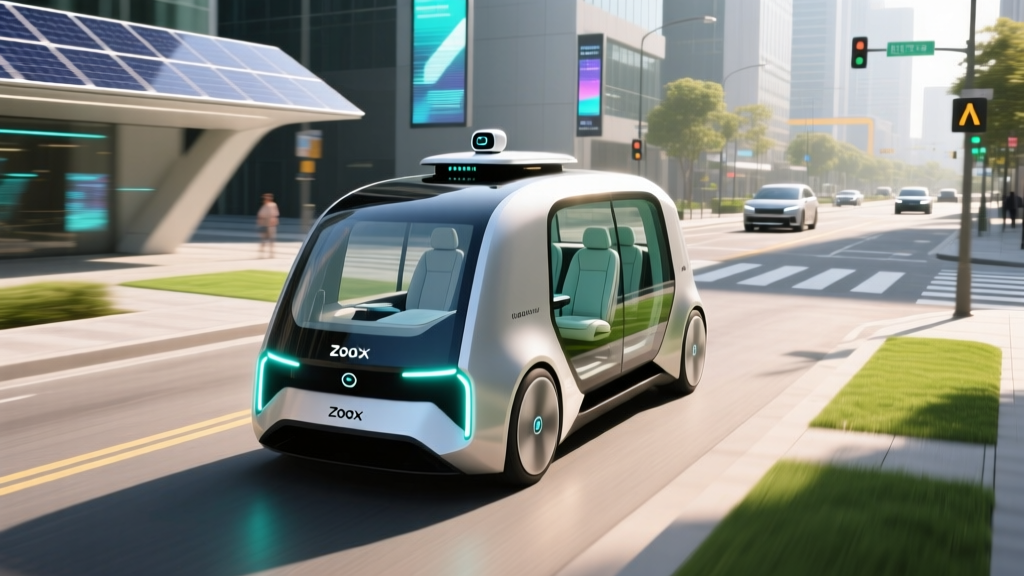
If you've seen Zoox's compact, carriage-style autonomous vehicle gliding through city streets and wondered how to actually get a ride, you're not alone. The Amazon-owned robotaxi startup has spent years testing its purpose-built vehicle — one with no steering wheel, no pedals, and no driver — but access has been tightly controlled. Here's exactly what you need to know about how to order a Zoox ride in 2026, where the service operates, what it costs, and where the technology genuinely stands.
Zoox operates as an SAE Level 4 robotaxi service. This means the vehicle handles all driving tasks within its defined operational design domain (ODD) — specific geofenced urban areas under certain conditions — without any human driver or remote operator controlling the vehicle in real time. This is fundamentally different from Level 2 driver-assist systems like Tesla Autopilot or GM Super Cruise, which require an attentive human driver behind the wheel at all times. In a Zoox, there is no driver's seat.
Where Can You Order a Zoox Right Now?
Zoox has not launched a broad commercial rideshare service the way Waymo has in Phoenix and San Francisco. As of early 2026, Zoox's rider experience remains limited to controlled operational areas and invite-based access programs. Here's the current landscape:
| City | Status | Public Access | Notes |
|---|---|---|---|
| Foster City, CA | Operational testing | Invite-only employees & select riders | Primary development and testing zone |
| Las Vegas, NV | Operational testing | Limited employee & partner rides | Expanded testing on public roads near the Strip |
| San Francisco, CA | Testing with safety drivers (in some vehicles) | Not publicly available | Mapping and validation; CPUC permits held |
| Seattle, WA | Announced testing | Not available | Early-stage road testing; Amazon HQ proximity |
| Austin, TX | Announced testing | Not available | Expansion market under evaluation |
The honest answer to "where can I ride a Zoox today?" is: you probably can't, unless you're a Zoox or Amazon employee, a contracted partner, or have received a specific invitation. Unlike Waymo, which allows anyone in its service areas to download the app and hail a ride, Zoox has not yet opened a general-public commercial service. The company holds a California Public Utilities Commission (CPUC) driverless testing permit and a deployment permit, but full commercial fare-charging service has not launched as of this writing.
How to Request a Zoox Ride (When Available)
For those in the limited access program or in cities where Zoox eventually opens public service, the process works through the Zoox mobile app — similar in concept to Uber or Lyft, but purpose-built for autonomous rides:
- Download the Zoox app (iOS/Android) and create an account with identity verification.
- Enter your pickup and dropoff — both must fall within the active geofence zone. The app will tell you if your route is outside the operational design domain.
- Confirm your ride. The app shows the vehicle's approach in real time, including a photo and identifier for the specific Zoox vehicle arriving.
- Board the vehicle. The Zoox carriage-style vehicle has facing bench seats for up to four passengers. There is no steering wheel, no pedals, and no driver. Doors unlock via the app when the vehicle arrives.
- Ride and monitor. An in-cabin screen displays the vehicle's perception of the environment (detected pedestrians, vehicles, traffic signals). A support line is available via in-vehicle button at all times.
- Exit at your destination. The vehicle waits until all passengers have exited, then departs for its next assignment or a charging depot.
Zoox Pricing: What Does a Ride Cost vs. Uber and Lyft?
Because Zoox has not launched a paid public service, there is no published per-mile or per-minute fare. During its invite-only testing phases, rides have been offered at no charge to participants.
However, industry analysts and Zoox leadership have signaled that when commercial service launches, pricing will be competitive with — and likely below — traditional rideshare. Here's what a comparison could look like based on current rideshare averages and projected robotaxi economics:
| Service | Base Fare (est.) | Per Mile | Per Minute | 3-Mile Trip Est. |
|---|---|---|---|---|
| UberX (SF avg.) | $3.50 | $1.75 | $0.45 | $12–$18 |
| Lyft Standard (SF avg.) | $3.25 | $1.60 | $0.40 | $11–$16 |
| Waymo (SF/Phoenix) | $3.00 | $1.50 | $0.35 | $10–$14 |
| Zoox (projected) | ~$2.50 | ~$1.20–$1.50 | ~$0.30 | $8–$12 (est.) |
The economic thesis behind robotaxi pricing: remove the driver (who earns 60–75% of a traditional rideshare fare), and the per-trip cost drops dramatically. Zoox's purpose-built vehicle also eliminates driver-facing hardware costs. However, the high sensor suite cost, fleet maintenance, and remote-assistance infrastructure partially offset those savings. Expect initial pricing near Waymo's levels, with potential discounts subsidized by Amazon to drive adoption.
Zoox Technology Stack: What Makes It Different
Zoox takes a fundamentally different hardware approach than Tesla's camera-only FSD system and even differs from Waymo in vehicle architecture. Here's the technical breakdown:
Sensor Suite
- LiDAR: Zoox uses multiple high-resolution LiDAR units providing 360° coverage — a critical differentiator from Tesla's camera-only approach. LiDAR provides precise depth mapping regardless of lighting conditions.
- Cameras: A multi-camera array covers all directions with overlapping fields of view for redundancy and object classification.
- Radar: Multiple radar units for velocity detection and performance in adverse weather (rain, fog) where LiDAR and cameras degrade.
- Microphones: External microphones detect emergency vehicle sirens and environmental audio cues.
Vehicle Architecture
- Purpose-built carriage design: Symmetrical, bidirectional vehicle — it can drive equally well in either direction. No front or back.
- Four-wheel steering: Enables tight turning radii and crab-walk maneuvers in confined urban spaces.
- Battery: ~75 kWh lithium-ion pack (estimated), supporting all-day operation with opportunity charging between rides.
- Seating: Four passengers on facing bench seats; no driver position, no steering controls.
Software & Compute
- Perception stack: Sensor fusion combining LiDAR point clouds, camera imagery, and radar returns into a unified world model.
- Prediction & planning: Machine learning models predict behavior of other road users; planning algorithms generate safe trajectories.
- Geofencing: Operations restricted to pre-mapped, validated zones. The vehicle will not operate outside its ODD.
This multi-sensor, LiDAR-forward approach aligns Zoox more closely with Waymo and Cruise than with Tesla. The redundant sensor philosophy means the system can tolerate individual sensor failures — if one camera is occluded, LiDAR and radar still provide coverage. This is a critical safety architecture for a vehicle with no human backup driver.
Safety Record: What the Data Shows
- Testing miles accumulated: Hundreds of thousands of autonomous miles across Foster City, Las Vegas, and San Francisco (exact cumulative figure not publicly disclosed in a single report).
- Disengagement reports: Zoox files disengagement reports with the California DMV as required. Disengagement rates have trended downward year-over-year, consistent with system maturation.
- Reported collisions: Zoox, like all AV operators in California, is required to report collisions to the DMV and NHTSA. As of this writing, Zoox has reported minor low-speed incidents typical of dense urban testing — no fatal or serious-injury collisions attributed to the autonomous system.
- No driver in the vehicle: In its driverless testing mode, there is no human to intervene. The system must handle all scenarios or execute a minimal-risk condition (safe pullover).
Context matters here. Zoox has driven fewer fully driverless miles than Waymo, which has accumulated over 30 million autonomous miles and completed hundreds of millions of paid trips. Zoox's more limited deployment means the statistical sample is smaller, making it harder to draw definitive safety conclusions. The National Highway Traffic Safety Administration (NHTSA) requires all AV operators to report crashes involving automated systems, and Zoox complies with these Standing General Orders.
The safety case for robotaxis generally rests on one argument: human drivers cause roughly 94% of crashes (per NHTSA estimates), primarily through distraction, impairment, and fatigue. A Level 4 system doesn't get drunk, text, or fall asleep. But robotaxis introduce different failure modes — sensor occlusion, edge-case confusion, software bugs — that are harder to quantify at scale.
Regulatory Landscape: Who Approves Zoox Operations?
Robotaxi regulation in the United States is a patchwork of state and federal oversight. Zoox must navigate multiple agencies:
- California DMV: Issues testing permits (with and without safety drivers) and requires annual disengagement reports. Zoox holds a driverless testing permit in California.
- California CPUC: Regulates commercial passenger service. Zoox holds permits for driverless deployment programs, but full unrestricted commercial fare service requires additional CPUC authorization.
- Nevada DMV & local authorities: Nevada has its own AV testing framework. Zoox operates in Las Vegas under state testing authorization.
- NHTSA (federal): Sets vehicle safety standards (FMVSS). Zoox received a notable exemption from certain FMVSS requirements (like having a steering wheel and mirrors) since its vehicle has no human driver. NHTSA also mandates crash reporting for all automated driving systems.
- Local municipalities: City councils and transportation agencies can restrict or condition AV operations within their jurisdictions — a factor that has slowed deployments in San Francisco.
The regulatory environment remains fluid. Following Cruise's serious pedestrian incident in San Francisco in late 2023 and subsequent suspension, regulators in California and other states have scrutinized robotaxi operations more closely. Zoox has benefited from a more cautious, slower rollout strategy — but this also means public access has been delayed relative to competitors.
Current Limitations: What Zoox Cannot Do
Operational Limitations
- Geofenced areas only: Zoox vehicles operate only within pre-mapped, validated zones. You cannot hail a Zoox to a destination outside the geofence — the app simply won't allow it.
- Weather constraints: Heavy rain, fog, and snow degrade LiDAR and camera performance. Zoox may limit or suspend service during severe weather events. The system is designed for the conditions of its ODD — currently mild, dry climates like Foster City and Las Vegas.
- No highway driving: Current operations are limited to surface streets at moderate speeds (typically under 45 mph). Highway merging and high-speed operation are not part of the active ODD.
- Construction zones: Unexpected road closures, lane shifts, and construction zones that differ from the pre-mapped environment can cause the vehicle to stop and request remote assistance or execute a safe pullover.
- Complex unprompted scenarios: Unusual events — a police officer directing traffic with hand signals, a parade, an overturned vehicle in an unexpected position — remain edge cases that may require the vehicle to stop and escalate.
- No inter-city trips: Zoox is an urban last-mile service. You cannot take it from San Francisco to Sacramento.
- Accessibility: While the carriage design aims for ADA compliance, real-world wheelchair accessibility and accommodation for mobility devices in all scenarios remains an area of ongoing validation.
These limitations aren't unique to Zoox — they apply to every Level 4 robotaxi operating today, including Waymo. The difference between Level 4 and the Level 5 "drive anywhere, any condition" vision is precisely this: Level 4 works within defined boundaries. Those boundaries are expanding, but slowly.
Zoox vs. Waymo vs. Cruise: Where Things Stand in 2026
To put Zoox in context, here's how it compares to the other major U.S. robotaxi programs:
| Feature | Waymo | Zoox | Cruise (GM) |
|---|---|---|---|
| SAE Level | Level 4 | Level 4 | Level 4 |
| Vehicle | Jaguar I-PACE (modified), Zeekr RT | Purpose-built carriage | Chevrolet Bolt (modified), Origin (paused) |
| Public Service | Yes — Phoenix, SF, LA, Austin | No — invite-only testing | Suspended; slow restart in progress |
| Parent Company | Alphabet (Google) | Amazon | General Motors |
| Paid Rides Completed | Millions | Not yet (testing only) | Hundreds of thousands (pre-suspension) |
| Key Sensor | LiDAR + cameras + radar | LiDAR + cameras + radar | LiDAR + cameras + radar |
Waymo is the clear leader in commercial robotaxi deployment. Zoox's advantage, if its strategy pays off, is the purpose-built vehicle — designed from the ground up for passengers rather than retrofitted from a consumer car. This could yield lower per-trip operating costs and a better rider experience at scale. But scale hasn't arrived yet.
Frequently Asked Questions
Can I order a Zoox ride right now as a regular consumer?
Not yet. As of early 2026, Zoox rides are available only to employees, contracted partners, and select invited participants in Foster City, CA, and Las Vegas, NV. There is no public app-based hailing service comparable to Waymo's open commercial service. Zoox has indicated commercial service is a goal, but no public launch date has been announced.
How much will a Zoox ride cost when it launches publicly?
Zoox has not published fares. Industry projections and the economics of driverless operation suggest pricing competitive with or slightly below Uber/Lyft — roughly $8–$12 for a typical 3-mile urban trip. Amazon's backing could enable introductory promotional pricing to build ridership.
Is Zoox truly self-driving, or is there a remote human controlling it?
Zoox is SAE Level 4 — the vehicle drives itself within its geofenced operational domain with no human driver onboard and no real-time remote control. Remote assistance exists for edge cases (the vehicle can phone home for guidance on an ambiguous scenario), but the remote operator does not steer or brake the vehicle. The autonomous system handles all real-time driving decisions.
What happens if the Zoox vehicle encounters something it can't handle?
The vehicle is programmed to execute a minimal-risk condition (MRC) — typically a controlled stop or pullover — if it encounters a scenario outside its capability. Remote support can then provide guidance or dispatch assistance. The vehicle will not proceed if it cannot confirm a safe path forward.
Does Zoox operate on highways?
No. Current Zoox operations are limited to surface streets within geofenced urban zones, typically at speeds under 45 mph. Highway operation is not part of the active operational design domain.
How does Zoox's safety record compare to human drivers?
Direct comparison is difficult because Zoox has accumulated far fewer miles than the billions driven annually by humans. The available data shows minor low-speed incidents consistent with dense urban testing and no fatal or serious-injury collisions attributed to the system. For context, human drivers cause approximately 40,000 traffic fatalities annually in the U.S. per NHTSA FARS data. Robotaxis aim to reduce this toll by eliminating impairment and distraction, but they must prove safety across billions of miles before statistical parity can be assessed.
Will Zoox come to my city?
Zoox has announced testing in Foster City, Las Vegas, San Francisco, Seattle, and Austin. Expansion beyond these markets will depend on regulatory approvals, mapping and validation work, and the company's commercial timeline. Amazon's logistics network and infrastructure could accelerate expansion if and when Zoox moves to full commercial deployment.