What Is Zoox and Can You Actually Ride One in Las Vegas?
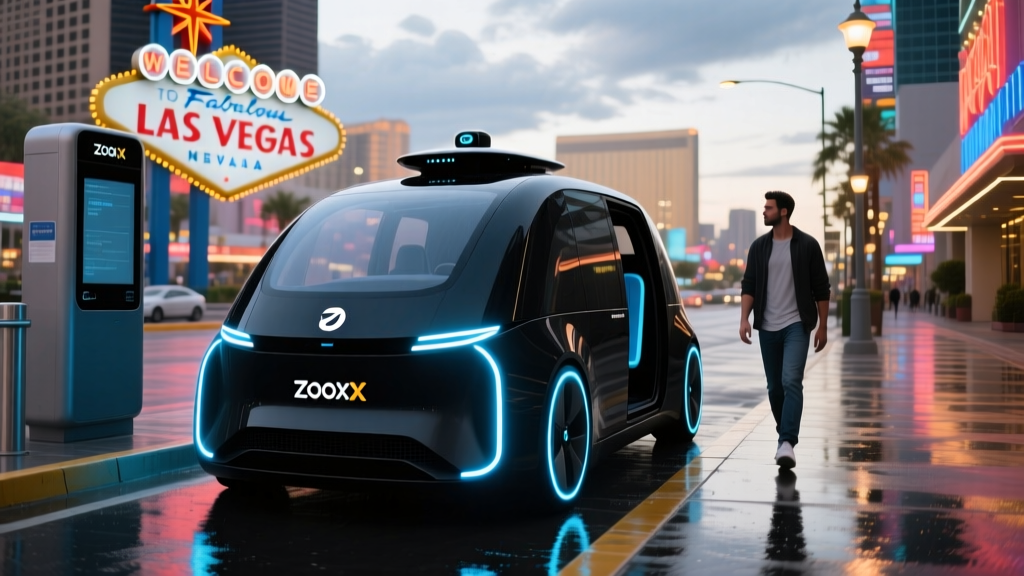
If you've spotted a small, boxy, steering-wheel-free vehicle gliding through Las Vegas traffic and wondered how to get a Zoox in Vegas, you're not alone. Amazon-backed Zoox has been testing and operating its purpose-built autonomous vehicles on Nevada roads, and the service has become one of the more visible robotaxi experiences available to the public. But access isn't as simple as opening an app anywhere in the city — there are specific operational zones, eligibility steps, and realistic expectations you need to know before you try to hail one.
This guide breaks down exactly how Zoox operates in Las Vegas, what it costs, how safe the technology is, and what the current limitations are. Whether you're a visitor planning a trip or a local curious about autonomous mobility, here's what you need to know.
Is Zoox Truly Self-Driving?
Yes — Zoox operates at SAE Level 4 autonomy. Unlike consumer driver-assist systems such as Tesla Autopilot, Ford BlueCruise, or GM Super Cruise (all SAE Level 2, requiring active driver supervision), Zoox vehicles have no steering wheel, no pedals, and no driver onboard. The vehicle handles all driving tasks within its geofenced operational design domain (ODD) without any human intervention. If the system encounters a scenario it cannot handle, it is designed to pull over safely rather than hand control to a passenger. This is a fundamental distinction from Level 2 systems.
Where Can You Use Zoox Right Now?
Zoox's robotaxi service is not available citywide in Las Vegas. The company operates within a defined geofence that covers specific corridors and neighborhoods. As of early 2026, Zoox has focused its Las Vegas operations primarily on areas near the Strip and surrounding commercial districts, though the exact boundaries shift as the company expands its mapping and validation zones.
Zoox also operates in a handful of other cities, though availability and public-access status vary by location.
| City | Status | Public Access | Notes |
|---|---|---|---|
| Las Vegas, NV | Active | Limited / Waitlist | Geofenced near Strip corridor |
| San Francisco, CA | Active | Limited / Waitlist | Select neighborhoods |
| Foster City, CA | Active | Employee / Invite | Headquarters testing area |
| Austin, TX | Testing | Not yet public | Mapping and validation phase |
| Seattle, WA | Testing | Not yet public | Early road validation |
Key takeaway: Even in cities where Zoox is "active," rides are typically offered through a waitlist or invitation-based early rider program rather than a fully open, on-demand model. You can't simply download an app and guarantee a ride today the way you would with Uber or Lyft.
How to Request a Zoox Ride in Las Vegas
Getting into a Zoox vehicle in Vegas requires a few more steps than hailing a conventional rideshare. Here's the process as it currently works:
- Join the Early Rider Program: Visit the official Zoox website and sign up for their rider program. You'll provide your name, contact info, and preferred city (Las Vegas). Placement is not instant — expect to be added to a waitlist.
- Wait for an Invitation: Zoox onboards riders in waves based on operational capacity. Invitations are sent via email or through the Zoox rider app when slots open in your area.
- Download the Zoox App: Once invited, you'll get access to the rider app, which lets you request a pickup within the geofenced zone.
- Request a Ride: Set your pickup and dropoff within the operational area. The app confirms vehicle availability and ETA.
- Board and Ride: The Zoox vehicle arrives — you'll verify your identity through the app, the doors unlock, and you take a seat in one of the four inward-facing chairs. There is no driver, no steering wheel, and no front seat.
During the early rider phase, Zoox rides have generally been offered at no cost to passengers as the company gathers rider feedback and operational data. This is standard practice across the robotaxi industry during limited-launch phases — Waymo's early rider program in Phoenix and San Francisco followed a similar model before transitioning to paid service.
Zoox Pricing vs Uber and Lyft
Because Zoox's public rider program is still in a limited-access, largely complimentary phase, direct price-per-ride comparisons aren't straightforward. However, Zoox has signaled that when it transitions to paid service, its pricing model will be competitive with conventional rideshare — and potentially cheaper over time due to the elimination of driver labor costs.
| Service | Typical Cost | Surge Pricing | Availability |
|---|---|---|---|
| UberX | $10–$18 | Yes (1.5x–3x+) | Citywide, 24/7 |
| Lyft Standard | $9–$16 | Yes (1.5x–3x+) | Citywide, 24/7 |
| Waymo One (where available) | $8–$15 | Limited / none | Geofenced zones |
| Zoox (current rider program) | Free (early access) | N/A | Geofenced, waitlist |
When Zoox begins charging, industry analysts expect per-mile pricing in the range of Uber/Lyft base fares, without the surge multipliers that can double or triple rideshare costs during peak demand on the Strip. The long-term thesis is that removing the human driver — who typically accounts for 60–80% of a rideshare fare — allows robotaxi operators to undercut traditional services while maintaining margins.
The Zoox Vehicle: Technology Stack Explained
The Zoox vehicle is not a retrofitted production car. It's a purpose-built, bidirectional robotaxi designed from the ground up for autonomous operation. Here's what makes it tick:
Sensors and Perception
- LiDAR: Multiple solid-state and spinning LiDAR units provide 360-degree, high-resolution 3D mapping of the vehicle's surroundings, effective at ranges beyond 150 meters.
- Cameras: A suite of high-dynamic-range cameras covers all directions, handling object classification, traffic-light recognition, and lane detection.
- Radar: Multiple radar units track the velocity and distance of nearby objects, particularly useful in low-visibility conditions where cameras and LiDAR can degrade.
- Redundancy: Zoox uses overlapping sensor coverage — if one sensor modality is impaired (e.g., a camera blinded by direct sun), the others compensate. This sensor-fusion approach is a key distinction from Tesla's camera-only FSD system.
Vehicle Design
- Bidirectional: The vehicle can drive equally well in either direction — there is no "front" or "back." This simplifies U-turns and tight-space maneuvers.
- Four-wheel steering: All four wheels can turn, enabling a tight turning radius and crab-like lateral movements.
- Battery electric: Fully electric powertrain with an estimated battery capacity in the range of 80–100 kWh (Zoox has not published exact figures), designed for all-day urban operation with opportunity charging between rides.
- Interior: Four inward-facing seats, no steering wheel, no pedals, no dashboard. Riders face each other in a lounge-like configuration.
Geofencing and Mapping
Zoox vehicles operate within a pre-mapped geofence — a high-definition 3D map of every lane, intersection, crosswalk, and traffic signal in the operational zone. The vehicle localizes itself within this map in real time using LiDAR and GPS. If a destination falls outside the geofence, the ride cannot be requested. This is a hard constraint, not a software preference.
Safety Record: What the Data Shows
Robotaxi safety is the most scrutinized aspect of the industry, and Zoox has been more guarded with public data than competitors like Waymo. Here's what is known:
Zoox Safety Data (Available as of Early 2026)
- Testing miles: Zoox has accumulated millions of autonomous testing miles across Las Vegas, San Francisco, and the Bay Area, though the company does not publish a live mileage counter the way Waymo does.
- Disengagement reports: California DMV disengagement reports (required for all autonomous vehicle testers in the state) have shown Zoox's intervention rate improving year-over-year, though it has historically reported higher disengagement rates than Waymo.
- Public incidents: As of early 2026, Zoox has not been involved in a publicly reported serious injury or fatality during autonomous operation. The NHTSA Standing General Order requires all ADS-equipped vehicles to report crashes — Zoox is subject to this reporting requirement.
- Safety driver era: During earlier testing phases with safety drivers onboard, Zoox logged extensive miles in mixed traffic. The transition to fully driverless operation within the geofence was gradual and phased.
For comparison, Waymo reports over 30 million fully driverless miles and has published peer-reviewed data showing its vehicles are involved in fewer police-reported crashes per million miles than human benchmarks in the same cities.
It's important to contextualize these numbers: robotaxi fleets are still relatively small, and the total miles driven are a fraction of the billions of miles human drivers accumulate annually. Statistically robust safety comparisons require larger sample sizes than currently exist for any single robotaxi operator.
Regulatory Landscape: Who Approves Robotaxi Operations?
Robotaxi operations in the United States are governed by a patchwork of state and local regulations — there is no single federal "robotaxi license." Here's how the approval chain works for Zoox specifically:
- Nevada: The Nevada DMV issues autonomous vehicle testing and deployment permits. Nevada was one of the first states to legislate for autonomous vehicles (AB 511 in 2011), and its regulatory framework allows driverless commercial operation with the appropriate permits and insurance.
- California: The California DMV issues testing permits, while the California Public Utilities Commission (CPUC) issues permits for commercial passenger service. Zoox holds permits in both categories.
- Federal (NHTSA): The National Highway Traffic Safety Administration does not "approve" robotaxis but sets Federal Motor Vehicle Safety Standards (FMVSS). Zoox received a notable exemption from NHTSA for its purpose-built vehicle, which lacks traditional controls (steering wheel, mirrors, windshield wipers in the conventional sense) that FMVSS historically required. This exemption was a significant regulatory milestone.
- Local jurisdictions: City and county governments can impose additional requirements on where and when robotaxis operate, including geofencing restrictions, speed limits, and school-zone rules.
Current Limitations of Zoox in Las Vegas
Riding a Zoox is an impressive experience, but the technology has hard constraints that riders should understand before setting expectations:
What Zoox Cannot Do (as of Early 2026)
- Leave the geofence: If your destination is outside the mapped operational zone — including most suburban areas, the airport, and outlying hotels — the vehicle simply won't go there. No exceptions.
- Handle severe weather: Heavy rain, flooding (a real concern during Vegas monsoon season), dust storms, or dense fog can cause the system to reduce speed or pull over. LiDAR and camera performance degrade in these conditions.
- Navigate unmapped construction zones: Las Vegas is perpetually under construction. If a road closure or lane shift isn't reflected in Zoox's HD map, the vehicle may reroute or, in some cases, terminate the trip.
- Operate at highway speeds: Zoox is designed for urban environments, typically operating at speeds up to 35–45 mph. It does not merge onto freeways or handle high-speed interchanges.
- Accommodate all passengers: The current vehicle seats four, has limited cargo space, and wheelchair accessibility in the current-generation vehicle is restricted. Zoox has discussed accessible variants but they are not yet deployed at scale.
- Respond to verbal requests: There is no driver to ask to "stop here" or "take the scenic route." The route is algorithmically determined, and intermediate stops are not possible.
- Guarantee availability: Even within the geofence, vehicle supply is limited. During peak hours, you may face extended wait times or be unable to get a ride at all.
Frequently Asked Questions
Is the Zoox service free in Las Vegas?
During the early rider program phase, Zoox has offered rides at no charge to invited participants. This is expected to change when the service transitions to full commercial operation, though Zoox has not yet published a pricing structure.
Can I hail a Zoox on the street like a taxi?
No. Zoox rides must be requested through the Zoox rider app. You cannot flag one down on the sidewalk, and you must be part of the rider program (currently waitlist-based) to request a trip.
Does Zoox go to Harry Reid International Airport?
As of early 2026, Zoox's Las Vegas geofence does not include the airport. Rides are limited to the mapped operational zone, which primarily covers areas near and around the Strip corridor. For airport transfers, Uber, Lyft, and taxis remain the standard options.
How is Zoox different from Waymo?
Both are Level 4 robotaxi services, but the approaches differ. Waymo uses retrofitted production vehicles (currently the Jaguar I-PACE and Zeekr minivan) with roof-mounted sensor arrays, while Zoox built a custom, purpose-built vehicle with no steering wheel. Waymo is further ahead in commercial deployment scale (Phoenix, San Francisco, Los Angeles, Austin), while Zoox is in an earlier phase of public access. Both use LiDAR-camera-radar sensor fusion.
What happens if the Zoox vehicle encounters a problem mid-ride?
Zoox vehicles are equipped with remote-assistance capabilities. If the autonomous system encounters an ambiguous scenario (e.g., a police officer directing traffic with hand signals), the vehicle can pause and connect to a remote operations specialist who can guide the vehicle's next action. The vehicle is designed to default to a safe stop if it cannot resolve a situation independently.
Is it safe to ride in a vehicle with no steering wheel?
Zoox's vehicle received a specific NHTSA exemption allowing it to operate without traditional manual controls. The vehicle's safety case rests on redundant computing, redundant sensors, and a fallback system designed to bring the vehicle to a controlled stop in the event of a hardware or software failure. No public serious-injury incidents have been reported in Zoox autonomous operations as of early 2026, though total fleet mileage is still relatively low compared to human-driver baselines.
Can I ride with children in a Zoox?
Zoox's rider program terms typically require passengers to be at least 18 years old to request a ride. Policies on child passengers vary, and the current vehicle does not have provisions for child safety seats. Check Zoox's current rider terms before planning a family trip.
Bottom Line: Should You Try to Get a Zoox Ride in Vegas?
If you're visiting Las Vegas and want to experience a genuine Level 4 robotaxi — one with no steering wheel, no driver, and no pretense of human backup — Zoox is one of the few options available. The ride itself is a compelling demonstration of where autonomous vehicle technology stands today: the vehicle navigates complex urban traffic, responds to pedestrians and cyclists, and handles signalized intersections with a competence that would have seemed implausible a decade ago.
But practical reality tempers the excitement. Access is waitlist-based, the geofence is limited, the vehicle won't take you to the airport or suburban restaurants, and availability is far from guaranteed. For now, a Zoox ride in Vegas is best understood as a technology experience worth pursuing if you have the time and flexibility — not as a reliable replacement for your Uber to dinner.
Sign up for the rider program before your trip, keep your expectations realistic about coverage and availability, and treat a successful Zoox ride as a bonus to your Vegas visit rather than a transportation plan you can build around. The technology is real, the progress is measurable, and the expansion is coming — just not quite yet to every corner of the city.