Quick Verdict: Can You Ride a Zoox in Las Vegas Right Now?
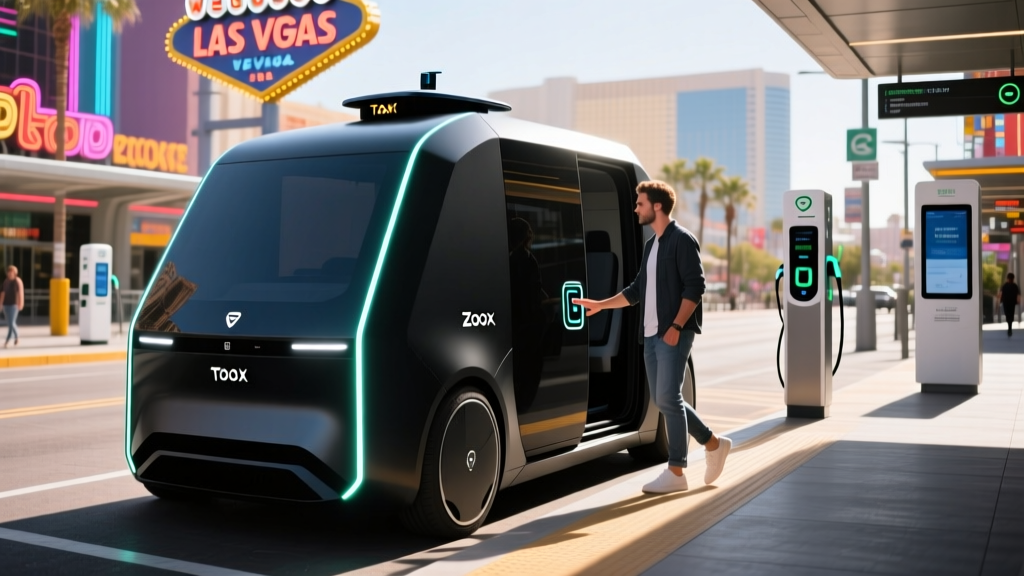
Zoox operates a limited, invite-only and early-access rider program in Las Vegas as of 2026, primarily around a geofenced corridor on and near the Las Vegas Strip and parts of downtown. Unlike Waymo's publicly available app-based service in Phoenix and San Francisco, Zoox has not yet launched a fully open, on-demand robotaxi network in Vegas that any traveler can hail on arrival. Access is typically granted through a waitlist, employee/partner programs, or targeted invitation rounds.
If you're searching for how to get a Zoox in Las Vegas, this guide breaks down exactly where the service operates, how to request access, what the vehicle is, and how it compares to Waymo, Uber, and Lyft on cost, safety, and convenience.
Where Can I Use Zoox in Las Vegas? Service Availability
Zoox's Las Vegas operations are geofenced — the vehicle will only drive within a pre-mapped zone approved by Nevada regulators. As of early 2026, the operational area covers a corridor including:
- The Las Vegas Strip corridor (roughly Mandalay Bay to the Wynn/Encore area)
- Select downtown Las Vegas streets near the Fremont Street Experience
- Portions of Paradise Road and Convention Center Drive
Zoox does not currently service Harry Reid International Airport (LAS), suburban Henderson or Summerlin, or the broader I-15 corridor. Rides must both originate and terminate within the geofence.
| City | Zoox Status | Waymo Status | Access Model |
|---|---|---|---|
| Las Vegas, NV | Early-access / invite-only | Not available | Waitlist / partner invite |
| San Francisco, CA | Testing (limited riders) | Open to public | Waymo One app |
| Phoenix, AZ | Not available | Open to public | Waymo One app |
| Los Angeles, CA | Testing | Expanding (limited) | Waitlist |
| Foster City, CA | Testing (HQ area) | Not available | Employee / partner |
| Austin, TX | Not available | Expanding (limited) | Waitlist |
Source: Zoox and Waymo official service pages, state regulatory filings. Availability changes frequently — always check the Zoox website for the latest.
How to Request a Zoox Ride in Las Vegas
Because Zoox is not yet a walk-up, open-market service in Vegas, here's the realistic pathway to getting a ride:
- Join the Zoox early-rider waitlist via the Zoox website or mobile app (available on iOS and Android). Select Las Vegas as your preferred city.
- Watch for invite rounds. Zoox periodically opens access to new rider cohorts, often tied to testing milestones or regulatory approvals.
- Check partner channels. Some Las Vegas hotels, casinos, and event venues have participated in Zoox partnership programs that grant guests ride access.
- Download the Zoox app once invited. The app handles pickup/dropoff location selection within the geofence, ride status tracking, and in-vehicle controls.
There is no published timeline for a full public launch in Las Vegas. Zoox, which is owned by Amazon, has historically expanded access gradually as it accumulates safety data and regulatory sign-off.
What Is the Zoox Vehicle? SAE Level 4 Autonomy Explained
The Zoox vehicle is a purpose-built, bidirectional robotaxi — not a retrofitted consumer car. It has no steering wheel, no pedals, and no driver's seat. Every ride is fully driverless.
The Zoox robotaxi operates at SAE Level 4 within its geofenced operational design domain (ODD). This means the vehicle handles all driving tasks — steering, acceleration, braking, route planning, and edge-case response — without any human intervention or supervision within its approved zone. This is fundamentally different from Level 2 driver-assist systems like Tesla Autopilot, GM Super Cruise, or Ford BlueCruise, which require an attentive human driver at all times.
Level 4 does not mean "drives everywhere in all conditions." It means "drives without a human, but only in specific, pre-approved conditions and areas."
Zoox Technology Stack Overview
| Sensor Suite | Redundant lidar, cameras, and radar covering 360° with overlapping fields of view |
| Compute | Custom onboard computing platform with redundant systems |
| HD Mapping | Pre-mapped geofenced zones with centimeter-level precision |
| V2X / Connectivity | Cellular connectivity for remote assistance and fleet management |
| Vehicle Platform | Purpose-built, bidirectional, 4-wheel steering, battery-electric |
| Battery | Estimated ~75 kWh usable (LFP chemistry reported in earlier filings), supporting all-day operation with opportunity charging |
| Top Speed | 75 mph (capable of highway-speed operation within geofence) |
| Seating | 4 passengers, face-to-face configuration, no driver seat |
Unlike Tesla's camera-only approach, Zoox relies on a multi-sensor fusion stack — lidar provides precise depth mapping independent of lighting conditions, radar handles velocity detection of moving objects, and cameras handle classification (pedestrian vs. cyclist vs. construction cone). This redundancy is a hallmark of Level 4 robotaxi design.
Zoox Pricing vs. Uber and Lyft in Las Vegas
During its early-access and testing phases, Zoox rides have been offered free of charge to invited riders. This is standard industry practice for pre-commercial operations — the goal is data collection and rider feedback, not revenue.
Once Zoox transitions to a commercial paid service (expected in select markets as regulatory approvals progress), pricing is anticipated to be competitive with rideshare. Here's how the expected economics compare:
| Service | Typical 3-Mile Ride (Strip) | Surge Pricing | Tipping | Current Status |
|---|---|---|---|---|
| Zoox (early access) | $0 (free / invite-only) | None | N/A | Pre-commercial |
| Zoox (projected commercial) | $8–$14 (est.) | Likely dynamic | N/A (no driver) | Not yet launched |
| Waymo One (Phoenix/SF) | $10–$18 | Minimal | Optional (in-app) | Commercial |
| UberX (Las Vegas) | $12–$22 | Frequent (events, nights) | Expected (15–20%) | Commercial |
| Lyft (Las Vegas) | $11–$20 | Frequent | Expected (15–20%) | Commercial |
The long-term robotaxi value proposition is lower per-mile cost than human-driven rideshare, since the largest cost component — the driver — is removed. However, robotaxi operators must recoup significant vehicle, sensor, mapping, and remote-assistance infrastructure costs, so prices won't necessarily undercut Uber/Lyft dramatically in the early commercial years.
How Safe Are Robotaxis? Real Data, Not Hype
Safety is the most legitimate question any prospective robotaxi rider should ask. Here's what the data shows for Level 4 services operating in the U.S.:
Robotaxi Safety Data Snapshot (through early 2026)
- Waymo has published peer-reviewed data showing its fleet was involved in ~85% fewer injury-causing crashes per million miles compared to human benchmarks in comparable urban environments, based on over 25 million driverless miles driven across Phoenix, San Francisco, and Los Angeles. (Waymo Safety Report)
- Zoox has not published a comparable public safety report with per-million-mile incident rates as of early 2026. The company has accumulated millions of testing miles in Las Vegas, San Francisco, and the San Francisco Bay Area, primarily with safety drivers during earlier phases and increasingly in driverless mode.
- Cruise (GM's robotaxi unit) suspended operations nationwide in October 2023 after a serious incident in San Francisco where a pedestrian was dragged. Cruise has since resumed limited testing with safety drivers in select cities under heightened regulatory scrutiny, but has not returned to full commercial driverless service as of this writing.
- The National Highway Traffic Safety Administration (NHTSA) maintains a Standing General Order requiring all ADS-equipped vehicle operators to report crashes. This database is publicly searchable and provides incident-level data.
Key context: Robotaxi safety data is still limited by total miles driven. The U.S. driving population covers roughly 3.2 trillion miles per year. Even the largest robotaxi fleets have driven a tiny fraction of that. Statistical confidence grows with every million miles, but we are still in the early-data era.
Zoox's purpose-built vehicle includes design features that address crash safety differently than a retrofitted consumer vehicle: symmetric seating, extensive airbag coverage for all four passengers, and a lower vehicle mass with a rigid passenger cell. The company has stated it is pursuing FMVSS (Federal Motor Vehicle Safety Standards) compliance for its production-intent vehicle.
Current Limitations: Where Robotaxis Can't Go (and Why)
Level 4 robotaxis are impressive within their operational domain, but they have real, physics-based limitations that riders should understand:
- Geofence boundaries are absolute. If your destination falls outside the pre-mapped zone, the ride cannot be completed. You cannot request a Zoox from the Strip to Red Rock Canyon or to the airport (unless/until those areas are mapped and approved).
- Weather constraints. Heavy rain, flash flooding (a real concern in Las Vegas monsoon season), dense fog, or dust storms may trigger service suspensions. Lidar and camera performance degrades in heavy precipitation. Zoox's Las Vegas operations benefit from the region's predominantly dry climate, but summer monsoon events (July–September) can disrupt service.
- Construction zones and temporary road closures. While robotaxis can handle many construction scenarios, major unplanned reroutes or complex temporary traffic patterns may require the vehicle to pull over safely and wait for remote assistance or route recalculation.
- No highway driving (yet, in most zones). Despite a 75 mph top speed, most current robotaxi geofences are limited to surface streets. Highway merging and high-speed lane changes represent a significantly harder autonomy problem.
- Pickup/dropoff precision. You must select a designated stop within the app. The vehicle won't pull into a hotel porte-cochère that isn't mapped, navigate a parking garage, or stop at an unmapped mid-block location.
- No special accommodations (yet). Wheelchair accessibility, child car seats, and pet transport are limited or unavailable in current robotaxi configurations. The Zoox vehicle's compact, symmetric cabin does not currently accommodate standard wheelchair roll-on access.
- Wait times. Fleet sizes are small during testing phases. Expect longer wait times than Uber/Lyft, especially outside peak testing hours or during high-demand events like CES or major conventions.
Regulatory Landscape: Who Approves Robotaxi Operations?
Robotaxi deployment in the United States requires navigating a layered regulatory framework:
- Federal (NHTSA / DOT): Sets vehicle safety standards (FMVSS). Zoox received a notable exemption from NHTSA to deploy its purpose-built vehicle, which lacks traditional controls like a steering wheel and mirrors, under specific conditions. The NHTSA automated vehicles page tracks federal rulemaking.
- State (Nevada DMV / PUCN): Nevada was one of the first states to pass autonomous vehicle legislation (AB 511, 2011). The Nevada Department of Motor Vehicles issues testing and deployment permits. Operators must demonstrate insurance coverage, submit safety plans, and report disengagements and incidents.
- Local (City of Las Vegas / Clark County): Local jurisdictions control road access, permitting for curbside pickup/dropoff, and coordination with law enforcement and emergency services.
This multi-jurisdictional process is why robotaxi expansion is city-by-city rather than nationwide. Each new market requires separate mapping, testing, permitting, and regulatory approval — a process that typically takes 12–24 months per city.
Frequently Asked Questions
Can I just download the Zoox app and call a ride in Vegas today?
Not yet as a general public service. You need to be invited through the early-rider program or a partner channel. Download the app and join the waitlist, but don't count on it for your next Vegas trip as a primary transportation option.
Is this truly self-driving, or is there a hidden driver?
The Zoox vehicle has no steering wheel, no pedals, and no driver's seat. Every ride is fully driverless at SAE Level 4. There is no human behind the wheel — ever. Remote assistance operators can monitor the fleet and intervene at the system level (e.g., rerouting), but they do not "drive" the vehicle in real time via teleoperation in the way a remote-control car works.
How does Zoox compare to Waymo?
Waymo is further ahead in commercial deployment, with open-to-public paid service in Phoenix and San Francisco, and expansion underway in Los Angeles and Austin. Waymo uses a retrofitted Jaguar I-PACE platform with a similar multi-sensor stack (lidar + cameras + radar). Zoox's advantage is its purpose-built vehicle design optimized for rider experience and urban maneuverability (bidirectional driving, 4-wheel steering), but it is behind Waymo on commercial availability and total driverless miles.
What happens if something goes wrong during a Zoox ride?
The vehicle is designed to detect faults and execute a "minimal risk condition" — typically a controlled pull-over to a safe stop. In-vehicle screens and audio allow riders to contact Zoox support at any time. The vehicle also has redundant braking, steering, and compute systems so that a single-point failure does not result in loss of control.
Is riding in a Zoox free?
During the current early-access and testing phase, yes — invited riders are not charged. Once Zoox transitions to commercial paid service, pricing will be introduced. No commercial pricing has been published as of early 2026.
Can I ride a Zoox to the Las Vegas airport?
Not currently. Harry Reid International Airport (LAS) is outside the active geofence. Airport service would require separate mapping, permitting, and coordination with airport authorities — a process that typically follows initial city-center deployment by a significant margin.
What's the Zoox vehicle's range and battery spec?
Zoox has not published detailed consumer-facing battery specifications for its production-intent vehicle. Earlier regulatory filings and industry reporting suggest a battery capacity in the range of 70–80 kWh (usable), using LFP (lithium iron phosphate) chemistry, which offers long cycle life and thermal stability at the cost of lower energy density than NMC. The vehicle is designed for all-day urban operation with opportunity charging between rides, rather than long-distance highway range. Exact EPA range figures are not applicable since this is not a consumer vehicle.
The Bottom Line for Las Vegas Visitors
If you're heading to Las Vegas hoping to experience a Zoox robotaxi, your best move is to join the waitlist now and monitor for invite rounds. Don't plan your transportation around it — Uber, Lyft, the Las Vegas Monorail, and the RTC Deuce bus remain your reliable options. But if you do get that invite notification, you'll be stepping into one of the most advanced ground vehicles ever built: a fully driverless, SAE Level 4, purpose-built electric robotaxi with no steering wheel and no compromises on the autonomy stack.
The robotaxi era is no longer theoretical — it's happening on real streets with real passengers. Las Vegas is one of the cities where it's arriving first. The question isn't whether you'll be able to hail a Zoox in Vegas; it's when the waitlist opens wide enough for everyone.