The Short Answer: Can You Order a Waymo Through Uber?
Yes — but only in select cities and under specific conditions. In late 2024, Waymo and Uber announced a partnership that allows riders in certain metro areas to request a Waymo autonomous vehicle directly through the Uber app. By early 2026, this integration has expanded, but it remains geographically constrained. If you're searching for how to get a Waymo on Uber, the process is straightforward where it's available: open Uber, select the "Waymo" ride option (if shown in your area), confirm pickup within the geofenced zone, and a driverless Jaguar I-PACE or Zeekr RT vehicle arrives.
This guide breaks down exactly where the Uber-Waymo integration is live, what it costs compared to standard rideshare, the real safety data behind Level 4 robotaxis, and the hard limitations you need to know before relying on one.
SAE Level 4: What "Self-Driving" Actually Means Here
Before booking, it's critical to understand what you're stepping into. Waymo's robotaxi service operates at SAE Level 4 automation — meaning the vehicle handles all driving tasks within its defined operational design domain (ODD) without any human intervention or supervision. There is no driver in the front seat. There is no steering wheel being held. This is fundamentally different from consumer driver-assist systems.
SAE Automation Levels: Where Waymo Sits
| Level | Name | Who Drives? | Example |
|---|---|---|---|
| Level 2 | Partial Automation | Human (always) | Tesla Autopilot, GM Super Cruise, Ford BlueCruise |
| Level 3 | Conditional Automation | System (in limited conditions), human on standby | Mercedes DRIVE PILOT (limited markets) |
| Level 4 | High Automation | System (within ODD), no human needed | Waymo One, Zoox |
| Level 5 | Full Automation | System (all conditions, everywhere) | Does not exist commercially |
Consumer vehicles with Autopilot, FSD Supervised, or BlueCruise are Level 2 — the driver must remain engaged at all times. Waymo robotaxis are Level 4 — no driver, no steering wheel interaction, but only within approved geofenced zones.
Where Can You Use Waymo on Uber Right Now?
The Uber-Waymo integration is not nationwide. It's restricted to Waymo's approved commercial operating zones, which are geofenced and carefully mapped. As of early 2026, here is where you can hail a Waymo through Uber:
| Metro Area | Uber Integration | Waymo One App | Operating Hours | Key Zones |
|---|---|---|---|---|
| Phoenix, AZ | ✅ Live | ✅ Live | 24/7 | Chandler, Tempe, Mesa, Gilbert, Scottsdale, parts of Phoenix proper |
| San Francisco, CA | ✅ Live | ✅ Live | 24/7 | Most of SF proper, Daly City, limited South Bay corridors |
| Los Angeles, CA | ✅ Live (phased) | ✅ Live | ~6 AM – 2 AM | Santa Monica, West Hollywood, Beverly Hills, Downtown LA, LAX (limited) |
| Austin, TX | ⏳ Announced (2026 rollout) | ⏳ Announced | TBD | Central Austin, South Congress, Domain area (preliminary) |
Important caveat: Even within these metro areas, you must be inside Waymo's geofence for both pickup and drop-off. If your destination falls outside the operational zone, the Uber app will not offer the Waymo option. The geofence boundaries are updated periodically as Waymo completes mapping and safety validation for new corridors.
Waymo has announced plans to expand to additional cities through 2026 and 2027, including potential airport route expansions. However, announced expansions are not live service — always check the Uber app in your location for real-time availability.
How to Get a Waymo on Uber: Step-by-Step
If you're in a supported city, the booking process is simple:
- Open the Uber app and enter your destination as usual.
- Look for the "Waymo" ride option in the list of available ride types (displayed alongside UberX, Comfort, etc.). It will only appear if both pickup and drop-off are within the geofence.
- Select Waymo and confirm your pickup spot. The app will guide you to a safe, legal pickup point — robotaxis cannot stop in bike lanes, bus lanes, or fire hydrant zones.
- Wait for arrival. Typical wait times in Phoenix and SF are 3–8 minutes during normal demand.
- Unlock the vehicle. When the Waymo arrives, the Uber app prompts you to unlock it. The vehicle identifies itself with your name on the exterior screen.
- Ride. There is no driver. You can start/stop the ride, adjust climate, and play music via the in-seatback screen. The vehicle handles all routing, traffic, and parking.
You can also book directly through the Waymo One app, which operates independently of Uber and sometimes offers different pricing or promotional credits.
Pricing: Waymo on Uber vs. Standard Rideshare
One of the most common questions is whether robotaxis cost more than a human-driven Uber. The answer is nuanced — Waymo pricing is generally competitive with UberX, and in some cases slightly cheaper due to promotional subsidies, but it varies by city, time, and distance.
| Route (Example) | UberX (Human Driver) | Waymo via Uber | Waymo One App (Direct) |
|---|---|---|---|
| SF: Embarcadero → Mission (3.2 mi) | $14–$19 | $12–$17 | $11–$16 |
| Phoenix: Chandler Mall → Tempe (8.5 mi) | $18–$24 | $16–$22 | $15–$20 |
| LA: Santa Monica → DTLA (15 mi) | $28–$38 | $26–$35 | $24–$32 |
| Average per mile (all cities) | $1.80–$2.50 | $1.60–$2.30 | $1.50–$2.10 |
Key pricing notes:
- Waymo on Uber is subject to Uber's surge pricing during peak demand, though Waymo supply is sometimes less affected because fleet size is algorithmically managed.
- Waymo One app frequently offers first-rider credits ($5–$15 off) that Uber does not always match.
- There is no tip expected or prompted — there's no driver to tip. This alone saves $2–$5 per ride versus a standard UberX.
- For airport trips (where available), pricing includes tolls and airport fees, comparable to UberX.
Robotaxi Safety: What the Real Data Shows
Safety is the single most scrutinized aspect of Level 4 robotaxis. Waymo publishes safety data and has been studied by third-party researchers. Here is what the concrete numbers show as of early 2026:
Waymo Safety Data: Key Figures
| Total autonomous miles driven (commercial) | Over 10 million fully driverless miles (as of late 2025) |
| Comparison: human driver injury rate | NHTSA benchmark: ~1.15 injury-causing crashes per 1M vehicle miles |
| Waymo injury-causing crash rate | ~0.41 per 1M miles (per NHTSA-aligned studies and Waymo's published data) — roughly 65% lower than human benchmark |
| Police-contactable crash rate | ~0.78 per 1M miles vs. human benchmark of ~2.10 per 1M miles |
| Notable incidents | Dec 2023 SF: Waymo struck a pedestrian who ran into its path from behind a parked truck (pedestrian sustained minor injuries). NTSB investigated. Waymo issued software updates for occluded-pedestrian scenarios. |
| Recall actions | Waymo filed voluntary safety recalls with NHTSA in 2023–2024 for specific software behaviors, resolved via OTA updates — standard practice for ADS (automated driving system) operators. |
Sources: NHTSA AV Safety Data, Waymo Safety Reports, Swiss Re partnership study (2024).
Context that matters: Waymo's fleet operates primarily in dense urban environments at moderate speeds (under 45 mph), which is statistically where most human crashes occur. The comparison is not perfectly apples-to-apples — Waymo doesn't drive rural highways or inclement mountain roads. However, within its ODD, the data consistently shows lower crash rates than human drivers.
The December 2023 pedestrian incident in San Francisco remains the most scrutinized event. NTSB found that the pedestrian emerged suddenly from behind a large parked vehicle at speed, and while Waymo's system detected the pedestrian and initiated braking, the stopping distance was insufficient. Waymo subsequently updated its prediction models for occluded-agent scenarios and filed a voluntary recall. No robotaxi company has a perfect record, but Waymo's transparency in filing NHTSA recalls and publishing comparison data sets it apart from some competitors.
How Waymo's Technology Stack Works
Understanding the sensor suite helps explain both the capabilities and limitations of the service. Waymo's 6th-generation "Waymo Driver" system, deployed on the Jaguar I-PACE fleet and the newer Zeekr RT purpose-built robotaxi, uses a multi-modal sensor approach — fundamentally different from Tesla's camera-only strategy.
Waymo 6th-Gen Sensor Suite
| Sensor Type | Count | Role |
|---|---|---|
| LiDAR (custom-built) | 4–6 units | 360° 3D point-cloud mapping, object detection at 500+ meters, functions in total darkness |
| Cameras (high-resolution) | 8+ units | Traffic light/signal reading, lane marking detection, construction-zone cone reading |
| Radar | 6 units | Velocity detection of moving objects, redundancy in rain/fog where LiDAR scatters |
| External audio sensors | Multiple | Detects sirens (ambulance, fire, police) to yield to emergency vehicles |
Unlike Tesla's "Tesla Vision" (camera-only, no LiDAR), Waymo relies on LiDAR as its primary depth-sensing modality, with cameras and radar providing redundancy and classification. This is the dominant approach for Level 4 operators (Waymo, Zoox, Cruise/Zoox, Aurora).
Geofencing and HD Maps: Waymo vehicles don't just "see" the road — they operate on pre-built, centimeter-accurate 3D maps of every street in their service area. These maps include curb heights, lane widths, speed limits, signal phasing, and known construction zones. The vehicle localizes itself within this map using LiDAR point-cloud matching. This is why Waymo can't simply drive anywhere — it needs the map first, which is why expansion to new cities takes months of mapping and validation.
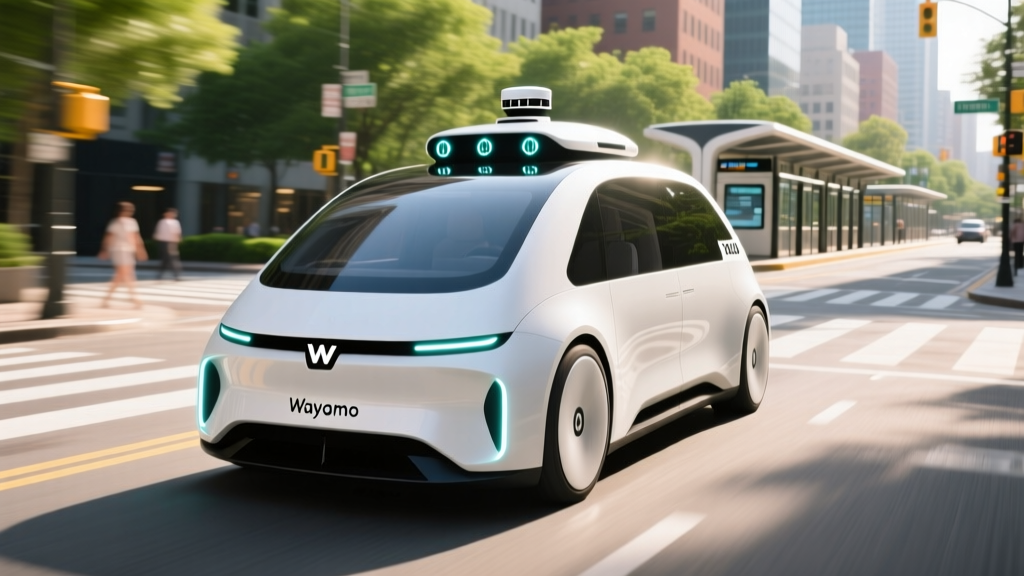
The Zeekr RT vehicle: Introduced in 2025, the Zeekr RT is Waymo's first purpose-built robotaxi (co-developed with Geely/Zeekr). It features a lower floor, sliding doors, wheelchair-accessible ramp options, and an optimized sensor pod. It replaces the Jaguar I-PACE in new-market deployments and has a purpose-built battery pack (estimated ~100 kWh, LFP chemistry for cycle-life longevity in high-utilization fleet service).
Regulatory Landscape: Who Approves Robotaxi Operations?
Robotaxi operations in the United States are governed by a patchwork of state and local regulations — there is no single federal "robotaxi license." Here's how the approval chain works:
- Federal (NHTSA): Sets vehicle safety standards (FMVSS) and requires ADS operators to file crash reports and voluntary recalls. NHTSA does not "approve" robotaxi services but has authority to investigate and mandate recalls. See NHTSA AV Safety page.
- State DMV / PUC: In California, the California Public Utilities Commission (CPUC) issues commercial robotaxi permits. Waymo holds a full commercial deployment permit (issued June 2023 for SF, expanded since). The California DMV issues testing permits. Arizona takes a lighter-touch approach — the state requires minimal permitting, which is why Phoenix was Waymo's first commercial market. Texas (Austin) requires local and state coordination.
- Local/municipal: Cities can impose operating restrictions (hours, zones, fleet size caps). San Francisco's Board of Supervisors and the SFMTA have been active in negotiating terms with Waymo, including fleet-size limits and reporting requirements.
This fragmented regulatory environment is the primary reason robotaxi expansion is slow and city-by-city. Each new market requires mapping, state permitting, local negotiation, and often public-comment periods.
Current Limitations: Where Robotaxis Fall Short
Level 4 autonomy is impressive within its ODD, but the ODD has hard boundaries. Here are the real-world limitations you'll encounter:
What Waymo Cannot Do (as of 2026)
- Heavy rain, fog, or snow: Waymo vehicles will pull over or refuse to dispatch in heavy precipitation. LiDAR scatters in dense rain, and camera visibility drops. In Phoenix monsoon season (July–September), service interruptions are common. SF fog can cause slowdowns.
- Highway driving (limited): Waymo has begun limited highway operations (e.g., SF → SFO airport routes on I-280), but most rides are surface-street only. Interstate highway driving at 70+ mph in mixed traffic is not broadly available.
- Construction zones: While Waymo handles standard cones and lane shifts, major unplanned construction or road closures can cause the vehicle to stop and request remote assistance (a human "fleet response" operator guides it through).
- Unmapped areas: If your destination is even one block outside the geofence, the service is unavailable. No manual override exists.
- Complex unprompted stops: You cannot ask a Waymo to "stop at the drive-through" or "wait here for 5 minutes while I run in." The ride is point-A to point-B only.
- Pets: Service animals are permitted. Pets in carriers are generally allowed, but loose pets are not. Policies vary by city.
- Minors: Riders must be 18+. Unaccompanied minors are not permitted.
- Accessibility gaps: While the Zeekr RT offers wheelchair-accessible configurations, availability is limited. The Jaguar I-PACE fleet is not wheelchair-accessible. Waymo is required under ADA frameworks to provide equivalent service, but practical availability lags.
Remote assistance: When a Waymo encounters a scenario it cannot resolve autonomously (e.g., an unusual road closure, a police officer directing traffic with non-standard gestures), the vehicle stops safely and connects to a remote fleet-response operator. This operator does not "drive" the car via joystick — they provide high-level guidance (e.g., "proceed around the obstacle on the left") and the vehicle executes the maneuver itself. Average resolution time is under 2 minutes, but in complex scenarios it can take 5–10 minutes, adding to your trip time.
Waymo vs. Uber/Lyft: When to Choose Robotaxi
Robotaxis aren't universally better than human-driven rideshare — they're better in specific scenarios:
| Scenario | Best Choice | Why |
|---|---|---|
| Short urban trip within geofence, normal weather | Waymo | Comparable or lower price, no tipping, consistent driving, no conversation pressure |
| Airport trip (if route is approved) | Waymo or UberX | Check pricing both apps; Waymo avoids driver-rated variability |
| Trip outside geofence | Uber/Lyft | Waymo unavailable |
| Heavy rain or fog | Uber/Lyft | Waymo may refuse dispatch or pull over |
| Late night in less-mapped area | Uber/Lyft | Geofence may not cover your destination |
| Multi-stop trip (errands) | Uber/Lyft | Waymo is point-to-point only |
| Accessibility needs (wheelchair) | Check Waymo One WAV availability, else Uber WAV | Waymo WAV fleet is small; Uber WAV has broader coverage |
Frequently Asked Questions
Is Waymo on Uber truly self-driving, or is there a safety driver?
Waymo rides booked through Uber are fully driverless — SAE Level 4. There is no human in the driver's seat, no steering wheel being operated, and no "safety driver" monitoring from inside the vehicle. Remote fleet-response operators are available to assist the vehicle's AI with high-level decisions in edge cases, but they do not drive the car remotely.
Why can't I see the Waymo option in my Uber app?
The Waymo option only appears if (a) you are in a supported city (Phoenix, San Francisco, Los Angeles as of early 2026), (b) your pickup location is within Waymo's geofence, and (c) your drop-off location is also within the geofence. If any of these conditions aren't met, the option won't display. Try the Waymo One app directly as an alternative — it sometimes has slightly different zone coverage.
How much does a Waymo ride cost compared to UberX?
Waymo on Uber is typically priced within 10–15% of UberX, and often slightly cheaper — especially when you factor in no tipping. A typical 3-mile urban ride runs $12–$18 on Waymo vs. $14–$20 on UberX. However, during surge pricing, both platforms spike, and Waymo's smaller fleet can sometimes mean longer wait times that offset any price savings.
Are Waymo robotaxis safe? What about crashes?
Based on over 10 million driverless miles, Waymo's injury-causing crash rate is approximately 0.41 per million miles — roughly 65% lower than the NHTSA human-driver benchmark of 1.15 per million miles. The most notable incident (December 2023, San Francisco) involved a pedestrian who ran into the vehicle's path from behind a parked truck; the pedestrian sustained minor injuries. Waymo issued software updates and filed a voluntary NHTSA recall. No robotaxi service is crash-free, but the data shows Waymo outperforms human drivers within its operating domain.
Can I use Waymo on Uber for airport trips?
In some cases, yes. Waymo offers approved airport routes in Phoenix (PHX) and San Francisco (SFO via I-280 corridors). LAX service in Los Angeles is in limited testing. However, airport availability depends on specific route approval and geofencing — check the app for your specific airport route before relying on it.
What happens if the Waymo vehicle gets confused or stuck?
The vehicle will come to a safe stop and connect to a remote fleet-response operator. This human operator provides high-level guidance (not joystick driving) to help the vehicle resolve the situation. Resolution typically takes 1–5 minutes. You'll see a notification on the in-vehicle screen during this process.
Is Waymo expanding to more cities in 2026?
Yes. Austin, TX has been announced for 2026 rollout. Waymo has also signaled plans for additional metro areas, though specific cities beyond Austin have not been confirmed as of early 2026. Expansion requires months of HD mapping, state regulatory approval, and local permitting — so new-city launches are measured in quarters, not weeks. Always verify live availability in the Uber or Waymo One app rather than relying on announcements.