Autonomous freight is no longer a concept demo. Companies like Aurora, Kodiak, and Waabi are hauling commercial loads on public highways right now — but the technology, limitations, and regulatory framework behind these trucks remain poorly understood. If you've been searching for a clear answer to how do self-driving trucks work, this guide covers the full technology stack, real-world deployment, safety record, and what separates today's Level 4 freight from the Level 2 driver-assist systems in consumer vehicles.
SAE Automation Levels: Where Self-Driving Trucks Actually Sit
Before unpacking the hardware, you need to understand the SAE automation scale — because marketing language routinely blurs the line between driver-assist and driverless.
| Level | Name | Who Drives | Example |
|---|---|---|---|
| Level 2 | Driver Assistance | Human (hands-on or eyes-on) | Tesla Autopilot, Ford BlueCruise, Volvo VNL driver-assist packages |
| Level 3 | Conditional Automation | System in narrow conditions; human must take over on request | Mercedes Drive Pilot (passenger cars); limited truck pilots |
| Level 4 | High Automation | System handles all driving within a defined ODD (geofence, weather, route) | Aurora Driver, Kodiak Driver, Waabi World on highway freight corridors |
| Level 5 | Full Automation | System everywhere, all conditions | Does not exist commercially for any vehicle class |
The Technology Stack: How Self-Driving Trucks See and Decide
Autonomous trucks rely on three integrated subsystems: perception (sensors that understand the environment), prediction (algorithms that forecast what other road users will do), and planning (the driving policy that selects steering, braking, and throttle actions). Here's how the hardware breaks down.
Sensor Suite: Lidar, Cameras, and Radar Working Together
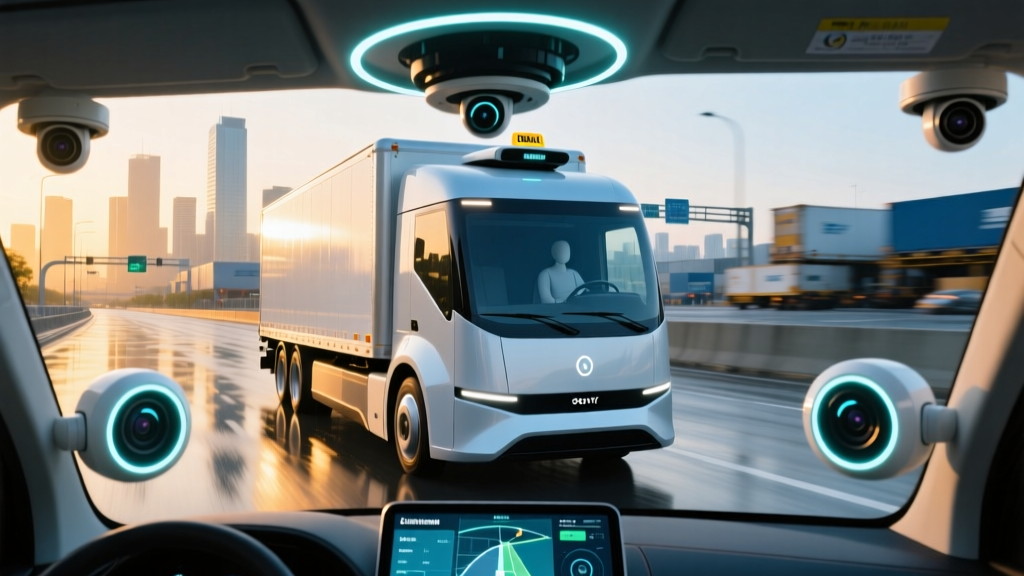
Unlike Tesla's camera-only approach in consumer vehicles, autonomous freight companies overwhelmingly use a redundant multi-sensor stack. A typical Class 8 self-driving truck in 2026 carries:
- Lidar (Light Detection and Ranging): Multiple roof- and bumper-mounted units generating a real-time 3D point cloud up to 250+ meters. Lidar provides precise depth measurement independent of lighting — critical for a 80,000-lb vehicle with 40+ second stopping distances at highway speed.
- Cameras: 8-14 high-resolution units covering 360° vision, handling lane detection, traffic sign recognition, and signal-light classification.
- Radar: Long-range forward radar (200+ m) plus short-range corner units for detecting metallic objects through rain, fog, and dust — conditions where lidar and cameras degrade.
- HD Maps and Localization: Centimeter-precision GPS combined with inertial measurement units (IMUs) and pre-scanned high-definition maps of the freight corridor.
Compute and Software
Onboard compute typically runs on NVIDIA DRIVE-class or custom silicon platforms delivering 500-1000+ TOPS (trillions of operations per second). Aurora's Driver, for example, uses a proprietary "Aurora Driver" stack that fuses sensor inputs into a unified world model, then runs planning algorithms trained on billions of simulated and real-world miles. The software must handle edge cases specific to trucking: trailer swing in crosswinds, jackknife prevention, grade management on 6% mountain descents, and the aerodynamic effects of passing or being passed by other semis.
Where Autonomous Trucks Operate Right Now
Self-driving freight is geographically constrained — by design. Companies deploy on specific highway corridors where they've completed HD mapping, secured regulatory approval, and established transfer-hub infrastructure. Here's the current landscape as of early 2026:
| Company | Primary Corridors | Cargo Type | Operating Model |
|---|---|---|---|
| Aurora Innovation | Dallas–Houston (I-45), Dallas–El Paso, expanding toward Phoenix | Retail, consumer goods (FedEx, Walmart, Uber Freight partners) | Hub-to-hub: human driver handles first/last mile; autonomous on highway |
| Kodiak Robotics | Texas Triangle (Dallas–Houston–San Antonio), limited Southeast routes | Oilfield logistics, retail freight | Hub-to-hub highway autonomy |
| Waabi (backed by Uber, Khosla) | Texas and select Sun Belt routes (limited commercial loads) | Mixed freight | Hub-to-hub with AI-heavy simulation-first approach |
| TuSimple | Winding down U.S. operations; pivoted to Asia-Pacific after 2024 restructuring | — | Not currently active in U.S. commercial freight |
The dominant operating model is hub-to-hub: a human truck driver handles surface streets and the first/last few miles to a highway-adjacent transfer yard, then the autonomous system takes over for the long-haul highway segment. At the destination hub, another human driver completes delivery. This sidesteps the hardest autonomy problems (unmapped urban streets, dock navigation, unpredictable pedestrian traffic) while capturing the highest-value miles — the monotonous, fatigue-prone highway stretches that cause the majority of trucking accidents.
Safety Record: What the Data Actually Shows
Autonomous trucking companies have collectively logged millions of autonomous highway miles, but the data pool is still small compared to the billions of human-driven truck miles annually. Here's what's publicly documented:
- Aurora: Over 5 million autonomous miles driven on public roads as of late 2025, with zero at-fault collisions reported during driverless commercial operations. The company publishes quarterly safety transparency reports aligned with NHTSA Standing General Order crash-reporting requirements.
- Kodiak: Reports 2+ million autonomous miles with no at-fault incidents during driverless revenue freight runs. The company emphasizes its "fallback" system — if a critical sensor fails, the truck can execute a controlled pullover without human intervention.
- Industry-wide: According to NHTSA Standing General Order data, Level 4 ADS-equipped vehicles (including robotaxis and trucks) reported roughly 1,500+ crashes between 2021 and mid-2025 across all operators. The vast majority were low-speed, minor-damage events where the ADS vehicle was rear-ended or side-swiped — not the at-fault party. Context: human-driven trucks are involved in roughly 500,000+ crashes per year in the U.S., with fatigue cited as a factor in approximately 13% of those.
The honest caveat: autonomous trucking miles are a statistical rounding error compared to the ~300 billion miles driven annually by human truckers. Drawing definitive "X times safer" conclusions isn't yet statistically valid. What is clear is that the technology eliminates the single largest risk factor in trucking — driver fatigue — because software doesn't get drowsy at 3 AM on I-10.
Regulatory Framework: Who Approves Self-Driving Trucks?
There is no single federal "self-driving truck license." Regulation is a patchwork:
- Federal (NHTSA / FMCSA): The National Highway Traffic Safety Administration sets vehicle safety standards (FMVSS) and requires crash reporting via Standing General Order. The Federal Motor Carrier Safety Administration oversees commercial driver licensing — and the question of whether a Level 4 system can substitute for a CDL holder remains state-by-state.
- State-level approval: Texas has emerged as the dominant jurisdiction for autonomous freight because it requires no special permit for Level 4 testing or deployment on public highways, provided the vehicle meets standard registration and insurance requirements. Arizona, Florida, and Nevada also permit driverless truck operations. California, by contrast, suspended Aurora and Kodiak's driverless permits in 2023-2024 following DMV safety-review actions, and the state remains more restrictive.
- Insurance and liability: Operators must carry commercial insurance policies (typically $5-10 million minimum for interstate freight) naming the ADS company as liable party during autonomous operation.
The IIHS and other safety bodies have called for more standardized federal oversight, but as of 2026, the regulatory environment remains state-driven — which is why most autonomous freight concentrates in Texas and the Sun Belt.
Current Limitations: What Self-Driving Trucks Cannot Do
Understanding the constraints is essential for anyone evaluating autonomous freight as a logistics option, an investment thesis, or a workforce concern.
- Weather restrictions: Heavy rain, snow, ice, and dense fog degrade lidar and camera performance. Most operators pull trucks from autonomous service in these conditions and either reroute or wait. This limits deployment to fair-weather Sun Belt corridors.
- Geofenced routes only: The truck cannot deviate from its pre-mapped highway corridor. Construction zone detours, road closures, or emergency reroutes require remote human-assisted guidance or fallback to a safety driver.
- No surface-street or dock autonomy: The hub-to-hub model exists because navigating distribution-center parking lots, backing into loading docks, and handling urban streets remain unsolved at commercial reliability thresholds.
- Remote assistance dependency: When the system encounters an "edge case" it can't resolve (an unusual obstacle, an unmapped lane closure), it escalates to a remote human operator who can authorize a path or dispatch roadside support. This isn't teleoperation (remote driving) — it's remote decision support — but it means the system isn't fully independent.
- Sensor maintenance and calibration: Lidar, camera, and radar units require regular cleaning (road grime, bug splatter, salt spray) and periodic recalibration. Operators staff maintenance crews at each transfer hub.
- No Level 5 anywhere: Despite periodic media hype, no autonomous truck — or any vehicle of any class — operates at Level 5 (all conditions, all roads, no human). Anyone claiming otherwise is not being accurate.
Economic Model: Cost Per Mile and Industry Impact
| Factor | Human Driver (Class 8) | Level 4 Autonomous (Hub-to-Hub) |
|---|---|---|
| Driver cost per mile | $0.55 – $0.75 | $0 (no onboard driver on highway segment) |
| ADS technology cost per mile (amortized) | $0 | $0.25 – $0.50 (sensor suite, compute, remote ops, maintenance) |
| Hours-of-service limit | 11 hours driving / 14-hour on-duty window (FMCSA) | Effectively 20+ hours/day (limited by fuel/charging and maintenance) |
| Utilization (miles per truck per year) | ~100,000 – 120,000 | ~200,000+ potential (no HOS constraints) |
| Fatigue-related crash risk | ~13% of truck crashes (FMCSA data) | Eliminated on autonomous segments |
The economic case rests on utilization. A human-driven truck is parked roughly 10-12 hours per day due to Hours-of-Service rules. An autonomous truck running hub-to-hub can nearly double annual mileage, spreading fixed costs (truck payment, insurance, depreciation) across more revenue miles. Aurora and Kodiak both pitch this utilization advantage as the primary ROI driver for fleet partners, not just labor-cost elimination.
For the trucking workforce, the hub-to-hub model means local and short-haul driving jobs — the first/last mile — remain human-driven. The impact concentrates on long-haul over-the-road positions, which already face chronic driver shortages (the American Trucking Associations estimates a shortfall of 78,000+ drivers). Autonomous freight is positioned as a capacity supplement, not a wholesale replacement — though the long-term labor implications remain a legitimate policy debate.
Electric Autonomous Trucks: The Powertrain Question
Most Level 4 freight trucks operating today are diesel-powered Class 8 tractors (typically based on Volvo VNL or International LT platforms retrofitted with Aurora or Kodiak drive systems). The sensor stack, compute hardware, and actuators are powertrain-agnostic — they can be integrated into battery-electric or hydrogen fuel-cell trucks as those platforms mature.
Several manufacturers have announced electric autonomous truck programs:
- Volvo Autonomous Solutions: Developing the VNL-AUTONOMOUS platform with integrated Level 4 capability; electric variants planned for drayage and short-haul.
- PACCAR / Aurora partnership: Peterbilt and Kenworth platforms with integrated Aurora Driver; battery-electric integration on the roadmap.
- Einride: Swedish-origin company operating autonomous electric freight pods (cabless design) in controlled environments and limited U.S. pilots.
The constraint for electric long-haul autonomy remains battery energy density. A Class 8 truck running 500+ miles per day needs 600+ kWh of usable battery capacity — adding 8,000-10,000 lbs of battery mass that cuts into payload. Until solid-state or next-gen LFP chemistries close that gap, diesel dominates the autonomous long-haul segment, while electric autonomous trucks concentrate on drayage, port operations, and 150-250 mile regional routes where depot charging is feasible.
Frequently Asked Questions
Is this truly self-driving or driver-assist?
Level 4 autonomous freight trucks operating on designated highway corridors are genuinely driverless — no human behind the wheel. This is categorically different from Level 2 systems like Tesla Autopilot, Ford BlueCruise, or GM Super Cruise in consumer vehicles, which require continuous driver supervision. However, Level 4 is geofenced: the truck cannot operate autonomously outside its mapped corridor or in adverse weather. Level 5 (full self-driving everywhere) does not exist.
Where can autonomous trucks operate right now?
Primarily Texas — the Dallas–Houston–San Antonio triangle and routes toward El Paso — plus limited operations in Arizona, Florida, and Nevada. California has been more restrictive following regulatory actions in 2023-2024. Expansion to new corridors requires HD mapping, regulatory approval, and transfer-hub infrastructure build-out.
How much does autonomous freight cost vs. traditional trucking?
The per-mile economics are still maturing. Autonomous operation eliminates the driver cost component ($0.55-$0.75/mile) but adds ADS technology amortization ($0.25-$0.50/mile) and hub-transfer logistics. The primary economic advantage is higher truck utilization — potentially doubling annual miles per tractor by eliminating Hours-of-Service downtime. For shippers, pricing is typically negotiated through freight partners like Uber Freight, FedEx, or direct fleet contracts rather than a public rate card.
How safe are self-driving trucks?
Aurora and Kodiak report zero at-fault collisions across millions of driverless commercial miles. NHTSA Standing General Order data shows that Level 4 ADS vehicles across all operators were typically the struck party (rear-ended, side-swiped) rather than at-fault in reported incidents. However, the autonomous mile count is statistically small compared to the ~300 billion human-driven truck miles annually, so definitive comparative safety claims aren't yet valid. The technology's strongest safety argument is eliminating fatigue — a factor in roughly 13% of all truck crashes.
What happens if the system fails mid-route?
Level 4 trucks include a "fallback" system: if a critical sensor or compute module fails, the vehicle is designed to execute a controlled deceleration and pull onto the shoulder or into a safe pulloff area without human intervention. Remote operations teams monitor the fleet continuously and can dispatch roadside assistance. The system is engineered to fail safe, not fail operational — meaning it stops rather than continuing to drive in a degraded state.
Will autonomous trucks replace truck drivers?
The hub-to-hub model preserves local and short-haul driving jobs — humans handle the first and last miles. The impact is on long-haul over-the-road positions, which already face chronic shortages (78,000+ unfilled positions per ATA estimates). Autonomous freight is positioned as a capacity supplement for the highway segment, not a wholesale workforce replacement. The long-term equilibrium will depend on freight demand growth, technology reliability, and regulatory evolution.