GM's Two-Track Autonomy Strategy: Consumer Assist vs. True Robotaxi
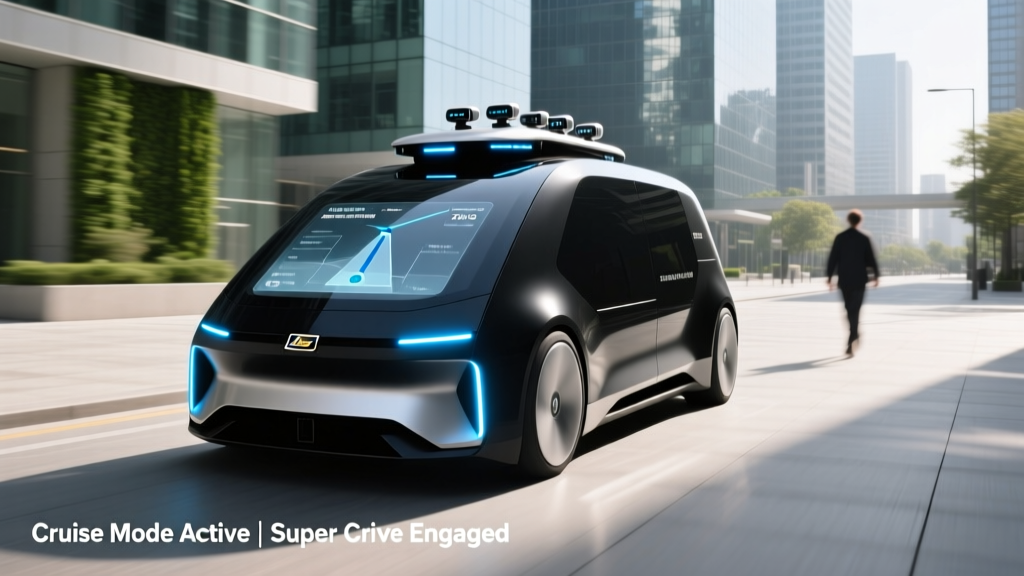
When buyers search for general motors autonomous vehicles, they're usually conflating two very different products under one corporate umbrella. On one side sits Super Cruise (and its newer sibling Ultra Cruise) — a Level 2 hands-off driver-assistance system available on production GM vehicles you can buy today. On the other sits Cruise, GM's majority-owned robotaxi subsidiary pursuing Level 4 driverless operations. Understanding the gulf between these two systems is essential before spending money on either.
| Level | Description | GM Product | Driver Required? |
|---|---|---|---|
| Level 2 | Partial automation (steering + speed) | Super Cruise | Yes — eyes on road |
| Level 2+ | Enhanced partial automation | Ultra Cruise | Yes — eyes on road |
| Level 4 | High automation (geofenced, no driver) | Cruise Origin (robotaxi) | No — vehicle handles all tasks in ODD |
| Level 5 | Full automation (anywhere, any condition) | Does not exist | N/A |
Source: SAE International J3016
Super Cruise is a consumer feature you purchase with a vehicle. Cruise is a ride-hailing service (when operational) where no human sits behind the wheel. The technology stacks, regulatory frameworks, and user experiences are fundamentally different.
Super Cruise & Ultra Cruise: GM's Consumer Autonomy Products
Super Cruise launched in 2017 on the Cadillac CT6 and has since expanded to over 400,000 miles of compatible mapped roads across the US and Canada. It uses a combination of GPS, LiDAR-mapped HD road data, a forward-facing camera suite, and a driver-attention monitoring camera mounted on the steering column. When conditions are met — compatible highway, clear lane markings, driver eyes confirmed on the road — the system takes over longitudinal and lateral control, allowing hands-free driving.
Ultra Cruise, introduced on select 2024+ Cadillac models (Celestiq, Escalade IQ), extends this to an estimated 2 million miles of roads, including many non-highway surface streets, using an upgraded sensor suite with additional cameras and higher-resolution LiDAR. However, Ultra Cruise remains a Level 2 system. The driver must remain attentive and ready to resume control at any moment.
As of early 2026, Super Cruise is available on the following GM models (availability varies by trim):
- Cadillac CT5, CT5-V Blackwing, Escalade, Escalade IQ, Celestiq, Lyriq, Optiq
- Chevrolet Silverado 1500 (certain trims), Tahoe, Suburban, Blazer EV, Equinox EV
- GMC Sierra 1500 (certain trims), Yukon, Hummer EV Pickup/SUV
- Buick Envista (select trims)
Pricing for Super Cruise typically runs $2,200–$2,500 as a standalone option package, though it's included standard on higher trims (e.g., Cadillac Lyriq Sport 3). After the initial three-year trial, connected services supporting Super Cruise's real-time map data require a subscription (approximately $15–$25/month through OnStar).
Cruise Robotaxi: Current Operational Status
Cruise LLC, in which GM holds a majority stake (with Honda and SoftBank as minority investors), operates a Level 4 robotaxi service using purpose-built and retrofitted vehicles. Following a serious pedestrian incident in San Francisco in October 2023 that led to the California DMV suspending Cruise's deployment permit, the company underwent a major restructuring throughout 2024 and 2025.
As of early 2026, Cruise has been conducting phased re-entry into limited markets with heightened safety oversight. Operations remain significantly scaled back compared to the company's 2022–2023 peak, when it ran thousands of rides daily across multiple cities.
| City | Status | Service Hours | Geofence Notes |
|---|---|---|---|
| San Francisco, CA | Limited operations (safety driver present in some vehicles) | Restricted hours | Select corridors only; expanded gradually |
| Phoenix, AZ | Phased re-entry with remote-assist oversight | Daytime/evening | Downtown and select suburbs |
| Austin, TX | Testing with safety operators | Limited | Mapped downtown area |
| Houston, TX | Announced / pre-deployment testing | N/A | Not yet open to public riders |
| Atlanta, GA | Announced / pre-deployment testing | N/A | Not yet open to public riders |
Service availability changes frequently. Always check the Cruise app or getcruise.com for current operational status before planning a trip.
Cruise Technology Stack: Sensors, Computing, and Geofencing
Cruise vehicles (historically based on the Chevrolet Bolt EV platform, with the purpose-built Cruise Origin announced but facing production delays) employ a sensor-heavy approach that contrasts sharply with Tesla's camera-only FSD architecture.
- LiDAR: Multiple roof-mounted and bumper-mounted solid-state and spinning LiDAR units providing 360° 3D point-cloud mapping out to ~200+ meters
- Cameras: 10+ high-resolution cameras covering all directions for object classification, traffic-light recognition, and lane detection
- Radar: Multiple short- and long-range radar units for velocity detection and redundancy in low-visibility conditions
- Ultrasonic sensors: Close-range object detection for low-speed maneuvers
- Compute: Custom high-performance computing platform processing terabytes of sensor data per hour
- HD Maps: Centimeter-precision LiDAR-scanned maps of every operational geofence, updated regularly
- Connectivity: Redundant cellular links for remote assistance and real-time fleet coordination
This redundant, multi-modal sensor approach gives Cruise's system several advantages in object detection — particularly in complex urban environments with occluded pedestrians, construction zones, and unpredictable cyclist behavior. The tradeoff is cost: each Cruise vehicle carries an estimated $100,000+ in sensor hardware alone, though unit costs have declined with each hardware generation (Gen 4 through Gen 5 platforms).
Geofencing is absolute: a Cruise vehicle will not operate outside its mapped operational design domain (ODD). If a vehicle approaches a geofence boundary, it will pull over safely and end the trip rather than venture into unmapped territory. This is a core safety constraint of all current Level 4 systems.
Safety Record: What the Data Shows
- Cumulative driverless miles (pre-October 2023): Approximately 3+ million fully driverless miles logged across San Francisco, Phoenix, and Austin (per Cruise's public disclosures and California DMV disengagement reports)
- October 2023 San Francisco incident: A pedestrian, thrown into the path of a Cruise vehicle by a human-driven car, was struck and then dragged approximately 20 feet as the Cruise vehicle pulled to the curb. The incident led to California DMV permit suspension and a nationwide operational pause.
- NHTSA Standing General Order data: Cruise reported multiple contact incidents during 2022–2023 operations, consistent with the reporting requirements under NHTSA's Standing General Order for ADS-equipped vehicles.
- Post-restructuring safety changes (2024–2026): Increased use of safety operators during re-entry, enhanced remote-assistance protocols, reduced operational speeds, and tighter geofencing.
Context matters: Cruise's pre-suspension safety record showed fewer at-fault collisions per million miles than human drivers in San Francisco, according to the company's published analyses. However, the severity and nature of the October 2023 incident — particularly the post-collision behavior of the vehicle (pulling to the curb with the pedestrian underneath rather than stopping immediately) — raised fundamental questions about how autonomous systems handle edge-case multi-vehicle scenarios.
For comparison, NHTSA data shows that human drivers in urban environments average approximately 1.5 police-reported crashes per million vehicle miles, though underreporting makes the true rate higher. Robotaxi operators' crash data is more transparent due to mandatory reporting requirements, making direct comparison imperfect.
Pricing: Cruise vs. Uber and Lyft
Before its October 2023 operational pause, Cruise priced rides competitively with — and often below — comparable Uber and Lyft fares in the same markets. The strategy was deliberate: subsidized pricing to build ridership and collect operational data.
| Metric | Cruise (Historical) | UberX (SF Avg.) | Lyft (SF Avg.) |
|---|---|---|---|
| Base fare | $0.00–$1.00 | $2.50–$3.50 | $2.00–$3.00 |
| Per mile | $1.00–$1.50 | $1.25–$1.75 | $1.15–$1.60 |
| Per minute | $0.30–$0.50 | $0.35–$0.55 | $0.30–$0.50 |
| Typical 3-mile ride | $6–$10 | $10–$16 | $9–$14 |
| Surge pricing | Less volatile (fleet-managed) | Frequent during peak | Frequent during peak |
Note: Cruise's 2026 re-entry pricing has not been fully published as of this writing. The figures above reflect pre-pause pricing and may change as the company moves toward unit-economic sustainability rather than growth-subsidy pricing.
To use Cruise where available: download the Cruise app (iOS/Android), create an account, enter pickup and drop-off within the geofenced zone, and request a ride. The vehicle arrives without a driver (in fully driverless zones), and you unlock it via the app. The experience is closer to an elevator ride than a traditional rideshare — no small talk, no driver rating anxiety, but also no human to handle unexpected situations in-cabin.
Regulatory Landscape: Who Approves Robotaxi Operations?
Autonomous vehicle deployment in the US operates under a patchwork of state and federal regulations, with no single unified framework:
- Federal (NHTSA): Sets vehicle safety standards (FMVSS) and requires crash reporting via Standing General Order. NHTSA does not currently "approve" ADS software but can issue recalls and investigate safety defects. The Cruise Origin, for example, required an FMVSS exemption petition because it was designed without a steering wheel or mirrors.
- California (DMV + CPUC): The DMV issues deployment permits (which it revoked for Cruise in October 2023). The California Public Utilities Commission (CPUC) regulates commercial passenger service, issuing permits for fare-charged robotaxi operations.
- Arizona (ADOT): Among the most permissive regulatory environments; Cruise and Waymo have operated with relatively fewer restrictions in Phoenix.
- Texas (TxDOT + city authorities): Austin and Houston have local permitting requirements in addition to state-level authorization.
- Federal legislation: As of 2026, Congress has not passed comprehensive AV legislation. The AV START Act and similar proposals have stalled in various sessions, leaving the state-by-state patchwork intact.
For consumers, this means robotaxi availability is hyper-local. A service that operates freely in Phoenix may be banned or heavily restricted 100 miles away in a different jurisdiction. GM and Cruise must negotiate each market individually.
Current Limitations of GM Autonomous Systems
- Super Cruise / Ultra Cruise: Cannot navigate unmapped roads, handle construction zones with missing lane markings reliably, operate in heavy snow/ice, make unprotected left turns across traffic in all scenarios, or function without driver attention monitoring. The driver is legally and operationally responsible at all times.
- Cruise robotaxi: Cannot operate outside its geofenced ODD, struggles in heavy rain, fog, or snow (LiDAR degradation), may take overly conservative routes, cannot handle certain complex construction zones, does not serve airports in all markets, and has limited wheelchair accessibility (Origin vehicle pending).
- Both systems: Cannot drive in unmapped rural areas, cannot navigate private roads or parking garages autonomously (Cruise), and are not Level 5 full-self-driving systems capable of handling every scenario in every condition.
Weather remains a fundamental constraint. Heavy precipitation scatters LiDAR returns and obscures cameras, reducing the effective sensor range of Cruise vehicles significantly. Super Cruise's camera-based system similarly degrades when lane markings are obscured by snow or when the forward camera is blocked by road grime. In both cases, the system will disengage and alert the driver (or end the trip, for Cruise).
Edge cases — the rare, unpredictable scenarios that human drivers handle intuitively — remain the hardest problem in autonomy. A police officer directing traffic with hand signals, a mattress falling off a truck ahead, a child chasing a ball between parked cars: these scenarios require contextual reasoning that current AI systems handle with varying degrees of success. Cruise's approach of pairing AI with remote human assistance (teleoperations) helps address some of these, but introduces latency and scaling challenges.
GM Autonomy FAQ
Where can I use a GM robotaxi right now?
Cruise's robotaxi service has limited availability in early 2026 following its post-incident restructuring. San Francisco and Phoenix have seen phased re-entries, often with safety operators present. Austin is in testing. Check the Cruise app for real-time availability — service areas are small, geofenced zones within these cities, not full metro coverage. Houston and Atlanta have been announced but are not yet open to public riders.
How much does Cruise cost vs. Uber or Lyft?
Before its operational pause, Cruise typically undercut Uber and Lyft by 20–40% on comparable urban rides (e.g., $7–$10 for a 3-mile trip vs. $10–$16 for UberX). Post-re-entry pricing may shift as Cruise prioritizes unit economics over growth subsidies. Expect pricing to be competitive with rideshare but not dramatically cheaper during the re-entry phase.
How safe are GM's autonomous vehicles? What does the real data show?
Pre-pause data showed Cruise vehicles involved in fewer at-fault collisions per million miles than human drivers in San Francisco. However, the October 2023 pedestrian incident demonstrated that when failures occur, they can be severe and involve edge-case scenarios the system didn't handle appropriately. Post-restructuring, Cruise has added safety operators, reduced speeds, and tightened geofences. NHTSA Standing General Order data provides ongoing transparency. No robotaxi system has achieved a zero-incident record.
Is Super Cruise truly self-driving?
No. Super Cruise and Ultra Cruise are SAE Level 2 driver-assistance systems. They control steering and speed on compatible roads, and allow hands-off operation, but the driver must remain attentive (verified by a steering-column camera monitoring eye gaze) and is legally responsible for the vehicle at all times. This is categorically different from Cruise's Level 4 robotaxi, which operates without any human driver.
What vehicles offer Super Cruise in 2026?
Super Cruise is available across Cadillac (Lyriq, Escalade, CT5, Celestiq, Optiq, Escalade IQ), Chevrolet (Silverado 1500, Tahoe, Suburban, Blazer EV, Equinox EV), GMC (Sierra 1500, Yukon, Hummer EV), and select Buick models. Pricing ranges from $2,200–$2,500 as an option, or included in higher trims. A three-year connected-services trial is included, after which an OnStar subscription (~$15–$25/month) is required for continued Super Cruise functionality.
Will the Cruise Origin robotaxi launch?
The Cruise Origin — a purpose-built, steering-wheel-free Level 4 vehicle co-developed with Honda — was announced and shown publicly but has faced production and regulatory delays. GM paused Origin production plans in mid-2024, citing the need to focus on near-term operational recovery and the FMVSS exemption process. As of 2026, the Origin remains in development limbo, and Cruise's current fleet uses modified Chevrolet Bolt EVs. GM has not confirmed a production timeline.
Sources: NHTSA Standing General Order, SAE International J3016, California DMV AV program, GM/Cruise public disclosures. Tax-credit and incentive information is not applicable to robotaxi services; for personal EV purchase incentives, consult IRS §30D guidelines.