What Is the Gatik Self-Driving Delivery Truck?
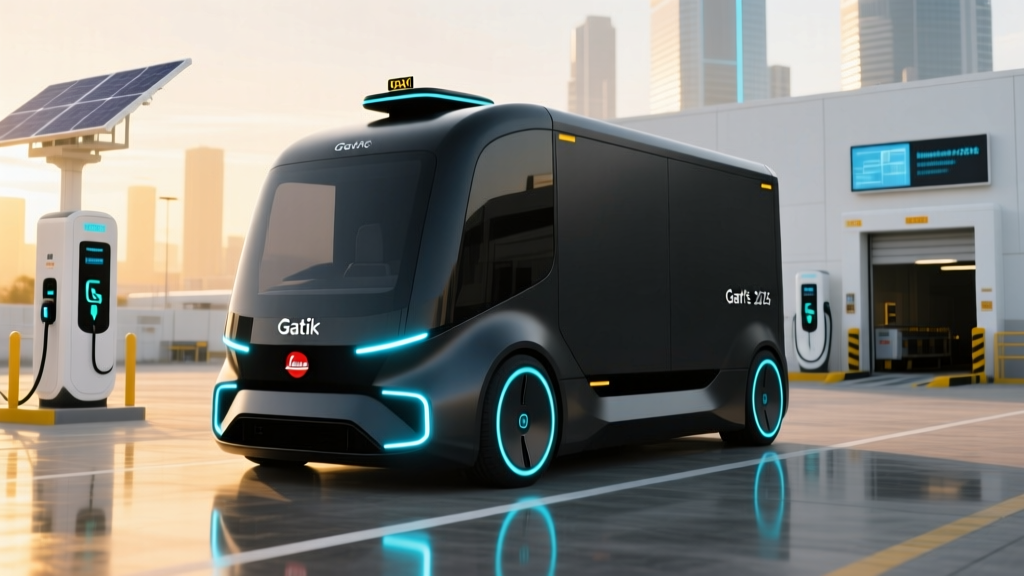
If you've been tracking commercial autonomy, the phrase self driving delivery truck gotik likely stems from searches around Gatik AI — the Mountain View, California–based autonomous trucking company that has been quietly running driverless freight hauls across Texas, Arkansas, and Louisiana since 2021. Unlike the consumer-facing robotaxi wars (Waymo, Cruise, Zoox), Gatik targets the middle mile: short-haul, repeatable B2B routes between distribution centers and retail stores.
Gatik's fleet primarily consists of Class 3–6 box trucks — vehicles in the 10,001–26,000 lb GVWR range — retrofitted with a proprietary sensor suite. As of early 2026, the company has removed safety drivers from select routes in Texas, making it one of the first commercial operations to run truly driverless freight at scale. Their marquee partnerships include Walmart, Tyson Foods, and Loblaw Companies (in Canada).
Gatik's driverless routes operate at SAE Level 4 — meaning the system performs all driving tasks within a defined operational design domain (ODD) without human intervention. This is fundamentally different from Level 2 driver-assist systems like Tesla Autopilot, GM Super Cruise, or Ford BlueCruise, which require an attentive human driver at all times. On Gatik's approved geofenced routes, there is no driver in the cab.
Where Does Gatik Operate Right Now?
Gatik's commercial operations are geofenced to specific corridors where the company has mapped routes extensively and secured regulatory approval. As of 2026, the active service regions include:
| Region | Corridor Type | Key Partners | Driverless Status |
|---|---|---|---|
| Dallas–Fort Worth, TX | Metro middle-mile | Walmart, Tyson | Driverless (no safety operator) |
| San Antonio, TX | Hub-to-store | Walmart | Driverless |
| Bentonville, AR | DC-to-retail | Walmart (HQ corridor) | Driverless |
| New Orleans / Baton Rouge, LA | Regional distribution | Tyson Foods | Driverless |
| Toronto / GTA, Canada | Urban middle-mile | Loblaw Companies | Safety operator present |
Gatik does not operate a consumer-facing service. You cannot hail a Gatik truck. Their business is strictly B2B logistics — moving goods from warehouses to retail shelves on fixed, repeatable routes typically ranging from 20 to 100 miles per trip.
Gatik's Technology Stack: Sensors, Compute, and Geofencing
Gatik uses a multi-modal sensor approach, rejecting the camera-only philosophy that Tesla pursues for its FSD system. The retrofit sensor suite on each Gatik box truck includes:
- LiDAR arrays: Multiple roof- and bumper-mounted units providing 360° 3D point-cloud mapping at up to 200+ meter range. LiDAR gives precise depth perception regardless of lighting conditions — critical for dawn/dusk freight runs.
- Camera system: A surround-view array of high-resolution cameras for lane detection, traffic-sign recognition, and object classification (pedestrians, cyclists, construction zones).
- Radar units: Forward- and corner-mounted millimeter-wave radar for velocity tracking of surrounding vehicles and all-weather object detection when LiDAR performance degrades (heavy rain, fog).
- HD mapping + localization: Pre-mapped routes with centimeter-level precision. The truck knows exactly where every lane marking, stop sign, and merge point is before it begins a run.
- Onboard compute: Redundant NVIDIA-based computing platforms processing sensor fusion in real time, with failover systems that bring the vehicle to a safe stop if primary compute degrades.
Gatik's Level 4 autonomy only works within its pre-approved Operational Design Domain (ODD). Each route is mapped, tested with safety drivers for thousands of miles, and approved by state regulators before the safety operator is removed. If a Gatik truck encounters a scenario outside its ODD — an unmapped detour, a road closure — the system will pull over safely and request remote human assistance rather than guessing.
Safety Record: What the Data Shows
Commercial autonomous trucking safety is scrutinized by both the National Highway Traffic Safety Administration (NHTSA) and state-level regulators. Gatik's public safety claims as of 2026 include:
- Total autonomous miles driven: 4+ million miles (combined safety-driver and driverless operations)
- At-fault accidents on autonomous routes: Zero reported at-fatal collisions during driverless operations
- Disengagement rate: Gatik has not published standardized disengagement reports like California DMV requires for passenger AV companies, because their Texas and Arkansas operations fall under different state frameworks
- Remote assistance interventions: The company reports a decreasing trend in remote-assist requests per 1,000 miles as the system matures, though exact figures remain proprietary
It's important to contextualize this: Gatik's routes are deliberately chosen for predictability. These are mostly suburban and light-industrial corridors with lower complexity than dense urban cores. The trucks run at moderate speeds (typically 35–55 mph on surface roads and highways) and avoid the chaotic mixed-traffic scenarios that challenge robotaxis in San Francisco or Phoenix.
For broader autonomous vehicle safety context, IIHS research continues to emphasize that Level 4 systems must demonstrate safety equivalence across diverse conditions before broader deployment is warranted.
Regulatory Landscape: Who Approves Driverless Freight?
Unlike consumer robotaxis, which often fall under state public-utility or transportation-network-company frameworks, autonomous trucking navigates a patchwork of state commercial-vehicle regulations:
- Texas: The most permissive major market for autonomous trucks. Texas law (Transportation Code § 547.614) allows driverless commercial vehicles provided they meet insurance, registration, and operational requirements. No special state permit is required beyond standard commercial registration.
- Arkansas: Passed autonomous-vehicle legislation in 2019 enabling testing and deployment. Gatik's Bentonville operations leverage Walmart's home-state influence and regulatory cooperation.
- Louisiana: Authorized autonomous vehicle operations, enabling Gatik's Tyson Foods partnership routes.
- California: Despite being Gatik's HQ state, California's DMV and CPUC impose more rigorous permitting for autonomous vehicles. Gatik has tested extensively in California but has focused commercial driverless operations in less restrictive states.
- Federal (FMCSA): The Federal Motor Carrier Safety Administration has not yet issued comprehensive regulations for driverless commercial vehicles, leaving the field to state-level governance. Hours-of-service rules (which limit human driver shifts) do not apply to driverless systems — a significant operational advantage for Gatik's 24/7 freight model.
How Gatik's Economics Compare to Traditional Freight
Gatik does not sell trucks to consumers or offer a per-ride pricing model. Their business operates on a per-mile or per-route contract basis with logistics partners. However, the cost dynamics are instructive for understanding why autonomous middle-mile freight is scaling:
| Cost Factor | Human-Driven Box Truck | Gatik Level 4 Autonomous |
|---|---|---|
| Driver wages + benefits | $0.60–$0.85/mi | $0.00 (no onboard driver) |
| Fuel / energy | $0.35–$0.50/mi (diesel) | $0.35–$0.50/mi (diesel current fleet) |
| Vehicle maintenance | $0.15–$0.20/mi | $0.18–$0.25/mi (sensor calibration adds cost) |
| Autonomy system amortization | N/A | $0.30–$0.50/mi (estimated, declining) |
| Estimated total | $1.10–$1.55/mi | $0.83–$1.25/mi |
| Daily operating window | ~11 hours (HOS limits) | ~20+ hours (maintenance breaks only) |
The elimination of driver wages is the primary economic driver. A Class 3–6 box truck driver earns $50,000–$75,000 annually, and federal hours-of-service rules cap driving at 11 hours per shift. A driverless Gatik truck can run nearly double the daily hours, dramatically improving asset utilization.
Current Limitations of Gatik's Autonomous Trucks
Despite significant progress, Gatik's Level 4 system operates within real constraints:
- Geofence boundaries: The trucks cannot deviate from pre-mapped routes. Road construction, detours, or new delivery points require re-mapping and re-validation before the system can handle them driverlessly.
- Weather limitations: Heavy rain, ice, snow, and dense fog degrade LiDAR and camera performance. In adverse conditions, Gatik may suspend driverless operations and either delay runs or insert a safety operator.
- Urban complexity: Gatik avoids dense downtown cores with heavy pedestrian traffic, unprotected left turns across multiple lanes, and complex multi-lane roundabouts. Their routes favor suburban industrial parks, highways, and arterial roads.
- Loading/unloading: The autonomous system handles driving only. Dock workers at each endpoint handle cargo loading and unloading — this is not a fully automated supply chain.
- Edge cases: Unusual road obstacles (downed trees, accident scenes without standard signage, emergency vehicle interactions) may trigger a remote-assist request, causing the truck to pull over until a human operator provides guidance.
- Not electric (yet): As of 2026, Gatik's fleet primarily runs on diesel-powered box trucks. The company has explored EV partnerships but has not committed to a fully electric fleet at scale. This means the environmental benefit is currently limited to efficiency gains rather than zero tailpipe emissions.
Frequently Asked Questions
Can I use a Gatik self-driving delivery truck for personal deliveries?
No. Gatik is a B2B logistics company. Their trucks move goods between warehouses and retail stores for partners like Walmart and Tyson Foods. There is no consumer-facing app or ordering interface. If you see a driverless Gatik box truck on a Texas highway, it's hauling commercial freight, not your Amazon package.
Is Gatik's system truly self-driving or just driver-assist?
On approved routes in Texas, Arkansas, and Louisiana, Gatik operates at SAE Level 4 — meaning there is genuinely no driver in the cab. This is fundamentally different from Level 2 systems like Tesla FSD (Supervised), GM Super Cruise, or Ford BlueCruise, all of which require an engaged human driver. Gatik's Level 4 autonomy is real, but it is constrained to specific pre-mapped corridors.
How does Gatik compare to Waymo or Cruise robotaxis?
Different use cases entirely. Waymo and Cruise operate passenger robotaxis (Level 4) in urban environments like Phoenix, San Francisco, and Los Angeles. Gatik operates commercial freight trucks (also Level 4) on suburban and highway middle-mile routes. The technology principles are similar — multi-sensor fusion, HD mapping, geofenced ODDs — but the vehicle platforms, regulatory frameworks, and business models are distinct.
What happens if the autonomous system fails mid-route?
Gatik's system has redundant compute and braking systems. If primary systems degrade, the truck is designed to execute a controlled stop on the shoulder or in a safe location. A remote operations team monitors the fleet in real time and can provide guidance or dispatch roadside assistance. The truck does not continue driving in a degraded state.
Will Gatik trucks eventually go electric?
The company has signaled interest in electric platforms, and several medium-duty EV trucks (like the Freightliner eM2 or Lightning Electric Class 4) could serve as future base vehicles. However, as of 2026, Gatik's active fleet remains primarily diesel. The economics of electric medium-duty trucks — higher upfront cost offset by lower per-mile energy and maintenance costs — are still being evaluated against the company's autonomy-system amortization timeline.
How safe are autonomous trucks compared to human truck drivers?
Human-driven commercial trucks are involved in approximately 4,000+ fatal crashes annually in the U.S., with fatigue, distraction, and impairment as leading factors. Autonomous systems eliminate these risks but introduce new ones (sensor failures, software edge cases). Gatik's published record shows zero at-fault fatal collisions across millions of driverless miles — but the sample size remains small compared to the billions of miles driven by human truckers annually. Definitive safety equivalence claims require more data and longer operational histories.