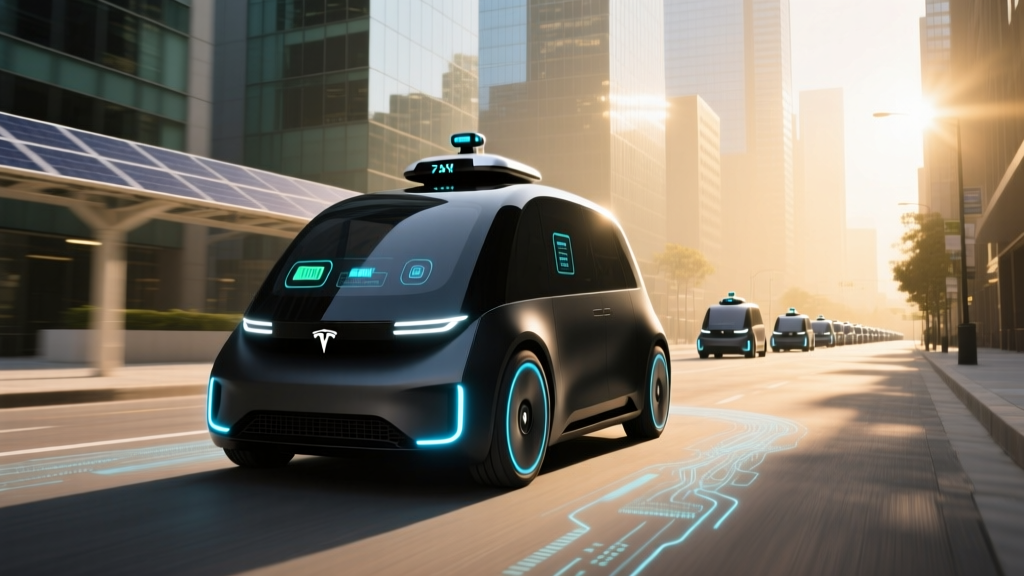
If you have ever wondered why Tesla's Full Self-Driving (Supervised) software seems to update with eerily specific improvements — better lane-merge behavior here, smoother unprotected left turns there — the answer lies in a background process called Shadow Mode. Unlike a traditional test fleet, Shadow Mode turns every Tesla on the road into a silent co-pilot, quietly comparing what the car's neural network would have done against what the human driver actually did. The result is one of the largest closed-loop driver-assistance training datasets on the planet, and understanding it is critical for any Tesla owner evaluating whether FSD is worth the $8,000 one-time purchase or $99/month subscription in 2026.
What Is FSD Shadow Mode and How Does It Work?
Shadow Mode is a passive, background machine-learning pipeline that runs on Tesla vehicles equipped with Hardware 4 (HW4) or the newer AI5 computer. It does not steer, brake, or accelerate the car. Instead, it continuously ingests data from the vehicle's camera suite — eight cameras on current models, since Tesla removed ultrasonic sensors (USS) and radar in favor of a pure Tesla Vision architecture — and runs the FSD neural network's perception and planning stack in real time.
The system then logs discrepancies between the neural net's hypothetical decisions and the human driver's actual inputs. For example:
- The driver brakes hard where Shadow Mode would have maintained speed
- The driver changes lanes where Shadow Mode would have stayed put
- The driver disengages Autopilot at a specific intersection geometry
- Shadow Mode predicts a path that would have triggered a forward-collision warning
These discrepancies are tagged, compressed, and uploaded to Tesla's Dojo supercomputer and external NVIDIA H100 clusters when the vehicle is on Wi-Fi. Tesla's engineering team then uses these "edge cases" to retrain the end-to-end neural network, pushing improvements via over-the-air (OTA) software updates. This flywheel is why FSD Supervised (v13.x and the newer v14 branch in 2026) has improved markedly in construction-zone handling and unprotected turns — those are precisely the scenarios where Shadow Mode flagged the most human-vs-model divergence.
FSD Supervised — and by extension Shadow Mode — operates at SAE Level 2 per the SAE J3016 standard. The driver must remain fully engaged, hands on the wheel (or applying torque, depending on firmware), and eyes on the road at all times. Tesla's cabin camera enforces attention monitoring and will escalate warnings, then disengage, if inattention is detected. This is not Level 4 "self-driving" in the Waymo or Zoox sense.
The Sensor Stack Behind Shadow Mode
Shadow Mode's fidelity depends entirely on the vehicle's sensor suite. As of 2026, Tesla's production vehicles rely on a vision-only architecture:
| Sensor | Count | Function |
|---|---|---|
| Front-facing main camera | 1 (narrow + wide on HW4) | Long-range object detection, lane tracking |
| Front fender cameras | 2 | Cross-traffic, blind-spot perception |
| Rear quarter-panel cameras | 2 | Rear-side lane changes, merge detection |
| Rear-view camera | 1 | Reverse, trailing-vehicle tracking |
| High-resolution front (AI5) | 1 (added on AI5) | Higher-fidelity far-field perception |
| Cabin-facing camera | 1 | Driver attention monitoring |
| Radar / LiDAR | 0 | Removed — Tesla Vision only |
| Ultrasonic sensors (USS) | 0 | Removed post-2022 |
The absence of radar and LiDAR is the single most debated aspect of Tesla's approach. Competitors like Waymo (Level 4 robotaxi) and Mercedes-Benz Drive Pilot (certified Level 3 in limited jurisdictions) use LiDAR for redundant depth perception. Tesla's bet — and Shadow Mode's training corpus — relies on neural networks extracting depth from camera imagery alone. The trade-off shows up in real-world limitations discussed below.
What Shadow Mode Actually Does (and Does Not Do)
It is worth being precise about Shadow Mode's role, because marketing language and internet forums often conflate it with active features.
| Capability | Status |
|---|---|
| Actively steers or brakes the vehicle | No — passive only |
| Runs FSD neural net in background | Yes — always when vehicle is on |
| Logs driver-vs-model discrepancies | Yes — core function |
| Uploads training clips to Tesla | Yes — on Wi-Fi, anonymized |
| Requires FSD purchase or subscription | No — runs on all HW4/AI5 Teslas |
| Visible to driver in UI | Limited — FSD visualization shows perception, not Shadow decisions |
| Improves your individual car over time | Indirectly — via fleet-wide OTA updates |
| Replaces attentive driving | Absolutely not |
- It does not make your Tesla autonomous. You remain the driver of record and are legally liable for all vehicle actions.
- It does not guarantee FSD Supervised will handle any given scenario safely — the neural net can still misclassify objects, miss stopped emergency vehicles, or misread faded lane markings.
- It does not operate in tunnels, heavy fog, blinding sun glare, or camera-obscured conditions (dirty lenses, ice buildup) with the same fidelity.
- It does not substitute for NHTSA-reported safety data. Check nhtsa.gov for recall and incident context.
FSD Supervised vs. Competing ADAS: Where Shadow Mode Fits
Shadow Mode is unique to Tesla's data-collection approach, but the consumer-facing product it trains — FSD Supervised — competes directly with Level 2 systems from legacy automakers. Here is how the landscape looks in 2026:
| System | OEM | Hands-Free? | Eyes-Free? | Sensor Suite | Cost |
|---|---|---|---|---|---|
| FSD Supervised | Tesla | Yes (torque monitoring) | No (cabin cam) | 8 cameras, vision only | $8,000 one-time or $99/mo |
| Super Cruise | GM (Cadillac, Chevy) | Yes (mapped highways) | No (IR eye tracker) | Cameras + radar + LiDAR map | $2,500 + $25/mo after trial |
| BlueCruise | Ford / Lincoln | Yes (mapped highways) | No (cabin cam) | Cameras + radar | $2,100 one-time or $75/yr |
| Drive Pilot | Mercedes-Benz | Yes (Level 3, limited) | Yes (conditional) | Cameras + radar + LiDAR | $2,500 (CA/NV only) |
| ProPILOT Assist 2.0 | Nissan | Yes (mapped highways) | No | Cameras + radar | Included on higher trims |
| Toyota Safety Sense 3.0 | Toyota | Lane-centering only | No | Cameras + radar | Standard on most trims |
The key differentiator: Tesla's Shadow Mode gives FSD Supervised a training-data moove competitors cannot easily replicate. GM's Super Cruise and Ford's BlueCruise are geofenced to pre-mapped divided highways (roughly 750,000 and 400,000 miles of road respectively), which limits their scope but makes their behavior highly predictable. FSD Supervised attempts to drive on any road, which is more ambitious — and more failure-prone at the edges.
FSD Cost in 2026: Purchase, Subscription, and What's Included
| Option | Price | Notes |
|---|---|---|
| FSD Supervised — one-time purchase | $8,000 | Transfers to new Tesla in some promo periods; non-refundable |
| FSD Supervised — monthly subscription | $99/month | Cancel anytime; best for evaluation |
| Basic Autopilot | Included | Traffic-aware cruise + lane centering; no city streets |
| Enhanced Autopilot (EAP) | Discontinued as standalone (2024) | Rolled into FSD tiers |
| Shadow Mode data collection | $0 | Runs on all HW4+ Teslas regardless of FSD purchase |
For most buyers in 2026, the $99/month subscription is the rational choice. It lets you evaluate FSD Supervised on your actual commute before committing $8,000 — money that does not reliably transfer to resale value. Shadow Mode itself runs regardless, so your Tesla contributes to fleet training whether or not you pay for FSD.
Real-World Limitations You Need to Know
Shadow Mode's training has made FSD Supervised dramatically better on suburban arterials and highway interchanges, but the system still struggles in conditions that expose the limits of vision-only perception:
- Low-contrast weather: Heavy rain, fog, and sun glare at dawn/dusk reduce camera fidelity. Expect more disengagements and phantom braking events.
- Faded or conflicting lane markings: Construction zones with old tape still visible confuse the planner more often than clean geometry.
- Unprotected left turns across multi-lane traffic: Improved in v13/v14 but still conservative — the car may abort the turn repeatedly.
- Nighttime rural roads without street lighting: Camera dynamic range is good but not LiDAR-equivalent; expect slower speeds and more cautious behavior.
- Cold-weather camera icing: Unlike radar, cameras ice over. Preconditioning helps but does not eliminate the issue below ~25°F.
Tesla publishes periodic safety reports, but independent evaluation matters. The IIHS has repeatedly noted that Level 2 systems — including Autopilot — require robust driver monitoring to prevent overreliance, and NHTSA's Standing General Order data shows Tesla vehicles are involved in a disproportionate share of reported Level 2 incidents, partly because Tesla's fleet is the largest and its reporting is more automated.
Which Tesla Models Include FSD and Shadow Mode?
Shadow Mode runs on any Tesla with HW4 or AI5 hardware, regardless of whether the owner purchases FSD. FSD Supervised itself is available across the 2026 lineup:
- Model 3 (Highland refresh, 2024+): HW4 standard; FSD available on all trims (Base, Long Range, Performance)
- Model Y (Juniper refresh, 2025+): HW4 standard; FSD available across trims
- Model S / Model X (2026): HW4 standard; FSD available, though the older platform sells in lower volume
- Cybertruck: HW4 standard; FSD Supervised rolled out progressively through 2025, fully available 2026
- Next-generation platform (announced): Expected AI5 hardware; specs preliminary, not yet on sale
Note: pre-2023 vehicles with HW3 may no longer receive the latest FSD branches, as Tesla has shifted development to HW4/AI5 compute capacity. If you are buying used, verify the hardware generation in the vehicle's Software menu before expecting current FSD features.
Frequently Asked Questions
Does Shadow Mode mean my Tesla is secretly driving itself?
No. Shadow Mode is a passive background computation that never actuates steering, braking, or acceleration. Your Tesla only moves under your input or under active Autopilot/FSD Supervised engagement, both of which require your supervision.
Does Shadow Mode drain my battery or affect range?
The compute overhead is minimal — roughly a few watts of continuous draw from the FSD computer, which is already powered on whenever the vehicle is active. Real-world range impact is negligible, well under 1% on EPA-rated figures (e.g., ~3 miles on a Model 3 Long Range's 341-mile EPA rating).
Can I opt out of Shadow Mode data collection?
You can disable data sharing in Settings > Safety & Security > Data Sharing. This limits the clips uploaded to Tesla but does not disable the on-vehicle Shadow Mode computation itself.
Is FSD Supervised actually self-driving?
No. It is SAE Level 2 driver assistance. You are the driver, you are legally responsible, and the system can and does fail without warning. True self-driving (Level 4) in the consumer market does not currently exist outside of geofenced robotaxi services like Waymo.
Will Shadow Mode eventually make FSD fully autonomous?
Tesla's stated goal is Level 4/5 capability via neural-net scaling, but no verified timeline exists. Regulatory approval, validation of vision-only perception in all weather conditions, and demonstrated safety statistics orders of magnitude better than human drivers are all unresolved hurdles. Treat any "by next year" predictions skeptically.
Do I need to buy FSD for Shadow Mode to benefit me?
No. Shadow Mode runs on all HW4/AI5 Teslas. The OTA improvements it generates flow to all vehicles running the relevant software branch, including Basic Autopilot — though FSD Supervised unlocks the full city-street feature set.