What Does FSD Mean on a Tesla?
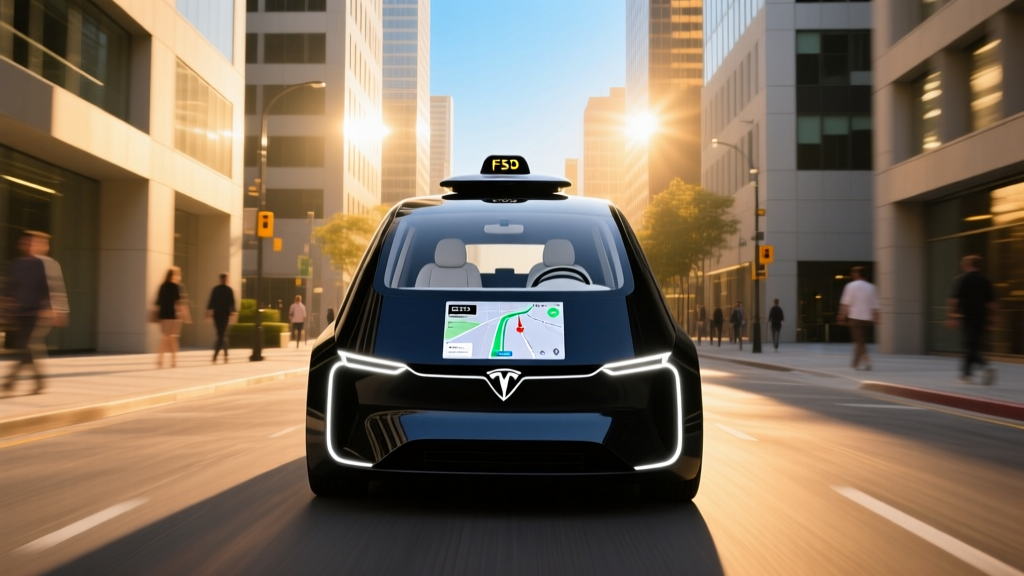
When Tesla buyers encounter the $8,000 "Full Self-Driving (Supervised)" option at checkout, the name implies a vehicle that handles all driving tasks. The reality is more nuanced. Tesla's FSD is an advanced Level 2 driver-assistance system that extends the brand's standard Autopilot with automated lane changes, traffic-light recognition, and navigation-guided steering on city streets — but it still requires the driver to remain fully attentive, hands near the wheel, and ready to intervene at any moment.
The "FSD meaning Tesla" question comes up constantly because the branding suggests autonomy that the software does not deliver. Understanding exactly what the system can and cannot do — and what you're actually paying for — is essential before adding it to your build.
Tesla FSD (Supervised) operates at SAE Level 2 under the SAE J3016 framework. The system controls steering and acceleration/braking simultaneously, but the human driver must continuously supervise, maintain situational awareness, and take over immediately when the system requests it or when conditions exceed its capabilities. This is the same automation level as GM Super Cruise, Ford BlueCruise, and Hyundai HDA2. True driverless operation (Level 4) exists only in geofenced robotaxi services like Waymo — not in any consumer vehicle you can purchase.
How Tesla FSD Works: Hardware and Software Architecture
Tesla's approach to driver assistance diverges sharply from competitors by relying almost exclusively on cameras and neural-network processing — a strategy the company calls "Tesla Vision." As of the 2026 model year, all new Tesla vehicles (Model 3, Model Y, Model S, Model X, and Cybertruck) ship with Hardware 4.0 (HW4), which includes:
- 8 external cameras providing 360-degree visibility (front main + narrow, left/right repeaters, left/right pillars, rear)
- HW4 processor with dual redundant SoCs capable of processing camera data at significantly higher resolution and frame rates than the legacy HW3 computer
- No ultrasonic sensors (USS) — Tesla removed these starting in late 2022, replacing proximity detection with vision-based "High Fidelity Park Assist"
- No radar — removed from all models beginning in 2021 (Model S/X briefly retained a high-resolution 4D radar in early HW4 builds, but camera-only remains the production standard)
FSD (Supervised) software runs on top of this hardware stack, using end-to-end neural networks that Tesla has progressively refined. The current FSD v13.x architecture processes raw camera feeds through transformer-based models that handle perception, prediction, and planning in a unified pipeline — replacing the older modular approach where separate networks handled lane detection, object recognition, and path planning independently.
FSD vs. Autopilot: Feature Breakdown
Tesla offers two tiers of driver assistance. Understanding what's included at each level prevents overpaying for features you may not need.
| Feature | Basic Autopilot (Standard) | Enhanced Autopilot ($6,000) | FSD Supervised ($8,000) |
|---|---|---|---|
| Traffic-Aware Cruise Control | ✓ | ✓ | ✓ |
| Autosteer (highway lane-keeping) | ✓ | ✓ | ✓ |
| Auto Lane Change | ✗ | ✓ | ✓ |
| Navigate on Autopilot (off-ramp guidance) | ✗ | ✓ | ✓ |
| Autopark (parallel/perpendicular) | ✗ | ✓ | ✓ |
| Smart Summon | ✗ | ✓ | ✓ |
| Traffic Light & Stop Sign Control | ✗ | ✗ | ✓ |
| Autosteer on City Streets | ✗ | ✗ | ✓ |
Basic Autopilot is included on every new Tesla at no extra cost. Enhanced Autopilot adds highway automation features that cover most daily commuting needs. FSD (Supervised) layers on city-street navigation and intersection handling — the features that most justify the name, though they remain the most variable in real-world performance.
Real-World Capabilities and Limitations
Tesla's FSD (Supervised) has improved substantially through 2025 and into 2026, particularly in smoothness of steering inputs and intersection navigation. On well-marked suburban arterials with clear lane paint and moderate traffic, the system handles turns, stoplights, and lane selection with growing competence. However, the gap between marketing impression and real-world behavior remains significant in several scenarios.
- Drive without supervision: You must keep your eyes on the road and hands detectable on the steering wheel. The cabin camera monitors attention and will issue escalating warnings before disengaging.
- Handle all weather conditions: Heavy rain, fog, snow, and direct sun glare can blind the camera system. FSD will disengage with minimal warning when visibility drops.
- Navigate construction zones reliably: Temporary lane shifts, missing lane markings, and cones frequently confuse the system. Expect to take over in any active work zone.
- Read temporary or conflicting signage: Handheld stop signs, faded lane markings, or contradictory signals (e.g., a green light with a temporary stop sign) can cause hesitation or incorrect behavior.
- Perform emergency maneuvers: FSD will not swerve around sudden obstacles, dodge debris, or make split-second evasive decisions at the level of an alert human driver.
- Operate on unmapped or severely degraded roads: Rural roads without lane markings, unpaved surfaces, or roads absent from Tesla's map database will trigger disengagement.
In highway use, FSD's Navigate on Autopilot feature handles on-ramp-to-off-ramp driving competently in moderate traffic, though lane-change timing can be conservative — the system sometimes hesitates at merge points where a human driver would proceed decisively. On city streets, the system manages four-way stops and protected left turns adequately, but unprotected left turns across oncoming traffic and complex multi-lane roundabouts remain scenarios where driver takeover is frequently necessary.
Cold-weather performance deserves specific mention: while cameras are less affected by cold than LiDAR or radar (which competitors use), ice or slush accumulation on camera lenses will degrade or disable FSD entirely. Tesla's camera heaters mitigate this partially, but in active freezing precipitation, expect reduced functionality.
FSD Pricing: Purchase, Subscription, and Transfer Options
Tesla has adjusted FSD pricing and packaging multiple times. As of 2026, the current structure is:
| Option | Cost | Details |
|---|---|---|
| FSD (Supervised) — One-Time Purchase | $8,000 | Perpetual license tied to the vehicle. Transfers with the car on resale. Tesla has occasionally offered purchase-to-subscription conversion promotions. |
| FSD (Supervised) — Monthly Subscription | $99/month | No long-term commitment; cancel anytime. Tied to your Tesla account, not the vehicle. Best for buyers uncertain about long-term value. |
| Enhanced Autopilot — One-Time | $6,000 | Highway-focused features without city-street Autosteer. No subscription option currently available. |
| Basic Autopilot | Included | TACC + Autosteer on divided highways. Standard on all new Teslas. |
Cost-per-month analysis: At $99/month, the subscription reaches parity with the $8,000 purchase after roughly 81 months (~6.7 years). If you plan to keep the vehicle longer than that and use FSD regularly, purchasing makes financial sense. If you expect to trade in within 3-4 years, the subscription is clearly cheaper — and you avoid the reality that FSD does not meaningfully increase resale value proportionally.
Tesla has periodically offered free FSD trials (typically 30 days) to new vehicle deliveries and has occasionally enabled FSD transfer from an old Tesla to a new one during promotional windows. These promotions are unpredictable and should not factor into your purchase decision.
Which Tesla Models Include FSD?
FSD (Supervised) is available as an add-on across Tesla's entire 2026 lineup:
- Model 3 (all trims: Rear-Wheel Drive, Long Range, Performance) — FSD available as $8,000 option or $99/mo subscription
- Model Y (Long Range, Performance, and the refreshed Juniper generation) — same availability
- Model S (Long Range, Plaid) — same availability
- Model X (Long Range, Plaid) — same availability
- Cybertruck (AWD, Cyberbeast) — FSD capability hardware included; software activation same pricing
No Tesla trim includes FSD as standard equipment in 2026. The software is always an additional purchase or subscription, regardless of vehicle price. This contrasts with some competitors who bundle advanced driver-assist features into higher trim levels.
How FSD Compares to Competing ADAS Systems
Tesla FSD does not exist in a vacuum. Several rival systems offer comparable or, in specific scenarios, superior driver assistance — often at lower cost or with less driver burden.
| System | Brand | SAE Level | Hands-Off? | Key Differentiator | Cost |
|---|---|---|---|---|---|
| FSD (Supervised) | Tesla | Level 2 | No | City-street navigation nationwide via cameras only | $8,000 / $99/mo |
| Super Cruise | GM (Cadillac, Chevrolet) | Level 2 | Yes (on mapped roads) | LiDAR-mapped highways (~750,000 mi); true hands-off with eye monitoring | $2,500 + $25/mo after trial |
| BlueCruise | Ford / Lincoln | Level 2 | Yes (on mapped roads) | Hands-free on ~130,000 mi of divided highways; camera-based driver monitoring | $2,100 or $75/mo |
| ProPILOT Assist 2.0 | Nissan | Level 2 | Yes (highway) | Hands-off highway cruising with nav-linked speed adjustment | Included on select trims |
| Driving Assistant Pro | BMW | Level 2 | Conditional (hands-off up to 85 mph on highway) | Highway hands-off with lane-change confirmation on select models | ~$1,700 package |
The critical distinction: GM Super Cruise and Ford BlueCruise offer hands-free operation on pre-mapped divided highways — something Tesla FSD does not permit. Tesla's advantage is geographic coverage: FSD (Supervised) operates on virtually any road in the US, while hands-free competitors are restricted to mapped highway corridors. If your primary use case is highway commuting, Super Cruise or BlueCruise may provide a more relaxed experience. If you want automation on local streets and unfamiliar roads, Tesla's broader coverage is the differentiator.
Safety Data and Regulatory Context
Tesla publishes quarterly safety reports claiming that vehicles driving with Autopilot engaged record fewer crashes per million miles than the US average. However, these statistics require context: Autopilot is predominantly used on divided highways (the safest driving environment), while the US average includes all road types, impaired drivers, and adverse conditions. Direct comparison is methodologically flawed.
The National Highway Traffic Safety Administration (NHTSA) has investigated multiple Tesla crashes involving Autopilot and FSD, particularly incidents where vehicles collided with stationary emergency vehicles. In 2023-2024, NHTSA's Office of Defects Investigation examined whether Tesla's driver-monitoring system adequately ensures driver engagement. Tesla responded with software updates increasing cabin-camera attention monitoring strictness.
The Insurance Institute for Highway Safety (IIHS) has consistently rated partial-automation systems — including Tesla Autopilot — as providing inadequate safeguards against driver inattention compared to systems with more robust monitoring requirements. IIHS research indicates that drivers using Level 2 systems frequently develop overreliance, engaging in secondary tasks that reduce their ability to respond when the system disengages.
No consumer ADAS system, including Tesla FSD, has received regulatory approval for unsupervised operation. The legal liability in any crash while using FSD rests entirely with the driver, not Tesla.
Frequently Asked Questions
Is Tesla FSD actually self-driving?
No. Tesla FSD (Supervised) is an SAE Level 2 driver-assistance system. The driver must remain fully engaged, monitor the road continuously, and be prepared to take control instantly. The "(Supervised)" designation Tesla now appends to the name reflects regulatory pressure to clarify this distinction. Only Level 4 robotaxi services like Waymo operate without a human driver — and those are not available for consumer purchase.
Can I use FSD on any road?
FSD (Supervised) is designed to operate on most US roads, including city streets, residential areas, and highways. However, it requires adequate lane markings, GPS signal, and map data. Performance degrades significantly on unpaved roads, in construction zones, and in adverse weather. The system will disengage if it encounters conditions beyond its capability.
Does FSD transfer if I sell my Tesla?
If you purchased FSD outright (the $8,000 one-time option), it is tied to the vehicle and transfers to the new owner upon sale. It does not transfer to your next Tesla. Subscription-based FSD is tied to your Tesla account and ends when you cancel — it does not attach to the vehicle.
Is the FSD subscription worth it over buying?
At $99/month versus $8,000 upfront, the subscription breaks even at approximately 6.7 years. If you plan to keep the car beyond that and use FSD regularly, purchasing is more economical. For shorter ownership periods or if you want flexibility to cancel, the subscription is the smarter financial choice. Tesla occasionally runs promotional pricing on subscriptions.
Does FSD improve my Tesla's safety rating?
FSD does not affect NHTSA star ratings or IIHS crash-test scores, which evaluate passive safety (crashworthiness) and basic active safety (automatic emergency braking). Advanced driver-assist features are evaluated separately by IIHS, and Tesla's driver-monitoring approach has drawn criticism for permissiveness compared to GM Super Cruise and Ford BlueCruise.
Will Tesla FSD ever become truly autonomous?
Tesla has predicted full autonomy "next year" since approximately 2016. As of 2026, FSD remains Level 2 with no announced timeline for Level 3 or Level 4 capability in consumer vehicles. Regulatory approval for unsupervised operation would require demonstrated safety performance far beyond current capabilities, and no jurisdiction has approved Tesla's vision-only approach for driverless use. Treat FSD as a sophisticated driver-assist tool — not as an investment in future autonomy.