Tesla's Cybertruck is one of the most sensor-stripped vehicles on the road — and simultaneously one of the most dependent on software to deliver its driver-assistance promises. Full Self-Driving (FSD) Supervised on the Cybertruck represents Tesla's purest vision-only approach: no radar, no ultrasonic sensors, just cameras and neural networks making split-second decisions for a 6,800-pound stainless-steel electric truck.
But what does FSD actually do in the Cybertruck today, in real-world conditions? And at what cost? This guide breaks down the hardware, the software behavior, the limitations every owner must understand, and how Tesla's system compares to competing ADAS platforms in 2026.
What FSD Supervised Actually Does in the Cybertruck
Tesla's Full Self-Driving (Supervised) is an advanced driver-assistance suite that layers on top of the standard Autopilot package. On the Cybertruck, FSD Supervised enables the following capabilities:
| Feature | What It Does | Driver Required? |
|---|---|---|
| Traffic-Aware Cruise Control | Maintains set speed, adjusts for vehicles ahead | Yes — hands on wheel |
| Autosteer | Keeps vehicle centered in marked lanes on highways | Yes — hands on wheel |
| Auto Lane Change | Initiates and executes lane changes on highways | Yes — must confirm |
| Navigate on Autopilot | Takes highway exits, interchanges based on nav route | Yes — must confirm |
| Autopark | Identifies and executes parallel/perpendicular parking | Yes — must monitor |
| Smart Summon | Drives to you in parking lots at low speed | Yes — phone-based supervision |
| Traffic Light & Stop Sign Control | Recognizes and responds to signals and signs | Yes — must confirm |
| City Streets (FSD) | Navigates urban intersections, turns, and roundabouts | Yes — full attention required |
The Cybertruck uses Tesla's Hardware 4 (HW4) suite, which includes a higher-resolution camera array compared to HW3 vehicles. Specifically, the Cybertruck is equipped with:
- 8 cameras providing 360-degree visibility (front-facing main + narrow, left/right repeaters, left/right pillars, rear)
- No radar — Tesla removed radar from all new vehicles starting in 2021, relying entirely on its Tesla Vision neural-network processing
- No ultrasonic sensors (USS) — removed in late 2022; proximity detection is now camera-based ("High Fidelity Park Assist")
- HW4 computer with improved inference chip, higher camera resolution (up to 5MP vs. 1.2MP on HW3), and a wider field of view on the front camera
This vision-only architecture is unique among major ADAS providers. Competing systems from Ford (BlueCruise), GM (Super Cruise), and Mercedes-Benz (Drive Pilot) all supplement cameras with radar, LiDAR, or both.
SAE Automation Level: Not Self-Driving, and Why That Matters
Tesla FSD (Supervised) is classified as an SAE Level 2 system per the SAE J3016 standard. This means:
- The system can control steering AND acceleration/braking simultaneously
- The driver must remain fully engaged, monitoring the road at all times
- The driver is legally responsible for all vehicle actions
- Hands must stay on the steering wheel (Tesla uses torque-based detection on the Cybertruck's yoke/steering wheel)
For comparison, Waymo's robotaxi service operates at SAE Level 4 — no driver present, geofenced areas only. No consumer vehicle sold in the US in 2026 is Level 4 or Level 5.
Tesla's use of "Full Self-Driving" in the product name has drawn regulatory scrutiny. The National Highway Traffic Safety Administration (NHTSA) has opened multiple investigations into Autopilot and FSD-related incidents. California's DMV has previously challenged Tesla's advertising language. The "(Supervised)" suffix Tesla now appends is a direct response to this pressure.
The practical implication for Cybertruck owners: you are the driver. FSD is a co-pilot, not a replacement. If the system makes an error — misreads a construction zone, fails to detect a stopped emergency vehicle, or misjudges a merging vehicle — you must intervene immediately.
Real-World Capabilities and Honest Limitations
In our experience and based on aggregated owner reports through early 2026, FSD on the Cybertruck performs well in specific scenarios and struggles in others. Here's an honest breakdown:
Where FSD Excels
- Divided highways with clear lane markings: Autosteer and Navigate on Autopilot are the system's strongest features. Lane centering is stable, speed management is smooth, and automatic lane changes are generally well-timed.
- Low-speed parking: Autopark on the Cybertruck has improved significantly with HW4's higher-resolution cameras, handling perpendicular and parallel spots competently in well-lit conditions.
- Stop-and-go traffic: Traffic-Aware Cruise Control handles congestion smoothly, reducing driver fatigue substantially.
Where FSD Struggles
- Rain, fog, and snow: Vision-only systems degrade significantly in poor visibility. Heavy rain on the front camera can cause Autosteer to disengage without warning. Tesla's camera heaters help with light frost but cannot compensate for heavy precipitation on lens surfaces.
- Faded or missing lane markings: Rural roads, construction zones, and freshly repaved roads without markings can confuse the system. It may center on the wrong reference or disengage.
- Complex urban intersections: City Streets FSD can handle simple signalized intersections but struggles with unprotected left turns across multiple lanes, roundabouts with irregular geometry, and temporary traffic control (flaggers, hand signals).
- Phantom braking: The Cybertruck's vision-only system has been reported to brake unexpectedly for shadows, overpasses, or roadside objects it misidentifies as obstacles. This is more dangerous at highway speeds.
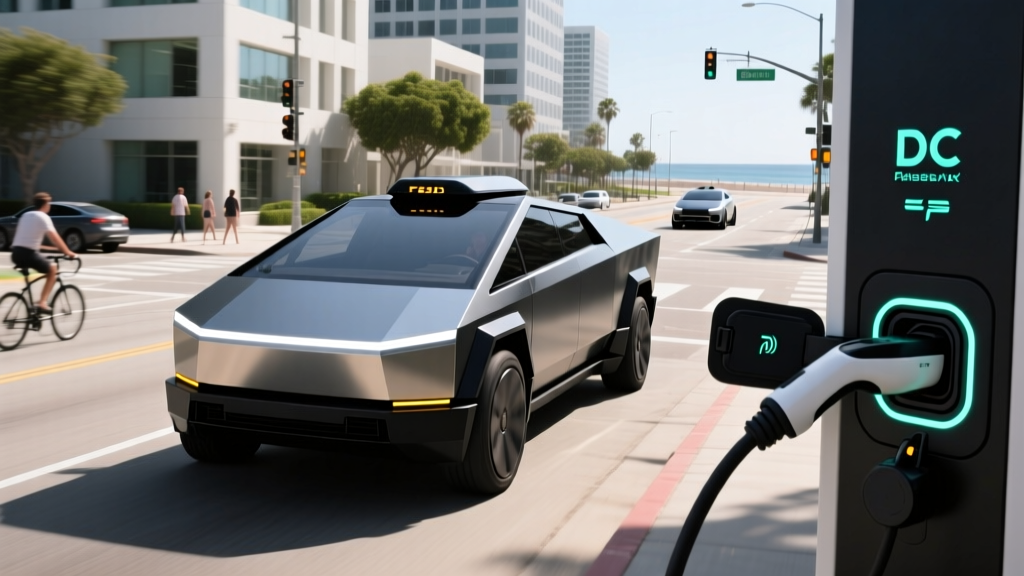
- Cybertruck-specific challenges: The truck's angular stainless-steel body creates unique reflection patterns that can confuse the system's perception in bright sunlight. The large hood and high beltline also mean the forward cameras sit higher than a sedan's, which changes perspective assumptions the neural network was partly trained on.
- Emergency vehicles: NHTSA has specifically investigated Tesla's response to stationary emergency vehicles with flashing lights. FSD has failed to slow or move over in several documented incidents.
Cold-Weather Impact on FSD
The Cybertruck's camera-based system is particularly vulnerable to winter conditions. Ice accumulation on camera housings — especially the front-facing and repeater cameras — can disable FSD entirely. While Tesla includes camera heaters, they are insufficient in active freezing rain or heavy wet snow. Owners in northern climates should expect FSD to be unavailable during winter storms and for 5–15 minutes after a cold start while camera heaters clear ice.
How Much Does FSD Cost on the Cybertruck?
Tesla has restructured FSD pricing several times. As of early 2026, Cybertruck buyers have two options:
| Option | Cost | Notes |
|---|---|---|
| FSD Monthly Subscription | $99/month | Cancel anytime; requires base Autopilot (included) |
| FSD One-Time Purchase | $8,000 | Transfers with vehicle; not transferable to a new Tesla you buy later |
| Base Autopilot | Included (standard) | Traffic-Aware Cruise + Autosteer; no FSD features |
Our recommendation: Unless you drive 20,000+ miles per year primarily on well-marked highways, the $99/month subscription is the smarter financial choice. It lets you evaluate FSD's value to your commute without an $8,000 commitment. You can also activate it for road trips and cancel during months you drive less.
Note: FSD is not transferable to a new vehicle if you trade in or sell your Cybertruck. The one-time purchase stays with the VIN. This significantly reduces the effective value of the $8,000 option if you plan to upgrade within 3–5 years.
Cybertruck Trim Availability and Hardware
All 2026 Tesla Cybertruck trims ship with the hardware required for FSD — the HW4 computer and full camera suite. However, FSD software is not activated by default:
| Trim | Base MSRP (est.) | Autopilot | FSD Available |
|---|---|---|---|
| Cybertruck Long Range AWD | ~$79,990 | Standard (included) | Add-on ($8,000 or $99/mo) |
| Cybertruck Dual Motor AWD | ~$74,990 | Standard (included) | Add-on ($8,000 or $99/mo) |
| Cybertruck (base RWD — announced) | ~$60,990 | Standard (included) | Add-on ($8,000 or $99/mo) |
Every Cybertruck leaves the factory capable of running FSD. The question is purely whether you pay to activate it. No trim bundles FSD as standard equipment.
FSD vs. Competing ADAS: How Cybertruck Stacks Up
| Feature | Tesla FSD (Cybertruck) | Ford BlueCruise | GM Super Cruise | Mercedes Drive Pilot |
|---|---|---|---|---|
| SAE Level | Level 2 | Level 2 | Level 2 | Level 3 (limited) |
| Sensors | Cameras only (8) | Cameras + radar | Cameras + radar + LiDAR | Cameras + radar + LiDAR |
| Hands-free driving | No (torque detection) | Yes (on approved roads) | Yes (on mapped highways) | Yes (under 40 mph, mapped) |
| Eyes-off capability | No | No (driver monitoring camera) | No (driver monitoring camera) | Yes (Level 3, limited conditions) |
| Road coverage | All roads (theoretically) | ~130,000 mi of divided highways | ~750,000 mi of mapped highways | Specific highways in NV/CA only |
| Cost | $99/mo or $8,000 | $2,100 (2-yr) then $750/yr | $2,200 (standard on trims); $25/mo after trial | $2,500/yr subscription |
| City street navigation | Yes (supervised) | No | No | No |
Key takeaway: Tesla FSD offers the broadest theoretical coverage — it attempts to work on any road, not just pre-mapped highways. But this ambition comes with more edge cases and less predictability. Ford BlueCruise and GM Super Cruise are more conservative: they only engage on mapped, divided highways, but within those boundaries, they are more reliable and — crucially — allow true hands-free driving (though not eyes-free). Mercedes' Drive Pilot is the only SAE Level 3 system available in the US, but its operational design domain is extremely narrow.
For a Cybertruck owner who frequently drives unmapped rural roads or city streets, FSD's broader coverage is an advantage. For someone who primarily commutes on Interstate highways, BlueCruise or Super Cruise may actually deliver a more consistent, lower-stress experience — though neither is available on the Cybertruck.
Safety Data and Regulatory Context
As of early 2026, NHTSA has collected data on Tesla Autopilot/FSD-involved crashes through its Standing General Order requiring automated-driving incident reporting. Key context from NHTSA's ADS reporting:
- Tesla vehicles represent a disproportionate share of reported Level 2 ADAS incidents, though Tesla also has the largest ADAS-equipped fleet and the most rigorous reporting compliance.
- A significant cluster of incidents involves rear-end collisions with stationary emergency vehicles — a known weakness of vision-only systems.
- Tesla's driver-monitoring approach (steering-wheel torque sensing) is less robust than the infrared eye-tracking cameras used by Ford, GM, and BMW. Torque sensing can be defeated with light pressure, allowing extended inattention.
The Insurance Institute for Highway Safety (IIHS) has consistently rated partial-automation systems as providing inadequate safeguards against driver disengagement. IIHS research shows that drivers using Level 2 systems are more likely to engage in secondary tasks (phone use, eating) compared to manual driving — creating a dangerous complacency loop.
Ownership Decision Framework
Choose FSD if:
- You commute 40+ miles daily on a mix of highways and surface streets
- You want the most advanced parking automation available for a vehicle this size
- You understand and accept that you must supervise the system 100% of the time
- You're willing to pay $99/month to evaluate before committing
Skip FSD (stick with base Autopilot) if:
- You primarily drive in heavy snow, rain, or fog
- Your commute is mostly unmapped rural roads with poor markings
- You want hands-free highway driving (consider that FSD does not allow this)
- You expect "self-driving" — no consumer system delivers this in 2026
Frequently Asked Questions
Is Tesla FSD on the Cybertruck actually self-driving?
No. FSD (Supervised) is an SAE Level 2 driver-assistance system. You must keep your hands on the steering wheel, monitor the road, and be prepared to take over at any moment. You are legally and practically the driver at all times. Only Level 4 services like Waymo operate without a human driver, and those are geofenced robotaxis, not consumer vehicles.
Can I use FSD in the rain with my Cybertruck?
FSD may work in light rain, but its performance degrades as water accumulates on camera lenses. In heavy rain, the system will likely issue a "Camera visibility reduced" warning and disengage Autosteer. Unlike radar-equipped competitors (BlueCruise, Super Cruise), Tesla's vision-only system has no sensor fallback when cameras are obscured. Plan to drive manually in significant precipitation.
Does FSD transfer if I sell my Cybertruck?
Yes, the one-time $8,000 FSD purchase stays with the vehicle's VIN. If you sell your Cybertruck, the new owner inherits FSD. However, FSD does not transfer to a new Tesla you purchase — you would need to repurchase or resubscribe for your next vehicle.
How does the Cybertruck's HW4 compare to older Tesla hardware?
HW4 (introduced 2023) features higher-resolution cameras (up to 5 megapixels vs. 1.2MP on HW3), a wider front camera field of view (~120° vs. ~50° narrow), and a more powerful inference chip. All Cybertrucks ship with HW4. This provides better object detection at distance and improved low-light performance compared to older Model 3/Y vehicles still running HW3.
What happens when FSD disengages unexpectedly?
The Cybertruck will issue an audible chime and visual alert on the touchscreen, then revert to base Autopilot (or no assistance, depending on the failure mode). You must immediately resume manual control. Repeated disengagement failures or ignoring warnings will result in an "Autopilot strike" — accumulate too many strikes within a period and Tesla will suspend your FSD access for one week.
Does the $7,500 federal EV tax credit cover FSD?
No. The IRS §30D Clean Vehicle Credit applies to the vehicle purchase price, not to software add-ons. FSD purchased separately (whether $8,000 one-time or $99/month) is not eligible for any federal tax credit. Additionally, the Cybertruck's MSRP may exceed the §30D truck cap of $80,000 on higher trims, and buyer income limits ($150K single / $300K joint for new vehicles) apply. Always consult a tax professional and verify current-year rules at irs.gov.