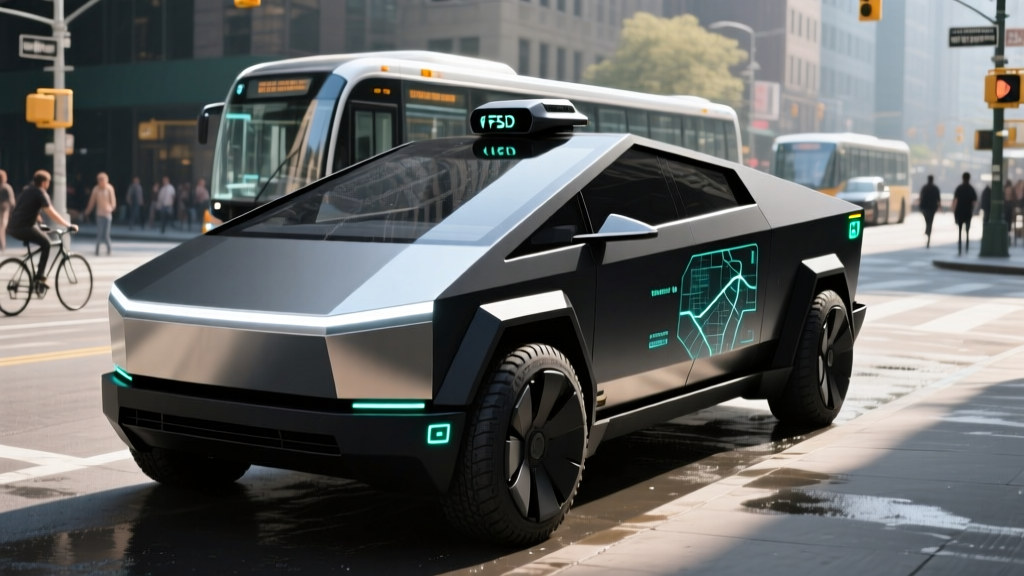
If you've been following Tesla's software updates, the arrival of FSD 14 on the Cybertruck represents the latest iteration of the company's vision-only driver-assistance stack — now adapted to the angular pickup's unique geometry, camera placement, and driving dynamics. But what does FSD 14 actually do when you're behind the wheel of a 6,800-pound stainless-steel truck? And more importantly, what does it not do?
This guide breaks down the technical architecture, real-world behavior, cost structure, and competitive positioning of FSD 14 as it runs on the 2025–2026 Tesla Cybertruck. No hype, no fear — just the data and driving experience you need to make an informed decision.
What FSD 14 Actually Does on the Cybertruck
Full Self-Driving (Supervised) version 14 is Tesla's most advanced consumer driver-assistance software. On the Cybertruck, it handles a broad set of driving tasks under active driver supervision:
- Navigate on Autopilot: Automatic lane changes, on/off-ramp navigation, and highway interchange routing.
- City Streets: Traffic-light and stop-sign recognition, intersection negotiation, unprotected left turns, and roundabout handling.
- Autopark: Parallel and perpendicular parking with minimal driver input.
- Smart Summon: Low-speed vehicle retrieval in parking lots (within line of sight).
- Lane-keeping and adaptive cruise: Continuous lateral and longitudinal control on highways and surface streets.
FSD 14 relies on Tesla's end-to-end neural network architecture, which processes inputs from the Cybertruck's camera suite to make driving decisions in a manner that more closely mimics human pattern recognition than earlier rule-based systems. The Cybertruck's HW4 computer provides the on-board processing power, running inference at significantly higher throughput than the legacy HW3 hardware.
Tesla FSD (Supervised) is classified as SAE Level 2 — a driver-assistance system. The driver must remain fully engaged, keep hands on the steering wheel (or maintain steering-torque input as monitored by the Cybertruck's column sensor), and be prepared to take over at any moment. This is not autonomous or self-driving. Only Level 4 services like Waymo One operate without a human driver in defined geofenced areas.
Cybertruck Sensor Suite and Technical Architecture
Unlike many competitors that supplement cameras with radar or lidar, the Cybertruck with HW4 runs a Tesla Vision (camera-only) architecture. Here's what's on board:
| Sensor | Count | Placement | Function |
|---|---|---|---|
| Front-facing main camera | 1 | Windshield top-center | Primary forward perception, lane/traffic/object detection |
| Front narrow camera | 1 | Windshield top-center | Long-range object and lane detection at highway speeds |
| Front-side cameras | 2 | Front fender repeaters | Cross-traffic, merge detection, blind-spot awareness |
| Rear-side cameras | 2 | C-pillar / rear quarter | Rear cross-traffic, lane-change monitoring |
| Rear-view camera | 1 | Tailgate area | Reverse, parking, following-traffic awareness |
| Cabin camera | 1 | Above rearview mirror | Driver-attention monitoring |
The Cybertruck's angular design places cameras at different heights and angles than the Model Y or Model 3, which required Tesla to retrain portions of the FSD neural network for this platform. The higher ride height and flat front fascia alter the camera's perspective on road geometry, curb detection, and low-object recognition.
Notably absent: ultrasonic sensors (removed from all new Teslas since late 2022) and radar. Tesla replaced ultrasonic proximity detection with "Tesla Vision" occupancy-network estimates, which work well in most scenarios but can occasionally exhibit less precision in tight parking situations compared to physical proximity sensors.
Real-World Performance: What Works and What Doesn't
Based on extensive real-world driving with FSD 14 on the Cybertruck across highway, suburban, and urban environments, here's an honest assessment:
Where FSD 14 Excels
- Highway driving: Smooth lane-keeping, confident merges, and reliable adaptive cruise behavior. The Cybertruck's mass and air suspension provide a stable platform, and FSD leverages this well at 65–80 mph.
- Well-marked suburban streets: Clear lane markings, predictable intersections, and moderate traffic density play to the system's strengths.
- Traffic-light and stop-sign compliance: FSD 14 reliably identifies and responds to traffic controls in most conditions.
- Long-distance fatigue reduction: On 200+ mile road trips, FSD significantly reduces cognitive load — though you must remain attentive.
Where FSD 14 Struggles
- Heavy rain, fog, or snow: Camera-only systems degrade significantly in low-visibility conditions. FSD 14 may disengage or issue takeover requests.
- Construction zones: Temporary lane markings, cones, and altered road geometry remain challenging. Expect frequent disengagements.
- Faded or conflicting lane markings: Old highway repaving with visible ghost lines can confuse the system.
- Unprotected left turns in heavy traffic: The system can be overly conservative or, in rare cases, misjudge gap timing.
- Narrow streets with parked cars: The Cybertruck's 80.2-inch width (excluding mirrors) combined with FSD's lateral positioning can result in tight clearance margins.
- Sun glare directly into cameras: Low-angle sun at dawn/dusk can temporarily impair forward camera perception.
- Unusual road users: Horse-drawn carriages, oversized loads, or irregularly shaped obstacles may not be classified correctly.
The Cybertruck's width is a practical consideration that amplifies FSD limitations in urban settings. At over 6.5 feet wide without mirrors, the truck already demands more spatial awareness in tight lanes — and when FSD's lateral positioning isn't perfectly centered, the margin for error shrinks.
Cost Breakdown: Purchase vs. Subscription
Tesla offers FSD in two payment structures for the Cybertruck. Pricing is current as of early 2026 and subject to change:
| Option | Cost | Transferable? | Notes |
|---|---|---|---|
| One-time purchase | $8,000 | Yes (to another Tesla in your account, per current policy) | Permanent; includes future FSD updates on the same vehicle |
| Monthly subscription | $99/month | No (tied to driver account/vehicle) | Cancel anytime; no long-term commitment |
Basic Autopilot — which includes Traffic-Aware Cruise Control and Autosteer (lane-keeping on highways) — comes standard on every Cybertruck at no additional cost. FSD (Supervised) is the optional upgrade layer that adds city-street capability, Navigate on Autopilot, Autopark, and Smart Summon.
For buyers who primarily drive on highways and don't need city-street automation, the standard Autopilot is already quite capable. The $8,000 FSD purchase or $99/month subscription is most justifiable for daily commuters in moderate-to-heavy urban traffic who want the system's full feature set.
Important: FSD does not currently qualify as an eligible expense under the federal §30D EV tax credit. The credit applies to the base vehicle MSRP (subject to IRS income and MSRP caps), and the Cybertruck's $79,990+ starting price for the AWD trim places it at or near the $80,000 MSRP cap for trucks under current rules.
How FSD 14 Compares to Competing ADAS Systems
The Cybertruck competes against several pickups and large SUVs with advanced driver-assistance suites. Here's how FSD 14 stacks up against the top alternatives:
| Feature | Tesla FSD 14 (Cybertruck) | GM Super Cruise (Silverado EV) | Ford BlueCruise (F-150 Lightning) | Toyota Safety Sense 3.0 (Tundra i-FORCE MAX) |
|---|---|---|---|---|
| SAE Level | Level 2 | Level 2 | Level 2 | Level 2 |
| Hands-free on mapped highways | No (torque monitoring required) | Yes (on 750,000+ mi of mapped roads) | Yes (on 130,000+ mi of divided highways) | No |
| City-street automation | Yes (supervised) | No | No | No |
| Automatic lane changes | Yes | Yes (on mapped roads) | Yes (with confirmation) | No |
| Sensor suite | Cameras only | Cameras + LiDAR + radar | Cameras + radar | Cameras + radar |
| Driver monitoring | Cabin camera + steering torque | Infrared eye-tracking camera | Infrared driver-facing camera | Steering-torque detection |
| Cost | $8,000 or $99/mo | $2,200 (one-time) or included on high trims | $2,100 (3-year) or included on Lariat+ | Standard (included) |
| Weather resilience | Moderate (camera-only limits) | High (LiDAR + radar redundancy) | Good (radar supplements cameras) | Good |
Key takeaway: FSD 14 offers the broadest feature set — it's the only system attempting city-street automation at the consumer Level 2 tier. However, Super Cruise and BlueCruise offer genuine hands-free driving on pre-mapped highways (a meaningful comfort advantage on road trips) and use radar or LiDAR for sensor redundancy that Tesla's camera-only approach lacks. If your primary use case is long highway commutes, Super Cruise on the Silverado EV is arguably the more polished experience. If you want the most ambitious system with the widest coverage area, FSD 14 leads — with the caveat that its coverage comes with more edge-case variability.
Cybertruck-Specific FSD Considerations
Driving FSD 14 in the Cybertruck presents unique dynamics compared to the same software in a Model Y or Model 3:
- Vehicle mass: At approximately 6,600–6,800 lbs depending on trim, the Cybertruck has more inertia. FSD's braking and acceleration decisions must account for this, and you'll notice the system begins deceleration slightly earlier than in lighter Tesla vehicles.
- Steer-by-wire: The Cybertruck uses a 48V steer-by-wire system with no mechanical connection between the yoke and the wheels. This gives FSD extremely precise lateral control inputs, but it also means the system's steering-torque monitoring works differently than in column-torque-based Teslas. The driver-attention system relies more heavily on the cabin camera.
- Air suspension variability: Ride-height changes (the Cybertruck offers up to 16 inches of ground clearance in Extract Mode) alter camera angles. FSD 14 accounts for this, but transitions between ride heights while the system is active can momentarily affect perception accuracy.
- Cyberbeast performance: The tri-motor Cyberbeast's 845 hp and 2.6-second 0–60 mph time mean FSD must manage aggressive acceleration capability. The system generally modulates this well, but sport-mode acceleration settings can make the experience feel abrupt in city-street scenarios.
Safety Context and Driver Responsibility
Tesla's own documentation, NHTSA guidance, and independent testing organizations are clear: FSD (Supervised) requires continuous driver attention. The "Supervised" label in the product name is intentional and legally significant.
Per NHTSA's framework for automated vehicle safety, Level 2 systems place full responsibility for driving outcomes on the human operator. If FSD 14 makes an error — misreads a signal, fails to detect a pedestrian, or misjudges a merge gap — the driver is liable.
Tesla's driver-monitoring approach on the Cybertruck includes:
- Cabin camera tracking of eye direction and head position
- Steering-wheel torque input detection (via steer-by-wire system)
- Audible and visual alerts if inattention is detected, escalating to system disengagement if ignored
According to IIHS research on driver-assistance systems, overreliance on Level 2 features — treating them as self-driving — is a documented safety risk. The most dangerous scenario is a driver who has become accustomed to FSD handling 95% of driving tasks and is unprepared for the 5% edge case that requires immediate human intervention.
Decision Framework: Should You Add FSD 14 to Your Cybertruck?
Choose FSD 14 (purchase or subscription) if:
- You commute daily in mixed urban/suburban traffic and want the broadest available driver-assist feature set
- You're comfortable maintaining active supervision and understand this is not autonomous driving
- You value continuous software improvements and want access to Tesla's most capable ADAS as it evolves
- You plan to keep the Cybertruck 4+ years (making the $8,000 purchase more cost-effective than long-term subscription)
Stick with standard Autopilot if:
- Your driving is predominantly highway-based, where basic Autosteer + TACC already performs well
- You frequently drive in heavy rain, snow, or fog where camera-only systems struggle
- You prefer hands-free highway driving — in that case, consider the Silverado EV with Super Cruise instead
- You're uncomfortable with the supervision burden and want a simpler driving experience
Frequently Asked Questions
Is Tesla FSD 14 on the Cybertruck actually self-driving?
No. FSD 14 is SAE Level 2 — an advanced driver-assistance system. The driver must remain fully engaged, monitor the road continuously, and be prepared to take over instantly. Only Level 4 services like Waymo One operate without a human driver, and those are limited to geofenced urban areas in specific cities.
How much does FSD cost on the Cybertruck?
As of 2026, FSD (Supervised) costs $8,000 as a one-time purchase or $99/month as a subscription. Basic Autopilot (highway cruise + lane-keeping) is included standard on all Cybertruck trims at no extra cost.
Does FSD 14 work better on the Cybertruck than on other Teslas?
Not necessarily better, but differently. The Cybertruck's steer-by-wire system allows very precise lateral control, and the higher ride position gives cameras a better vantage point. However, the vehicle's width, mass, and unique geometry introduce their own edge cases. The core neural network is the same across the Tesla fleet, but the Cybertruck's specific calibration has been refined through OTA updates since its late-2023 launch.
Can I use FSD 14 in bad weather?
FSD 14 can function in light rain, but heavy rain, fog, snow, or conditions that obscure the cameras will cause the system to degrade or disengage. Tesla Vision's camera-only approach is more susceptible to weather limitations than radar- or LiDAR-equipped competitors like Super Cruise or BlueCruise. Always be prepared to take full manual control in adverse conditions.
Will FSD eventually become fully autonomous?
Tesla has stated this goal for years, but as of 2026, FSD remains a Level 2 supervised system with no announced timeline for Level 3 or Level 4 certification. Regulatory approval for higher automation levels requires extensive safety validation, and no consumer vehicle sold in the U.S. currently offers Level 3 or above for general use. Treat FSD as the most capable Level 2 system available — not as a pathway to imminent autonomy.
Which Cybertruck trims include FSD?
FSD (Supervised) is available as an add-on for all Cybertruck trims: AWD ($79,990), All-Wheel Drive ($99,990), and Cyberbeast ($119,990). It is not included standard on any trim — you must purchase or subscribe separately. All trims include Basic Autopilot as standard equipment.