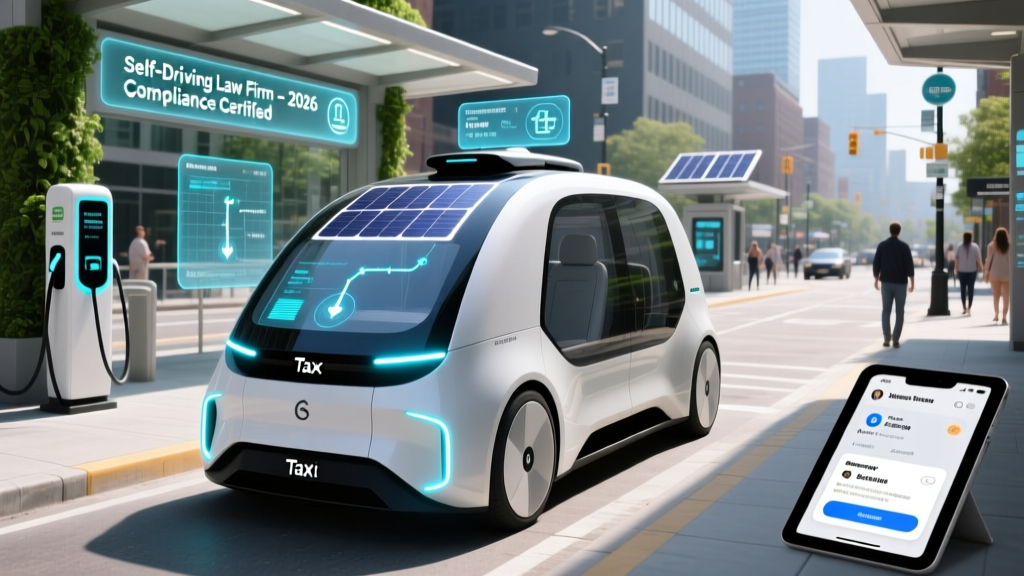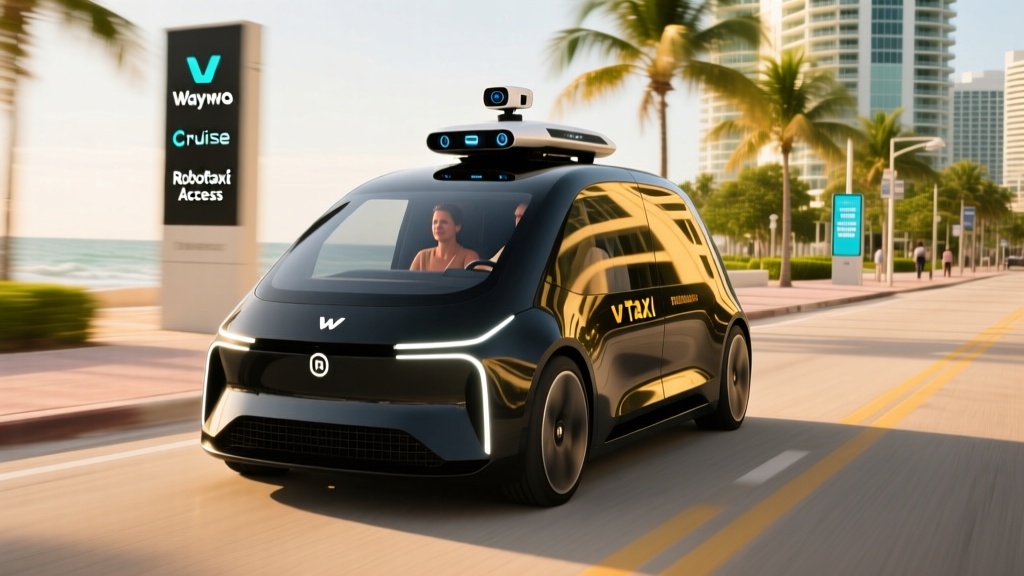
If you've searched for Fort Lauderdale self-driving taxis, you've likely encountered a confusing mix of headlines about robotaxis expanding to Florida and marketing videos of driverless cars cruising Miami Beach. The reality on the ground in Broward County is more nuanced. As of early 2026, fully driverless commercial robotaxi service is not yet available to the general public within Fort Lauderdale proper, though South Florida has become an active testing and limited-launch corridor for several autonomous vehicle (AV) operators.
This guide breaks down exactly which services operate near Fort Lauderdale, what autonomy level they actually achieve, how pricing compares to Uber and Lyft, what the safety data shows, and when you might realistically hail a driverless ride in Broward County.
Where Can You Actually Use a Robotaxi Near Fort Lauderdale?
Florida is one of the most permissive states for autonomous vehicle testing and deployment, thanks to legislation like SB 1020 and earlier frameworks that allow driverless testing and commercial operation without a human safety operator behind the wheel. However, commercial robotaxi availability is concentrated in specific metro areas — and Fort Lauderdale is currently on the periphery, not the center, of live service zones.
| Operator | Live Commercial Service | Testing / Limited Access | Notes |
|---|---|---|---|
| Waymo (Alphabet) | Phoenix, AZ; San Francisco, CA; Los Angeles, CA; Austin, TX (expanding) | Miami-Dade testing corridor | No paid Fort Lauderdale service yet; Miami testing since late 2024 |
| Cruise (GM) | Limited restart in Phoenix & Dallas (safety operator present) | None in FL currently | Operations scaled back significantly after 2023 San Francisco incident |
| Zoox (Amazon) | Limited Las Vegas & Foster City, CA service | Miami area mapping/testing | Purpose-built vehicle; no Fort Lauderdale presence |
| Motional (Hyundai/Aptiv) | Las Vegas (via Lyft) — limited | Previously tested in South FL | Paused expansion after restructuring in 2024–2025 |
| Waymo via Uber | Austin, TX (pilot) | — | Uber integration expanding slowly |
Bottom line: If you're standing on Las Olas Boulevard or at Fort Lauderdale-Hollywood International Airport (FLL) right now, you cannot open an app and summon a fully driverless robotaxi. The closest active robotaxi testing is happening in Miami-Dade County, roughly 30 miles south. Waymo has been conducting mapping and validation drives in the Miami area, which is typically a precursor to commercial launch — but a Fort Lauderdale or broader Broward County launch has not been announced with a firm date.
SAE Automation Levels: Why This Distinction Matters
Much of the confusion around "self-driving taxis" stems from conflating different levels of vehicle automation. The SAE International J3016 standard defines six levels, and the gap between what you can buy for your driveway and what a robotaxi company deploys is enormous.
| Level | Name | Who Drives? | Examples |
|---|---|---|---|
| 0 | No Automation | Human does everything | Basic cruise control, warnings only |
| 1 | Driver Assistance | Human, with one assist function | Adaptive cruise OR lane-keeping (not both simultaneously) |
| 2 | Partial Automation | Human must supervise at all times | Tesla Autopilot/FSD (Supervised), GM Super Cruise, Ford BlueCruise |
| 3 | Conditional Automation | System drives in limited conditions; human must take over on request | Mercedes DRIVE PILOT (limited markets, ≤40 mph, good weather) |
| 4 | High Automation | System drives without human in defined operational domain (geofenced) | Waymo One, Zoox — no steering wheel or driver needed in zone |
| 5 | Full Automation | System drives everywhere, all conditions | Does not exist commercially |
Critical distinction: Tesla's Full Self-Driving (Supervised) is a Level 2 system. The driver must remain attentive, hands on or near the wheel, and is legally responsible for the vehicle at all times. Waymo's robotaxis operating in Phoenix and San Francisco are Level 4 — there is no driver, no steering wheel, and the company bears operational responsibility within its geofenced service area. These are fundamentally different categories, and no amount of marketing should blur that line.
How Robotaxi Services Work: Hailing, Riding, and Pricing
For markets where Level 4 robotaxis are commercially live (Phoenix, San Francisco, Los Angeles, Austin), the user experience has converged on a consistent model:
- Download the operator's app (Waymo One, for example) or access through a partner like Uber where integrated.
- Enter your destination within the geofenced service area — the app will confirm whether your pickup and drop-off are within the operational zone.
- Wait for the vehicle. A Jaguar I-PACE (Waymo's current fleet vehicle) or purpose-built AV arrives. There is no driver inside.
- Unlock via app. You confirm your identity, the doors unlock, and you begin the ride. Screens inside display the route and allow you to adjust climate or music.
- Pay automatically. The ride is charged to your linked payment method upon completion.
| Service | Typical 5-Mile Ride | Typical 10-Mile Ride | Surge Pricing? | Notes |
|---|---|---|---|---|
| Waymo One | $10–$16 | $18–$28 | No (fixed algorithmic pricing) | Often competitive with UberX; promotional pricing in new markets |
| UberX (human driver) | $9–$18 | $16–$32 | Yes (surge during peak) | Varies heavily by time, demand, market |
| Lyft (human driver) | $8–$17 | $15–$30 | Yes (prime time) | Similar variability |
| Waymo via Uber | $11–$17 | $19–$29 | Minimal | Integrated into Uber app where available |
Robotaxi operators have generally priced rides to be competitive with UberX and Lyft, not dramatically cheaper. The long-term economic thesis is that removing the driver cuts the largest cost component — but current fleets are expensive to operate (sensor suites, remote monitoring staff, limited fleet density), so operators aren't yet passing massive savings to riders. Expect pricing in Fort Lauderdale, when it arrives, to land in a similar range: roughly comparable to a standard rideshare, with introductory discounts to drive adoption.
Safety Data: What the Numbers Actually Show
Safety is the single most scrutinized aspect of robotaxi operations, and for good reason. The data is mixed but increasingly detailed, thanks to mandatory reporting requirements in states like California.
Waymo safety data (through 2025):
- Over 10 million fully driverless miles completed across Phoenix, San Francisco, and Los Angeles combined (per Waymo's published safety reports).
- A Waymo-commissioned study (peer-reviewed, published in 2024) found that Waymo vehicles were involved in ~85% fewer injury-causing crashes per million miles compared to human-driven benchmarks in the same geographies.
- California DMV disengagement reports show Waymo vehicles required fewer than 0.1 human interventions per 1,000 miles in recent reporting periods — though disengagement metrics are imperfect and context-dependent.
Cruise safety context:
- In October 2023, a Cruise robotaxi in San Francisco struck and dragged a pedestrian who had been thrown into its path by a human-driven vehicle. The incident led to Cruise's California permit suspension, a nationwide operational pause, executive departures, and a significant restructuring.
- Cruise has since restarted limited operations in select cities with human safety operators present, a de facto step back from Level 4 to a supervised model while rebuilding regulatory trust.
- The National Highway Traffic Safety Administration (NHTSA) has opened and closed several investigations into both Waymo and Cruise incidents. NHTSA's Standing General Order requires AV operators to report crashes involving ADS-equipped vehicles.
The honest assessment: Robotaxis in geofenced, well-mapped urban environments appear to have a lower crash rate per mile than the average human driver in those same environments. However, they are not immune to edge-case failures — and the severity of some failures (the Cruise dragging incident, several Waymo minor collisions with construction-zone obstacles) shows that "fewer crashes" does not mean "zero risk." For Fort Lauderdale specifically, there is no local robotaxi safety record to evaluate, as no commercial service has operated there.
Technology Stack: How Robotaxis Actually See the Road
Understanding the hardware and software inside a robotaxi helps explain both its capabilities and its limitations — especially in a place like South Florida, where heavy rain and complex intersections are everyday challenges.
Sensor Suites (Typical Level 4 Robotaxi)
- LiDAR (Light Detection and Ranging): Multiple roof- and body-mounted LiDAR units create a real-time 3D point cloud of the vehicle's surroundings, accurate to centimeters, in daylight or darkness. Waymo's 6th-generation system uses custom-built LiDAR with improved range and resolution. This is the primary sensor for object detection and spatial awareness.
- Cameras: A network of high-resolution cameras (often 20+) provides color imagery for lane-marking detection, traffic-light state recognition, sign reading, and classification of objects (pedestrian vs. cyclist vs. cone). Camera-only approaches (Tesla's FSD) lack the depth-perception redundancy that LiDAR provides.
- Radar: Millimeter-wave radar units complement LiDAR for velocity detection of moving objects and perform more reliably in heavy precipitation, though at lower spatial resolution.
- IMU/GPS/HD Maps: Inertial measurement units, high-precision GPS, and pre-built high-definition maps give the vehicle centimeter-level localization — it knows exactly where it is on the road, not just what's around it.
Software & Decision-Making
The perception stack fuses data from all sensors into a unified world model. The prediction stack forecasts what other road users will do (will that pedestrian step off the curb?). The planning stack generates a safe, comfortable trajectory. All of this runs on custom compute hardware (often NVIDIA-based) processing terabytes of sensor data per hour.
Geofencing
Level 4 robotaxis operate within a pre-mapped, geofenced Operational Design Domain (ODD). If the vehicle approaches the boundary of its approved zone, it will not proceed — it will pull over or reroute. This is not a limitation that's going away soon; expanding the ODD requires extensive mapping, validation, and regulatory approval for each new area.
Florida's Regulatory Landscape for Autonomous Vehicles
Florida has positioned itself as one of the most AV-friendly states in the U.S., which is why multiple operators have chosen South Florida for testing. Key regulatory facts:
- Florida Statute §316.86 and related legislation permit the operation of autonomous vehicles on public roads, including without a human driver present, provided the vehicle meets federal motor vehicle safety standards and the operator maintains minimum insurance coverage ($1 million+ for bodily injury/property damage).
- No special state-level permit is required for testing (unlike California's DMV permit system), though operators must coordinate with local municipalities and law enforcement.
- Federal oversight remains limited. NHTSA regulates vehicle safety standards and investigates crashes but does not "approve" robotaxi services — that authority largely falls to states and cities. The U.S. Department of Transportation has issued voluntary guidance frameworks but no binding federal AV deployment rules as of early 2026.
- Local authority: Cities like Fort Lauderdale, Miami, and Tampa can influence AV operations through traffic-management agreements, curb-access rules, and geofencing requests. A robotaxi operator wanting to serve FLL airport, Port Everglades, or the Las Olas entertainment district would need to coordinate with Broward County and city officials.
This regulatory environment means that when an operator like Waymo decides South Florida is ready for commercial launch, the legal pathway is relatively clear compared to states like California or New York. The bottleneck is operational readiness — mapping, validation, fleet deployment, and local partnership — not legislation.
Current Limitations: Why Fort Lauderdale Isn't Live Yet
The gap between a robotaxi working in Phoenix and one working in Fort Lauderdale comes down to several hard constraints:
- Weather: South Florida's frequent heavy rain, tropical storms, and occasional flooding degrade LiDAR and camera performance. Waymo's Phoenix service benefits from ~300 sunny days per year. Fort Lauderdale averages roughly 60 inches of rain annually and experiences sudden downpours that reduce sensor range and road-marking visibility. Operators must validate that their systems handle these conditions safely before launching.
- Mapping complexity: Fort Lauderdale's road network includes complex multi-lane intersections (especially along Federal Highway/U.S. 1 and Broward Boulevard), frequent construction zones, beachfront corridors with heavy pedestrian activity, and the I-95/I-595 interchange — all of which require detailed HD mapping and validation drives before a geofence can be drawn.
- Edge cases: Beach-area tourists crossing mid-block, golf carts in some suburban areas, marine-bridge openings on the Intracoastal Waterway, and hurricane-evacuation traffic patterns all represent scenarios that must be accounted for in the AV's decision-making logic.
- Fleet economics: Each Waymo-generation robotaxi is estimated to cost $150,000–$200,000+ in sensor and compute hardware alone. Deploying a fleet dense enough to provide reasonable wait times across Fort Lauderdale, Hollywood, Davie, and surrounding communities requires a major capital commitment that operators are currently prioritizing for markets already generating revenue.
- No-go scenarios: Even in live markets, robotaxis will not operate during severe weather (hurricane conditions, flooded roads), will avoid unmapped private roads or parking garages, and cannot handle scenarios requiring human judgment calls (directed detours by police, off-road recovery). A Fort Lauderdale deployment would likely exclude the beach strip initially and avoid areas with heavy marine-event traffic.
When Might Fort Lauderdale Get Robotaxi Service?
Based on current operator trajectories, here's a realistic assessment:
- Waymo is the most likely first mover in South Florida. Miami-Dade testing has been underway, and Waymo's expansion pattern (Phoenix → SF → LA → Austin → next tier) suggests a Miami/Fort Lauderdale combined market is a strong candidate for a 2026–2027 commercial launch, though no date has been confirmed.
- Zoox is mapping in the Miami area but has been slower to scale commercial service nationally. A Fort Lauderdale presence is plausible but likely further out (2027+).
- Cruise is in rebuilding mode after its 2023 crisis and is unlikely to be a first mover in a new Florida market.
- Tesla's planned "Robotaxi" (Cybercab) has been announced but is not in commercial operation anywhere. Tesla's approach relies on a camera-only sensor suite without LiDAR, which is unproven for unsupervised Level 4 deployment and faces significant regulatory scrutiny. Treat any Tesla robotaxi timeline with extreme skepticism until verified by independent regulators and real-world deployment data.
Frequently Asked Questions
Where can I use a self-driving taxi right now in 2026?
Fully driverless (Level 4) commercial robotaxi rides are currently available through Waymo One in Phoenix, San Francisco, Los Angeles, and Austin. Zoox operates a limited service in Las Vegas and Foster City, California. There is no commercial robotaxi service available in Fort Lauderdale or anywhere in Broward County as of early 2026. The closest activity is Waymo's testing in Miami-Dade County.
How much does a robotaxi ride cost compared to Uber or Lyft?
In live markets, Waymo One pricing is generally comparable to UberX — typically $10–$16 for a 5-mile ride and $18–$28 for a 10-mile ride. Robotaxis do not use surge pricing, which can make them cheaper during peak demand. However, they are not dramatically cheaper than human-driven rideshares; the cost advantage of removing the driver has not yet been fully passed to consumers due to high fleet and operational costs.
Are robotaxis actually safe? What does the data show?
Waymo's published and peer-reviewed safety data indicates its driverless vehicles are involved in approximately 85% fewer injury-causing crashes per million miles compared to human drivers in the same cities. Waymo has completed over 10 million fully driverless miles. However, incidents do occur — including minor collisions and edge-case failures — and Cruise's 2023 pedestrian-dragging incident in San Francisco demonstrated that serious failures are possible. The NHTSA monitors AV safety through its Standing General Order crash-reporting requirement. "Safer than average" does not mean "risk-free."
What are the current limitations of robotaxi service?
Robotaxis are geofenced to pre-mapped areas and will not drive outside their operational zone. They may suspend service during heavy rain, flooding, or severe weather — a significant concern for South Florida. They cannot navigate unmapped areas like parking garages or private roads, may struggle with construction zones, and cannot respond to human-directed detours (e.g., a police officer waving traffic off-route). Wait times depend on fleet density, which is still limited in most markets.
Is Tesla's FSD the same as a robotaxi?
No. Tesla's Full Self-Driving (Supervised) is an SAE Level 2 driver-assistance system that requires the driver to remain fully attentive and legally responsible for the vehicle at all times. A Level 4 robotaxi like Waymo's has no driver, no steering wheel, and the company operates the vehicle autonomously within its geofenced zone. Tesla has announced a future "Cybercab" robotaxi concept, but it is not in commercial operation anywhere, and its camera-only approach to Level 4 autonomy remains unproven and unapproved by regulators.
Is Fort Lauderdale likely to get robotaxi service soon?
South Florida is a high-priority expansion market for Waymo, which has been testing in Miami-Dade. A combined Miami–Fort Lauderdale commercial launch is plausible within the 2026–2027 timeframe, but no firm date or service-area boundary has been announced. Florida's permissive AV regulatory environment removes legal barriers; the timeline depends on operational readiness — mapping, weather validation, fleet deployment, and local coordination.