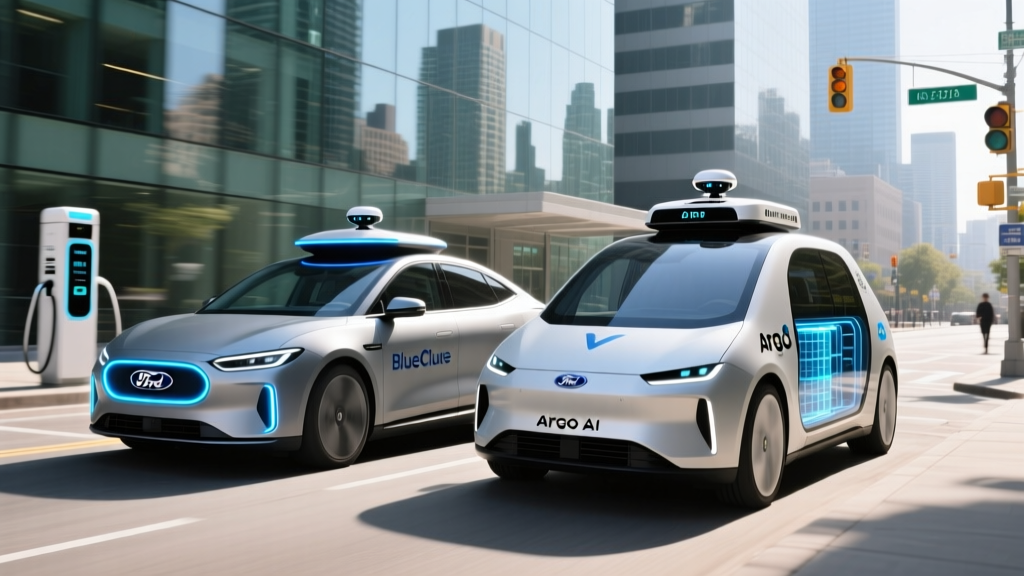
Ford's relationship with autonomous driving has been one of the most turbulent in the auto industry. The company once promised a fully driverless robotaxi fleet by 2021, invested over $1 billion in Pittsburgh-based Argo AI, then abruptly shut the program down in late 2022. Today, Ford's self-driving ambitions are channeled through BlueCruise, its Level 2 hands-free driver-assistance system — a fundamentally different proposition from the Level 4 robotaxis that companies like Waymo now operate. If you're searching for Ford self-driving cars, understanding exactly what Ford offers today, what it abandoned, and what's realistically coming next is essential before you buy or expect a driverless ride.
What Ford Self-Driving Cars Actually Offer in 2026: BlueCruise Explained
Ford's current production autonomy product is BlueCruise, a hands-free highway driving system available on select Ford and Lincoln models. As of the 2026 model year, BlueCruise is offered on vehicles including the Ford F-150 Lightning, Mustang Mach-E, Explorer, and Lincoln Navigator. The latest iteration (BlueCruise 1.4 and newer) enables hands-free driving on over 130,000 miles of pre-mapped, divided highways across the United States and Canada.
BlueCruise is a Level 2 system under the SAE J3016 framework. This means the vehicle can simultaneously manage steering and acceleration/braking under certain conditions, but the driver must remain attentive and ready to take over at any moment. A driver-facing infrared camera monitors your eyes and head position; if you look away from the road for too long, the system issues escalating alerts and will eventually bring the vehicle to a controlled stop. This is not self-driving. It is driver-assist.
| Level | Name | Who Drives? | Example |
|---|---|---|---|
| 0 | No Automation | Human | Standard car, no assist |
| 1 | Driver Assistance | Human | Adaptive cruise OR lane-keep |
| 2 | Partial Automation | Human (supervised) | Ford BlueCruise, Tesla Autopilot, GM Super Cruise |
| 3 | Conditional Automation | System (limited) | Mercedes Drive Pilot (traffic jam, low speed, approved roads) |
| 4 | High Automation | System (geofenced) | Waymo One, Zoox (no driver needed in service area) |
| 5 | Full Automation | System (everywhere) | Does not exist commercially |
The Argo AI Shutdown: Why Ford Abandoned Robotaxis
In October 2022, Ford and Volkswagen jointly shut down Argo AI, the autonomous-vehicle startup into which they had collectively poured more than $3.6 billion. Ford took a $2.7 billion write-down. The decision reflected an industry-wide reckoning: developing Level 4 robotaxi technology was proving far more expensive and slower than anticipated, with no clear path to profitability.
Ford CEO Jim Farley stated at the time that the company had concluded profitable, fully autonomous vehicles were "a long way off" and that Ford's resources were better spent on Level 2 and Level 3 driver-assistance features that could be sold to consumers immediately. Some Argo AI engineers were absorbed into Ford's internal Latitude AI division, which now focuses on advancing BlueCruise and exploring higher-level autonomy for commercial applications, including potential future Level 3 systems for highway use.
The Argo AI collapse was not unique. Cruise (backed by GM) suspended operations in late 2023 after a serious incident in San Francisco, and multiple other AV startups (Zoox before Amazon's acquisition, Aurora's pivot to trucking) faced similar financial pressure. The lesson: Level 4 autonomy requires billions in sustained R&D with no near-term revenue, a model only companies like Alphabet (Waymo) and Amazon (Zoox) can absorb.
BlueCruise Capabilities: What It Can and Cannot Do
BlueCruise is a sophisticated but bounded system. Understanding its specific capabilities prevents the disappointment that comes from conflating marketing language with engineering reality.
- Sensors: Forward-facing camera, 4 surround-view cameras, 6 radar units (including long-range front radar), ultrasonic parking sensors
- No lidar: Unlike Waymo's Level 4 robotaxis, BlueCruise does not use lidar. Ford relies on camera and radar fusion
- HD maps: Pre-mapped, divided highway sections ("Hands-Free Blue Zones") validated by Ford's mapping fleet
- Driver monitoring: Infrared camera mounted on the instrument cluster tracks eye gaze and head position
- Compute: Ford's Mobileye-based driver-assistance processor (not the same hardware as Tesla's FSD computer)
What BlueCruise handles well: Hands-free driving on pre-mapped divided highways at speeds up to approximately 85 mph; adaptive cruise with stop-and-go in traffic; lane-centering with smooth curve negotiation; automated lane changes (on newer versions, when the driver confirms with a turn-signal tap). Ford reports BlueCruise has accumulated over 100 million hands-free miles across its user base as of early 2026.
What BlueCruise does NOT do: Navigate city streets, handle construction zones without mapped data, drive on unmapped roads, operate without a licensed driver in the seat, make decisions at uncontrolled intersections, or function in severe weather (heavy snow, fog, torrential rain that obscures sensors). The moment you leave a Blue Zone, the system reverts to standard adaptive cruise and lane-keeping — both of which require hands on the wheel.
- Only works on pre-mapped divided highways (~130,000 miles of Blue Zones in US/Canada)
- Driver must remain attentive — eye-tracking camera will issue warnings and disengage
- Performance degrades in heavy rain, snow, fog, or when cameras/sensors are obstructed
- Construction zones, temporary lane shifts, and unmapped detours require manual driving
- Not a robotaxi — cannot operate without a driver, cannot be summoned, cannot navigate to a destination autonomously
- Lane-change assist requires driver confirmation; the car does not independently decide to change lanes
BlueCruise Pricing and Availability by Vehicle
BlueCruise is not standard equipment on every Ford. It requires specific hardware packages and is sold either as an included feature on higher trims or as a subscription add-on.
| Vehicle | Trim Requirement | Included or Subscription | Subscription Cost |
|---|---|---|---|
| F-150 Lightning | Lariat and above (with Co-Pilot360 Active 2.0) | 4-year trial included; then subscription | $75/mo or $800/yr |
| Mustang Mach-E | Premium and above (with Co-Pilot360 Active 2.0) | 4-year trial included; then subscription | $75/mo or $800/yr |
| Ford Explorer | Limited and above (with Active Drive Assist package) | 1-year trial; then subscription | $75/mo or $800/yr |
| Lincoln Navigator | Standard on most trims (ActiveGlide) | 4-year trial included; then subscription | $75/mo or $800/yr |
The subscription model is notable: Ford is one of the few automakers charging a recurring fee for a driver-assist feature that was previously sold as a one-time package. Buyers should factor this ongoing cost into total ownership calculations. After the included trial period expires, BlueCruise reverts to standard adaptive cruise control — you don't lose safety features, but you lose hands-free capability.
How Ford BlueCruise Compares to Competitors
BlueCruise does not exist in a vacuum. Its direct competitors are GM's Super Cruise, Tesla's Autopilot/FSD (Supervised), and emerging systems from Stellantis and BMW.
| Feature | Ford BlueCruise 1.4+ | GM Super Cruise | Tesla FSD (Supervised) |
|---|---|---|---|
| SAE Level | Level 2 | Level 2 | Level 2 |
| Hands-free roads | ~130,000 mi (Blue Zones) | ~750,000+ mi (mapped roads) | Any road (no geofencing) |
| Driver monitoring | IR camera (eye tracking) | IR camera (head/eye tracking) | Steering wheel torque + camera |
| Auto lane change | Yes (driver-confirmed) | Yes (driver-confirmed) | Yes (driver-confirmed) |
| Subscription model | Yes ($75/mo after trial) | Yes ($25/mo after trial) | $99/mo or $12,000 one-time |
| City street capability | No | No | Yes (supervised, variable quality) |
| Lidar | No | Yes (on select 2024+ models) | No |
GM's Super Cruise covers significantly more mapped road, making it more practical for cross-country travel. Tesla's FSD operates on any road but has drawn scrutiny from NHTSA over safety incidents and the gap between marketing language and actual capability. Ford's advantage is the F-150 Lightning — BlueCruise is the only hands-free system available on a full-size electric pickup, which matters for the commercial and fleet market.
Safety Record: What the Data Shows
Ford has published limited but meaningful safety data on BlueCruise. The company states that in over 100 million hands-free miles driven, there have been no reported crashes directly attributed to BlueCruise system failure while the system was engaged and operating within its design parameters.
- Miles driven: 100+ million hands-free miles (Ford-reported)
- System-attributed crashes: None publicly reported while engaged in Blue Zones
- NHTSA Standing General Order: Ford has reported BlueCruise-related incidents under NHTSA's mandatory crash-reporting rule for ADAS. Specific counts are available via NHTSA's SGORD database
- IIHS assessment: The Insurance Institute for Highway Safety has rated partial-automation systems, including BlueCruise, as having "acceptable" or marginal driver-monitoring safeguards — IIHS has consistently noted that all Level 2 systems require stronger safeguards against driver inattention
Context matters: BlueCruise operates only on divided highways with no cross-traffic, pedestrians, or traffic signals — the simplest driving environment. This inherently limits exposure to the complex scenarios where most AV incidents occur. Waymo's Level 4 robotaxis, by contrast, operate in dense urban environments with pedestrians, cyclists, and construction, facing far more edge cases per mile. Comparing BlueCruise's safety record to Waymo's is therefore not apples-to-apples.
For buyers, the relevant question is whether BlueCruise reduces fatigue and improves lane discipline on long highway trips. User surveys and third-party reviews consistently report that it does — drivers arrive less fatigued after multi-hour BlueCruise highway drives compared to manual driving. It is a comfort and fatigue-reduction tool, not a safety replacement for an attentive driver.
Where Ford Autonomy Goes From Here: Latitude AI and Level 3
Ford's internal autonomy group, Latitude AI, continues to develop higher-capability systems. In 2024, Ford demonstrated a Level 3 prototype system on a test track — a vehicle that could handle full driving responsibility under specific conditions (low-speed highway traffic jams) without requiring driver attention, though with a requirement that the driver be available to resume control within a defined transition time.
As of 2026, Ford has not announced a production timeline for a Level 3 system. The company has indicated that any Level 3 deployment would likely begin in commercial or fleet applications (delivery vans, ride-hail partnerships) before reaching consumer vehicles. This mirrors the broader industry pattern: Mercedes-Benz offers Drive Pilot (Level 3) in Germany and limited US markets for low-speed traffic jams, but the operational design domain is extremely narrow.
Ford has also invested in applied autonomy for logistics — autonomous yard trucks at distribution centers and autonomous delivery pilots in partnership with companies like Agility Robotics. These closed-environment applications are where Ford sees the clearest near-term ROI on autonomy R&D, far more than consumer robotaxis.
Frequently Asked Questions About Ford Self-Driving Cars
Can I buy a Ford that drives itself without a driver?
No. No Ford vehicle sold to consumers is capable of driverless operation. BlueCruise is a Level 2 hands-free driver-assist system that requires a licensed, attentive driver in the seat at all times. Ford does not currently operate or sell a Level 4 robotaxi service.
How does BlueCruise compare to Tesla's Full Self-Driving?
Both are Level 2 systems requiring driver supervision. BlueCruise is geofenced to pre-mapped divided highways (~130,000 miles) but offers reliable hands-free operation within those zones. Tesla FSD (Supervised) operates on any road but has variable performance quality and has drawn more regulatory scrutiny from NHTSA. Neither system is self-driving.
Does BlueCruise work in rain and snow?
BlueCruise performance degrades in heavy rain, snow, and fog. If sensors become obstructed (e.g., ice on the front radar, heavy spray on cameras), the system will alert the driver and disengage, requiring manual control. Light rain is generally manageable; severe weather is not.
What happens if I fall asleep while using BlueCruise?
The infrared driver-monitoring camera will detect that your eyes are closed or your head is down. The system issues escalating alerts: visual warning, audible chime, then a seat vibration. If you do not respond, BlueCruise will gradually slow the vehicle, activate hazard lights, and bring the car to a stop in the lane (or on the shoulder if possible). It will not continue driving unattended.
Is Ford planning to launch a robotaxi service?
Ford has no announced plans for a consumer robotaxi service. After shutting down Argo AI in 2022, the company redirected autonomy investment toward consumer driver-assist (BlueCruise) and commercial/logistics applications. Any future Level 3 or Level 4 deployment is expected to target fleet and commercial use cases first.
How much does BlueCruise cost long-term?
After the included trial period (typically 1–4 years depending on model and trim), BlueCruise costs $75/month or $800/year. Over a 10-year ownership period, that's approximately $4,800–$6,000 in subscription fees after the trial expires — a cost buyers should budget for when choosing a vehicle with this feature.
Ford self-driving cars, in the form they exist today, are a sophisticated highway driving aid — not a replacement for a driver. BlueCruise is effective within its well-defined operational boundaries and represents genuine progress in reducing driver fatigue. But buyers who equate "hands-free" with "self-driving" are setting themselves up for dangerous misunderstandings. Ford's retreat from Level 4 robotaxis via Argo AI was an honest acknowledgment of where the technology actually stands, and the company's current roadmap is more credible for it. If you want a car that eases the burden of long highway commutes, a Ford with BlueCruise delivers. If you want a car that drives itself to a destination while you read a book, that product does not exist from Ford — or from any automaker selling to consumers in 2026.