The Truth About Ford Self-Driving in 2026
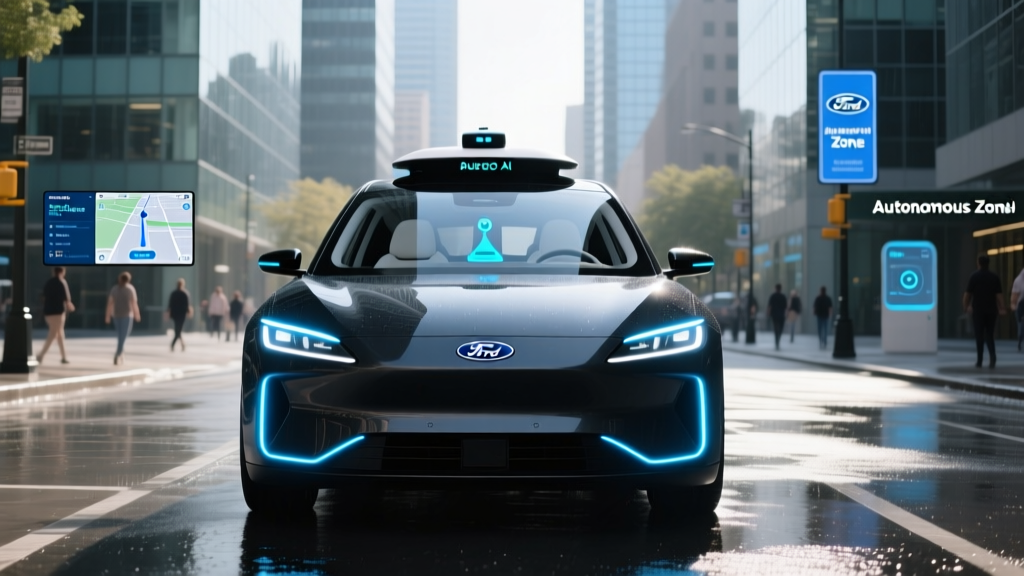
Search for "Ford self-driving" and you'll find a tangle of marketing terms, discontinued projects, and consumer confusion. Let's cut through it with precision: Ford currently sells Level 2 driver-assistance through its BlueCruise system. Ford does not operate a robotaxi service, and the company's path to Level 4 autonomy collapsed when it shut down Argo AI in late 2022. As of 2026, Ford's autonomous strategy has pivoted toward commercial delivery and advanced driver-assist — not driverless rides.
This article breaks down exactly what Ford's self-driving technology can and cannot do today, where the company stands versus true robotaxi operators like Waymo, and what buyers should actually expect when they see the BlueCruise badge on a new F-150 Lightning or Mustang Mach-E.
SAE Automation Levels: Where Ford Actually Sits
The biggest source of "Ford self-driving" confusion is the failure to distinguish between driver-assist and driverless systems. The Society of Automotive Engineers (SAE) defines six levels of driving automation, and Ford's consumer technology occupies Level 2 — the same tier as Tesla Autopilot and GM Super Cruise.
| Level | Name | Who Drives? | Example Systems |
|---|---|---|---|
| 0 | No Automation | Human does everything | Basic cruise control |
| 1 | Driver Assistance | Human + one assist (steering OR speed) | Adaptive cruise, lane-keep |
| 2 | Partial Automation | Human supervises steering AND speed | BlueCruise, Autopilot, Super Cruise |
| 3 | Conditional Automation | System drives in limited conditions; human on standby | Mercedes Drive Pilot (limited markets) |
| 4 | High Automation | System drives without human in geofenced area | Waymo, Zoox, Cruise (pre-suspension) |
| 5 | Full Automation | System drives everywhere, all conditions | Does not exist commercially |
BlueCruise: Ford's Current Self-Driving Technology
Ford's BlueCruise is the system most buyers encounter when researching Ford self-driving features. It launched in 2021 and has evolved through several versions, with BlueCruise 1.4 (the latest widely deployed version as of 2026) offering hands-free driving on pre-qualified divided highways.
What BlueCruise Does
- Hands-free steering on mapped, divided highways (over 130,000 miles of qualified roads in the U.S. and Canada as of 2025)
- Adaptive cruise control with stop-and-go capability in traffic
- Lane centering with automated lane changes on BlueCruise 1.3 and 1.4 (driver confirms via turn signal)
- Driver monitoring via an infrared cabin camera that tracks eye gaze — you cannot look at your phone
- Predictive Speed Assist that slows for curves based on map data
What BlueCruise Does NOT Do
- Navigate city streets, intersections, or roundabouts autonomously
- Handle construction zones reliably
- Operate on unmapped or non-divided roads
- Function in heavy rain, snow, or fog (sensor limitations)
- Remove the need for a licensed, attentive driver
Vehicle Availability and Pricing (2026)
BlueCruise is available or standard on several Ford models, though packaging changes by model year. As of the 2026 model year:
- F-150 Lightning (Lariat and up): Available as part of technology packages, typically $1,500–$2,100 add-on or included in higher trims
- Mustang Mach-E (Premium/GT): Included with Ford Co-Pilot360 Active 2.0; subscription renewal approximately $75/month or $800/year after the initial trial period
- F-150 (ICE/PowerBoost): Available on Lariat and above trims
- Expedition (2025+ redesign): Available on King Ranch, Platinum, and Limited trims
Ford shifted to a subscription model for BlueCruise continuation after an initial complimentary period (typically 90 days to 1 year depending on model year and trim). This is a cost buyers should factor into ownership.
The Argo AI Shutdown: Why There's No Ford Robotaxi
Understanding Ford's self-driving story requires addressing what happened to Argo AI, the Pittsburgh-based autonomy startup into which Ford and Volkswagen invested over $3.6 billion combined. Argo AI was developing Level 4 self-driving technology intended for robotaxi deployment.
In October 2022, Ford and VW jointly decided to shut down Argo AI. Ford CEO Jim Farley stated that developing Level 4 autonomy internally would require years more investment with an unclear path to profitability. Instead, Ford pivoted to focus on:
- Level 2+ and Level 3 driver-assist for consumer vehicles (BlueCruise advancement)
- Level 4 technology for commercial applications — specifically last-mile delivery and hub-to-hub logistics through partnerships
- Latitude AI — a new subsidiary formed from former Argo AI talent, initially focused on developing advanced driver-assist (not robotaxi) technology
By 2024, Ford had effectively folded Latitude AI's efforts back into its core product development, with the focus remaining squarely on enhancing BlueCruise rather than launching a driverless service. As of 2026, Ford has no announced timeline for a consumer or commercial Level 4 robotaxi.
Ford Self-Driving vs. Actual Robotaxi Services
To put Ford's position in context, here's how BlueCruise compares to genuine Level 4 robotaxi operations currently running in the United States:
| Attribute | Ford BlueCruise | Waymo One | Zoox (Amazon) |
|---|---|---|---|
| SAE Level | Level 2 | Level 4 | Level 4 |
| Driver Required? | Yes — always attentive | No — fully driverless | No — fully driverless |
| Where Available | Any qualified highway, nationwide | Phoenix, San Francisco, Los Angeles, Austin (expanding) | Limited pilot: Las Vegas, Foster City, SF (no public fare service yet) |
| How to Access | Buy/lease a equipped Ford vehicle | Waymo One app (like Uber/Lyft) | Invite-only pilot (not public rideshare) |
| Cost to User | Vehicle purchase + ~$800/yr subscription | Per-ride fare (comparable to Uber/Lyft) | N/A (not commercially available) |
| Operational Domain | Mapped divided highways only | Geofenced urban/suburban areas | Geofenced urban areas (testing) |
| Sensor Stack | Cameras + radar | LiDAR + cameras + radar | LiDAR + cameras + radar (custom vehicle) |
Safety Data: What the Numbers Actually Show
Safety is the most critical — and most contested — question in autonomous driving. Here's what we know from reported data:
Ford BlueCruise safety data is less publicly quantified at the system level. Ford has cited internal data suggesting BlueCruise-equipped vehicles show reduced collision rates compared to non-equipped vehicles, but comprehensive third-party crash-rate studies specific to BlueCruise (analogous to IIHS analyses of other systems) remain limited as of early 2026.
What NHTSA Standing General Order data reveals across all Level 2 systems (not Ford-specific) is that the vast majority of reported crashes involving advanced driver-assist occur with systems like Tesla Autopilot/FSD — largely because of market share and the aggressive way those systems are marketed. BlueCruise's more conservative operational domain (highway only, driver monitoring enforced) likely correlates with fewer edge-case incidents, but absence of evidence is not evidence of absence.
Known BlueCruise Incidents
NHTSA has investigated several incidents involving Ford vehicles with Co-Pilot360/BlueCruise systems, though most investigations have centered on whether the system adequately ensures driver engagement. As of 2026, no major NHTSA recall has been issued specifically targeting BlueCruise's core hands-free driving functionality, though Ford has issued over-the-air updates to improve driver monitoring sensitivity and system disengagement warnings.
Technology Stack: How BlueCruise Works Under the Hood
Understanding Ford's self-driving capability requires knowing the sensor and compute architecture:
- Cameras: A surround-view camera array (front-facing, side, and rear) provides lane detection, traffic sign recognition, and object classification
- Radar: Forward-facing long-range radar plus corner radars handle adaptive cruise distance-keeping and blind-spot monitoring
- No LiDAR: Unlike Waymo or Zoox, Ford's consumer system does not use LiDAR — keeping vehicle cost manageable but limiting depth perception in edge cases
- HD Maps: BlueCruise relies on pre-mapped highway data (provided by partners including HERE Technologies) to validate the road is a qualified divided highway before enabling hands-free mode
- Driver Monitoring: An infrared camera mounted on the instrument cluster tracks eye position and head orientation; if the driver looks away for more than a few seconds, the system escalates warnings and eventually disengages, slowing the vehicle
- Compute: Ford's Mobileye-based processing handles sensor fusion and driving decisions; this is less powerful than the custom silicon in Level 4 robotaxis but adequate for the constrained Level 2 domain
The absence of LiDAR and the reliance on HD maps are deliberate trade-offs. LiDAR adds thousands of dollars to vehicle cost and is necessary for Level 4 systems that must handle unpredictable urban environments. For highway-only Level 2 use, cameras and radar — combined with map data — are sufficient for the task, which is why GM's Super Cruise and Ford's BlueCruise share this architecture.
Regulatory Landscape: Who Approves What
Autonomous vehicle regulation in the U.S. is a patchwork of federal and state authority:
- Federal (NHTSA): Sets vehicle safety standards (FMVSS) but does not currently "approve" Level 2 systems before sale. NHTSA investigates post-market through defect investigations and Standing General Orders requiring crash reporting
- State DMVs/Regulators: Control where Level 4 robotaxis can operate. California (CPUC + DMV), Arizona, and Texas have been the most permissive. States like New York require a safety driver in the vehicle, effectively blocking driverless service
- Level 2 (BlueCruise): Legal in all 50 states — no special approval needed because a licensed driver is always responsible
- Level 4 (robotaxi): Requires state-by-state approval; Ford has no Level 4 service to regulate
The regulatory environment is shifting. NHTSA has proposed more rigorous driver-monitoring standards for Level 2 systems, and several states have introduced legislation requiring clearer consumer disclosure about automation limitations. Ford's conservative approach with BlueCruise — enforcing eye monitoring, limiting to mapped highways — positions it favorably if regulation tightens.
Current Limitations: What Ford Self-Driving Cannot Do
Every buyer researching Ford self-driving technology should understand these hard constraints before purchasing:
- Geofencing: BlueCruise only activates on pre-qualified divided highways. Exit the highway, enter a city street, or take an unmapped route and you're back to standard adaptive cruise with lane-keeping — hands on the wheel required
- Weather: Heavy rain, snow, fog, or even direct low-angle sunlight can degrade camera performance and cause the system to disengage. Ford explicitly warns that BlueCruise may not function in adverse conditions
- Construction zones: Temporary lane shifts, missing lane markings, and cone patterns confuse the system. BlueCruise will typically disengage and hand control back with limited warning
- Subscription dependency: After the trial period, BlueCruise requires an ongoing subscription (~$75/month or $800/year). Let it lapse and you lose hands-free capability, though basic Co-Pilot360 features (lane-keeping, automatic emergency braking) continue
- No point-to-point navigation: Unlike Tesla's FSD (Supervised) which attempts to follow a navigation route including on-ramps and exits, BlueCruise does not autonomously navigate interchanges. The driver handles merges and exits
- Driver monitoring strictness: Some users find the eye-tracking camera overly sensitive, triggering warnings when glancing at mirrors or the center display. This is by design for safety, but it can feel intrusive compared to GM Super Cruise's earlier, slightly more permissive system
Should You Buy a Ford for Its Self-Driving Tech?
Choose Ford with BlueCruise if:
- You commute on well-mapped divided highways and want genuine hands-free relief on long, predictable stretches
- You want a proven Level 2 system with enforced driver monitoring (reducing the temptation to misuse it)
- You're buying an F-150 Lightning, Mach-E, or Expedition and BlueCruise is a bonus, not the sole purchase reason
- You understand and accept the subscription cost
Look elsewhere if:
- You expect true self-driving (no steering wheel, no attention required) — that's Level 4, and Ford doesn't offer it
- You primarily drive on rural, unmapped, or undivided roads where BlueCruise won't activate
- You want point-to-point autonomous navigation including interchanges (Tesla FSD Supervised attempts this, though still Level 2)
- You live in an area with frequent construction, severe weather, or poor lane markings
Frequently Asked Questions
Does Ford have a self-driving car?
Ford offers BlueCruise, a Level 2 hands-free driver-assist system available on the F-150 Lightning, Mustang Mach-E, Expedition, and select other models. It is not a self-driving car — a licensed driver must remain attentive at all times. Ford does not operate a driverless robotaxi service.
Can BlueCruise drive me anywhere?
No. BlueCruise operates only on pre-qualified divided highways (over 130,000 miles mapped in the U.S. and Canada). On city streets, residential roads, and unmapped routes, the system reverts to standard adaptive cruise with lane-keeping that requires hands on the wheel.
How much does BlueCruise cost?
BlueCruise is either included with certain trim packages or available as a $1,500–$2,100 option. After an initial trial (90 days to 1 year depending on model), continued use requires a subscription of approximately $75/month or $800/year. Basic safety features (automatic emergency braking, lane-keeping assist) continue without a subscription.
Is Ford working on Level 4 self-driving?
Ford shut down its Level 4 autonomy partner Argo AI in 2022 and formed Latitude AI from former Argo talent, initially focused on advanced driver-assist. As of 2026, Ford has no announced Level 4 robotaxi program or timeline. The company's public statements emphasize commercial delivery applications over consumer robotaxis.
How does BlueCruise compare to Tesla FSD?
Both are Level 2 systems requiring driver supervision. BlueCruise is more restrictive — it only works on mapped divided highways with enforced eye monitoring. Tesla FSD (Supervised) attempts broader operation including city streets and navigation-following, but with less restrictive (and more controversial) driver monitoring. BlueCruise's narrower domain arguably makes it safer for its intended use case; FSD attempts more but has a higher profile in NHTSA investigations.
Is it safe to use BlueCruise?
BlueCruise is designed for a constrained operational domain (divided highways) with active driver monitoring, which reduces risk compared to systems that allow broader use with less monitoring. However, it remains Level 2 — the driver is legally and practically responsible for the vehicle at all times. No Level 2 system eliminates crash risk, and Ford's published safety data for BlueCruise specifically is less comprehensive than Waymo's published robotaxi safety record.