Is There a Driverless Uber in Las Vegas Right Now?
If you've searched for "driverless Uber Las Vegas" hoping to hail a fully autonomous ride on the Strip, here's the honest answer as of early 2026: there is no fully driverless Uber service operating in Las Vegas. Uber's own robotaxi ambitions rely on partnerships with autonomous-vehicle companies, and Las Vegas is not currently among the cities where those partners run commercial driverless operations.
That said, the robotaxi landscape is shifting fast. Waymo operates commercial Level 4 services in a handful of U.S. cities, and Uber has announced integration deals to surface Waymo rides within its app in select markets. Understanding what's live, what's announced, and what remains testing-only is essential before you plan a trip.
SAE Automation Levels: What "Self-Driving" Actually Means
| Level | Name | Who Drives | Example |
|---|---|---|---|
| Level 2 | Driver Assistance | Human (hands may leave wheel briefly) | Tesla Autopilot, GM Super Cruise, Ford BlueCruise |
| Level 3 | Conditional Automation | Vehicle in narrow conditions; human must take over on request | Mercedes DRIVE PILOT (limited markets) |
| Level 4 | High Automation | Vehicle within geofenced ODD; no human needed | Waymo One, Zoox (pilot services) |
| Level 5 | Full Automation | Vehicle everywhere, all conditions | Does not exist commercially |
Key takeaway: Consumer features like Tesla FSD (Supervised) and GM Super Cruise are Level 2 — the driver must remain engaged and liable. Robotaxi services like Waymo One are Level 4 — no driver present, but limited to a mapped operational zone.
Where Can You Actually Use a Robotaxi in 2026?
Commercial, driverless robotaxi services remain geographically concentrated. Here's where you can genuinely hail a ride with no one in the driver's seat today:
| Operator | Service Name | Live Cities (Driverless) | SAE Level | App |
|---|---|---|---|---|
| Waymo (Alphabet) | Waymo One | Phoenix metro, San Francisco, Los Angeles, Austin (partial) | Level 4 | Waymo app; Uber integration in select cities |
| Zoox (Amazon) | Zoox Pilot | Foster City, CA; Las Vegas (limited employee/invite pilot) | Level 4 | Invite-only / closed pilot |
| Cruise (GM) | Suspended | Operations paused since late 2023; no commercial service as of 2026 | — | — |
| Motional (Hyundai/Aptiv) | Testing | Las Vegas testing (with safety driver); no commercial driverless service | Level 4 (testing) | Not publicly available |
| Uber AV Partners | Uber Autonomous | Waymo rides surfaced in Uber app — Phoenix, select LA zones only | Level 4 | Uber app |
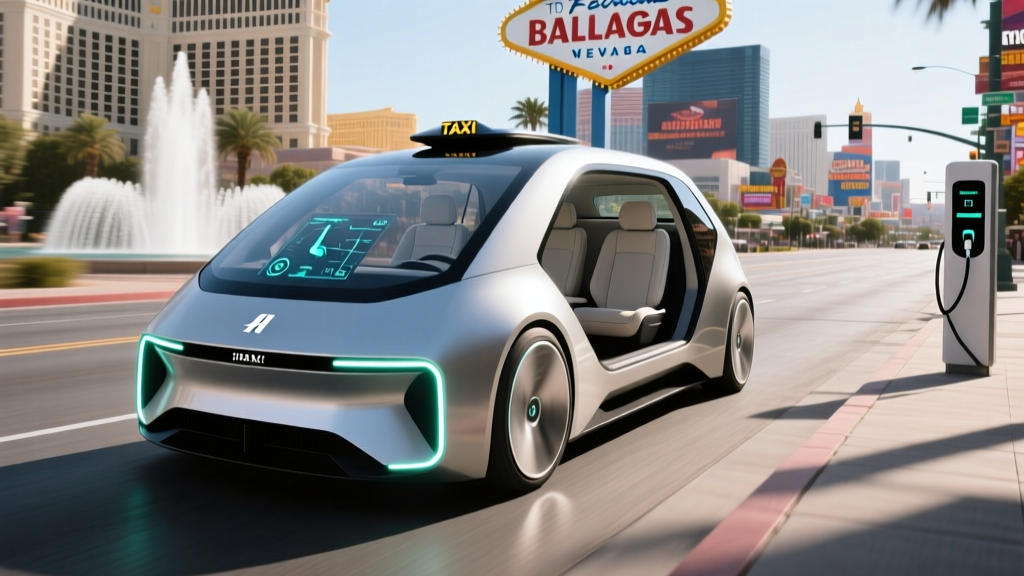
Las Vegas specifics: Zoox has conducted closed pilot testing on Las Vegas roads with its purpose-built bidirectional vehicle, and Motional (the Hyundai/Aptiv joint venture) has logged extensive test miles on the Strip with safety drivers behind the wheel. Neither offers a public, app-hailable, driverless ride in Las Vegas as of this writing. If you're visiting Vegas hoping for a robotaxi, you'll still be in a human-driven Uber or Lyft.
How Much Does a Robotaxi Cost vs. Uber or Lyft?
Where robotaxi services are live, pricing is designed to compete with — or slightly undercut — traditional rideshare. Here's a comparison based on Waymo One pricing in active markets and typical Uber/Lyft rates in comparable cities:
| Metric | Waymo One (Phoenix/SF) | UberX (Comparable) | Lyft (Comparable) |
|---|---|---|---|
| Base fare | $3.00–$4.50 | $2.50–$4.00 | $2.50–$3.50 |
| Per-mile rate | $1.10–$1.50 | $1.00–$1.40 | $0.95–$1.30 |
| Per-minute rate | $0.25–$0.40 | $0.20–$0.35 | $0.20–$0.35 |
| Typical 5-mile ride | $11–$16 | $10–$15 | $9–$14 |
| Surge pricing | Rare / capped | Frequent / uncapped | Frequent / uncapped |
| Tipping | Not expected (no driver) | Expected ($2–$5+) | Expected ($2–$5+) |
The real cost edge: Robotaxis eliminate the tip and often avoid surge multipliers. On a 5-mile trip, the all-in cost can be 15–25% lower than a surge-priced UberX, though during off-peak hours the difference narrows to a few dollars. In Las Vegas, where UberX pricing is already moderate outside of event weekends, a robotaxi would need to be priced aggressively to win on cost alone.
Robotaxi Safety: What the Data Actually Shows
Safety is the single biggest question for prospective robotaxi riders. Here's what the available data tells us — sourced from operator reports, state filings, and NHTSA standing general orders:
Waymo Safety Data (Through 2025 Reporting Period)
- Total driverless miles driven: Over 10 million fully autonomous (no safety driver) miles across Phoenix, San Francisco, and Los Angeles combined.
- Injury-critical crash rate: Waymo reports its driverless fleet is involved in injury-critical crashes at approximately 85% lower rate than human benchmarks, based on Waymo's published safety analysis cross-referenced with NHTSA crash data.
- Police-contactable incidents: Fewer than 30 police-contactable incidents per million autonomous miles, the majority being low-speed property-damage events (e.g., being rear-ended at a stop).
- Cruise suspension context: Cruise's commercial operations were suspended in late 2023 after a pedestrian-dragging incident in San Francisco, underscoring that robotaxi safety failures carry outsized regulatory consequences. Cruise has not resumed commercial service as of 2026.
Important nuance: Robotaxi safety data is self-reported by operators and verified unevenly across jurisdictions. California's DMV requires annual disengagement reports, but other states have less stringent reporting. The Insurance Institute for Highway Safety (IIHS) has noted that comparing robotaxi crash rates to human benchmarks requires careful normalization — robotaxis operate in geofenced, mapped, lower-speed environments, not on rural highways or in whiteout blizzards.
The Technology Stack: Lidar, Cameras, and Geofencing
Robotaxis don't navigate the way a Tesla on FSD (Supervised) does. The sensor and computing architecture is fundamentally different:
Typical Level 4 Robotaxi Sensor Suite (Waymo 6th-Gen / Zoox)
| Component | Function | Typical Specs |
|---|---|---|
| Lidar (multiple units) | 3D point-cloud mapping of surroundings | 360° coverage, 200m+ range, 1.3M+ points/sec |
| Cameras (8–12+) | Object classification, lane/traffic-signal reading | High-res, HDR, overlapping fields of view |
| Radar (4–6 units) | Velocity detection, adverse-weather redundancy | 77 GHz, forward + corner-mounted |
| IMU + GPS + HD maps | Localization within centimeter-level precision | Pre-mapped geofenced zones; RTK GPS |
| Compute platform | Real-time sensor fusion + planning | Custom ASICs / NVIDIA Orin-class; redundant systems |
Lidar vs. camera-only: This is the central technical divide in autonomous driving. Waymo, Zoox, and most robotaxi operators use lidar as a core sensor, arguing that redundant depth perception is essential for Level 4 operation. Tesla's approach for FSD (Supervised) is camera-only — but FSD remains Level 2, with the human driver as the ultimate fallback. No camera-only system currently operates a commercial driverless service.
Geofencing is the key constraint: Level 4 robotaxis operate within a pre-mapped Operational Design Domain (ODD). Every street, intersection, and lane has been surveyed in high definition. If a robotaxi encounters a road outside its geofence — or a construction zone that has changed significantly since mapping — it will reroute or pull over safely rather than attempt to improvise.
Current Limitations: What Robotaxis Cannot Do
Before robotaxis can scale beyond a handful of cities, several hard limitations persist:
- Weather: Heavy rain, fog, snow, and sandstorms degrade lidar and camera performance. Waymo operates in Phoenix (dry heat) and San Francisco (mild, foggy) but does not yet run in cities with harsh winters. Las Vegas monsoon-season downpours can trigger service pauses.
- Geofence boundaries: You cannot hail a robotaxi to a destination outside the mapped ODD. In Phoenix, Waymo's zone covers roughly 225 square miles — large, but it doesn't extend to Sedona or even all of Scottsdale.
- Construction zones: Temporary lane shifts, flaggers, and unmapped detours remain challenging. Robotaxis will often stop and request remote human guidance, adding minutes to your trip.
- No-go scenarios: Unpaved roads, private driveways, parking garages, and drive-throughs are generally outside the ODD. You'll be dropped at the curb, not at your apartment door.
- Accessibility: Current Waymo vehicles (Jaguar I-PACE based) and Zoox's purpose-built pod are still being adapted for full wheelchair accessibility. Not all robotaxi fleets can accommodate mobility devices today.
- Pickup/dropoff precision: Robotaxis use designated pull-over spots. In dense urban areas, you may need to walk a short distance to the vehicle rather than being met at your exact pin.
The Regulatory Landscape: Who Approves Robotaxis?
Robotaxi operations in the U.S. require approval from multiple layers of government:
- State level: In California, the DMV issues testing permits and the California Public Utilities Commission (CPUC) grants commercial deployment permits. Arizona takes a lighter-touch approach, allowing testing and commercial operation with minimal state oversight. Nevada allows autonomous vehicle testing but has not yet established a framework for commercial driverless rideshare at scale.
- Federal level: NHTSA sets vehicle safety standards (FMVSS) but has not yet issued comprehensive regulations for Level 4 robotaxi deployment. Zoox received the first NHTSA exemption for its purpose-built vehicle (which lacks a steering wheel) in 2024.
- Local/municipal: Cities can impose operating hours, zone restrictions, and fleet-size caps. San Francisco's Board of Supervisors has debated caps on robotaxi fleet sizes following congestion complaints.
For Las Vegas specifically: Nevada Revised Statutes (NRS 482A) permit autonomous vehicles on public roads, and the state has historically been AV-friendly. However, commercial robotaxi rideshare requires coordination between the Nevada DMV, the city of Las Vegas, and Clark County — and no operator has received full commercial deployment approval there as of 2026.
When Will Las Vegas Get a Real Driverless Rideshare?
Based on operator roadmaps and regulatory signals, here's a realistic outlook:
- Zoox is the most likely candidate for Las Vegas commercial service, given its existing pilot presence and Amazon's interest in high-visibility markets. A public launch could materialize in late 2026 or 2027, pending regulatory approval.
- Waymo has signaled interest in expanding beyond its current four-city footprint, with Las Vegas and Miami frequently cited as candidate cities. No timeline has been confirmed.
- Motional continues testing with safety drivers in Las Vegas but has not announced a commercial driverless timeline since restructuring in 2024.
- Uber's role will likely be as an aggregator — surfacing Waymo or other robotaxi rides within the Uber app, as it already does in Phoenix and parts of Los Angeles. Uber is not developing its own Level 4 system after selling its ATG unit to Aurora in 2020.
If you're visiting Las Vegas in 2026 and want a taste of autonomous driving, your best option remains renting a vehicle equipped with Level 2 driver-assist (such as GM's Super Cruise on compatible mapped highways) — with the understanding that you are still the driver, legally and practically.
Frequently Asked Questions
Can I hail a driverless Uber in Las Vegas today?
No. As of 2026, there is no commercial driverless Uber or robotaxi service available to the public in Las Vegas. Uber can surface Waymo rides in its app, but only in Phoenix and select Los Angeles zones — not Las Vegas.
Is Zoox operating in Las Vegas?
Zoox has conducted closed pilot testing in Las Vegas with its purpose-built bidirectional vehicle, but the service is invite-only and not available to the general public. A commercial launch has not been announced.
How much would a robotaxi ride cost compared to Uber?
In cities where Waymo One operates, a typical 5-mile ride costs $11–$16, comparable to or slightly cheaper than UberX ($10–$15) once you factor in the absence of tipping and surge pricing. Exact Las Vegas pricing has not been published since no commercial service exists there yet.
Are robotaxis safer than human drivers?
Waymo reports its driverless fleet experiences injury-critical crashes at roughly 85% lower rates than human benchmarks, based on over 10 million autonomous miles. However, this data comes from geofenced, mostly low-speed urban environments and is self-reported. Independent verification remains limited, and the Cruise suspension of 2023 demonstrates that serious incidents do occur.
What's the difference between Tesla FSD and a Waymo robotaxi?
Tesla's Full Self-Driving (Supervised) is a Level 2 driver-assist system — the human driver must remain engaged, monitor the road, and is legally liable for all driving decisions. Waymo One is a Level 4 robotaxi — no human driver is present, the vehicle handles all driving within its geofenced zone, and the operator (Waymo) bears liability. Tesla FSD uses cameras only; Waymo uses lidar, cameras, radar, and HD maps.
Will Las Vegas get robotaxi service soon?
Zoox or Waymo could potentially launch commercial service in Las Vegas in late 2026 or 2027, but no operator has confirmed a date. Regulatory approval from the Nevada DMV and local jurisdictions is still pending for commercial driverless rideshare.