Las Vegas Robotaxis in 2026: What's Actually Operating
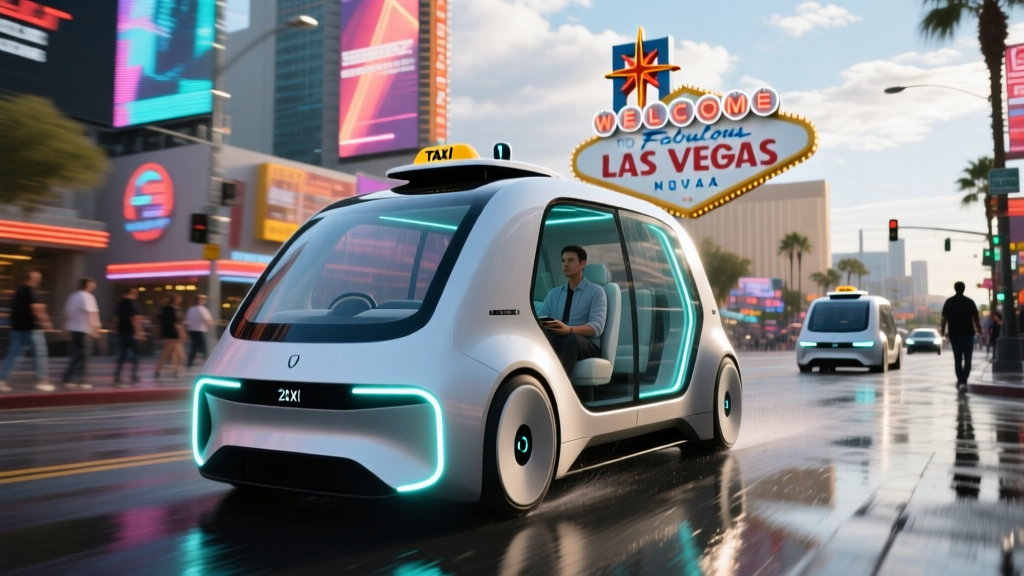
If you've visited Las Vegas recently, you've likely spotted a white Jaguar I-PACE with a roof-mounted sensor array gliding down the Strip with nobody behind the wheel. That's not a demo or a test mule — it's a commercial robotaxi you can hail right now. Driverless cars in Las Vegas have moved from novelty to everyday transportation, with Waymo operating a paid, fully driverless service across a large geofenced zone covering the Strip, downtown, and the airport corridor.
But availability, pricing, and safety realities are more nuanced than the headlines suggest. This guide breaks down exactly where you can ride, what it costs versus Uber and Lyft, how the technology works, and what the safety data actually shows.
SAE Automation Levels: What "Self-Driving" Actually Means
| Level | Classification | Who Drives | Example |
|---|---|---|---|
| Level 2 | Driver Assistance | Human (must monitor at all times) | Tesla Autopilot/FSD Supervised, GM Super Cruise, Ford BlueCruise |
| Level 3 | Conditional Automation | System in limited conditions; human on standby | Mercedes Drive Pilot (select markets, <40 mph) |
| Level 4 | High Automation | System (no human driver needed in geofenced area) | Waymo One, Zoox |
| Level 5 | Full Automation | System everywhere, all conditions | Does not exist commercially |
Key distinction: The driverless cars in Las Vegas you can hail today are SAE Level 4 — fully autonomous within their approved operational zone, with no human driver present. This is fundamentally different from Level 2 driver-assist systems like Tesla FSD Supervised, which require constant human attention and are not "self-driving."
Where Can I Use a Robotaxi in Las Vegas Right Now?
As of early 2026, Waymo One is the primary commercial robotaxi service operating in Las Vegas with fully driverless vehicles (no safety driver in the front seat). Waymo launched its Las Vegas service area in phases, beginning with a limited zone and expanding progressively.
| Service | Status | Coverage Area | Vehicle |
|---|---|---|---|
| Waymo One | Live — fully driverless, paid rides | Strip corridor, Downtown, Convention Center, Harry Reid International Airport (LAS), parts of Summerlin and Henderson | Jaguar I-PACE (5th-gen Waymo Driver) |
| Zoox | Limited operations / employee + invited rider program | Small geofenced zone near Strip and downtown (expansion pending regulatory approval) | Zoox purpose-built vehicle (no steering wheel) |
| Motional (Hyundai/Aptiv) | Testing with safety driver; no public commercial service | Select test routes on and around the Strip | Hyundai Ioniq 5 |
| Cruise (GM) | Not operating in Las Vegas (suspended nationally since late 2023; limited restarts in other cities) | N/A | Chevrolet Bolt EV / Origin |
Practical coverage note: Waymo's Las Vegas geofence covers roughly 80+ square miles as of 2026, including the major hotel-casino corridor along Las Vegas Boulevard, the Convention Center, downtown Fremont Street area, and routes to Harry Reid International Airport. However, suburban areas beyond Summerlin and Henderson, Red Rock Canyon, and the route to Lake Mead are outside the service zone. If your destination falls outside the geofence, the app will not let you complete the booking.
How to Hail a Waymo in Las Vegas
- Download the Waymo One app (iOS or Android).
- Create an account — you'll need a valid payment method (credit/debit card or Google Pay).
- Enter your pickup and drop-off locations. If both are within the Las Vegas service area, you'll see a fare estimate and ETA.
- Confirm the ride. The vehicle arrives, typically within 3–8 minutes in the Strip corridor during normal hours.
- Unlock by tapping the app or entering a PIN on the door handle screen.
- Start the ride via the in-car screen. There is no driver — the vehicle operates autonomously.
Wait times vary significantly: expect 3–5 minutes on the Strip between 10 AM and midnight, but 10–20+ minutes during peak convention hours (CES, SEMA) or in outlying zones like Henderson. Service operates 24/7, though availability thins in the early morning hours (2–6 AM).
Robotaxi Pricing: Waymo vs. Uber vs. Lyft in Las Vegas
One of the most common questions about driverless cars in Las Vegas is cost. Robotaxi pricing is designed to compete directly with rideshare, and in many common Las Vegas trips, Waymo is price-competitive or slightly cheaper than UberX — particularly because there's no driver tip expected (though in-app tipping is available).
| Route | Distance | Waymo One | UberX | Lyft |
|---|---|---|---|---|
| McCarran (LAS) Airport → Bellagio | ~4.5 mi | $18–$24 | $22–$30 | $20–$28 |
| Bellagio → Fremont Street (Downtown) | ~5.2 mi | $16–$22 | $18–$26 | $17–$24 |
| Convention Center → Venetian | ~1.5 mi | $8–$12 | $10–$16 | $9–$14 |
| Wynn → Harry Reid Airport | ~4.0 mi | $16–$22 | $20–$28 | $18–$25 |
| Summerlin → Strip (Red Rock Casino area) | ~10 mi | $28–$38 | $32–$45 | $30–$42 |
Pricing notes: Waymo uses dynamic pricing similar to rideshare surge — fares rise during high-demand periods (New Year's Eve, major conventions, Saturday nights on the Strip). However, Waymo's surge multipliers have generally been less aggressive than Uber/Lyft during peak Las Vegas events. Fares shown are estimates based on typical conditions; always check the app for the exact quoted price before confirming.
There is no tip required with Waymo (no driver to tip), which effectively saves 15–20% compared to a comparable Uber/Lyft ride where tipping is customary. Waymo also offers Waymo Pass subscription plans in some markets, which can reduce per-ride costs for frequent users.
The Technology Behind Las Vegas Robotaxis
The 5th-generation Waymo Driver powering the Las Vegas fleet is one of the most sensor-dense autonomous driving systems in commercial operation. Unlike camera-only approaches (such as Tesla's FSD), Waymo uses a multi-modal sensor stack designed for redundancy.
Waymo 5th-Gen Sensor Suite (Jaguar I-PACE)
- LiDAR: Multiple roof-mounted and body-integrated LiDAR units providing 360° 3D point-cloud mapping up to 500+ meters. LiDAR works independently of lighting conditions — critical for nighttime Strip driving and tunnel transitions.
- Cameras: 29+ high-resolution cameras covering 360° with overlapping fields of view for object classification, traffic signal recognition, and lane detection.
- Radar: 6 radar units for velocity detection and performance in rain, fog, or direct sun glare.
- Audio sensors: External microphones that detect emergency vehicle sirens (police, fire, ambulance) and trigger appropriate yield behavior.
- HD Maps: Pre-mapped, centimeter-accurate maps of the entire service area, continuously updated. The vehicle cross-references its real-time sensor data against the HD map for precise localization.
- Compute: Custom Waymo-designed computing platform processing sensor fusion, prediction, and planning in real time.
LiDAR vs. Camera-only debate: Waymo's reliance on LiDAR is a key differentiator from Tesla's camera-only FSD approach. LiDAR provides precise depth measurement regardless of lighting — a significant advantage in Las Vegas, where vehicles transition between bright desert sun, dark parking structures, and neon-lit nighttime streets. The trade-off is higher hardware cost (the sensor suite adds tens of thousands of dollars per vehicle), which is viable for fleet-operated robotaxis but not yet economical for consumer vehicles.
Geofencing: The Waymo Driver operates only within its pre-mapped, approved service area. If a route would take the vehicle outside the geofence, the ride cannot be booked. This is a deliberate safety constraint — the system has been extensively validated within this zone but has not been certified for areas beyond it.
How Safe Are Driverless Cars in Las Vegas? The Real Data
Safety is the most scrutinized aspect of robotaxi operations, and for good reason. Here's what the data shows about Waymo's operations, including Las Vegas, based on NHTSA reporting and Waymo's published safety metrics.
Waymo Safety Data (through 2025)
- Total autonomous miles driven (all markets): 30+ million fully driverless miles (Phoenix, San Francisco, Los Angeles, Austin, Las Vegas combined).
- Injury-causing crash rate: Waymo's fully autonomous vehicles were involved in injury-causing crashes at a rate approximately 85% lower than human drivers in comparable urban environments, according to Waymo's peer-reviewed safety study published with insurance claims data.
- Police-reported crash rate: Approximately 57% lower than human benchmark for comparable driving environments.
- Contact events: The vast majority of Waymo vehicle contacts involve the Waymo vehicle being rear-ended or sideswiped by human-driven vehicles — not the robotaxi initiating the contact.
- NHTSA Standing General Order: Waymo reports all Level 4 incidents to NHTSA under the Standing General Order requiring crash reporting for ADS-equipped vehicles.
Las Vegas-specific context: Waymo's Las Vegas operations have not been associated with any high-profile serious injury incidents as of early 2026. The Strip environment presents unique challenges — heavy pedestrian density, frequent jaywalking, construction zones, and complex multi-lane intersections — and Waymo's conservative driving behavior (lower speeds, extended following distances, cautious unprotected left turns) has resulted in occasional traffic congestion complaints but a strong safety record.
Important comparison point: This safety data applies to Level 4 robotaxis (no human driver). It should not be conflated with Level 2 driver-assist systems like Tesla Autopilot or FSD Supervised, which have different safety profiles and where the human driver remains responsible. IIHS research has shown that Level 2 system users sometimes over-rely on automation, leading to inattention — a risk that doesn't apply to Level 4 robotaxis where the system is fully responsible.
Current Limitations: What Robotaxis Still Can't Do
Despite the impressive safety record, driverless cars in Las Vegas have real limitations that riders should understand before booking.
Known Operational Limitations
- Geofence boundaries: You cannot ride to Red Rock Canyon, Lake Mead, Mt. Charleston, or most suburban areas beyond the approved zone. The app simply won't let you book these trips.
- Heavy rain and flash floods: Las Vegas monsoon-season storms (July–September) can trigger service suspensions or route restrictions. LiDAR performance degrades in heavy rain, and flooded roadways are a known edge case. Waymo will pause service or restrict routes during severe weather.
- Dust storms (haboobs): Rare but possible in the Las Vegas valley — airborne dust scatters LiDAR returns and reduces camera visibility. Service may be suspended.
- Construction zones: Major road construction (lane shifts, temporary barriers, flaggers) can confuse the system. Waymo maps are updated regularly, but sudden overnight construction changes may cause the vehicle to take longer routes or request remote assistance.
- Pickup/drop-off precision: The vehicle will pull to a safe, legal stopping point — but that may not be directly in front of your hotel's main entrance. On the Strip, expect to walk 100–300 feet from the vehicle's stop to your exact destination. The vehicle will not stop in travel lanes or bus zones.
- No multi-stop trips: Unlike Uber/Lyft, you cannot add intermediate stops. One pickup, one drop-off.
- Passenger capacity: Waymo's Jaguar I-PACE seats up to 3 passengers in the rear. There is no front-seat passenger area. Large groups will need multiple vehicles.
- No car seats: Waymo vehicles do not provide child safety seats. Children under 8 must be in an appropriate car seat brought by the rider, which limits practicality for families with young children.
- Luggage: The I-PACE trunk accommodates 1–2 standard suitcases. Airport runs with excessive luggage may not fit.
- Pets: Service animals are permitted; other pets are generally not allowed.
Regulatory Landscape: Who Approves Robotaxi Operations?
Robotaxi operations in Las Vegas exist within a layered regulatory framework:
- Federal (NHTSA): The National Highway Traffic Safety Administration sets vehicle safety standards and requires crash reporting for all ADS-equipped vehicles under its Standing General Order. NHTSA does not "approve" robotaxi services but has authority to investigate and order recalls.
- State (Nevada DMV): Nevada was one of the first states to pass autonomous vehicle legislation (AB 511 in 2011, updated since). The Nevada DMV issues autonomous vehicle testing and deployment permits. Operators must demonstrate safety validation, insurance coverage ($5M+ minimum), and compliance with state traffic law before receiving a deployment permit.
- Local (City of Las Vegas / Clark County): Local jurisdictions control road access, permitting for commercial operations, and coordination with first responders. Las Vegas has been broadly supportive of robotaxi operations, viewing them as a tourism and technology credential.
- Insurance: Waymo carries commercial insurance covering its fleet operations. In a Level 4 robotaxi, liability for at-fault incidents falls on the operator (Waymo), not the passenger — a significant distinction from Level 2 driver-assist where the human driver remains liable.
This regulatory environment is one reason Las Vegas has become a leading robotaxi market: Nevada's early legislative framework, combined with a concentrated tourism corridor ideal for geofenced operations, created favorable conditions for deployment.
Frequently Asked Questions
Is the Waymo in Las Vegas truly self-driving, or is there a hidden driver?
Truly self-driving. Waymo One vehicles in Las Vegas operate at SAE Level 4 with no human driver in the vehicle. The front driver's seat is empty. A remote operations team monitors the fleet and can provide guidance in unusual situations, but there is no human physically controlling the vehicle.
How much does a Waymo ride cost compared to Uber in Las Vegas?
Waymo fares are generally comparable to or 10–20% cheaper than UberX for equivalent routes, especially when you factor in the no-tip expectation. A typical Strip-to-airport ride runs $18–$24 on Waymo versus $22–$30 on UberX. Surge pricing applies during peak demand on both platforms.
Can I take a driverless car from the Las Vegas airport?
Yes. Waymo One serves Harry Reid International Airport (LAS) with designated pickup areas. Follow in-app directions to the rideshare pickup zone after collecting your bags. Note that airport pickups may have slightly longer wait times (5–12 minutes) due to the pickup zone being farther from the vehicle staging areas.
What happens if the robotaxi gets confused or encounters an unexpected situation?
The vehicle will pull over safely and contact Waymo's remote operations team for guidance. In most cases, the remote team can resolve the situation within 1–3 minutes and the vehicle resumes its route. In rare cases, the ride may be rerouted or cancelled with a refund. The vehicle will not proceed if it cannot confidently determine a safe path.
Can I ride a Zoox robotaxi in Las Vegas?
Zoox (owned by Amazon) has conducted testing in Las Vegas and has operated limited rides for employees and invited participants. As of early 2026, Zoox has not launched a fully open commercial service in Las Vegas comparable to Waymo One. Availability may expand pending regulatory approvals — check the Zoox app for current status.
Are robotaxis safe at night on the Las Vegas Strip?
Yes. Waymo's sensor suite (LiDAR, radar, cameras) performs well at night — LiDAR is independent of ambient light. The system is designed for 24/7 operation and handles the neon-lit, high-pedestrian-density nighttime Strip environment as part of its normal operating conditions. Waymo's published safety data includes extensive nighttime driving miles.
What if I feel unsafe during a driverless ride?
Every Waymo vehicle has a "Help" button and in-car screen interface connecting you to a live support agent. You can also request the vehicle to pull over and end the ride early. The vehicle will find a safe stopping point and unlock the doors. Waymo's rider support is available throughout the trip.
The Bottom Line on Driverless Cars in Las Vegas
Las Vegas is one of the best cities in the world to experience a commercial robotaxi in 2026. Waymo One offers a genuinely driverless, SAE Level 4 ride across a large service area covering the Strip, downtown, and the airport — with pricing competitive with Uber and Lyft, and safety data that compares favorably to human drivers. The technology is real, the service is operational, and the experience is remarkably unremarkable: the car simply drives you where you need to go, without a driver.
The limitations are real too — geofence boundaries, weather sensitivity, limited passenger capacity, and no multi-stop trips. But for the most common Las Vegas visitor use cases (airport transfer, hotel-to-hotel, Strip-to-downtown), driverless cars are a practical, available, and increasingly routine transportation option.