What Mercedes-Benz Drive Pilot Actually Is (And Isn't)
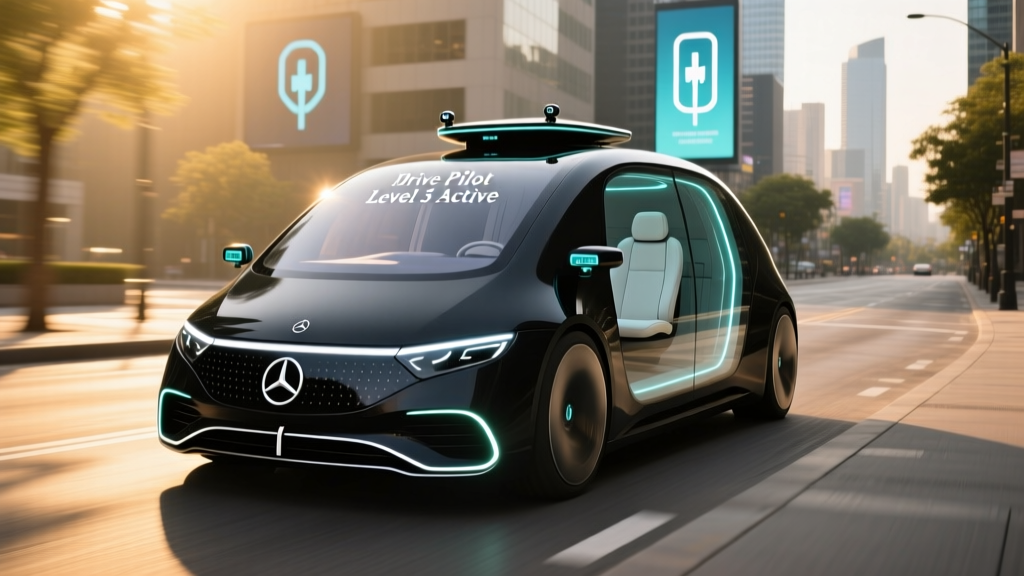
When shoppers search for a "driverless car Mercedes," they're usually imagining a vehicle that handles everything while they nap in the back seat. The reality is more nuanced — and more interesting. Mercedes-Benz offers Drive Pilot, the world's first internationally certified SAE Level 3 conditional automated driving system available in a production vehicle sold to consumers. It is not a robotaxi. It is not Level 4 or Level 5. But it represents a genuine leap beyond the Level 2 driver-assist systems (like Tesla Autopilot, GM Super Cruise, or Ford BlueCruise) that still demand constant driver attention.
| Level | Name | Driver Role | Examples |
|---|---|---|---|
| Level 2 | Driver Assistance | Must monitor at all times, hands near wheel | Tesla Autopilot/FSD, Super Cruise, BlueCruise |
| Level 3 | Conditional Automation | Can disengage (read, watch video) in approved conditions; must take over when requested | Mercedes Drive Pilot |
| Level 4 | High Automation | No driver needed in geofenced area | Waymo One, Zoox |
| Level 5 | Full Automation | No driver needed anywhere | Does not exist commercially |
Source: SAE International J3016
The critical distinction: when Drive Pilot is engaged under qualifying conditions, Mercedes-Benz assumes legal liability for the driving task. You can legally take your eyes off the road, watch a video on the MBUX screen, or read a document. If the system encounters a scenario it cannot handle, it issues a takeover request with roughly 10 seconds of warning. If you fail to respond, the vehicle performs a controlled emergency stop. This liability shift is what separates Level 3 from Level 2 — not just a technology difference, but a legal one.
Where Can You Use Mercedes Drive Pilot Right Now?
As of early 2026, Drive Pilot availability remains geographically constrained. The system requires pre-mapped, divided highways with physical median barriers, specific lane markings, and favorable conditions. Here is where it is approved for consumer use:
| Region | Status | Approved Roads | Max Speed |
|---|---|---|---|
| Germany (nationwide) | Live since 2022 | ~8,100 miles of Autobahn (divided sections) | 60 km/h (37 mph) |
| Nevada, USA | Live since late 2023 | I-15, US-95 (specific divided segments near Las Vegas) | 40 mph (initially); expanded to 60 mph in 2024 |
| California, USA | Approved; deployment ongoing | Select divided highways (I-5, I-80 corridors) | Up to 60 mph |
| China (Beijing/Shanghai) | Testing/approval phase | Limited urban expressways | TBD |
If you live outside these regions, Drive Pilot is not available to you regardless of vehicle trim. The system relies on high-definition maps and geofencing; it will not activate on unmapped roads even if they physically meet the criteria.
Which Mercedes Models Offer Drive Pilot, and at What Cost?
Drive Pilot is not a standalone robotaxi service you hail via an app — it is a purchasable feature on specific Mercedes-Benz vehicles. For the 2025–2026 model years, availability is limited to:
- 2024–2026 Mercedes-Benz S-Class (W223) — Drive Pilot available as a $2,500 option (U.S. pricing) on S 500 4MATIC and S 580 4MATIC trims. Base MSRP: S 500 starts at ~$118,300; S 580 at ~$128,500.
- 2024–2026 Mercedes-Benz EQS Sedan — Drive Pilot offered on EQS 450+ and EQS 580 4MATIC. Base MSRP: EQS 450+ starts at ~$105,550. The EQS features a 118 kWh (usable) NMC battery with an EPA-estimated range of up to 390 miles (450+), making it one of the longest-range luxury EVs on the market.
| Option | Upfront Cost | Per-Trip Cost | Autonomy Level |
|---|---|---|---|
| Mercedes Drive Pilot (S-Class/EQS) | $2,500 option + vehicle ($105K–$130K+) | $0 per trip (you own the car) | Level 3 (conditional) |
| Waymo One (Phoenix, SF, LA) | $0 | $0.70–$1.20/mile (varies by city/time) | Level 4 (geofenced) |
| Uber/Lyft (human driver) | $0 | $1.50–$3.00/mile (varies by surge) | Human-driven |
Waymo pricing reflects published 2025–2026 rates in Phoenix/SF. Uber/Lyft are national averages.
The economics are fundamentally different: Drive Pilot is a premium feature on a luxury vehicle you purchase and drive yourself (with conditional automation in traffic). Waymo is a per-ride service. They solve different problems.
The Technology Stack: How Mercedes Drive Pilot Works
Unlike Tesla's camera-only approach, Mercedes employs a redundant, multi-sensor fusion stack:
- LiDAR: Roof-mounted Valeo Scala 3 LiDAR providing a 3D point cloud of the vehicle's surroundings up to ~150 meters
- Radar: Multiple long-range and short-range radar units (front, rear, corners) for object detection and velocity tracking
- Cameras: Stereo cameras behind the windshield plus surround-view cameras for lane marking, sign recognition, and object classification
- Ultrasonic sensors: Short-range proximity detection for nearby vehicles
- HD Maps: Centimeter-precision pre-scanned maps of every approved road segment, updated regularly via OTA
- Rear-window camera: Monitors for emergency vehicle approach (lights/sirens detection)
- Redundant computing: Dual independent computing units; if one fails, the other maintains control
- Redundant steering & braking: Dual actuators for steering and braking — if primary systems fail, backups engage
The system also monitors road moisture via a dedicated sensor in the wheel well, refusing activation on wet surfaces where traction modeling becomes less reliable.
This is a fundamentally different philosophy from Tesla's vision-only FSD. Mercedes prioritizes redundancy and certainty over broad coverage. The result is a system that works in a narrow domain with high confidence, rather than one that attempts to drive everywhere with variable reliability.
Safety Record: What the Data Shows
- Consumer deployment miles: Mercedes has not published a cumulative public mileage figure comparable to Waymo's billions of simulated and millions of real-world miles. The system has been in consumer hands in Germany since mid-2022 and in Nevada since late 2023.
- Reported incidents: As of this writing, there are no publicly reported at-fault collisions involving a consumer vehicle operating under Drive Pilot engagement. NHTSA's Standing General Order (SGO) requires manufacturers to report crashes involving ADS/ADAS; Mercedes reports under this framework. See NHTSA SGO data.
- Operational design domain (ODD): The tight constraints (divided highway, ≤60 mph, dry roads, clear weather, mapped segments) drastically reduce exposure to high-risk scenarios like intersections, pedestrians, and cross-traffic.
- Liability framework: Mercedes has publicly stated it accepts liability when Drive Pilot is properly engaged — a significant commitment that incentivizes conservative system behavior.
Note: Small deployment scale means the statistical sample is far smaller than Waymo's millions of driverless miles. Absence of reported incidents is encouraging but not equivalent to a proven large-scale safety record.
For comparison, Waymo reports over 10 million fully driverless miles across Phoenix, San Francisco, and Los Angeles, with published safety benchmarks showing significant reductions in police-reported crash rates versus human baselines. Drive Pilot operates at a fraction of that scale but under far more constrained conditions.
Current Limitations: What Drive Pilot Cannot Do
Understanding what this system does not handle is as important as knowing its capabilities. Drive Pilot will refuse to engage — or will issue a takeover request — under any of the following conditions:
| Limitation | Detail |
|---|---|
| Speed | Only activates at ≤60 mph (U.S.) / ≤60 km/h (Germany initially). This targets stop-and-go highway congestion, not free-flowing cruising. |
| Road type | Divided highways only, with physical median barriers. No surface streets, no undivided roads, no rural highways. |
| Weather | Dry roads only. Rain, snow, ice, fog, or even heavy spray from trucks will prevent activation or trigger a takeover request. |
| Lighting | Daytime operation only in most deployments. Night driving, tunnels with poor lighting, or heavy glare may limit function. |
| Geofencing | Must be on a pre-mapped, approved road segment. Construction zones, newly built roads, or roads with changed lane configurations may not be supported. |
| Driver monitoring | Interior camera monitors driver head position and eye state. You cannot sleep, and you must be ready to resume within ~10 seconds of a takeover request. |
| Lane changes | Drive Pilot maintains your lane and follows traffic. It does not perform autonomous lane changes — the driver must execute those manually. |
These constraints are not bugs — they are the system's safety philosophy made concrete. Mercedes chose to solve a narrow problem (highway traffic jams) with extreme reliability rather than attempt broad coverage with variable performance.
Regulatory Landscape: Who Approves This?
Level 3 automation exists in a complex regulatory patchwork:
- Germany: The Kraftfahrt-Bundesamt (KBA) certified Drive Pilot under UN Regulation 157 (ALKS — Automated Lane Keeping System), which permits Level 3 systems at up to 130 km/h on divided highways. Germany also passed the Autonomous Driving Act (2021) creating a legal framework for Level 4 vehicles.
- United States — Federal: NHTSA does not currently "approve" ADS systems pre-market. Instead, manufacturers self-certify compliance with Federal Motor Vehicle Safety Standards (FMVSS). NHTSA monitors via the Standing General Order crash-reporting requirement and can initiate investigations.
- United States — State: Deployment is state-by-state. Nevada was first to approve Mercedes Drive Pilot (Nevada DMV issues autonomous vehicle testing/deployment permits). California requires a DMV Autonomous Vehicle Deployment Permit, and Mercedes received approval there as well. Many states have no specific Level 3 framework, meaning Drive Pilot cannot legally operate in those jurisdictions even if technically capable.
This fragmented regulatory environment is a major reason why Drive Pilot expansion is slow. Each new state or country requires separate approval processes, HD map validation, and legal framework alignment.
Drive Pilot vs. Robotaxis: Different Solutions, Different Use Cases
If your search for a "driverless car Mercedes" was driven by curiosity about hailing a self-driving vehicle, the answer is that Mercedes does not currently operate a robotaxi service. Mercedes-Benz has invested in autonomous technology through various partnerships (including past collaborations with Bosch on a Level 4 parking system), but the consumer-facing product is Drive Pilot — a personal-vehicle feature, not a mobility service.
For true driverless rides today, you need a Level 4 robotaxi operator:
| Service | Cities | Availability | How to Ride |
|---|---|---|---|
| Waymo One | Phoenix, San Francisco, Los Angeles, Austin (expanding) | Open to public; waitlists in some cities | Waymo app (iOS/Android) |
| Zoox | Las Vegas, Foster City (limited public access) | Invite-only / limited public | Zoox app (limited availability) |
| Baidu Apollo Go | Wuhan, Beijing, Chongqing, Shenzhen (China) | Open to public in China | Apollo Go app (Chinese market) |
Is Drive Pilot Worth It? A Decision Framework
- You already plan to buy an S-Class or EQS and commute on qualifying divided highways in Nevada or California
- You frequently sit in stop-and-go highway traffic (the ≤60 mph sweet spot) and want to reclaim that time legally
- The idea of manufacturer-assumed liability during automated driving matters to you
- You value a personal vehicle over per-ride services
- You live in Phoenix, San Francisco, Los Angeles, or Austin and want fully driverless point-to-point rides
- You don't want to own a $100K+ vehicle
- You need autonomy on surface streets, at intersections, and in urban environments — not just divided highways
- You want hands-off, eyes-off, attention-off driving with no takeover requirement
- You live outside approved regions and need automation for daily commuting on non-highway roads
- You expect full self-driving everywhere — that technology does not exist commercially at any price point in 2026
Frequently Asked Questions
Is Mercedes Drive Pilot truly self-driving or just driver-assist?
It is SAE Level 3 conditional automation — genuinely self-driving under strict conditions (divided highway, ≤60 mph, dry roads, daytime, mapped segments). Unlike Level 2 systems (Autopilot, Super Cruise), you are not required to monitor the road while it's engaged, and Mercedes assumes legal liability. However, it is not Level 4: you must be present in the driver's seat, awake, and ready to take over within ~10 seconds when requested.
How much does Mercedes Drive Pilot cost compared to Uber or Waymo?
Drive Pilot is a $2,500 option on vehicles costing $105,000–$130,000+. There is no per-trip fee — you own the vehicle. Waymo charges approximately $0.70–$1.20 per mile depending on city and demand. Uber/Lyft average $1.50–$3.00 per mile. The breakeven math depends entirely on your mileage and whether you were already buying an S-Class or EQS.
Can Drive Pilot change lanes or navigate exits on its own?
No. Drive Pilot maintains your current lane and follows the vehicle ahead. Lane changes, exit navigation, and any off-highway driving require full manual control. The system is designed for sustained congestion on divided highways, not point-to-point navigation.
What happens if I don't respond to a takeover request?
If the system encounters a scenario outside its capabilities (road geometry change, weather deterioration, end of mapped segment), it issues visual, audible, and haptic alerts. You have approximately 10 seconds to resume control. If you do not respond, the vehicle activates hazard lights, gradually decelerates, and performs a controlled stop in its lane. Emergency services may be contacted automatically via Mercedes' emergency call system.
Does the EQS with Drive Pilot qualify for the federal EV tax credit?
The IRS §30D clean vehicle credit has strict requirements for 2026: the vehicle MSRP must not exceed $55,000 (sedans), the buyer must meet income caps ($150K single / $300K joint), and battery components and critical minerals must meet domestic-sourcing thresholds. The EQS sedan (MSRP $105,550+) exceeds the MSRP cap and does not qualify for the federal credit. State-level incentives may still apply — check your local DMV or energy office for current programs.
Will Drive Pilot expand to more states and higher speeds?
Mercedes has indicated plans to expand coverage and increase the operational speed ceiling. The UN R157 amendment now permits ALKS systems up to 130 km/h (~81 mph), and Mercedes is working toward validating higher-speed operation. State-by-state expansion in the U.S. depends on individual state regulatory frameworks. Do not purchase expecting near-term nationwide availability.
Sources: Mercedes-Benz USA press archives, NHTSA Standing General Order, SAE J3016, IRS §30D Clean Vehicle Credit. Specifications and pricing reflect 2025–2026 model year data and are subject to change. Verify current availability and regulatory status with Mercedes-Benz and your state DMV before purchasing.