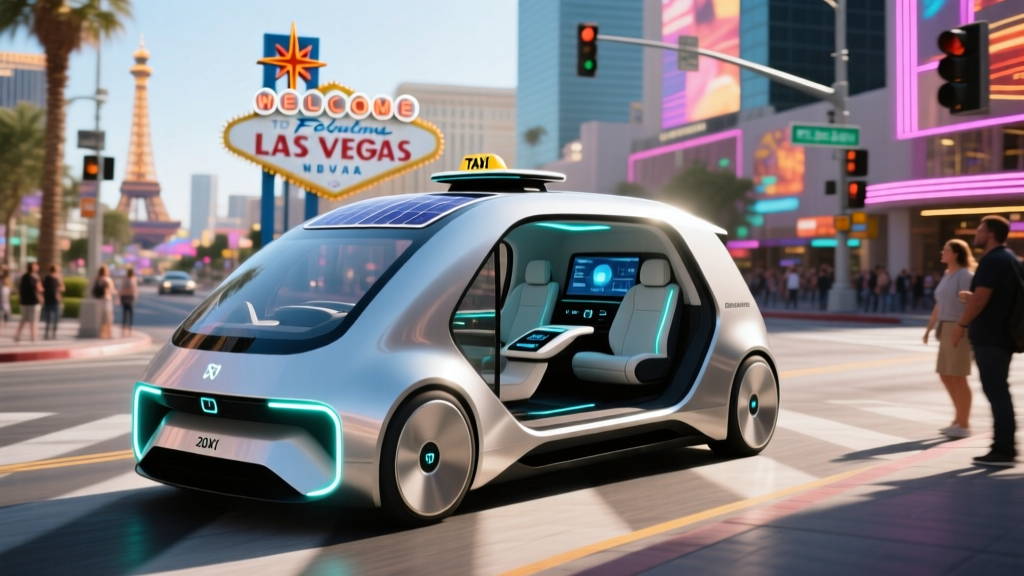
If you've searched for a driverless car Las Vegas experience, you're not alone. Las Vegas has become one of the most active testing and deployment grounds for Level 4 robotaxis in the United States, thanks to Nevada's permissive regulatory environment, wide multi-lane boulevards, and predictable desert weather. But not every "autonomous" ride you see on the Strip is truly driverless — and availability depends heavily on which service you're looking for, where exactly you're going, and what time of day you're hailing a ride.
This guide breaks down every robotaxi service operating or testing in Las Vegas as of early 2026, with exact service areas, pricing comparisons, safety records, and the limitations you need to know before you book.
SAE Automation Levels: What "Driverless" Actually Means
Before evaluating any robotaxi, you need to understand the SAE International automation scale. Marketing materials often blur the line between driver-assist and true driverless operation. Here's the distinction that matters:
| Level | Name | Who Drives | Example |
|---|---|---|---|
| Level 0 | No Automation | Human does everything | Conventional car |
| Level 1 | Driver Assistance | Human drives; system assists steering OR speed | Adaptive cruise control |
| Level 2 | Partial Automation | Human drives and supervises; system handles steering AND speed | Tesla Autopilot, GM Super Cruise, Ford BlueCruise |
| Level 3 | Conditional Automation | System drives in limited conditions; human must take over on request | Mercedes Drive Pilot (limited markets) |
| Level 4 | High Automation | System drives entirely within its operational domain; no human needed | Waymo, Zoox, Motional robotaxis |
| Level 5 | Full Automation | System drives everywhere, all conditions | Does not exist commercially |
Which Robotaxi Services Operate in Las Vegas?
As of 2026, Las Vegas hosts a mix of fully commercial driverless services and controlled testing programs. Here's what's actually available to riders:
| Service | Status | Service Area | Hours | How to Ride |
|---|---|---|---|---|
| Waymo | Commercial (driverless) | Expanding across Las Vegas valley; covers Strip corridor, downtown, suburbs | 24/7 in core zones | Waymo One app |
| Motional (Hyundai/Aptiv) | Commercial via Lyft (safety rider present in some vehicles) | Limited geofenced zones: Strip, Convention Center, downtown | Select hours | Lyft app (filter for autonomous) |
| Zoox (Amazon) | Testing / limited employee + invited-rider program | Restricted test corridors | Limited | Invite-only; not publicly bookable |
| Cruise | Suspended / gradual return-to-road testing phase | Limited test routes with safety driver | Daytime only | Not available to public |
Waymo: The Dominant Driverless Option
Waymo, Alphabet's autonomous driving subsidiary, is the only service offering truly driverless commercial rides to the general public in Las Vegas at scale. After launching its Las Vegas operations in late 2024 and expanding through 2025, Waymo One now covers a substantial portion of the metro area. You open the Waymo One app, enter your destination, and a Jaguar I-PACE equipped with Waymo's 6th-generation driver system arrives with no one in the driver's seat.
Motional: Strip-Focused via Lyft
Motional — the joint venture between Hyundai and Aptiv — has operated autonomous vehicles on Las Vegas roads since 2018, logging extensive miles in testing. Rides are bookable through the Lyft app, though depending on the current phase of deployment, a safety rider may be present in the front seat. Motional uses the Hyundai IONIQ 5 as its current robotaxi platform, equipped with a comprehensive lidar-camera-radar sensor suite.
How Much Does a Robotaxi Cost vs. Uber and Lyft?
Pricing is the first question most riders ask. Robotaxi services have generally aimed for price parity with conventional rideshare — sometimes undercutting it to build ridership habits. Here's a representative comparison for a typical Las Vegas trip:
| Route | Distance | Waymo One | UberX | Lyft Standard |
|---|---|---|---|---|
| McCarran Airport → Strip (mid-Strip hotel) | ~4 mi | $12–$18 | $14–$22 | $13–$20 |
| Strip (Bellagio) → Downtown (Fremont St) | ~5 mi | $14–$20 | $16–$25 | $15–$23 |
| Strip → Convention Center | ~2 mi | $8–$12 | $10–$16 | $9–$14 |
| Suburban (Summerlin → Strip) | ~12 mi | $22–$32 | $25–$38 | $24–$35 |
Note: All prices are estimates based on observed ranges and may vary with demand, time of day, and promotional pricing. Waymo has periodically offered introductory discounts in new markets.
Waymo's pricing algorithm factors in distance, time, and demand, but unlike Uber and Lyft, it does not apply aggressive surge multipliers during peak hours. This makes robotaxi pricing more predictable during major events like CES or New Year's Eve — times when UberX fares on the Strip can spike 3–5x.
How Safe Are Driverless Cars in Las Vegas? The Real Data
Safety is the most scrutinized question in autonomous vehicles, and it deserves concrete numbers — not marketing claims. California's DMV requires companies testing in that state to publish disengagement reports, and the National Highway Traffic Safety Administration (NHTSA) tracks crashes involving automated driving systems through its Standing General Order.
- Total driverless miles driven: Over 30 million fully autonomous miles (cumulative across Phoenix, San Francisco, Los Angeles, Las Vegas)
- Injury-causing crash rate: Waymo's published analysis (peer-reviewed methodology) shows its driverless vehicles are involved in injury-causing crashes at approximately 85% lower rate than human benchmarks per million miles
- Police-reported crash rate: Approximately 57% lower than human benchmarks
- Most incidents: Low-speed contacts, typically when another human driver rear-ends or sideswipes the robotaxi — not the robotaxi causing the collision
Source: Waymo safety data publications; NHTSA Standing General Order crash reports.
For context, human drivers in the U.S. experience roughly 1.5 injury-causing crashes per million miles driven (based on NHTSA FARS and insurance industry data). Waymo's rate in its operational domains is substantially lower, though direct comparison requires caveats: robotaxis operate in geofenced, mapped areas, mostly in fair weather, and tend to drive more cautiously than aggressive human drivers.
Motional's Las Vegas Track Record
Motional has logged millions of autonomous miles in Las Vegas since 2018. The company has not reported any at-fault injury-causing crashes in its Las Vegas operations. However, because Motional's public deployment has been more limited in scale than Waymo's, the statistical sample is smaller, making rate-based comparisons less definitive.
The Cruise Suspension: A Cautionary Tale
It's worth remembering why Cruise (GM's robotaxi division) suspended nationwide operations in late 2023: a serious incident in San Francisco where a pedestrian was dragged after being struck by a human-driven vehicle and then run over by a Cruise robotaxi that failed to properly detect the situation. The California DMV revoked Cruise's permit, and the company has been gradually returning to testing with safety drivers in limited markets. As of early 2026, Cruise is not offering public rides in Las Vegas.
Under the Hood: Robotaxi Technology Stacks Explained
The vehicles navigating Las Vegas boulevards rely on fundamentally different technology approaches. Here's what's powering the major platforms:
Waymo 6th-Generation System (Jaguar I-PACE)
- LiDAR: Multiple custom-built units providing 360° 3D point-cloud mapping; effective range 500+ meters
- Cameras: High-resolution surround cameras with improved low-light and high-dynamic-range performance
- Radar: Imaging radar for velocity detection and all-weather object tracking
- Audio sensors: External microphones to detect sirens from emergency vehicles
- Compute: Custom Waymo-designed computing platform running proprietary perception, prediction, and planning software
- HD Mapping: Pre-built centimeter-accurate maps of every operational road; the vehicle localizes within this map in real-time
Motional (Hyundai IONIQ 5 Platform)
- LiDAR: Roof-mounted and corner-mounted units for 360° coverage
- Cameras: Multi-camera surround array
- Radar: Long-range and short-range radar units
- Compute: Aptiv's autonomous driving compute platform
- HD Mapping: Proprietary high-definition maps of geofenced zones
Zoox (Purpose-Built Vehicle)
- Symmetrical design: Bidirectional — no traditional "front" or "rear"; can drive equally in either direction
- Sensor suite: LiDAR, cameras, radar integrated into a unified perception system
- Vehicle: Custom-built from scratch (not a modified production car) with four-wheel steering and no steering wheel or pedals
A critical distinction: all current Level 4 robotaxis use LiDAR as a core sensor, unlike Tesla's camera-only approach for its Level 2 FSD Supervised system. LiDAR provides precise depth measurement independent of lighting conditions — a significant advantage for driverless operation where there is no human to fall back on.
The Regulatory Landscape: Who Approves Robotaxis?
Robotaxi deployment in the U.S. involves a layered regulatory framework:
- Federal (NHTSA): Sets vehicle safety standards (FMVSS). NHTSA currently requires a crash-reporting Standing General Order for all ADS-equipped vehicles. Federal standards still assume a human driver (steering wheel, mirrors, pedals), which is why Zoox needed a special exemption for its purpose-built vehicle.
- State level (Nevada): Nevada was one of the first states to authorize autonomous vehicle testing (2011) and deployment. The Nevada DMV issues autonomous vehicle testing and operation permits. Nevada does not require a safety driver in the vehicle for approved Level 4 operations.
- Local (Clark County / City of Las Vegas): Local jurisdictions coordinate on road access, traffic incident protocols, and first-responder interaction with driverless vehicles.
Nevada's regulatory posture is notably permissive compared to California, where the DMV and the California Public Utilities Commission (CPUC) both play approval roles — and where Cruise's permit was revoked after safety incidents. This regulatory environment is a key reason Las Vegas has attracted multiple robotaxi operators.
Current Limitations: What Robotaxis Can't Do Yet
- Geofencing: Robotaxis operate only within pre-mapped, approved zones. If your destination falls outside the geofence, the app simply won't let you book the ride. Waymo's Las Vegas coverage is extensive but does not yet reach every suburb or outlying area.
- Weather restrictions: While Las Vegas's dry climate is ideal for autonomous sensors, heavy rain or dust storms can degrade LiDAR and camera performance. Services may suspend operations or restrict areas during severe weather — though this is rare in the desert.
- Construction zones: Major, unmapped road construction can confuse the system. Robotaxis will typically reroute or, if unable to proceed safely, pull over and contact remote assistance.
- Complex pickup/drop-off: Hotel porticos, valet lanes, and crowded pedestrian areas on the Strip present edge cases. You may be directed to a designated pickup point on a main road rather than a hotel's front door.
- No highway driving (currently): Most robotaxi services in Las Vegas avoid high-speed freeway segments. If your trip requires I-15 or the 215 beltway, expect surface-street routing, which takes longer.
- Wait times: During peak demand (convention nights, weekends on the Strip), wait times can stretch to 10–15 minutes as fleet density has not yet matched Uber/Lyft availability.
- Accessibility: Waymo's Jaguar I-PACE fleet is not wheelchair-accessible. Zoox's purpose-built vehicle is designed for accessibility but is not yet in public commercial service in Las Vegas.
- Minors and unaccompanied riders: Waymo requires riders to be 18+ with an account. You cannot send a minor alone in a robotaxi.
How to Ride a Driverless Car in Las Vegas: Step by Step
- Download the app. For Waymo, install Waymo One (available on iOS and Android). For Motional, use the Lyft app and look for the autonomous vehicle option.
- Create an account. You'll need a valid payment method and to agree to the rider terms. Waymo may require a brief orientation video.
- Enter your destination. The app will confirm whether both your pickup and drop-off are within the service area. If not, it will suggest the nearest available point.
- Confirm your ride. You'll see the vehicle type, license plate, and estimated arrival time.
- Find and unlock the vehicle. When the car arrives, the app guides you to it. Tap "Unlock" in the app — the doors open automatically. There is no driver to greet you.
- Start the ride. Buckle up (the vehicle won't move until all passengers are belted). Tap "Start Ride" on the in-seatback screen or your phone.
- Ride and monitor. Screens inside display the vehicle's perception of its surroundings — cars, pedestrians, cyclists, and traffic signals. You can watch the system "think."
- Exit at your destination. The vehicle pulls over, unlocks the doors, and prompts you to exit. Check for belongings — the car will drive itself to its next rider.
Frequently Asked Questions
Where can I use a driverless car in Las Vegas right now?
Waymo One is the primary publicly available driverless service, covering the Las Vegas Strip corridor, downtown Las Vegas, the Convention Center area, and expanding suburban zones. Motional offers autonomous rides via Lyft in more limited geofenced areas. Zoox and Cruise are not publicly bookable in Las Vegas as of early 2026.
How much does a robotaxi cost compared to Uber or Lyft?
Robotaxi fares are generally comparable to or slightly below standard UberX and Lyft fares for equivalent routes. A Strip-to-downtown trip typically costs $14–$20 on Waymo. The advantage is price stability: robotaxis do not apply the extreme surge pricing that Uber and Lyft use during peak demand.
How safe are robotaxis — is there real data?
Yes. Waymo has published data showing its driverless fleet experiences injury-causing crashes at roughly 85% below the human benchmark per million miles. NHTSA tracks all ADS-involved crashes through its Standing General Order. The most common incidents involve other human drivers colliding with the robotaxi, not the robotaxi causing the crash. No Level 4 robotaxi service has a perfect record, but the available data indicates they are safer than average human drivers within their operational domains.
What are the current limitations of Las Vegas robotaxis?
The main limitations are geofencing (you can only go where the service has mapped and approved), avoidance of freeways, longer wait times during peak hours, designated pickup points at complex locations like hotel porticos, inability to serve wheelchair users with current Waymo vehicles, and no unaccompanied minor riders. Construction zones and severe weather can also disrupt service.
Is this truly self-driving or is it driver-assist?
Waymo One and Motional's Las Vegas services operate at SAE Level 4 — meaning the vehicle handles all driving tasks within its operational domain with no human driver present. This is fundamentally different from consumer Level 2 systems like Tesla Autopilot, GM Super Cruise, or Ford BlueCruise, which require a fully attentive human driver at all times. Level 4 robotaxis are genuinely driverless; Level 2 systems are driver-assist.
Can I take a robotaxi from the Las Vegas airport?
Waymo has been expanding airport access in its markets. Check the Waymo One app for current McCarran (Harry Reid International) pickup availability, as airport access involves specific coordination with airport authorities and may be limited to designated ride-app pickup zones.
What happens if something goes wrong during the ride?
Every robotaxi has an in-vehicle "Help" or "Stop" button that connects you to a remote support agent. The vehicle can be instructed to pull over safely. In the event of a collision, the vehicle stops, contacts emergency services if needed, and the remote operations team manages the situation. Law enforcement in Las Vegas has protocols for interacting with driverless vehicles.