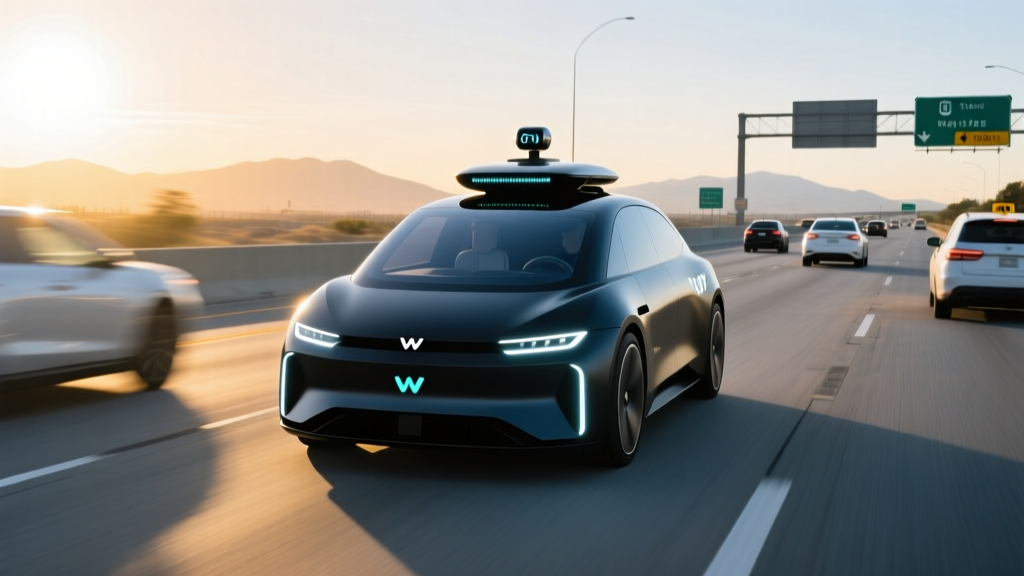
If you've hailed a Waymo One ride in Phoenix, San Francisco, or Los Angeles, you've likely noticed the car sticks to surface streets — even when a freeway on-ramp is right there. That raises a practical question for anyone planning a trip: does Waymo take highways?
The short answer in 2026 is nuanced. Waymo's sixth-generation robotaxi can handle some limited-access roads, but full freeway routing remains restricted in most markets. Here's exactly where Waymo operates, what its highway capabilities look like today, and how the service compares to rideshare on price, safety, and coverage.
SAE Automation Levels: Where Waymo Actually Sits
Before mapping routes, it's critical to understand what "self-driving" means here. Consumer systems like Tesla's FSD (Supervised), GM's Super Cruise, and Ford's BlueCruise are SAE Level 2 driver-assist — the human must remain engaged and legally responsible. Waymo One is a fundamentally different category.
| SAE Level | Definition | Example | Driver Required? |
|---|---|---|---|
| Level 2 | Partial automation — steering + acceleration assisted | Tesla Autopilot, GM Super Cruise, Ford BlueCruise | Yes, always |
| Level 3 | Conditional automation — system drives in narrow conditions | Mercedes DRIVE PILOT (limited markets) | No, but must be ready to resume |
| Level 4 | High automation — no driver needed within operational design domain | Waymo One, Zoox | No (within geofence) |
| Level 5 | Full automation — any road, any condition | Does not exist commercially | No |
Source: SAE International J3016
Waymo One operates at SAE Level 4: no driver in the front seat, no steering wheel interaction, no human fallback — but only within a tightly defined Operational Design Domain (ODD). That ODD is the key to answering the highway question.
Where Can I Use Waymo Right Now?
As of early 2026, Waymo One is commercially available to the general public (no waitlist) in these core markets:
| Metro Area | Status | Approx. Service Area | Highway Segments Enabled |
|---|---|---|---|
| Phoenix, AZ (East Valley) | Live, open to all | ~315 sq mi (Chandler, Gilbert, Mesa, Tempe, parts of Scottsdale) | Select segments: Loop 101, Loop 202, portions of I-10 and US-60 |
| San Francisco, CA | Live, open to all | ~47 sq mi (most of SF proper) | Limited: portions of I-280, US-101 within city limits; no Bay Bridge or Golden Gate Bridge routing |
| Los Angeles, CA | Live, open to all | ~80+ sq mi (Santa Monica, Hollywood, Downtown, Mid-City, expanding) | Limited surface-adjacent freeway segments under evaluation |
| Austin, TX | Live (limited rollout) | Downtown + select corridors | Not yet enabled |
Phoenix remains the only market where Waymo routinely routes passengers on freeway segments as part of normal trips. In San Francisco and LA, the car will generally decline a route that requires freeway travel and suggest surface-street alternatives — even if the freeway would be faster.
So, Does Waymo Take Highways — and Why the Restriction?
Highway driving sounds simpler than city driving: no pedestrians, no cross-traffic, predictable lanes. But for a Level 4 system with no human fallback, highways introduce distinct engineering challenges:
- Speed and reaction time: At 65–75 mph, stopping distances triple versus 25 mph urban streets. Sensor range and compute latency budgets shrink.
- Merging and lane changes: Highway on-ramps require aggressive negotiation with human drivers who don't always yield — a socially complex maneuver.
- Edge-case consequences: A stalled vehicle, debris in a lane, or emergency-vehicle approach at highway speed demands split-second rerouting with no shoulder to pull onto in many corridors.
- Geofence boundary handoffs: If the ODD ends mid-freeway, the car needs a safe pull-off strategy — hard to guarantee everywhere.
Waymo has addressed these incrementally. Phoenix freeway segments were enabled after years of mapping and validation; other cities will follow as the sixth-generation hardware stack (with longer-range lidar and improved compute) accumulates highway miles in testing. But as of 2026, most Waymo trips are surface-street trips, and the app will tell you before you confirm a ride if freeway routing isn't available.
Waymo Pricing vs Uber and Lyft: Real Numbers
Robotaxi rides aren't cheaper than rideshare in every case — yet. Waymo uses dynamic pricing similar to Uber/Lyft, but without a human driver to pay, the cost structure is fundamentally different. Here's a representative comparison based on sampled fares in early 2026:
| Route (approx.) | Waymo One | UberX | Lyft Standard |
|---|---|---|---|
| Phoenix: Chandler Mall → Sky Harbor Airport (~18 mi) | $32–$42 | $28–$38 | $26–$36 |
| SF: Mission District → SFO (~14 mi) | $38–$52 | $34–$48 | $32–$45 |
| LA: Santa Monica → LAX (~8 mi) | $22–$30 | $18–$28 | $17–$26 |
| Short urban hop (~3 mi) | $10–$15 | $10–$16 | $9–$14 |
Fares vary by time of day, demand, and route. Waymo occasionally offers promotional credits for new riders.
Key takeaways: Waymo is generally price-competitive with UberX and Lyft, sometimes slightly higher on longer routes (partly because surface-street routing adds time when freeway isn't available), and sometimes slightly lower on short hops. Tipping is not expected (there's no driver), though the app allows it. Waymo also offers Waymo Via delivery in some markets, but that's a separate service from the passenger robotaxi.
How Safe Are Waymo Robotaxis? The Data
Safety is the most scrutinized question in autonomous vehicles, and Waymo publishes more data than any competitor. Here's what the numbers show:
Waymo Safety Record (through 2025 data, published 2025–2026)
- Cumulative autonomous miles driven: Over 50 million fully driverless miles across all markets (Waymo Safety Report).
- Injury-causing crash rate: Waymo's driverless fleet showed an 85% reduction in injury-causing crashes compared to human benchmarks in the same geographies, per a study co-authored with Swiss Re.
- Police-reported crash rate: Approximately 6x lower than human drivers in comparable urban environments.
- Contact incidents: The vast majority of Waymo-involved incidents are low-speed (under 15 mph), rear-end or side-swipe contacts where the other party is at fault — often human drivers rear-ending a Waymo that stopped cautiously.
- NHTSA Standing General Order: Waymo reports all qualifying incidents to NHTSA under SGO 2021-01, the same mandate covering Tesla, Cruise, and other ADS developers.
For context, the IIHS reports roughly 1.33 fatalities per 100 million vehicle miles for human drivers nationally. Waymo has not reported a passenger fatality in its driverless commercial service. That's not a guarantee — the sample size is still small relative to the trillions of human-driven miles annually — but the directional signal is strong.
Notable incident context: In late 2023, a Cruise robotaxi (a GM competitor, not Waymo) dragged a pedestrian in San Francisco, triggering a statewide suspension and ultimately causing Cruise to pause operations nationally. That event underscored how fragile public and regulatory trust is for Level 4 systems. Waymo's more conservative ODD strategy — including its highway caution — reflects lessons from that incident.
Technology Stack: Lidar, Cameras, and Geofencing
Waymo's approach diverges sharply from Tesla's camera-only philosophy. The sixth-generation Waymo Driver (introduced 2024, deployed through 2025–2026) uses a redundant sensor suite:
Waymo 6th-Gen Hardware
- Lidar: Multiple units providing 360° 3D point clouds, with improved range (>500 m) and resolution over 5th-gen. Lidar is the core sensor for object detection and distance measurement regardless of lighting.
- Cameras: High-resolution surround cameras for lane markings, traffic-light state, sign reading, and classification. Now with improved low-light and high-dynamic-range performance.
- Radar: Imaging radar for velocity measurement of moving objects and all-weather penetration (rain, fog).
- Audio detection: External microphones to detect emergency-vehicle sirens and adjust behavior (pull over, yield).
- Compute: Custom-designed onboard computers with redundant processing paths. If one compute module fails, the vehicle can still execute a safe stop.
- HD mapping: Centimeter-accurate pre-built maps of every operational street, updated continuously. The car localizes within this map in real time — this is why Waymo can't simply "drive anywhere" the way a human can.
The geofence isn't just a line on a map. It's a volumetric definition of where the system has been validated: every lane, every intersection geometry, every signal phase has been mapped and tested. Expanding the geofence — including onto highways — requires re-mapping, simulation, and on-road validation before the ODD is updated.
The Regulatory Landscape: Who Approves Robotaxi Operations?
Robotaxi deployment in the US isn't federally licensed the way aircraft are. Instead, it's a patchwork:
- California (CPUC + DMV): The California Public Utilities Commission issues commercial passenger-service permits; the DMV issues testing and deployment permits. Both must be maintained. After the Cruise incident, CPUC tightened reporting requirements.
- Arizona: The least restrictive major robotaxi market. No state-level permit regime equivalent to California's; Waymo has operated commercially in Phoenix since 2020 under general business and vehicle-registration rules.
- Texas: Austin operations began under a more permissive state framework, with local coordination.
- Federal (NHTSA): Sets vehicle safety standards (FMVSS) and investigates defects. NHTSA has granted limited exemptions for vehicles without steering wheels (like the Zoox carriage and GM Cruise Origin), but Waymo's current fleet uses stock Jaguar I-PACE and Zeekr vehicles with conventional controls.
For consumers, the practical effect is that expansion is city-by-city, state-by-state, and a regulatory incident in one market can slow approvals elsewhere. This is why Waymo's highway rollout will likely be gradual and market-specific rather than a single "highway mode" flip.
Current Limitations: What Waymo Still Can't Do
- No cross-city or intercity trips: You can't take a Waymo from San Francisco to Sacramento or Phoenix to Tucson. The geofence is bounded.
- Limited highway access outside Phoenix: As detailed above, SF and LA freeway routing is restricted or unavailable.
- Weather constraints: Heavy rain, dense fog, or snow can trigger the system to pull over or decline rides. Phoenix's dry climate is one reason it was the launch market.
- No airport curbside everywhere: Sky Harbor (PHX) and SFO have approved Waymo pickup/dropoff zones, but procedures vary and some terminal areas remain restricted.
- Construction zones: While Waymo handles routine construction rerouting, long-term complex work zones may be avoided or cause trip cancellations.
- Pets and car seats: Service animals are permitted; personal pets and child car seats are generally not allowed under current policy.
- Accessibility: Waymo has deployed wheelchair-accessible vehicles (WAVs) in Phoenix, but availability is limited and not yet universal across markets.
These limitations aren't permanent — they're the current edges of the ODD. Each one requires engineering validation and, often, regulatory approval before expansion.
Frequently Asked Questions
Can I take a Waymo to the airport?
Yes, in Phoenix (Sky Harbor) and San Francisco (SFO), Waymo has approved pickup and dropoff zones. In LA, LAX access has been in pilot phases — check the Waymo One app for current availability, as airport policies evolve.
Is Waymo truly self-driving, or is there a remote operator?
Waymo vehicles are fully driverless — no one is in the driver's seat, and no remote human is "joystick-driving" the car. Waymo does have a remote assistance team that can provide guidance in ambiguous situations (e.g., confirming whether a police officer's hand signal means "go" or "stop"), but the car executes all driving actions autonomously. This is a Level 4 architecture, not teleoperation.
How do I hail a Waymo?
Download the Waymo One app (iOS/Android), create an account, enter your pickup and dropoff within the service area, confirm the fare, and walk to the designated pickup spot. The app shows the car's approach in real time. You unlock it via the app when it arrives.
What vehicle does Waymo use?
The current fleet primarily uses the all-electric Jaguar I-PACE (90 kWh battery, EPA range ~234 mi) retrofitted with the Waymo Driver. Newer deployments are beginning to integrate the purpose-built Zeekr M-Vision (a Geely-designed robotaxi platform with no steering wheel in its final form). Both are battery-electric.
Will Waymo ever work in my city?
Expansion depends on mapping, testing, regulatory approval, and market economics. Waymo has announced plans to explore additional US metros, but timelines are measured in years, not months. Each new city requires building HD maps from scratch and validating the ODD.
What happens if the car encounters something it can't handle?
The vehicle will execute a minimal-risk condition — typically pulling to the curb or stopping safely — and contact remote assistance. If the situation can't be resolved, the ride ends and you're charged only for distance covered. Waymo's conservative approach means it will decline a route or stop rather than guess in an unsafe scenario.
Bottom Line: Highway Access Is Coming, but Not Everywhere Yet
To directly answer the question: Waymo does take highways — but only in Phoenix, and only on specific mapped segments. In San Francisco, Los Angeles, and Austin, expect surface-street routing for the foreseeable future. This is a deliberate engineering and regulatory choice, not a hardware limitation. Waymo's sixth-generation stack is capable of highway operation; the bottleneck is validation within each market's ODD.
For riders, the practical implication is that Waymo excels at urban and suburban trips within its geofence — airport runs, dinner across town, commuting within the service area. If your trip requires 30 miles of interstate, Waymo probably isn't the right tool yet. As the ODD expands through 2026 and beyond, expect highway segments to unlock city by city, with Phoenix's playbook serving as the template.
For the autonomous-vehicle industry, Waymo's cautious, data-driven expansion stands in contrast to the "ship it and iterate" approach that cost Cruise its operating permit. The highway question is ultimately a proxy for a bigger one: can Level 4 robotaxis scale beyond sunny, well-mapped cities into the full complexity of American driving? The answer is yes — but on a timeline measured in validation miles, not marketing announcements.