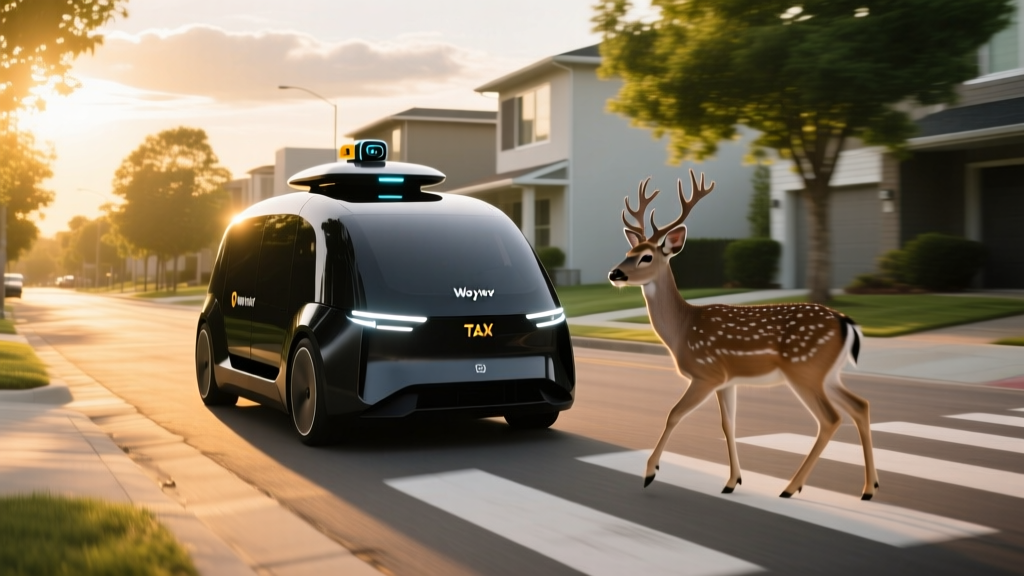
It's a question that comes up in almost every robotaxi forum thread: does Waymo stop for animals? Whether it's a deer darting across a Phoenix boulevard at dusk or a stray dog wandering through a San Francisco crosswalk, how a driverless vehicle handles an unpredictable, non-human road user is one of the sharpest tests of autonomous perception. The short answer is yes — Waymo's 6th-generation sensor stack detects, classifies, and reacts to animals — but the nuance of how and how reliably matters far more than a binary answer.
This article breaks down the technology that makes animal detection possible, where Waymo actually operates today, what the safety data says, and what limitations still exist when a four-legged obstacle enters the roadway.
Waymo Is SAE Level 4 — Here's Why That Matters for Edge Cases
SAE Automation Level: Level 4 (High Automation)
Waymo One operates at SAE Level 4, meaning the system performs all driving tasks within its defined Operational Design Domain (ODD) — specific geofenced areas under mapped conditions — with no human driver required. This is fundamentally different from Level 2 driver-assist systems like Tesla Autopilot, GM Super Cruise, or Ford BlueCruise, which require continuous driver supervision. When a Waymo vehicle encounters a deer, there is no human to fall back on; the vehicle must resolve the situation autonomously or execute a safe stop.
This distinction is critical for understanding animal encounters. A Level 2 system can hand the problem back to the driver with a disengagement alert. A Level 4 robotaxi cannot. That engineering constraint is precisely what forces Waymo to invest so heavily in redundant perception — the system must handle edge cases like wildlife on its own, every time, or pull over safely.
| Level | Name | Driver Role | Examples |
|---|---|---|---|
| Level 2 | Partial Automation | Must supervise at all times | Tesla Autopilot/FSD Supervised, BlueCruise, Super Cruise |
| Level 3 | Conditional Automation | Can disengage in approved conditions; must take over on request | Mercedes DRIVE PILOT (limited markets) |
| Level 4 | High Automation | No driver needed within ODD | Waymo One, Zoox (limited service) |
| Level 5 | Full Automation | No driver needed anywhere | Does not exist commercially |
The Sensor Stack: How Waymo Sees a Deer Before You Would
Waymo's 6th-generation "Waymo Driver" hardware suite, deployed across its current Jaguar I-PACE and Zeekr RT fleet, uses a sensor-fusion approach that combines three complementary perception modalities. This redundancy is what gives the system an advantage over human vision in many animal-encounter scenarios.
Waymo 6th-Gen Perception Stack
- LiDAR: Multiple roof-mounted and bumper-integrated units providing a 360° 3D point cloud. LiDAR detects objects by shape and distance regardless of lighting — critical for spotting a low-reflectivity animal at night.
- Cameras: High-resolution surround cameras with improved low-light performance for classification (distinguishing a dog from a trash bag from a child).
- Radar: Imaging radar for velocity tracking and operation in rain or fog where LiDAR and cameras degrade.
- Audio detection: External microphones that detect emergency vehicle sirens; contributes to situational awareness.
Why this matters for animals: A human driver at night might not see a dark-colored dog until it's 30–40 feet away at 35 mph. Waymo's LiDAR detects the object's 3D profile at 150+ meters and the perception model classifies it as "animal" well before the vehicle reaches it. The system then adjusts speed, lane position, or executes a stop based on predicted trajectory.
Waymo does not rely on a camera-only approach (unlike Tesla's FSD architecture). The LiDAR redundancy means the system has a ranging modality that works identically in pitch darkness, direct sun glare, and moderate rain — conditions where animal encounters are most common and most dangerous for human drivers.
Where Can You Actually Ride a Waymo Robotaxi Right Now?
As of early 2026, Waymo One — the company's commercial ride-hailing service — operates in a defined set of metro areas. Expansion is incremental and gated by regulatory approval, mapping completion, and safety validation in each new zone.
| City | Status | Service Area Notes |
|---|---|---|
| Phoenix, AZ | Fully operational | ~600+ sq mi coverage including Chandler, Tempe, Mesa, Scottsdale, Sky Harbor airport |
| San Francisco, CA | Fully operational | Most of SF proper; expanded to include highway segments |
| Los Angeles, CA | Fully operational | Downtown LA, Hollywood, Westside, portions of the Valley |
| Austin, TX | Operational / expanding | Core metro with ongoing ODD expansion |
| Atlanta, GA | Announced / limited launch | Initial zones active; full rollout phased through 2026 |
Geofencing is the key constraint. Waymo vehicles will not operate outside their mapped ODD. If you request a ride that exits the approved zone, the app simply won't allow it. This also means rural roads with high wildlife density — where deer and elk collisions are most common — are generally outside Waymo's current operating areas. The animal encounters Waymo handles are overwhelmingly urban and suburban: stray dogs, cats, coyotes (in Phoenix and LA), and occasionally deer in suburban fringe zones.
Safety Data: What the Numbers Actually Say
Waymo Safety Record — Key Data Points
- Cumulative autonomous miles driven: Over 50 million fully driverless miles as of late 2025 (NHTSA AV data reporting).
- Property-damage crash rate: Waymo's published analysis (peer-reviewed with the Swiss Re partnership) showed a 76% reduction in property-damage crash rate compared to human benchmarks.
- Injury-causing crash rate: Approximately 85% lower than human drivers in comparable urban environments, per Waymo's validated claims methodology.
- Animal-specific incidents: No publicly reported at-fault collisions with large animals. Waymo's safety reports categorize these under "roadway object avoidance" — the vehicle typically executes a controlled deceleration or stop rather than a swerving maneuver.
It's important to contextualize these numbers. Waymo operates primarily in dense urban environments at moderate speeds (25–45 mph typical). The most severe animal-vehicle collisions in the US occur on rural highways at 55–70 mph — scenarios Waymo doesn't currently encounter. So while the data is genuinely strong for the environments where Waymo operates, it's not directly comparable to the 1.5 million deer-vehicle collisions the Insurance Information Institute estimates annually across all road types.
What the data does confirm: in urban and suburban zones, Waymo's sensor fusion and conservative driving policy (the vehicle tends to decelerate and wait rather than swerve aggressively) results in strong avoidance behavior for unexpected roadway obstacles, including animals.
How to Use Waymo One — and What It Costs vs. Uber or Lyft
Riding in a Waymo is straightforward if you're in an active service zone:
- Download the Waymo One app (iOS/Android).
- Create an account — no waitlist in most operational cities as of 2026.
- Enter your pickup and dropoff. The app confirms whether both points are within the ODD.
- A white Jaguar I-PACE or Zeekr RT pulls up. Unlock via the app by tapping the vehicle icon when it arrives.
- No driver. The car starts the trip automatically once you buckle up.
| Metric | Waymo One | UberX | Lyft Standard |
|---|---|---|---|
| Base fare | ~$5.50 | ~$3.50–$5.00 | ~$3.00–$4.50 |
| Per-mile rate | ~$1.75 | ~$1.30–$1.80 | ~$1.20–$1.70 |
| Per-minute rate | ~$0.40 | ~$0.30–$0.45 | ~$0.28–$0.42 |
| 5-mile / 15-min trip estimate | $18–$22 | $16–$24 | $15–$22 |
| Surge pricing | Rare / capped | Frequent / uncapped | Frequent / uncapped |
| Tipping | Not applicable | Expected ($2–$5) | Expected ($2–$5) |
The pricing is competitive — sometimes slightly higher than rideshare on paper, but Waymo's lack of surge multipliers and no tipping expectation often makes the final cost comparable or lower during peak demand. You're also paying for consistency: the vehicle doesn't cancel on you, doesn't rate you, and doesn't make conversation.
Current Limitations: Where Waymo (and All Robotaxis) Still Struggle
Waymo's system is remarkably capable within its ODD, but it's not omnipotent. Understanding these constraints is essential — especially when thinking about animal encounters.
Known Limitations of Waymo's Level 4 System
- Heavy rain and fog: LiDAR point-cloud quality degrades in heavy precipitation. Waymo may reduce speed, increase following distance, or in severe conditions, pause service and pull over safely.
- Geofence boundaries: The vehicle will not drive outside its mapped zone. No rural highways, no unmapped construction detours.
- Unprotected left turns in complex intersections: Waymo has improved here dramatically, but multi-lane unprotected lefts with heavy cross-traffic can still result in extended wait times or rerouting.
- Construction zones with shifted lanes: If lane markings are obscured and cones reconfigure the road in ways not yet mapped, the vehicle may stop and request remote guidance.
- Small animals at high relative speed: A squirrel darting into the road at close range may not trigger a full stop — the system weighs braking severity against rear-end collision risk, just as a human driver must. Waymo will not slam the brakes at 35 mph for a squirrel if a truck is 10 feet behind.
- Off-road or unpaved surfaces: Not supported. Waymo requires paved, mapped roads.
- Extreme weather events: Snow-covered roads (rare in current cities) or flooding will suspend operations.
On the animal question specifically: Waymo's decision-making framework classifies obstacles by size, predicted trajectory, and collision risk. A large animal (deer, dog, coyote) triggers conservative deceleration and avoidance. A small animal (squirrel, bird) in a situation where hard braking would risk a rear-end collision may result in the vehicle maintaining course — the same calculus a defensive human driver makes. The system is not "unaware" of the squirrel; it's making a risk-weighted decision.
Regulatory Oversight: Who Approves Robotaxi Operations?
Robotaxi deployment in the US involves a patchwork of state and federal oversight:
- Federal (NHTSA): Sets vehicle safety standards and requires crash/incident reporting for AVs. NHTSA's Standing General Order mandates that Level 4 operators report crashes involving their vehicles. NHTSA does not "approve" AV technology — it regulates post-deployment safety.
- State DMVs and PUCs: California's DMV issues testing and deployment permits. The California Public Utilities Commission (CPUC) regulates commercial passenger service. Arizona takes a lighter-touch approach via executive order. Texas and Georgia have their own frameworks.
- Local municipalities: Cities negotiate operating agreements covering pickup/dropoff zones, data sharing, and equity requirements.
This regulatory fragmentation means Waymo's expansion is city-by-city, state-by-state — not a single national approval. Each new metro area requires mapping, regulatory negotiation, and phased deployment.
Frequently Asked Questions
Does Waymo stop for deer and large animals?
Yes. Waymo's LiDAR and camera fusion detects large animals at significant range (100+ meters in clear conditions) and the driving policy defaults to conservative deceleration and stopping. In Waymo's current urban/suburban operating areas, large-animal encounters are relatively rare but the system is designed to handle them.
Is Waymo actually self-driving or is there a remote human driver?
Waymo vehicles are genuinely driverless — there is no human behind the wheel and no remote joystick operator. The system is SAE Level 4. Waymo does employ remote guidance operators who can answer questions like "is this cone marking a closed lane?" but they do not steer or brake the vehicle in real time.
How does Waymo compare to Tesla FSD for handling animals?
These are fundamentally different systems. Tesla FSD (Supervised) is SAE Level 2 — the driver must remain engaged and is ultimately responsible for all driving decisions, including animal avoidance. Waymo is Level 4 with no driver present. Tesla uses a camera-only vision stack; Waymo uses LiDAR + cameras + radar. Comparing their animal-detection capability directly is difficult because Tesla's system expects the human to intervene, while Waymo's must resolve the situation independently.
What happens if a Waymo vehicle encounters an animal it can't classify?
If the perception system detects an object but cannot confidently classify it, the default behavior is conservative: reduce speed, increase distance, or stop. The vehicle will not assume an unknown object is safe. If the situation cannot be resolved, the vehicle will pull over safely and may request remote guidance to proceed.
Has a Waymo vehicle ever hit an animal?
Waymo does not publish granular animal-strike data separately. Their safety reports aggregate "roadway object" incidents. No publicly documented at-fatal or at-fault large-animal collision has been reported in Waymo's commercial operations through early 2026. Minor contacts with small animals in unavoidable scenarios may occur, as they do with human drivers.
Can I request a Waymo ride outside the city, where wildlife is more common?
No. Waymo operates only within its geofenced ODD, which covers urban and suburban areas. Rural highways and back roads — where the majority of serious deer-vehicle collisions occur — are not part of the service area. If your destination is outside the zone, the app will not allow the request.
The Bottom Line on Waymo and Animal Encounters
Waymo's 6th-generation system handles animal encounters with a combination of long-range LiDAR detection, multi-sensor classification, and a fundamentally conservative driving policy that prioritizes controlled deceleration over aggressive maneuvering. In the urban and suburban environments where Waymo operates, this approach has produced a strong safety record with no publicly reported at-fault large-animal collisions.
The honest caveat: Waymo doesn't operate on the rural highways where the most dangerous wildlife collisions happen. And in edge cases — a squirrel at close range with a tailgating truck behind — the system makes the same risk-weighted decision a defensive human driver would. It's not infallible, but within its defined operating domain, it's demonstrably capable of detecting and responding to animals more consistently than the average human driver, particularly at night and in low-visibility conditions where LiDAR's ranging advantage is most pronounced.