Quick Answer: Does Waymo Go to the Airport?
Yes — Waymo One serves several major airports as of 2026, but availability depends entirely on which city you're in. San Francisco International Airport (SFO) has had Waymo service since mid-2024, Phoenix Sky Harbor (PHX) is covered within its expansive metro geofence, and Los Angeles International Airport (LAX) was added to the service area in late 2024. However, not every terminal pickup is identical, and geofence boundaries can change without much notice.
If you've ever stood at a curb wondering whether to open the Waymo app or default to Uber, this guide breaks down exactly where Waymo operates at airports, what it costs, how safe the service is, and the real-world limitations you'll encounter as a rider.
Where Can You Use Waymo Right Now?
Waymo One — the company's commercial rider-hailing service — operates in a limited but growing set of metro areas. Unlike Uber or Lyft, which cover nearly everywhere, Waymo is restricted to pre-mapped geofenced zones. Here's the current landscape:
| Metro Area | Service Status | Airport Access | Approximate Coverage Area |
|---|---|---|---|
| San Francisco Bay Area | Fully operational | SFO (all terminals), partial OAK coverage | ~80+ sq mi across SF, parts of Oakland, Daly City, South SF |
| Phoenix, AZ | Fully operational | PHX Sky Harbor | ~225+ sq mi covering Phoenix, Scottsdale, Tempe, Mesa, Chandler |
| Los Angeles, CA | Fully operational | LAX (designated pickup zones) | ~80+ sq mi across West LA, Hollywood, Downtown, Santa Monica |
| Austin, TX | Limited/early rider | AUS (partial geofence) | Expanding; central Austin core |
Phoenix has the broadest coverage by area, while San Francisco has the densest urban mapping. Los Angeles service has expanded steadily since its 2024 public launch, with LAX airport trips becoming a reliable option for Westside travelers. Austin remains in a more limited rollout phase.
Key constraint: You must be within the geofenced zone at both your pickup and dropoff. If your destination falls outside Waymo's mapped territory, the app will not let you book the ride — even if the route passes through covered areas.
Waymo at the Airport: How Pickup Actually Works
Airport rides are one of the most common use cases for Waymo, but the experience differs from a standard curbside hail. Here's what to expect:
- SFO: Waymo vehicles pick up at designated zones on the Departures/Ticketing level. The app guides you to the correct door and pillar number after you confirm your ride. Drop-offs work at any terminal.
- LAX: Pickup is available at LAX-it or designated rideshare areas depending on terminal. The Waymo app provides walking directions to the correct zone.
- PHX: Sky Harbor pickup is available at the designated rideshare zones outside each terminal. Phoenix's grid layout makes for some of Waymo's smoothest airport operations.
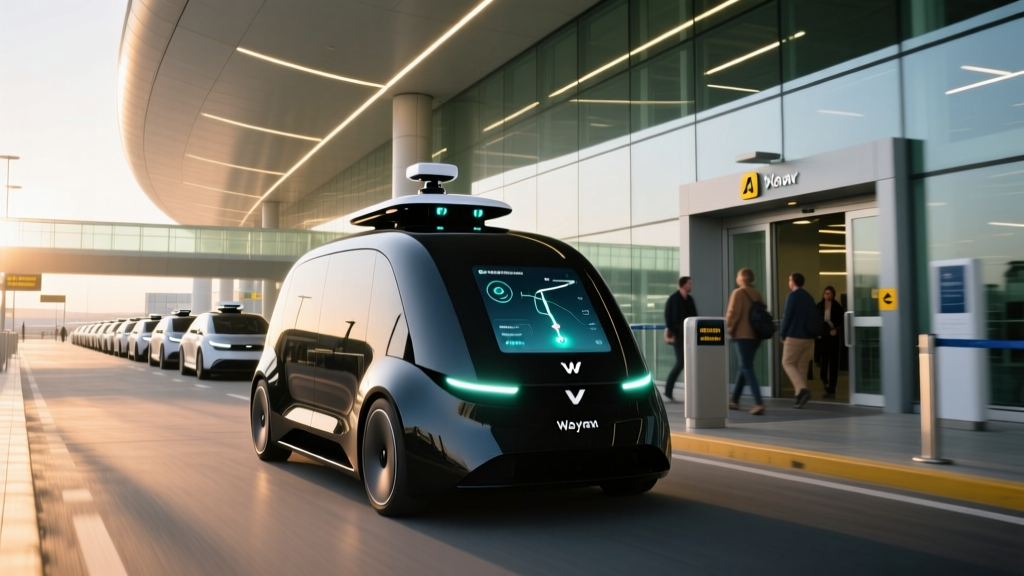
In our experience, airport pickups add 3–7 minutes of wait time compared to a street-level urban hail, largely because you need to navigate to the designated zone with your luggage. The vehicles themselves — primarily the all-electric Jaguar I-PACE and the newer Zeekr RT1 custom robotaxi — are easy to spot with their prominent roof-mounted lidar arrays and Waymo branding.
How Much Does Waymo Cost vs. Uber and Lyft?
Pricing is where many riders expect robotaxis to have a massive advantage — no human driver to pay. The reality is more nuanced. Waymo uses dynamic pricing that fluctuates with demand, similar to rideshare surge pricing, though the company has stated its goal is to eventually undercut traditional rideshare as fleet scale increases.
| Route | Waymo One | UberX | Lyft Standard |
|---|---|---|---|
| SFO → Downtown SF (~14 mi) | $28–$42 | $25–$45 | $24–$43 |
| LAX → Santa Monica (~8 mi) | $22–$35 | $20–$38 | $19–$36 |
| PHX Sky Harbor → Scottsdale (~10 mi) | $18–$28 | $17–$30 | $16–$29 |
| Downtown SF → Mission District (~3 mi) | $10–$16 | $9–$18 | $9–$17 |
The bottom line: Waymo pricing is generally competitive with UberX and Lyft Standard — sometimes slightly cheaper on short urban hops, sometimes slightly more expensive during airport peak hours. You won't save dramatically yet, but you also won't pay a premium. The value proposition right now is the novelty and consistency of a driverless ride, not deep discounts.
Waymo occasionally offers promotional pricing for new riders in newly launched cities. Tipping is not expected (there's no driver), though the app does offer an option to leave a "cleaning fee" contribution if you've made a mess.
Is Waymo Actually Self-Driving? Understanding SAE Levels
SAE Automation Level: Level 4 (High Automation)
Waymo vehicles operate at SAE Level 4 — meaning they handle all driving tasks within their defined operational design domain (ODD) without any human driver or remote teleoperator controlling the vehicle in real time. There is no one behind the wheel. This is fundamentally different from consumer driver-assist systems.
| SAE Level | Name | Who Drives? | Examples |
|---|---|---|---|
| Level 0 | No Automation | Human does everything | Traditional gas cars |
| Level 1 | Driver Assistance | Human + one assist feature | Adaptive cruise control, lane keep |
| Level 2 | Partial Automation | Human supervises at all times | Tesla Autopilot/FSD, GM Super Cruise, Ford BlueCruise |
| Level 3 | Conditional Automation | System drives; human takes over when requested | Mercedes DRIVE PILOT (limited markets/conditions) |
| Level 4 | High Automation | No human driver needed in defined zone | Waymo One, Zoox (limited areas) |
| Level 5 | Full Automation | No human needed anywhere, ever | Does not yet exist commercially |
This distinction matters enormously. When you read about Tesla's Full Self-Driving or Ford BlueCruise incidents, those are Level 2 systems where a human driver is legally responsible. Waymo vehicles have no steering wheel controls accessible to passengers and no expectation that you'll intervene. The company — not the rider — bears liability for the driving task within its service area.
Waymo's Safety Record: What the Data Shows
Safety Data Snapshot
- Cumulative autonomous miles driven: Over 40 million fully driverless miles (as of early 2026)
- Fatalities involving Waymo driverless vehicles: Zero reported as of publication
- Injury-causing crashes: Waymo's published data shows a significantly lower rate of injury-causing crashes per million miles compared to human-driver benchmarks in the same operating cities
- Common incident types: Low-speed contact events (e.g., being rear-ended at stoplights), not at-fault in the majority of documented cases
Waymo has published safety data comparing its crash rates to human benchmarks. According to data the company submitted to NHTSA and published in its own safety reports, Waymo vehicles experienced roughly 85% fewer injury-causing crashes per million miles than human drivers in comparable urban environments. However, this comparison has limitations — Waymo operates in mapped, geofenced areas and avoids the most dangerous road types (unpaved roads, extreme weather conditions).
The service is not incident-free. Waymo vehicles have been involved in low-speed collisions, often when other human drivers rear-end the robotaxi at stops. There have also been high-profile edge cases, such as vehicles encountering unexpected construction zones or emergency scenes. Waymo's response is to pull over safely and contact remote assistance (not remote driving — the remote team provides high-level guidance like "proceed" or "wait," while the vehicle's onboard system still executes all driving maneuvers).
For context, the Insurance Institute for Highway Safety (IIHS) has noted that while robotaxi safety data is promising, the sample sizes remain small compared to the billions of miles driven by humans annually. The data is directionally positive but not yet definitive at a national scale.
Under the Hood: Waymo's Technology Stack
Understanding how Waymo's vehicles perceive the world helps explain both the service's strengths and its limitations. Waymo's approach is sensor-heavy and stands in stark contrast to Tesla's camera-only FSD strategy.
Waymo 6th-Generation Driver System — Key Sensors
- LiDAR: Multiple roof-mounted and body-mounted units providing 360° 3D point-cloud mapping up to 500+ meters, functioning in total darkness
- Cameras: High-resolution surround cameras for object classification, traffic light state detection, and sign reading
- Radar: Imaging radar for velocity detection of moving objects, redundancy in rain/fog
- Audio detection: External microphones to detect emergency vehicle sirens
- HD Maps: Centimeter-precision pre-mapped routes updated continuously — the vehicle knows every lane, curb, and signal before it arrives
This sensor fusion approach gives Waymo a critical advantage in redundancy. If cameras are washed out by sun glare, lidar still maps the environment. If rain degrades lidar range, radar maintains object tracking. The tradeoff is cost — each Waymo vehicle carries an estimated $100,000+ in sensor hardware, though costs have dropped substantially with each generation.
The system relies on geofencing: Waymo only operates in areas it has exhaustively mapped and validated. This is why Waymo can't simply expand to any city overnight — each new area requires months of mapping, testing, and regulatory approval before riders are allowed.
Regulatory Landscape: Who Approves Robotaxi Operations?
Robotaxi operations in the United States exist at the intersection of federal vehicle safety standards and state-level deployment permits. There is no single "robotaxi license" — it's a patchwork:
- Federal (NHTSA): Sets vehicle safety standards (FMVSS). NHTSA has granted limited exemptions allowing vehicles without steering wheels (like Zoox) to operate, and tracks crash reporting through Standing General Orders.
- State — California (CPUC + DMV): The California Public Utilities Commission issues permits for commercial passenger service. The DMV issues testing and deployment permits. Waymo holds both. The CPUC can revoke permits — as it effectively did to Cruise in late 2023 following a serious incident in San Francisco.
- State — Arizona: Largely self-certification model. Arizona has been the most permissive state for autonomous vehicle deployment, which is why Phoenix was Waymo's first commercial market.
- Local municipalities: Cities can impose additional restrictions on operating hours, zones, and fleet sizes. San Francisco's Board of Supervisors has held multiple hearings on robotaxi expansion limits.
The Cruise suspension in late 2023 — following an incident where a pedestrian was dragged by a Cruise vehicle after being struck by a human-driven car — demonstrated that regulators will act decisively when safety concerns arise. Cruise did not resume driverless operations until mid-2024 under strict conditions, and ultimately GM shut down the Cruise robotaxi division in early 2025 to consolidate autonomous efforts.
Current Limitations: What Waymo Cannot Do
Know Before You Ride — Waymo Limitations
- Geofence boundaries: Waymo cannot pick up or drop off outside its mapped service area. If your hotel is 200 feet outside the geofence, the app will not allow the booking.
- Weather restrictions: Heavy rain, fog, or flooding can cause Waymo to suspend service in affected areas. Phoenix's monsoon season occasionally triggers pauses. San Francisco fog generally does not disrupt service, but extreme conditions can.
- Construction zones: While Waymo can navigate many construction areas, major unanticipated road closures or complex temporary lane shifts may cause the vehicle to pull over and wait for remote guidance.
- No highway driving (most areas): Waymo's geofenced routes primarily use surface streets. Some freeway segments are included in Phoenix, but the system does not handle long highway corridors the way a human driver would.
- Passenger limits: Typically 1–3 adult passengers in the rear seats. No front-seat riding. Car seats and large luggage may not fit comfortably in the I-PACE.
- No stops along the route: You cannot ask the vehicle to stop at a drive-through, wait while you run into a store, or make multiple stops. It's point-A to point-B only.
- Accessibility: Waymo has been working on wheelchair-accessible vehicle options, but availability remains limited. The I-PACE fleet is not wheelchair-accessible by default.
How to Use Waymo One: Step by Step
- Download the Waymo One app (iOS/Android) and create an account. You'll need a valid payment method.
- Confirm you're in a service area. The app shows the geofence boundary on a map.
- Enter your destination. If both pickup and dropoff are within the zone, you'll see a price estimate and ETA.
- Walk to the designated pickup point. At airports, this is a specific zone — follow in-app directions.
- Verify the vehicle. The app shows the car's location, license plate, and a unique code or name to confirm it's your ride.
- Unlock and ride. Tap "Start Ride" in the app when you're inside. Screens in the backseat show the route and let you control music and climate.
- Exit at your destination. The vehicle will pull over at the nearest safe spot to your pin. Check for belongings — there's no driver to remind you.
Frequently Asked Questions
Does Waymo go to SFO airport?
Yes. Waymo One serves all terminals at San Francisco International Airport. Pickup is at designated zones on the Departures level. The app provides walking directions to the correct door and pillar. Drop-offs are available at any terminal.
Does Waymo go to LAX airport?
Yes, as of late 2024, Waymo serves LAX with pickup at designated rideshare zones. Coverage depends on your origin being within the LA geofence (Westside, Hollywood, Downtown, Santa Monica, and expanding areas).
Can I take Waymo to Phoenix Sky Harbor?
Yes. Phoenix was Waymo's first commercial market and Sky Harbor is well within the service geofence. The Phoenix metro area has the broadest Waymo coverage of any city — over 225 square miles.
Is Waymo cheaper than Uber?
Generally comparable. On most routes, Waymo pricing falls within the same range as UberX and Lyft Standard — sometimes a few dollars less, sometimes a few dollars more during peak demand. There is no tipping, which can save $3–$5 per ride.
Is Waymo really driverless? Is there a safety driver?
Yes, Waymo One rides are fully driverless with no one in the driver's seat. This is SAE Level 4 autonomy within the geofenced area. There is no human driver, no steering wheel accessible to passengers, and no expectation that you will take control. Remote assistance exists for edge cases, but remote operators do not drive the vehicle.
What happens if something goes wrong during my ride?
Waymo vehicles have an in-app "Help" button and a physical support button inside the cabin. If the vehicle encounters an unexpected situation, it will pull over safely. Remote support can provide guidance to the vehicle. In an emergency, the vehicle is programmed to stop and can contact emergency services.
Does Waymo operate at night?
Yes, Waymo One operates 24/7 in San Francisco and Phoenix. Los Angeles service hours have expanded to include overnight operation. The lidar-based sensor suite functions identically in darkness, though certain poorly mapped or unlit areas may have restrictions.
Can Waymo handle rain and bad weather?
Light rain is generally not an issue. However, heavy rain, flooding, or severe weather can cause Waymo to suspend service temporarily. Phoenix monsoon storms and atmospheric river events in California have both triggered service pauses. The app will notify you if service is unavailable due to weather.
Sources: NHTSA Automated Vehicle Safety, Waymo Safety Report, IIHS.