Quick Answer: No, Rivian Does Not Have Self-Driving
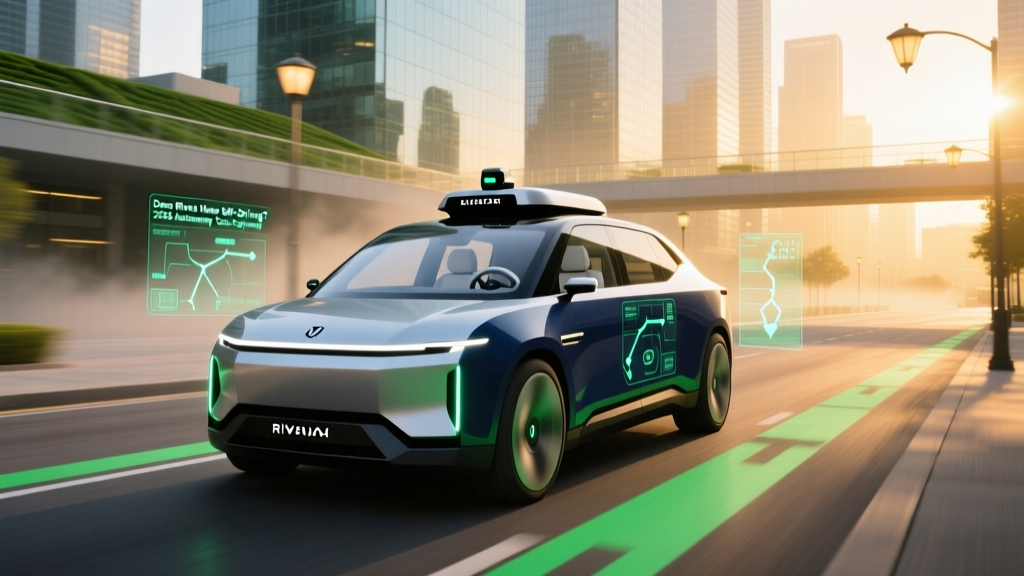
If you're asking "does Rivian have self-driving?" the short answer is no. As of the 2026 model year, Rivian offers an advanced driver-assistance system (ADAS) called Rivian Driver+, which operates at SAE Level 2. This means the vehicle can simultaneously manage steering and speed on qualified highways, but the human driver must remain fully attentive, hands available, and ready to intervene at any moment.
Rivian has no operational robotaxi service, no Level 4 driverless program in public testing, and no announced timeline for full autonomy. The R1T, R1S, and the newer R2 platform are consumer vehicles with sophisticated driver-assist features — not autonomous vehicles.
- Level 0: No automation. Warnings only (e.g., blind-spot alerts).
- Level 1: Single-axis assist — either steering OR speed (e.g., basic adaptive cruise).
- Level 2: Combined steering AND speed assist. Driver must supervise at all times. This is where Rivian Driver+, Tesla Autopilot, Ford BlueCruise, and GM Super Cruise all sit.
- Level 3: Conditional automation — the car drives itself in specific scenarios, but the human must take over when requested. (Mercedes DRIVE PILOT in limited markets.)
- Level 4: High automation — no driver needed within a defined operational design domain (geofenced area). This is the robotaxi tier: Waymo, Zoox.
- Level 5: Full automation anywhere, any condition. Does not exist in production today.
Rivian operates at Level 2. The driver is always responsible.
What Rivian Driver+ Actually Does in 2026
Rivian Driver+ is the brand's bundled ADAS suite, standard or available across the R1T pickup, R1S SUV, and the R2 crossover. It integrates several active-safety and convenience functions into a cohesive highway-driving experience.
Core Capabilities
- Adaptive Cruise Control (ACC): Maintains a set speed and following distance, including stop-and-go traffic, using radar and camera fusion.
- Lane Centering Assist: Actively steers to keep the vehicle centered in marked highway lanes.
- Automatic Lane Change: On compatible divided highways, the system can initiate a lane change when the driver confirms via the turn signal stalk — but only after verifying the adjacent lane is clear.
- Traffic Sign Recognition: Reads speed-limit and regulatory signs, displaying them on the instrument cluster and optionally adjusting cruise speed.
- Automatic Emergency Braking (AEB): Forward collision mitigation with pedestrian and cyclist detection.
What Driver+ Does NOT Do
- Navigate point-to-point without driver input
- Operate on unmapped or unmarked roads
- Handle construction zones, complex intersections, or roundabouts autonomously
- Function without active driver supervision (hands-on-wheel or eyes-on-road monitoring is enforced)
- Operate as a robotaxi or driverless service in any capacity
Rivian's Sensor and Technology Stack
Understanding whether Rivian has self-driving capability requires looking at the hardware. Rivian uses a multi-sensor fusion approach — distinct from Tesla's camera-only strategy and similar in philosophy to Waymo's layered redundancy, though at a different capability tier.
| Sensor Type | Count (R1T/R1S Gen 2) | Purpose |
|---|---|---|
| Forward-facing cameras | 3 (narrow, wide, telephoto) | Lane detection, sign reading, object classification |
| Surround-view cameras | 4–6 | 360° awareness, blind-spot monitoring |
| Forward radar | 1 (long-range) | Distance/speed measurement for ACC, AEB |
| Corner radars | 4 | Cross-traffic alert, blind-spot, lane-change assist |
| Ultrasonic sensors | 12 | Low-speed parking, near-field obstacle detection |
| LiDAR | None | — |
The absence of LiDAR is a deliberate engineering choice. Rivian, like Tesla, relies on camera and radar data processed through neural-network-based perception software. This approach is cost-effective and sufficient for Level 2 driver-assist. However, most Level 4 robotaxi operators — including Waymo and Cruise — consider LiDAR essential for the redundancy and precision required when no human driver is present to serve as a backup sensor.
Rivian vs. Actual Robotaxi Services: How They Compare
The question "does Rivian have self-driving?" often arises from confusion between consumer ADAS and commercial robotaxi operations. These are fundamentally different product categories. Here's how Rivian's system stacks up against the Level 4 services operating in the U.S. as of 2026.
| Feature | Rivian Driver+ | Waymo One | Zoox |
|---|---|---|---|
| SAE Level | Level 2 | Level 4 | Level 4 |
| Driver required? | Yes — always | No | No |
| LiDAR | No | Yes (5th-gen custom) | Yes (custom array) |
| Operational area | Any marked highway (driver's responsibility) | Geofenced metro zones (Phoenix, SF, LA, Austin) | Geofenced zones (Las Vegas, Foster City) |
| Available to consumers? | Yes (vehicle purchase) | Yes (ride-hail app) | Limited invite/employee |
| Cost to user | Included with vehicle | ~$0.90–$1.50/mi (varies by city/time) | Not publicly priced |
| Weather limits | Driver adapts; system may reduce capability | Service paused in heavy rain/fog | Service paused in adverse conditions |
The distinction is stark. Rivian sells a vehicle with driver-assist features that reduce fatigue on long highway drives. Waymo and Zoox operate fully driverless transportation services within tightly defined geofences, backed by millions of mapped miles and regulatory approvals that Rivian neither has nor is pursuing for its consumer vehicles.
Current Robotaxi Service Availability (Where You Can Ride Today)
If your interest in Rivian's autonomy stems from wanting a driverless ride, here is where Level 4 robotaxi services are actually operational in 2026 — not announced, not in testing, but available to paying riders.
| Service | Operational Cities | Hours | Access |
|---|---|---|---|
| Waymo One | Phoenix metro, San Francisco, Los Angeles, Austin | 24/7 (most markets) | Open app (waitlist in some zones) |
| Zoox | Las Vegas (Strip corridor), Foster City, CA | Limited hours | Invite-based / employee |
| Cruise | Suspended operations (post-2023 incidents); limited supervised testing only | N/A | Not available to public |
Waymo One remains the only robotaxi service with broad public availability across multiple U.S. metros. If you're outside these geofenced zones, no Level 4 service — Rivian or otherwise — is available to you.
Safety Data: Driver-Assist vs. Robotaxi Records
Any discussion of autonomous safety requires separating Level 2 ADAS data from Level 4 robotaxi data. They operate under different regulatory frameworks and incident-reporting requirements.
Rivian does not publicly release aggregated disengagement or collision-rate data for Driver+. As a Level 2 system, it falls under NHTSA's Standing General Order, which requires manufacturers to report crashes involving ADS or Level 2+ systems. Individual incident data is not broken out by manufacturer in public NHTSA dashboards in a way that permits direct comparison.
What we know: Level 2 systems like Driver+, Autopilot, and BlueCruise have been associated with rear-end and lane-departure incidents when drivers become inattentive. The IIHS has repeatedly found that drivers over-trust partial-automation systems, leading to longer eyes-off-road periods.
For Level 4 robotaxis, Waymo has published safety data covering over 50 million driverless miles as of late 2025. Their published analysis shows a fatal-involvement rate roughly 85% lower than human benchmarks in comparable urban environments, though direct comparison is complicated by geofencing (Waymo avoids the most dangerous road types) and the absence of drunk or distracted robotaxi "drivers."
The key takeaway: Rivian's Driver+ is designed to assist an attentive driver, not replace one. Its safety value depends entirely on whether you remain engaged. A Level 4 robotaxi's safety depends on the system's ability to handle all scenarios within its operational domain without any human fallback.
Pricing: Rivian Ownership vs. Robotaxi Rides
Comparing Rivian ownership costs to robotaxi pricing requires different frameworks — one is a vehicle purchase, the other is per-ride transportation.
| Cost Factor | Rivian R1T (2026 Dual-Motor) | Waymo One (Phoenix) | UberX (Phoenix avg.) |
|---|---|---|---|
| Base price / per-ride | ~$69,900 MSRP | ~$1.10/mi + base fare | ~$0.85/mi + base fare |
| 5-mile ride cost | N/A (you drive) | ~$9–$13 | ~$7–$11 |
| Energy cost per mile | ~$0.04–$0.06 (home L2) | Included in fare | Included in fare |
| §30D federal tax credit | Up to $7,500 (subject to IRS §30D MSRP, income, and battery-sourcing rules) | N/A | N/A |
| Driver-assist cost | Included (Driver+ standard on most trims) | Included | N/A |
Rivian includes Driver+ functionality in the vehicle price — there is no monthly subscription fee for the core ADAS features, unlike Tesla's FSD (Supervised) at $8,000 upfront or $99/month. This is a meaningful ownership advantage for buyers who want highway assist without recurring costs.
Current Limitations of Rivian's System
Rivian is transparent about what Driver+ can and cannot do. The system's limitations are typical of all Level 2 ADAS on the market, but buyers should understand them before relying on the technology.
- Hands-on requirement: Rivian uses a torque-based steering-wheel sensor. If the system detects no steering input for an extended period, it issues escalating alerts and will eventually bring the vehicle to a controlled stop with hazard lights — but it will not navigate to safety autonomously.
- No city-street autonomy: Lane centering and automatic lane change are designed for divided highways with clear markings. Residential streets, construction zones, and unmarked roads are entirely the driver's responsibility.
- Weather degradation: Heavy rain, fog, snow, and direct low-angle sunlight can impair camera and radar performance. The system may issue a "Driver+ Unavailable" alert and revert to basic cruise control.
- No stoplight/stop-sign handling: Unlike some competitors' more aggressive Level 2+ systems, Rivian does not currently claim automatic traffic-signal recognition with stop-and-go execution at intersections.
- No valet or parking autonomy: Rivian offers a 360° camera and parking sensors, but not automated remote parking or summon features at the level of Tesla's Smart Summon.
- OTA updates add features incrementally: Rivian regularly ships over-the-air software updates that refine Driver+ behavior and occasionally add capabilities. However, these updates remain within the Level 2 envelope — there is no indication of a planned jump to Level 3 or 4.
Rivian's Autonomy Roadmap: What's Next?
Rivian CEO RJ Scaringe has publicly stated that the company is investing in autonomy R&D, with a focus on incremental ADAS improvement rather than a moonshot Level 4 program. The company's approach mirrors that of most legacy and startup automakers outside of Tesla: build excellent Level 2/2+ features that provide real daily value while the industry collectively works toward higher autonomy levels.
Key signals from Rivian's 2025–2026 communications:
- The R2 platform (launching 2026) includes a next-generation compute module with higher processing throughput, designed to support more advanced perception algorithms via OTA.
- Rivian has hired from autonomous-driving talent pools, but job postings and patent filings focus on ADAS refinement — lane-change decision-making, construction-zone handling, and improved driver-monitoring — not driverless operation.
- There is no announced robotaxi division, no mapping fleet, and no regulatory filings for driverless testing permits in California, Arizona, or any other state.
If Rivian eventually pursues Level 3 or Level 4 capability, it would likely debut on a future commercial or fleet vehicle (potentially tied to their Amazon delivery van partnership) before reaching consumer models. For now, Rivian's autonomy story is firmly in the driver-assist category.
Frequently Asked Questions
Does Rivian have self-driving in 2026?
No. Rivian's Driver+ system is SAE Level 2, meaning it assists with steering and speed on highways but requires the driver to remain fully attentive and in control at all times. It is not self-driving.
Can I take my hands off the wheel in a Rivian?
No. Rivian Driver+ requires hands-on-wheel contact (detected via torque sensor). Extended hands-off periods trigger warnings and eventual system disengagement. Unlike GM's Super Cruise on mapped highways, Rivian does not currently offer a hands-free driving mode.
Does Rivian use LiDAR?
No. Rivian uses a camera-and-radar sensor suite without LiDAR. This is similar to Tesla's approach and is sufficient for Level 2 ADAS but would require significant hardware additions for any Level 4 ambition.
Is Rivian planning a robotaxi service?
There is no announced robotaxi program. Rivian's public roadmap focuses on incremental ADAS improvements through OTA updates, not driverless transportation services.
How does Rivian Driver+ compare to Tesla FSD?
Both are Level 2 systems requiring driver supervision. Tesla's FSD (Supervised) attempts broader functionality including city-street navigation and traffic-signal handling, but has drawn regulatory scrutiny for incidents and marketing claims. Rivian's Driver+ takes a more conservative approach — highway-focused, with automatic lane changes — and includes the feature at no extra subscription cost.
What's the best way to get a driverless ride today?
If you're in Phoenix, San Francisco, Los Angeles, or Austin, Waymo One offers fully driverless Level 4 rides via their app. Outside those metros, no robotaxi service is available to the public, and no consumer vehicle — Rivian, Tesla, or otherwise — offers self-driving capability.