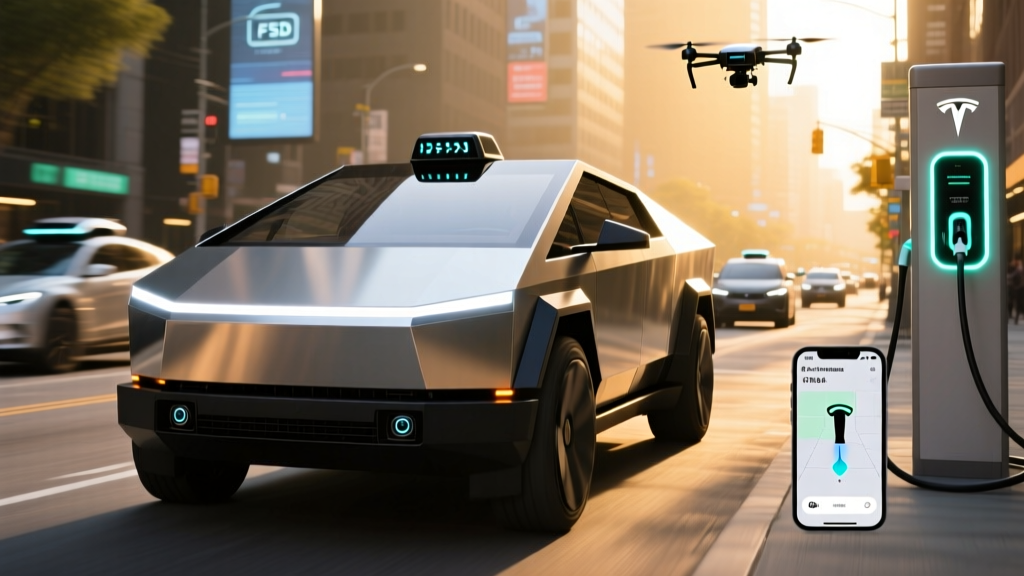
If you've been researching Tesla's electric pickup and wondering whether the Cybertruck has FSD (Full Self-Driving), the short answer is yes — but with critical caveats every buyer needs to understand. Tesla offers its Full Self-Driving (Supervised) capability on every Cybertruck trim, but it is neither free, nor standard, nor truly autonomous. Here's exactly what you get, what it costs, and where the system falls short in real-world driving.
What FSD Actually Is on the Cybertruck
Tesla's Full Self-Driving (Supervised) — the official name as of 2026 — is an advanced driver-assistance system (ADAS) that layers additional functionality on top of Tesla's base Autopilot. On the Cybertruck, FSD (Supervised) uses a pure-vision sensor suite: eight external cameras providing 360-degree visibility, processed by Tesla's Hardware 4.0 (HW4) computer. There is no radar or lidar on the Cybertruck; Tesla removed ultrasonic sensors starting with the 2023 production models and relies entirely on neural-network-based vision processing.
Here's how the feature stack breaks down on the Cybertruck:
| Feature | Basic Autopilot (Standard) | FSD Supervised (Optional) |
|---|---|---|
| Traffic-Aware Cruise Control | Yes | Yes |
| Autosteer (lane centering) | Yes (highway only) | Yes (highway + city streets) |
| Auto Lane Change | No | Yes |
| Navigate on Autopilot (on/off-ramps) | No | Yes |
| Traffic Light & Stop Sign Control | No | Yes |
| City Street Autosteer | No | Yes |
| Smart Summon (parking lot) | No | Yes |
| Autopark (parallel/perpendicular) | No | Yes |
The key differentiator is city-street driving. Basic Autopilot handles highway lane-keeping and adaptive cruise control competently. FSD (Supervised) extends that to surface streets — recognizing stop signs, navigating intersections, making turns, and handling traffic lights. However, every one of these actions requires the driver to confirm, intervene, or override as needed.
SAE Automation Level: This Is Not Self-Driving
Tesla's FSD (Supervised) on the Cybertruck is classified as SAE Level 2 automation. This means the system can simultaneously control steering and acceleration/braking under certain conditions, but the human driver must remain fully engaged — eyes on the road, hands available to take over instantly. Tesla's own documentation and the NHTSA's framework for automated vehicles make clear that Level 2 systems are driver-assist features, not autonomous driving. Only Level 4 systems, such as Waymo's driverless ride-hail service operating in geofenced areas, qualify as truly self-driving without a human in the loop.
Tesla's choice to name the product "Full Self-Driving" has drawn scrutiny from regulators, including the National Highway Traffic Safety Administration (NHTSA), and consumer safety advocates. The parenthetical "(Supervised)" was added to Tesla's branding to clarify that a driver must be present and attentive. Do not confuse marketing language with SAE classification: no consumer Tesla vehicle, including the Cybertruck, drives itself.
How Much Does FSD Cost on the Cybertruck?
Tesla offers FSD (Supervised) through two payment models on all 2026 Cybertruck trims — the Rear-Wheel Drive, All-Wheel Drive, and Cyberbeast:
| Payment Option | Cost (2026) | Notes |
|---|---|---|
| One-Time Purchase | $8,000 | Transfers with the vehicle at resale; non-refundable |
| Monthly Subscription | $99/month | Cancel anytime; tied to your Tesla account, not the VIN |
| Basic Autopilot | Included (no extra cost) | Standard on every Cybertruck trim |
The subscription model makes sense for buyers who want to evaluate FSD before committing $8,000. If you subscribe for more than roughly 80 months, the one-time purchase becomes cheaper — but the subscription offers flexibility if you plan to sell the vehicle within a few years. FSD purchases do not transfer between vehicles if you trade in; they stay with the original VIN. Note that FSD cost is separate from the vehicle MSRP and does not factor into federal §30D tax credit calculations, which are based on the vehicle's base price and battery sourcing requirements.
Cybertruck Trims and FSD Availability
Every 2026 Cybertruck trim supports FSD (Supervised) as an add-on — there is no trim-level restriction. However, none of them include FSD as standard equipment:
| 2026 Cybertruck Trim | Base MSRP | Autopilot | FSD (Supervised) |
|---|---|---|---|
| Rear-Wheel Drive | ~$60,990 | Standard | +$8,000 or $99/mo |
| All-Wheel Drive | ~$79,990 | Standard | +$8,000 or $99/mo |
| Cyberbeast | ~$99,990 | Standard | +$8,000 or $99/mo |
All trims ship with Tesla's HW4 computer and the full camera suite. If you purchase a Cybertruck without FSD and decide later to add it, you can activate the subscription or one-time purchase through the Tesla app at any time — the hardware is already present.
Real-World Capabilities: Where FSD Works Well
In controlled testing and daily driving, Tesla's FSD (Supervised) on the Cybertruck performs competently in several scenarios:
- Divided highways: Lane-keeping is stable, lane changes are smooth, and Navigate on Autopilot handles on-ramps, off-ramps, and interchanges with minimal intervention on well-marked roads.
- Suburban streets with clear markings: Traffic light and stop sign recognition is generally reliable. The system correctly identifies red lights, stops at marked lines, and proceeds on green after driver confirmation.
- Parking assistance: Autopark handles parallel and perpendicular spots with reasonable accuracy, though tight spaces may require multiple attempts.
- Adaptive cruise in traffic: Stop-and-go traffic management is one of the system's strongest features, reducing fatigue in congestion.
The Cybertruck's large windshield and elevated camera mounting position give the vision system a commanding view of the road, which can be an advantage in highway scenarios compared to lower-slung vehicles.
Real-World Limitations: Where FSD Struggles
- Heavy rain, fog, and snow: The vision-only system degrades significantly in poor visibility. Cameras can be obscured by road spray, ice, or condensation, causing Autosteer to disengage with little warning.
- Faded or missing lane markings: Rural roads, construction zones, and older urban streets with worn paint cause the system to wander or disengage.
- Unprotected left turns: Crossing oncoming traffic at intersections remains one of FSD's weakest scenarios. The system may hesitate excessively or misjudge gaps.
- Complex multi-lane roundabouts: Lane selection and yielding behavior can be unpredictable.
- Phantom braking: The Cybertruck, like other Tesla vehicles, has been subject to NHTSA investigations for unexpected deceleration events where the system detects obstacles that do not exist.
- The Cybertruck's width (86.6 inches including mirrors): Narrow lanes and tight construction zones create additional margin-of-error challenges for the system's path planning.
Bottom line: You must remain prepared to take full control at any moment. FSD (Supervised) is not a system you can set and forget.
How Cybertruck FSD Compares to Competing Systems
Tesla isn't the only automaker offering advanced Level 2 driver-assist systems. Here's how the Cybertruck's FSD stacks up against key competitors available in 2026:
| System | Manufacturer | Sensors | Hands-Free? | City Streets? | Cost |
|---|---|---|---|---|---|
| FSD (Supervised) | Tesla | 8 cameras (vision-only) | No (hands-on wheel) | Yes | $8,000 / $99/mo |
| Super Cruise | GM (Chevy, Cadillac) | Cameras + lidar + HD maps | Yes (on mapped roads) | Limited | $2,200 + $25/mo after trial |
| BlueCruise | Ford | Cameras + radar | Yes (on approved highways) | No | $2,100 or $75/mo |
| ProPILOT Assist 2.0 | Nissan | Cameras + radar | Yes (highway, eyes-off capable) | No | Included on select trims |
| Toyota Safety Sense 3.0 | Toyota | Cameras + radar | No | No | Standard (included) |
The most important distinction: GM's Super Cruise and Ford's BlueCruise allow true hands-free driving on pre-mapped divided highways, using driver-monitoring cameras to confirm eye attention. Tesla's FSD requires hands on the steering wheel (detected via torque sensors) despite offering broader geographic coverage on surface streets. Tesla covers more road types; its competitors offer more relaxed engagement on the road types they do cover.
For Cybertruck buyers who primarily drive on highways, BlueCruise on the Ford F-150 Lightning or Super Cruise on the Silverado EV may provide a less fatiguing experience. For those who want driver-assist coverage on city streets and suburban roads, Tesla's FSD offers the widest operational scope — with the trade-off of constant hands-on supervision.
Should You Buy FSD on the Cybertruck?
Subscribe ($99/mo) if:
- You want to evaluate FSD before committing $8,000
- You plan to keep the Cybertruck for under 3–4 years
- You primarily drive in areas with well-marked roads and moderate traffic
Purchase outright ($8,000) if:
- You plan to keep the Cybertruck for 5+ years
- You commute daily in stop-and-go traffic where adaptive cruise and lane-keeping reduce fatigue
- You believe Tesla's future over-the-air updates will expand capabilities meaningfully
Skip FSD entirely if:
- You drive primarily in regions with heavy snow, rain, or poorly marked roads
- You are uncomfortable being a beta tester for evolving software
- Basic Autopilot's highway lane-keeping and adaptive cruise meet your needs
One final consideration: Tesla has a history of adjusting FSD pricing, offering promotional transfers to new vehicles, and changing subscription terms. Any purchase decision should be based on current utility, not speculative promises about future Level 4 or Level 5 capability — which Tesla has predicted for years but has not delivered as of 2026.
Frequently Asked Questions
Does every Cybertruck come with Full Self-Driving?
No. Every Cybertruck comes with Basic Autopilot (traffic-aware cruise control and highway lane-keeping) at no extra cost. FSD (Supervised) is an $8,000 one-time purchase or a $99/month subscription available on all trims — Rear-Wheel Drive, All-Wheel Drive, and Cyberbeast.
Is Tesla FSD on the Cybertruck actually self-driving?
No. FSD (Supervised) is an SAE Level 2 driver-assist system. The driver must remain fully attentive, keep hands on the steering wheel, and be prepared to take over at any moment. It is not autonomous driving. Only Level 4 services like Waymo operate without a human driver.
Does FSD work in bad weather on the Cybertruck?
Performance degrades significantly in heavy rain, snow, fog, or any condition that obscures the cameras. The vision-only system has no radar or lidar backup, so reduced visibility directly reduces capability. Expect frequent disengagements in adverse weather.
Can I add FSD to my Cybertruck after purchase?
Yes. All Cybertrucks ship with the HW4 computer and full camera suite. You can activate FSD (Supervised) at any time through the Tesla app, either as a subscription or a one-time purchase.
Does FSD transfer if I sell my Cybertruck?
If you purchased FSD outright, it stays with the vehicle's VIN and transfers to the next owner. It does not transfer to a new vehicle you purchase. Subscription-based FSD is tied to your Tesla account and can be applied to any compatible Tesla you own.
How does Cybertruck FSD compare to Ford BlueCruise on the F-150 Lightning?
BlueCruise allows hands-free driving on approximately 130,000 miles of pre-mapped divided highways but does not operate on city streets. Tesla FSD covers city streets and highways but requires hands on the wheel at all times. For highway-only commuting, BlueCruise offers a more relaxed experience; for mixed-route driving, FSD provides broader coverage.