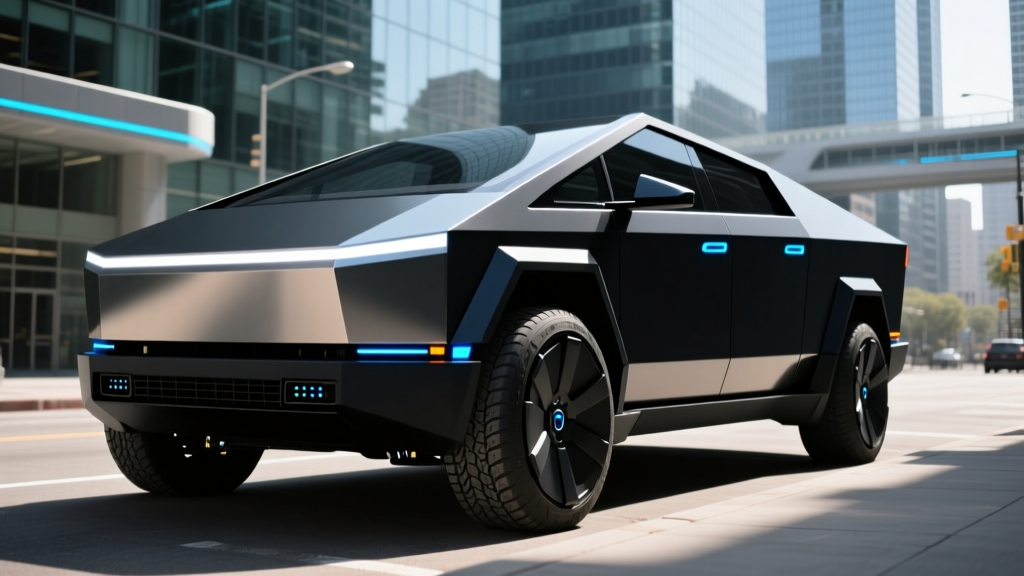
If you're shopping for Tesla's angular electric pickup, one of the first tech questions that surfaces is: does Cybertruck have Autopilot? The short answer is yes — every 2026 Tesla Cybertruck ships with basic Autopilot as standard equipment. But understanding what Autopilot actually does, where it falls short, and how it differs from Tesla's pricier Full Self-Driving (Supervised) package requires a closer look at the sensor suite, software tiers, and real-world behavior of this large, heavy vehicle.
This guide unpacks exactly what you get at each price point, the hardware running the show, the limitations you'll encounter on real roads, and how Cybertruck's driver-assistance compares to rival systems from Ford, GM, and Rivian.
What Autopilot Actually Does on the Cybertruck
Autopilot is Tesla's baseline advanced driver-assistance system (ADAS). On the 2026 Cybertruck, it bundles two core functions:
- Traffic-Aware Cruise Control (TACC): Maintains your set speed and adjusts it to match the vehicle ahead, using camera-based perception to track distance.
- Autosteer: Provides lane-centering assistance on divided highways and clearly marked roads, making micro-corrections to keep the Cybertruck centered in its lane.
Together, these functions reduce fatigue on long highway stretches. However, Autopilot does not handle stoplights, stop signs, roundabouts, lane changes without driver initiation, or navigation-based routing. For those capabilities, Tesla upsells its Full Self-Driving (Supervised) package.
| Feature | Autopilot (Standard) | FSD Supervised (Add-On) |
|---|---|---|
| Traffic-Aware Cruise Control | ✅ Included | ✅ Included |
| Autosteer (lane centering) | ✅ Included | ✅ Included |
| Auto Lane Change | ❌ | ✅ |
| Navigate on Autopilot (highway interchanges) | ❌ | ✅ |
| Autopark (parallel/perpendicular) | ❌ | ✅ |
| Smart Summon | ❌ | ✅ |
| Traffic Light & Stop Sign Control | ❌ | ✅ |
| City Street Autosteer | ❌ | ✅ |
The Hardware: Tesla Vision and the Camera-Only Approach
The 2026 Cybertruck uses Tesla's HW4 (Hardware 4) computer paired with a pure vision sensor suite — no radar, no ultrasonic sensors (USS), and no lidar. Tesla calls this architecture Tesla Vision.
The camera array typically includes:
- Multiple forward-facing cameras (main, wide, narrow) mounted behind the windshield
- Side-repeater cameras on the front fenders
- Rear-view and side-pillar cameras
All perception — object detection, lane reading, depth estimation, speed calculation — is handled by neural networks processing camera imagery in real time through the HW4 chip. Tesla has invested heavily in this vision-only approach, arguing that cameras plus advanced AI can replicate and eventually exceed human perception.
The tradeoff: camera-based systems are more susceptible to degradation in heavy rain, fog, snow, direct sun glare, and poorly marked roads. Where radar-equipped competitors can "see" through precipitation to track vehicles ahead, Tesla Vision relies entirely on optical clarity. In our experience, the system performs well in clear conditions but may reduce speed limits or disengage more frequently in adverse weather.
SAE Level 2: Why Cybertruck Is Not Self-Driving
Both Autopilot and Full Self-Driving (Supervised) on the 2026 Cybertruck are classified as SAE Level 2 systems under the SAE J3016 framework. This means the system can simultaneously control steering and acceleration/braking under certain conditions, but the driver must remain fully engaged, monitor the environment at all times, and be prepared to take over immediately.
For reference, true self-driving without a human driver — like Waymo's robotaxi service operating in Phoenix and San Francisco — is SAE Level 4. No consumer vehicle sold in 2026, including the Cybertruck, is Level 3 or above.
Tesla enforces driver attention through a cabin camera mounted above the rearview mirror. The system monitors whether your eyes are directed toward the road. If attention drifts, you receive escalating warnings — visual, then audible — and repeated inattention can result in a temporary "Autopilot strike" that locks you out of the feature for a week or longer.
- Drive without an attentive, licensed driver in the seat
- Reliably handle construction zones, temporary lane shifts, or faded markings
- Navigate unmapped roads or private driveways
- Guarantee safe operation in heavy rain, snow, or dense fog
- Replace your judgment at complex intersections or emergency scenarios
- Operate as a Level 3+ system — you are the driver, legally and practically
Autopilot vs. FSD Supervised: Cost and What You're Paying For
Understanding the pricing tiers is essential before you configure your Cybertruck. Tesla structures its ADAS offerings as follows for the 2026 model year:
| Package | Cost | Payment Model |
|---|---|---|
| Basic Autopilot (TACC + Autosteer) | $0 | Included with every Cybertruck |
| Enhanced Autopilot (EAP) | $6,000 | One-time purchase |
| Full Self-Driving (Supervised) | $8,000 | One-time purchase |
| FSD (Supervised) Monthly | $99/month | Subscription (cancel anytime) |
Our take: For most Cybertruck owners, the standard Autopilot package handles highway cruising adequately. The $99/month FSD subscription is the smarter financial play if you want to test city-street capabilities, auto lane changes, and traffic light recognition without committing $8,000 upfront. The one-time FSD purchase only makes sense if you plan to keep the truck for 7+ years and use the feature daily — and even then, Tesla's pricing and feature set have historically shifted without notice.
Note that Enhanced Autopilot sits between the two, adding Navigate on Autopilot, Auto Lane Change, Autopark, and Smart Summon but omitting city-street driving and traffic light/stop sign control.
Which Cybertruck Trims Include Autopilot?
Basic Autopilot is standard on every 2026 Cybertruck trim — there is no base model that ships without it. Here's how the lineup breaks down:
| Trim | Base MSRP | Autopilot | FSD Availability |
|---|---|---|---|
| Long Range AWD | ~$79,990 | ✅ Standard | Add-on ($8K or $99/mo) |
| Cyberbeast (Tri-Motor) | ~$99,990 | ✅ Standard | Add-on ($8K or $99/mo) |
Tesla does not currently offer any ADAS features as a standalone subscription without the FSD package. You cannot subscribe to just lane changes or just Smart Summon — it's all-or-nothing at the FSD tier.
Real-World Performance: Where It Works and Where It Struggles
The Cybertruck's size and weight — roughly 6,600 to 6,800 pounds depending on trim — add a unique dimension to ADAS performance. Here's what to expect based on real-world driving patterns and owner reports:
Where Autopilot Excels
- Divided interstate highways with clear lane markings and consistent traffic flow — this is the system's comfort zone.
- Moderate-traffic commuting where TACC can manage stop-and-go without aggressive braking demands.
- Long-distance road trips where sustained lane-centering reduces driver fatigue over 300+ mile stretches.
Where Limitations Surface
- Construction zones: Orange barrels, shifted lanes, and temporary barriers frequently confuse Tesla Vision. Expect disengagements and take over manually.
- Faded or missing lane markings: Rural roads and older highway sections can cause Autosteer to hunt or disengage.
- Heavy precipitation: Rain, snow, and fog reduce camera clarity. The system may issue a "Camera Visibility Reduced" alert and limit or disable Autosteer.
- Phantom braking: A documented behavior across Tesla's fleet where the vehicle brakes unexpectedly for perceived (but nonexistent) obstacles. While HW4 and software updates have reduced frequency, it remains a known issue — particularly on two-lane roads with oncoming traffic or overpasses.
- Tight urban streets: The Cybertruck's 82-inch width (excluding mirrors) means FSD city-street driving can feel tense in narrow lanes, with the system occasionally positioning the truck closer to curbs or obstacles than a human driver would prefer.
Tesla pushes over-the-air (OTA) software updates regularly, and ADAS behavior can change meaningfully between versions. What performs poorly in one release may improve in the next — or introduce new quirks. This iterative approach is a double-edged sword: continuous improvement, but also continuous unpredictability.
How Cybertruck ADAS Compares to Rival Pickup Systems
The electric and full-size pickup segment now offers several mature ADAS alternatives. Here's how Tesla's system stacks up against the key competitors available in 2026:
| System | Vehicle | SAE Level | Hands-Free? | Cost | Key Differentiator |
|---|---|---|---|---|---|
| Tesla Autopilot / FSD | Cybertruck | Level 2 | No (hands-on, eyes-on) | Included / $8K or $99/mo | City-street coverage (FSD); vision-only |
| BlueCruise 1.4+ | Ford F-150 Lightning | Level 2 | Yes (on pre-mapped highways) | ~$2,100 (2-yr) or $75/mo | True hands-free on 130K+ mi of divided highway |
| Super Cruise | GMC Sierra EV / Silverado EV | Level 2 | Yes (on pre-mapped highways) | Included on premium trims | Lidar + cameras; 750K+ mi mapped roads |
| Highway Assist | Rivian R1T (Dual/Quad) | Level 2 | No (hands-on) | Included | Conservative, reliable lane-keeping; no city features |
The key distinction: Ford's BlueCruise and GM's Super Cruise offer hands-free driving on pre-mapped, divided highways — something Tesla's Autopilot and FSD still require you to keep hands on the wheel for (though Tesla's attention monitoring is primarily eyes-based via cabin camera). If your priority is relaxed interstate cruising without gripping the wheel, BlueCruise and Super Cruise have a tangible usability edge on highways. If you want the broadest geographic coverage including city streets, Tesla FSD is the only consumer option — with the caveat that it demands constant supervision.
Rivian's Highway Assist is the most conservative of the group, with no city-street ambitions, but owners consistently report high satisfaction with its reliability and lack of phantom braking events. According to IIHS testing, systems with more conservative tuning tend to score better in driver-monitoring evaluations.
Safety Data and Regulatory Context
Tesla publishes quarterly safety reports claiming that vehicles driving with Autopilot engaged record fewer crashes per million miles than the U.S. average. However, these statistics warrant scrutiny: Autopilot is predominantly used on controlled-access highways, which are inherently safer than urban and rural roads where most crashes occur. The comparison is not apples-to-apples.
The National Highway Traffic Safety Administration (NHTSA) has investigated multiple Tesla Autopilot and FSD incidents, particularly regarding crashes into stationary emergency vehicles and phantom braking complaints. As of 2026, NHTSA's Standing General Order requires Tesla (and all ADAS manufacturers) to report crashes involving Level 2+ systems, providing a growing public dataset on real-world safety performance.
The bottom line: no current ADAS system, including Tesla's, eliminates the need for an attentive driver. Treat Autopilot and FSD as fatigue-reduction tools, not replacements for your judgment.
Frequently Asked Questions
Does the Cybertruck come with Autopilot standard?
Yes. Every 2026 Tesla Cybertruck — both the Long Range AWD and Cyberbeast trims — includes basic Autopilot (Traffic-Aware Cruise Control and Autosteer) at no additional cost.
Is Tesla's Full Self-Driving actually self-driving on the Cybertruck?
No. FSD (Supervised) is an SAE Level 2 driver-assistance system. Despite the "Full Self-Driving" name, it requires an attentive driver at all times. You must keep your eyes on the road and be ready to take over instantly. Only Level 4 services like Waymo operate without a human driver — and those are not available in consumer vehicles.
How much does FSD cost for the Cybertruck?
As of 2026, FSD (Supervised) costs $8,000 as a one-time purchase or $99 per month as a subscription. Enhanced Autopilot, which adds lane changes, Autopark, and Smart Summon but not city-street driving, is $6,000 one-time. Basic Autopilot is included free.
Does the Cybertruck use radar or lidar for Autopilot?
No. The Cybertruck uses Tesla Vision, a camera-only system powered by the HW4 computer. There is no radar, lidar, or ultrasonic sensor array. All perception is derived from neural networks processing camera data, which performs well in clear conditions but can be affected by heavy rain, snow, fog, and sun glare.
How does Cybertruck Autopilot compare to Ford BlueCruise?
They serve different use cases. BlueCruise allows true hands-free driving on over 130,000 miles of pre-mapped divided highways, while Tesla Autopilot requires hands on the wheel at all times. However, Tesla's FSD offers city-street capabilities that BlueCruise does not. For pure highway comfort, BlueCruise has an edge. For broader geographic coverage, Tesla FSD is more expansive — though it demands constant driver supervision.
Can I add FSD to my Cybertruck after purchase?
Yes. You can purchase FSD (Supervised) or subscribe to it at any time through the Tesla app, provided your Cybertruck has HW4 hardware (all 2026 models do). The feature activates via an over-the-air software update.
Does Autopilot work in bad weather on the Cybertruck?
Tesla Vision's camera-only system is more weather-sensitive than radar-equipped competitors. In heavy rain, snow, or fog, you may see "Camera Visibility Reduced" warnings, and Autosteer may limit functionality or disengage. Always be prepared to take full manual control in adverse conditions.