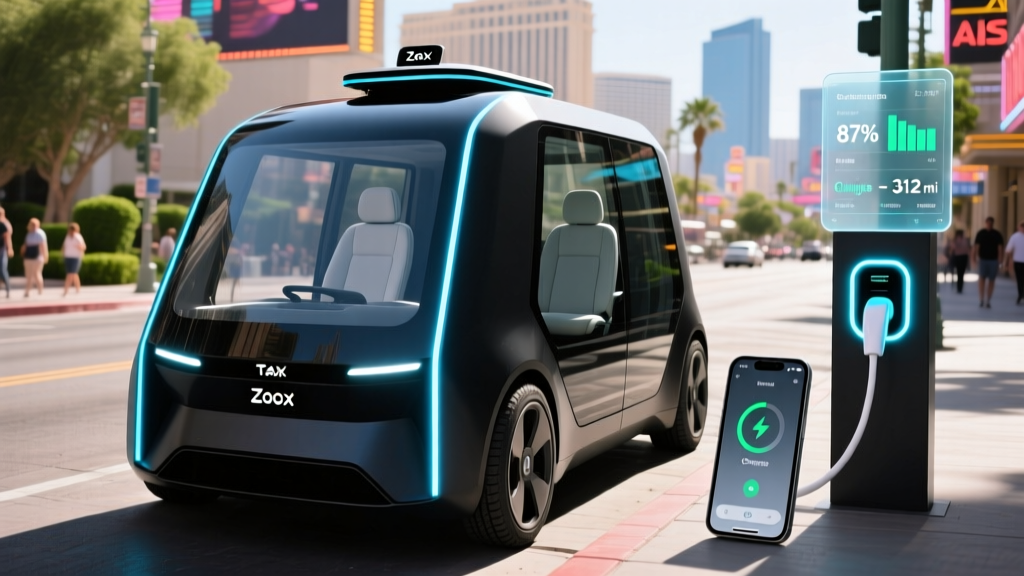
If you've spent any time on the Las Vegas Strip recently, you've likely spotted them: the compact, symmetrical, steering-wheel-free pods gluing themselves to bike lanes and right-turn lanes. Those are Zoox robotaxis, and after years of limited testing, Amazon's autonomous vehicle subsidiary has been expanding its commercial service footprint across the city. For visitors and locals alike, the most pressing question is practical: what does a Zoox ride actually cost in Las Vegas, and how does it compare to hailing an Uber or Lyft?
This guide breaks down everything we know about Zoox's Las Vegas operations as of early 2026 — pricing structure, service zones, safety performance, the technology under the hood, and the real-world limitations you'll encounter. We'll also clarify exactly what "self-driving" means in this context, because the distinction between a Level 4 robotaxi and a Level 2 driver-assist system like Tesla's FSD Supervised is not just semantic — it's the entire business model.
What Is Zoox and What Autonomy Level Does It Operate At?
Zoox is a fully autonomous vehicle company acquired by Amazon in 2020 for roughly $1.2 billion. Unlike companies that retrofit existing vehicles with sensor suites (Waymo's approach with the Jaguar I-PACE), Zoox designed its vehicle from the ground up as a purpose-built robotaxi. The result is a bidirectional, carriage-style pod with no steering wheel, no pedals, and no driver's seat — just two rows of four inward-facing seats.
Zoox operates at SAE Level 4 within its geofenced service areas. This means the vehicle performs all driving tasks — steering, braking, navigating, responding to traffic — without any human driver present or required. There is no steering wheel or manual override. This is fundamentally different from Level 2 driver-assist systems like Tesla Autopilot, Ford BlueCruise, or GM Super Cruise, where a human driver must remain attentive and ready to take over at any moment. When you step into a Zoox, you are a passenger, not a driver.
The Zoox vehicle is a battery-electric platform with a roughly 75 kWh battery pack, all-wheel drive via dual electric motors, and a top speed of approximately 75 mph — though in practice, the robotaxi rarely exceeds 35-45 mph in its urban operating zones. The vehicle can travel bidirectionally (it's symmetrical front-to-back), which gives it unusual flexibility for tight maneuvers and route optimization.
How Much Does a Zoox Ride Cost in Las Vegas?
Here's the headline answer: Zoox currently offers free rides to invited users in Las Vegas. As of early 2026, Zoox has not yet launched a fully open, pay-per-ride commercial pricing model in Vegas the way Waymo has in Phoenix and San Francisco. Instead, the company operates through an early rider program and invitation-based access, meaning most rides carry no charge to the passenger.
That said, Zoox has signaled that a paid commercial launch is in its roadmap, and we can model expected pricing based on Waymo's established rates and Zoox's likely cost structure. Here's what the landscape looks like:
| Service | Base Fare | Per Mile | Per Minute | Est. 3-Mile Ride |
|---|---|---|---|---|
| Zoox (current) | Free (invite-only) | $0.00 | $0.00 | $0.00 |
| Zoox (projected commercial) | ~$2.50 | ~$1.25 | ~$0.35 | ~$8-12 |
| Waymo One (Phoenix/SF) | ~$2.00-3.00 | ~$1.10-1.50 | ~$0.30-0.45 | ~$7-14 |
| UberX (Las Vegas avg.) | ~$2.50 | ~$1.30 | ~$0.30 | ~$9-15 |
| Lyft (Las Vegas avg.) | ~$2.25 | ~$1.20 | ~$0.28 | ~$8-13 |
Key takeaway: If and when Zoox transitions to paid rides, expect pricing roughly on par with or slightly below Uber/Lyft — not dramatically cheaper. The long-term robotaxi thesis is that removing the human driver eventually lowers per-ride costs, but current fleet operations, sensor maintenance, remote-assistance infrastructure, and insurance overhead mean early commercial pricing won't undercut rideshare by a wide margin. The real cost advantage is expected to emerge at scale, potentially years out.
One pricing advantage Zoox may carry: no surge pricing in the traditional sense. Robotaxi fleets manage demand through queue times and capacity limits rather than dynamic price spikes, though this could change once the service matures.
Where Can You Use Zoox in Las Vegas Right Now?
Zoox's Las Vegas service area is geofenced — the vehicles operate only within a precisely mapped zone approved by the State of Nevada and the Nevada Department of Motor Vehicles' autonomous vehicle testing program. As of early 2026, the operational area covers key corridors including:
- Las Vegas Strip corridor — select segments of Las Vegas Boulevard
- Downtown Las Vegas — portions of the Fremont Street area
- Surrounding arterials — connecting roads between the Strip and downtown zones
| City | Status | Access Type | Notes |
|---|---|---|---|
| Las Vegas, NV | Active | Invite-only / early rider | Strip & downtown geofenced zones |
| San Francisco, CA | Active (testing) | Employee + invite | Select neighborhoods |
| Foster City, CA | Active (testing) | Employee + invite | Suburban test zone near HQ |
| Austin, TX | Announced / testing | Not yet public | Mapping and validation in progress |
| Atlanta, GA | Announced / testing | Not yet public | Early-stage operations |
How to get access: Zoox does not have a publicly downloadable app that anyone can use to hail a ride on demand, unlike Waymo One in Phoenix and San Francisco. Access in Las Vegas is primarily granted through Zoox's early rider program, which you can sign up for via the Zoox website. Approval is not guaranteed and tends to prioritize local residents and frequent travelers in the service zone. Amazon employees and partners also receive priority access.
The Technology Stack: How Zoox Sees the Road
Zoox's sensor and compute architecture is one of the most comprehensive in the robotaxi space. The company does not rely on a camera-only approach (as Tesla does with its FSD system). Instead, Zoox uses a multi-modal sensor fusion stack:
- LiDAR: Multiple solid-state and spinning LiDAR units providing 360-degree, high-resolution 3D point clouds up to ~150-200 meters. LiDAR is the primary depth-sensing modality and works identically in daylight and darkness.
- Cameras: A surround array of high-dynamic-range cameras covering 360 degrees at multiple focal lengths — wide-angle for near-field awareness and telephoto for long-range object classification (traffic lights, signage, distant pedestrians).
- Radar: Multiple radar units for velocity measurement of moving objects and redundancy in adverse weather where LiDAR and cameras may degrade.
- Compute: Custom onboard computing platform with redundant processing paths. The system runs Zoox's proprietary prediction, planning, and perception models in real time.
- HD Mapping: Zoox pre-maps every inch of its geofenced service area at centimeter-level precision. The vehicle localizes itself within this map in real time, cross-referencing sensor data against known landmarks, lane geometry, and traffic infrastructure.
- Remote Assistance: While no human driver is in the vehicle, Zoox employs remote fleet operators who can provide high-level guidance to vehicles encountering unusual scenarios (construction zones, accidents blocking roads). These operators do not "joystick" the car — they approve or suggest routes, and the vehicle executes the driving.
This sensor-redundant approach is standard among Level 4 operators. Waymo uses a similar LiDAR-camera-radar fusion stack on its Jaguar I-PACE fleet. The camera-only path championed by Tesla remains unproven at Level 4 — Tesla's FSD Supervised is a Level 2 system requiring driver attention, and Tesla has not yet deployed a driverless commercial service.
Safety Record: What the Data Actually Shows
Robotaxi safety is the most scrutinized — and most debated — topic in autonomous vehicles. Here's what we know about Zoox's safety performance based on publicly available data and regulatory filings:
- Testing miles accumulated: Hundreds of thousands of autonomous miles across California and Nevada test zones (exact cumulative figure not publicly disclosed as of early 2026).
- DMV disengagement reports (California): Zoox files annual disengagement reports with the California DMV. Disengagement rates (miles between human-safety-driver interventions during testing) have improved year-over-year, though direct comparison across companies is unreliable due to differing test conditions.
- Reported collisions: Zoox has filed collision reports with NHTSA under the Standing General Order requiring all ADS-equipped vehicles to report crashes. Most reported incidents involve other human-driven vehicles contacting the Zoox pod at low speed — the robotaxi was not the at-fault party in the majority of filings.
- No passenger fatalities: As of early 2026, no Zoox robotaxi passenger fatality has been reported in any operational market.
Context matters enormously here. Zoox operates at low speeds in geofenced urban zones, which inherently reduces crash severity. The vehicle's symmetrical design also means passengers sit inward-facing with substantial crumple zones fore and aft — a safety architecture impossible in a conventional sedan with a driver up front.
For comparison, Waymo — the most mature robotaxi operator — has published data showing its vehicles are involved in police-reported crashes at a lower rate per million miles than human benchmarks in the same cities, and with significantly fewer injury-causing incidents. Zoox has not published a comparable peer-reviewed safety study, which is a gap worth noting.
Regulatory Landscape: Who Approves Robotaxi Operations?
Robotaxi deployment in the United States is governed by a patchwork of state and local regulations — there is no single federal license to operate a driverless commercial service.
In Nevada, autonomous vehicle testing and operation are regulated under state law (NRS 482A), which was among the first in the nation to create a legal framework for self-driving cars. The Nevada DMV issues autonomous vehicle testing permits, and operators must meet insurance, safety, and reporting requirements. Las Vegas does not require a separate municipal permit, though the city coordinates with operators on road-work notifications and traffic management.
In California, the regulatory environment is more complex: the DMV issues testing permits, while the California Public Utilities Commission (CPUC) issues permits for commercial passenger service. Waymo holds a CPUC permit for fare-charging driverless service in San Francisco; Zoox has not yet obtained an equivalent commercial passenger permit in California as of early 2026.
At the federal level, NHTSA oversees vehicle safety standards and crash reporting but does not currently issue "approval" for autonomous operations. The agency's Standing General Order (since 2021) requires all Level 2 and above ADS-equipped vehicles to report crashes within 24 hours — a critical transparency mechanism.
Current Limitations: What Zoox Cannot Do
Level 4 autonomy is powerful but bounded. Here are the real-world constraints you'll encounter with Zoox in Las Vegas:
Zoox robotaxis are not a replacement for all ground transportation. The following limitations apply:
- Geofence boundaries: You can only request rides with pickup and drop-off points inside the approved service zone. Request a ride to a destination outside the geofence, and the app will decline or suggest the nearest valid drop-off.
- Weather restrictions: Heavy rain, flooding, sandstorms (relevant in the Nevada desert), or dense fog can trigger service suspensions. LiDAR performance degrades in heavy precipitation, and the system is designed to pull over safely rather than continue in conditions it cannot handle.
- No highway driving: Zoox operates on surface streets within its geofence. It does not merge onto freeways or travel between cities. A Strip-to-Henderson trip is not possible.
- Construction zones: Major, unmapped road construction can confuse the vehicle or cause it to request remote assistance, adding delay. While the system handles minor cones and lane shifts, large-scale reconfigurations remain a challenge.
- Parking structures and valet: The vehicle drops you at the curb. It does not navigate multi-story parking garages or valet zones on your behalf.
- Accessibility: Zoox's purpose-built pod includes wheelchair-accessible configurations, but availability of ADA-compliant vehicles may be limited depending on fleet size and demand at any given time.
- Wait times: With a smaller fleet than Uber or Lyft, expect longer wait times — particularly during peak hours on the Strip. Five to fifteen minutes is typical; during events (CES, major fights, New Year's Eve), waits can stretch significantly longer.
Zoox vs. Waymo: How Do the Two Robotaxi Leaders Compare?
Zoox is not the only robotaxi game in town. Waymo (Alphabet's autonomous vehicle subsidiary) is the current market leader in paid commercial robotaxi rides. Here's how the two stack up on the dimensions that matter to riders:
| Attribute | Zoox | Waymo One |
|---|---|---|
| Vehicle | Purpose-built Zoox pod (no steering wheel) | Jaguar I-PACE (modified SUV with steering wheel) |
| SAE Level | Level 4 | Level 4 |
| Paid commercial service | Not yet (free invite-only in Vegas) | Yes (Phoenix, SF, LA; expanding) |
| Public app | No (invite program) | Yes (Waymo One app, open to public) |
| Las Vegas presence | Active | Not yet operational |
| Max passenger capacity | 4 | 4 (I-PACE) |
| Sensor stack | LiDAR + camera + radar | LiDAR + camera + radar |
| Published safety study | No peer-reviewed study | Yes (multiple, peer-reviewed) |
How to Ride a Zoox in Las Vegas: Step by Step
- Sign up for the early rider program at zoox.com. Provide your name, phone number, and Las Vegas address or travel dates.
- Wait for an invitation. Approval is not instant. Zoox onboards riders in waves and prioritizes users who are likely to take rides within the active service zone.
- Download the Zoox app (once invited). The app is not available on public app stores without an active invitation linked to your account.
- Request a ride. Enter your pickup and drop-off locations. Both must fall within the geofenced service area. The app will confirm availability and estimated wait time.
- Board the vehicle. The Zoox pod will arrive and unlock its doors automatically. There is no driver to greet you — just step in, buckle up, and the ride begins.
- Monitor the ride. An in-vehicle screen displays the vehicle's perception of its surroundings and the planned route. You can contact remote support at any time via an in-cabin button.
Frequently Asked Questions
Is Zoox really self-driving, or is there a human controlling it remotely?
Zoox is genuinely self-driving within its geofenced service area. There is no human driver in the vehicle, and no one is "joysticking" it remotely. The onboard AI handles all real-time driving decisions — steering, braking, lane changes, intersection navigation. Remote fleet operators provide high-level guidance in unusual situations (e.g., "the road ahead is closed, reroute"), but they do not directly control the vehicle's movements. This is SAE Level 4 autonomy.
Can I just download the Zoox app and hail a ride today?
Not yet — at least not without an invitation. Unlike Waymo One, which is open to the general public in its operating cities, Zoox still gates access through its early rider program. You can request an invitation, but there is no guarantee of approval or timeline.
Will Zoox rides eventually be cheaper than Uber or Lyft?
The long-term economic thesis says yes: remove the driver, and you remove the largest per-ride cost. But in the near term, the overhead of fleet maintenance, sensor calibration, remote operations, insurance, and HD mapping means early commercial pricing is likely to be comparable to — not dramatically cheaper than — conventional rideshare. Meaningful cost advantages are expected at scale, potentially years after commercial launch.
What happens if the Zoox vehicle encounters a situation it can't handle?
The vehicle is designed to reach a safe state — typically pulling over to the curb and stopping. It will then contact a remote fleet operator for guidance. The operator may approve an alternate route or, in rare cases, dispatch a human support team. You will never be left stranded in traffic; the system defaults to stopping safely rather than attempting a maneuver it cannot confidently execute.
How does Zoox's safety record compare to human drivers?
Zoox has not published a peer-reviewed, per-million-mile safety comparison the way Waymo has. What we know from NHTSA crash-report filings is that most Zoox-involved incidents have been low-speed contacts where another party was at fault. The vehicle's low operating speeds and geofenced urban environment inherently limit exposure to high-severity crash scenarios. More data transparency from Zoox would be welcome.
Does Zoox operate on the entire Las Vegas Strip?
No. The geofenced zone covers select segments of the Strip and connecting corridors, not the full length from Mandalay Bay to the Strat. Your app will show the precise service boundary when requesting a ride. Expansion of the geofence is ongoing but incremental — each new zone requires extensive mapping, validation, and regulatory coordination.
Can Zoox drive me to Harry Reid International Airport (LAS)?
As of early 2026, airport service has not been confirmed as part of the active geofence. Airport pickups and drop-offs require specific agreements with airport authorities and dedicated staging areas. Check the Zoox app for the most current service boundaries.