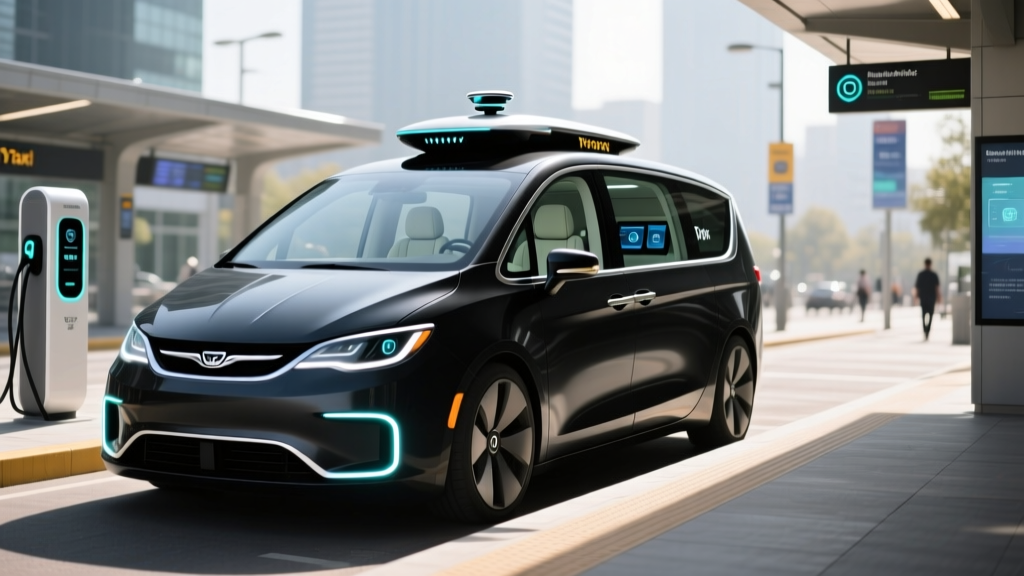
If you've seen a Chrysler Pacifica minivan navigating Phoenix or San Francisco streets with no one in the driver's seat, you've witnessed the Chrysler Pacifica Waymo robotaxi in action. Waymo's fifth-generation autonomous driving system has been deployed primarily on the Pacifica Hybrid platform since 2019, making it one of the longest-running Level 4 robotaxi fleets in commercial operation. But what does riding in one actually involve, how safe is the technology, and where can you hail one in 2026?
This guide breaks down the Chrysler Pacifica Waymo service with hard data — not marketing claims — covering autonomy levels, operational cities, the sensor stack, safety records, pricing, and the real-world limitations you should understand before booking a ride.
SAE Automation Level: What Level 4 Actually Means
The Chrysler Pacifica Waymo operates as an SAE Level 4 autonomous vehicle. This is a critical distinction from consumer driver-assist systems like Tesla Autopilot, GM Super Cruise, or Ford BlueCruise, which are all Level 2. Here's how the levels differ:
| SAE Level | Classification | Driver Required? | Examples |
|---|---|---|---|
| Level 2 | Partial Automation | Yes — hands on/near wheel, eyes on road | Tesla Autopilot, FSD (Supervised), BlueCruise, Super Cruise |
| Level 3 | Conditional Automation | No in specific conditions, but must take over when prompted | Mercedes DRIVE PILOT (limited markets) |
| Level 4 | High Automation | No — vehicle handles all driving within its operational domain | Waymo One (Pacifica), Zoox, Cruise (pre-suspension) |
| Level 5 | Full Automation | No — any road, any condition | Does not exist commercially |
The Pacifica Waymo is Level 4, meaning it drives fully autonomously within its defined operational design domain (ODD) — specific geofenced areas, approved weather conditions, and mapped routes. Outside that domain, the vehicle simply won't operate. There is no steering wheel handoff to a passenger; the minivan either drives itself or doesn't move. This is fundamentally different from any car you can buy at a dealership today.
Where Can You Use the Chrysler Pacifica Waymo Right Now?
Waymo One, the commercial ride-hailing service using the Pacifica Hybrid fleet, operates in select metro areas. Service boundaries are geofenced and expand incrementally. As of early 2026:
| Metro Area | Status | Service Area Notes |
|---|---|---|
| Phoenix, AZ (East Valley) | Fully operational | Chandler, Tempe, Mesa, Gilbert, Scottsdale — largest continuous ODD; ~225+ sq mi |
| San Francisco, CA | Fully operational | Most of SF proper; expanded to include highway segments and SFO airport routes |
| Los Angeles, CA | Operational (expanding) | Santa Monica, Hollywood, downtown LA core; gradual geographic expansion ongoing |
| Austin, TX | Operational (limited) | Initial service area launched; expansion in progress |
How to ride: Download the Waymo One app (iOS/Android), enter your pickup and dropoff within the service area, and request a ride. The app shows the approaching Pacifica's location, license plate, and a PIN to unlock the doors. Rides are fully driverless — no safety operator is in the vehicle.
Phoenix remains the most mature market, where the Pacifica fleet has accumulated the most miles and the geofenced area is largest. San Francisco is the second major hub, though the urban density creates more complex driving scenarios.
Waymo's 5th-Generation Tech Stack on the Pacifica
The Chrysler Pacifica Waymo is not a camera-only system. It uses a redundant, multi-sensor fusion approach — a key differentiator from Tesla's vision-only FSD strategy. Here's what's mounted on the vehicle:
Sensor Suite Breakdown
- LiDAR: Multiple roof-mounted and bumper-integrated LiDAR units providing 360° 3D point-cloud mapping. LiDAR gives precise distance measurements independent of lighting conditions — critical for night driving and detecting objects cameras might miss.
- Cameras: A surround-camera array (typically 8+ cameras) covering all directions, used for lane detection, traffic-light state recognition, sign reading, and object classification.
- Radar: Multiple radar units for velocity detection of moving objects, functioning reliably in rain and fog where LiDAR and cameras can degrade.
- Audio sensors: External microphones that detect emergency-vehicle sirens, triggering the vehicle to pull over or yield.
- HD Maps + Localization: Waymo pre-maps every road in its ODD at centimeter-level precision. The vehicle localizes itself within this map in real time using sensor data — it doesn't rely solely on GPS.
The compute platform runs Waymo's proprietary "Waymo Driver" software, which handles perception (what's around the vehicle), prediction (what other road users will do next), and planning (the vehicle's trajectory decisions). The Pacifica Hybrid's plug-in hybrid powertrain is practical for this use case: it can operate on electric power for short trips but has a gas engine backup for all-day fleet duty without return-to-base charging downtime.
Safety Record: What the Data Actually Shows
Waymo publishes safety data periodically and has been subject to NHTSA scrutiny like all autonomous operators. Here's what we know from reported figures and regulatory filings:
Key Safety Metrics (Cumulative Through 2025)
- Fully autonomous miles driven: Over 50 million driverless miles across Phoenix, SF, and LA combined (Waymo Safety Reports).
- Injury-causing crash rate: Waymo's driverless fleet showed approximately 85% fewer injury-causing crashes per million miles compared to human benchmarks in Phoenix, according to a study published in collaboration with NHTSA-referenced data and peer-reviewed research.
- Contact rate: Waymo reported roughly 5.5 police-reported crashes per million autonomous miles — but the vast majority were low-speed incidents where the Waymo vehicle was rear-ended or side-swiped at intersections, not at-fault collisions.
- Fatalities: As of early 2026, no pedestrian or occupant fatalities have been attributed to a Waymo driverless vehicle operating in autonomous mode.
Context matters: robotaxi crash data is reported differently from human-driver data, and direct comparisons require careful normalization. Waymo vehicles tend to drive more cautiously and conservatively than humans, which reduces severe crashes but can increase minor-contact incidents (e.g., being rear-ended by a human driver who didn't expect the Waymo to stop). The NHTSA Standing General Order requires all ADS operators to report crashes, providing a regulatory baseline for transparency.
Pricing: Waymo One vs. Uber and Lyft
Waymo One uses dynamic pricing similar to rideshare platforms, with base fares, per-mile, and per-minute rates. Here's a representative comparison based on typical Phoenix and San Francisco rides:
| Route Example | Waymo One | UberX | Lyft Standard |
|---|---|---|---|
| Airport to downtown (Phoenix, ~12 mi) | $28–$36 | $24–$32 | $22–$30 |
| Short urban trip (SF, ~3 mi) | $14–$19 | $12–$17 | $11–$16 |
| Cross-town (LA, ~8 mi) | $22–$29 | $19–$26 | $18–$25 |
Waymo pricing is generally comparable to or slightly above standard UberX/Lyft fares, but without surge pricing spikes that human rideshare can hit during peak demand. Waymo also offers Waymo One membership tiers and promotional pricing for new users. The trade-off: you eliminate the variability of human-driver quality, routing decisions, and vehicle cleanliness — but you're limited to Waymo's geofenced area and can't request rides outside it.
Unlike Uber/Lyft, there's no tipping. The fare you see is the fare you pay.
Regulatory Landscape: Who Approves Robotaxi Operations?
Robotaxi deployment in the US is governed by a patchwork of state and local regulations — there is no single federal "robotaxi license." Here's how approval works:
- Arizona: Among the most permissive states. No specific state permit is required for driverless testing or commercial deployment, though vehicles must be registered and insured. Waymo has operated commercially in Phoenix since 2020 under this framework.
- California: The California DMV issues testing permits, while the California Public Utilities Commission (CPUC) grants commercial deployment permits. Waymo received its CPUC permit for driverless commercial service in San Francisco in 2023, after years of permitted testing.
- Federal (NHTSA): NHTSA does not currently "approve" autonomous vehicles but requires crash reporting under its Standing General Order and retains authority over vehicle safety standards. The agency has investigated specific Waymo incidents but has not issued a blanket recall or suspension.
- Local municipalities: Cities within approved states can impose additional requirements (e.g., SF's Board of Supervisors held hearings on robotaxi expansion, and first-responder coordination protocols are required).
The regulatory environment is evolving. States like Texas (Austin) and Nevada have created frameworks to attract ADS operators, while others remain cautious after Cruise's 2023 San Francisco suspension.
Current Limitations: What the Chrysler Pacifica Waymo Cannot Do
Level 4 autonomy is impressive within its domain, but the domain is narrow. Here are the real-world constraints:
- Geofencing: The vehicle will not operate outside its mapped and approved service area. Request a ride to an address beyond the boundary, and the app won't let you book it.
- Weather: Heavy rain, fog, and dust storms can degrade LiDAR and camera performance. In Phoenix monsoon conditions or San Francisco dense fog, Waymo may restrict or pause service. Snow and ice remain entirely outside the current ODD.
- Construction zones: While Waymo handles many construction scenarios, major unmapped lane shifts or long-term road reconfigurations can cause the vehicle to pull over and wait for remote guidance.
- No highway driving (most markets): Initially limited to surface streets, Waymo has begun adding select highway segments (e.g., SFO airport routes in SF), but full freeway navigation across all markets isn't yet standard.
- Complex unprompted scenarios: Unusual road users (e.g., horse-drawn carriages, oversized loads, funeral processions) or ambiguous hand-signal situations from construction flaggers can trigger conservative behavior — the vehicle may stop and wait rather than proceed.
- No inter-city trips: You cannot hail a Waymo from Phoenix to Tucson or SF to Sacramento. These are point-to-point, intra-metro services only.
- Accessibility: The Pacifica Hybrid is a wheelchair-accessible option in some markets, but availability is limited and must be requested specifically. Standard Pacifica robotaxis require passengers to enter/exit independently.
These limitations aren't failures — they're the defined boundaries of Level 4. The system is designed to refuse to drive rather than drive unsafely, which is a fundamentally different philosophy than Level 2 systems that pass control back to the human driver.
The Pacifica Hybrid Platform: Why This Minivan?
Waymo chose the Chrysler Pacifica Hybrid for practical fleet reasons, not because it's a luxury vehicle. The PHEV powertrain offers a ~32-mile EPA electric-only range for short urban trips, plus a 3.6L V6 engine for all-day operation without return-to-base charging. The minivan's tall roofline accommodates the roof-mounted LiDAR and sensor pod, and its sliding doors simplify passenger entry/exit in tight urban spaces.
From an ownership perspective, you cannot buy a Waymo-equipped Pacifica. These vehicles are fleet-only, built to Waymo's specifications with integrated sensor hardware and redundant computing platforms that Chrysler doesn't offer on consumer models. The base Pacifica Hybrid starts around $51,000 MSRP for consumer purchase, but the autonomous hardware package adds substantial cost that Waymo absorbs as a fleet operator.
Frequently Asked Questions
Is the Chrysler Pacifica Waymo truly self-driving or just driver-assist?
It is genuinely self-driving — SAE Level 4. There is no human driver in the vehicle, no steering-wheel intervention available to passengers, and no "supervision" requirement. This is categorically different from Tesla FSD (Supervised), GM Super Cruise, or Ford BlueCruise, which are Level 2 systems requiring an attentive human driver. The Waymo Pacifica handles the entire driving task within its geofenced service area autonomously.
How much does a Waymo ride cost compared to Uber or Lyft?
Waymo One fares are typically within 10–20% of standard UberX or Lyft fares in the same market, without surge pricing. A 12-mile airport trip in Phoenix runs roughly $28–$36. There's no tipping. Membership plans and new-user promotions can reduce costs further. For short urban hops, the price difference is often negligible.
How safe are Waymo robotaxis in real-world operation?
Waymo has driven over 50 million fully driverless miles with zero reported fatalities in autonomous mode. Peer-reviewed research and Waymo's own published data show injury-causing crash rates roughly 85% lower than human-driver benchmarks in comparable conditions. Most reported incidents are low-speed, not-at-fault contacts (e.g., being rear-ended). The IIHS and NHTSA continue to monitor ADS safety data as fleet miles accumulate.
What happens if something goes wrong during a Waymo ride?
Waymo operates a remote-assistance center where fleet specialists can monitor vehicles and provide guidance (not remote driving — they can't steer or accelerate the vehicle). If the Pacifica encounters a scenario it can't resolve, it performs a minimal-risk maneuver: pulling to the curb, stopping, and contacting remote support. Passengers can also reach support via the in-app help button or in-vehicle intercom at any time.
Can I use Waymo in any city?
No. As of 2026, Waymo One is operational in Phoenix (largest area), San Francisco, Los Angeles, and Austin — each with specific geofenced boundaries. Expansion to additional cities is ongoing but subject to regulatory approval, mapping, and testing timelines. You cannot use the service outside these defined zones.
Will Waymo replace Uber and Lyft drivers?
Not in the near term. Waymo's geofenced, city-by-city rollout means coverage remains a fraction of what Uber/Lyft offer nationally. Robotaxis work well for predictable, mapped urban corridors but can't serve rural areas, highways outside their ODD, or cities where regulatory approval hasn't been granted. Human rideshare will remain the dominant model outside Waymo's operational footprint for years.