When people ask "how does ChatGPT differ from Waymo AI?" they're usually comparing two wildly different applications of artificial intelligence. ChatGPT is a large language model (LLM) built by OpenAI to process and generate text. Waymo's AI is a real-time perception and decision-making system that pilots a 5,000-pound vehicle through live traffic in Phoenix, San Francisco, Los Angeles, and Austin. One predicts the next word in a sentence; the other predicts whether the pedestrian at the crosswalk will step off the curb in the next 1.2 seconds.
This article breaks down the fundamental architecture differences, explains what SAE Level 4 autonomy actually means, and gives you the concrete data on where Waymo operates, what it costs, and how safe the record is.
The Core Difference: Language Models vs Perception-Action AI
ChatGPT operates on text tokens. It ingests a prompt, runs it through a transformer neural network trained on hundreds of billions of words, and outputs a statistically likely continuation. There is no physical-world feedback loop. If ChatGPT hallucinates a fact, the consequence is a wrong sentence.
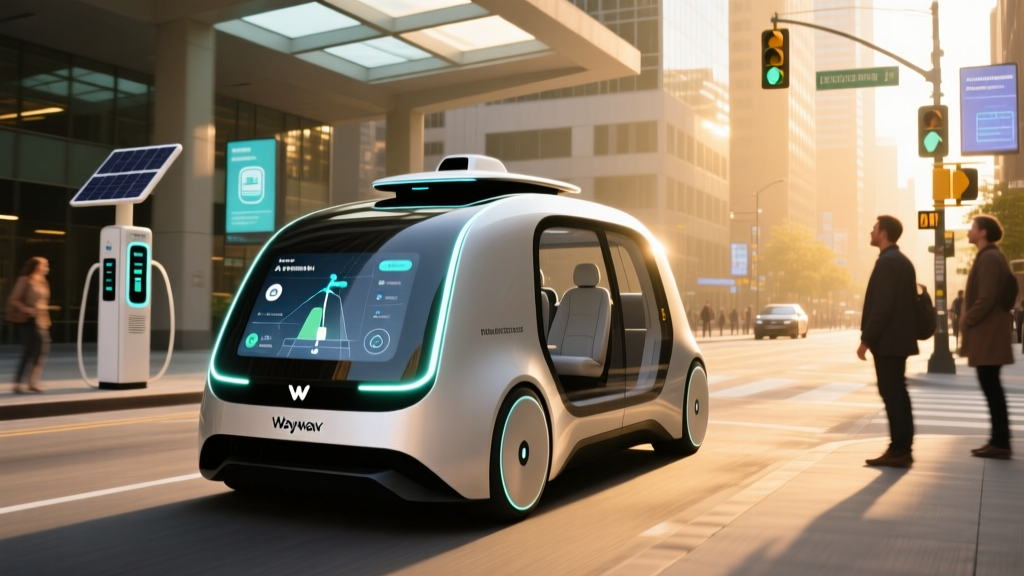
Waymo's AI — branded as the Waymo Driver — operates on a continuous stream of sensor data: lidar point clouds, camera frames, radar returns, and audio. It must simultaneously localize the vehicle to centimeter precision, classify every object in a 360-degree field of view, predict the trajectories of dozens of agents (cars, cyclists, pedestrians), plan a safe path, and execute steering and braking commands — all within a latency budget measured in tens of milliseconds. A hallucination here means a collision.
Waymo Driver Tech Stack (6th-Gen Hardware, 2026)
- LiDAR: Custom-built 360° rooftop unit plus short-range corner sensors; generates millions of points per second for precise 3D mapping
- Cameras: 8+ high-resolution cameras covering 360° with HDR and low-light optimization
- Radar: Imaging radar for velocity detection and performance in rain/fog where lidar scatters
- Compute: Custom onboard AI inference hardware running perception, prediction, and planning models in parallel
- HD Maps: Centimeter-accurate pre-built maps of every operational zone, updated continuously
ChatGPT has none of this. It has no lidar, no cameras, no real-time sensor fusion. Its "world model" is a statistical approximation learned from text, not from physics or direct observation. This is the single biggest misconception in popular AI coverage: a language model that can describe driving is not the same as an AI that can drive.
SAE Automation Levels: Where ChatGPT and Waymo Actually Sit
The SAE International J3016 standard defines six levels of driving automation. This framework is essential for understanding why consumer driver-assist systems like Tesla Autopilot, Ford BlueCruise, and GM Super Cruise are fundamentally different from Waymo's robotaxi.
| SAE Level | Name | Who Drives | Example |
|---|---|---|---|
| Level 0 | No Automation | Human | Basic cruise control |
| Level 1 | Driver Assistance | Human (system assists steering OR speed) | Adaptive cruise, lane-keep |
| Level 2 | Partial Automation | Human (must supervise at all times) | Tesla Autopilot, FSD Supervised, BlueCruise, Super Cruise |
| Level 3 | Conditional Automation | System (in narrow conditions; human must take over on request) | Mercedes Drive Pilot (limited markets/speeds) |
| Level 4 | High Automation | System (no human needed within geofenced ODD) | Waymo One, Zoox |
| Level 5 | Full Automation | System (everywhere, all conditions) | Does not exist commercially |
ChatGPT is not a driving system at any level — it is a text-processing tool with zero vehicle-control capability. Waymo operates at SAE Level 4: fully driverless within its defined operational design domain (ODD), with no human in the driver's seat and no expectation of human takeover. Tesla's FSD Supervised, despite the marketing, remains SAE Level 2 — the driver is legally and functionally responsible at all times.
Where Can You Use Waymo Right Now?
As of early 2026, Waymo One — the company's commercial ride-hailing service — operates in the following metro areas:
| City | Status | Coverage Area | Hours |
|---|---|---|---|
| Phoenix, AZ | Fully open (no waitlist) | ~315 sq mi across Phoenix, Scottsdale, Tempe, Mesa, Chandler, Gilbert | 24/7 |
| San Francisco, CA | Fully open | ~50 sq mi covering most of SF proper | 24/7 |
| Los Angeles, CA | Fully open | ~80 sq mi (Santa Monica, Hollywood, Downtown, Beverly Hills corridor) | 24/7 |
| Austin, TX | Launched 2025, expanding | Initial downtown and South Austin zones | Limited hours, expanding |
Waymo has announced plans for additional cities, but announced expansion is not live service. If you're outside these geofenced zones, you cannot summon a Waymo. The vehicle will not operate outside its mapped ODD.
Pricing: Waymo vs Uber vs Lyft
Waymo One pricing is structured similarly to rideshare — you get an upfront fare estimate before confirming. Based on rides taken in Phoenix and San Francisco through late 2025 and early 2026:
| Route Example | Waymo One | UberX | Lyft Standard |
|---|---|---|---|
| Airport to downtown (PHX, ~5 mi) | $18–$24 | $15–$22 | $14–$20 |
| Cross-town SF (Mission to Marina, ~4 mi) | $16–$22 | $14–$20 | $13–$19 |
| Short hop LA (Santa Monica to Venice, ~2 mi) | $10–$14 | $9–$13 | $8–$12 |
Waymo fares are generally competitive with UberX and Lyft Standard — sometimes slightly higher during peak demand, sometimes lower since Waymo does not apply traditional surge pricing in the same way. Waymo also periodically offers promotional credits for new riders. Tipping is optional and available in-app, though there's no driver to tip.
How to use it: Download the Waymo One app (iOS/Android), enter your pickup and dropoff within a supported zone, confirm the fare, and the vehicle arrives — typically within 3–8 minutes in well-covered areas. You sit in the back; there is no one in the driver's seat.
Safety Data: What the Numbers Actually Show
Waymo Safety Record (Through Late 2025)
- Total autonomous miles driven: Over 40 million fully driverless miles (Waymo's published cumulative figure as of mid-2025; continued growth through 2026)
- NHTSA Standing General Order data: Waymo reports incidents as required; the vast majority are minor low-speed contacts, often caused by other human-driven vehicles
- Insurance claim comparison: A IIHS-cited Swiss Re study found Waymo vehicles had approximately 73% fewer property damage liability claims and 76% fewer bodily injury claims compared to a human-driver baseline fleet
- Key context: Most robotaxi incidents involve other parties (human drivers rear-ending a stopped Waymo, for example), not the robotaxi initiating contact
For comparison, U.S. human drivers experience roughly 1.5 property-damage crashes per 100,000 miles and about 5.5 fatal crashes per billion miles (NHTSA data). Waymo's at-fault incident rate is meaningfully lower in the geofenced urban environments where it operates, though direct comparison is complicated by the fact that Waymo drives in dense, low-speed city grids — not rural highways where fatal crashes concentrate.
The critical point: Waymo's safety record is built on Level 4 operation with no human fallback. Consumer systems like Tesla FSD Supervised operate at Level 2, where the human is the safety system. These are fundamentally different safety architectures and should not be conflated.
Current Limitations: Where Robotaxi AI Falls Short
What Waymo Cannot Do Today
- Heavy precipitation: Dense rain, snow, or fog degrades lidar and camera performance. Waymo may pause service or restrict routes during severe weather events.
- Unmapped zones: The vehicle will not drive outside its pre-mapped geofence. If your destination is outside the ODD, the app won't let you book the ride.
- Construction zones: While Waymo handles many temporary lane shifts, major unmapped construction can trigger a remote-assist pause or reroute.
- Highway driving: Waymo's urban ODD includes some freeway segments (e.g., in Phoenix), but high-speed interstate routing is limited compared to human rideshare.
- Complex off-road or unpaved routes: Driveways, dirt roads, parking garages with tight spirals — these are edge cases the system may decline.
- Emergency vehicle interaction: Waymo detects and yields to emergency vehicles, but complex multi-vehicle emergency scenes can require remote guidance.
ChatGPT has a different kind of limitation: it can confidently produce false information (hallucinations) with no mechanism to verify truth. Waymo's AI faces "edge cases" in the physical world — unusual objects, adversarial weather, ambiguous human behavior — but it has a verification loop: sensor data either confirms or contradicts its predictions in real time.
Regulatory Landscape: Who Approves Robotaxi Operations
Robotaxi deployment in the U.S. is regulated at the state and local level, with federal oversight from NHTSA for vehicle safety standards:
- California: The California Public Utilities Commission (CPUC) and the DMV jointly regulate autonomous vehicle testing and commercial deployment. Waymo holds a CPUC permit for driverless commercial service in SF and LA.
- Arizona: Arizona has minimal state-level AV regulation; Waymo has operated in Phoenix since 2020 with relatively permissive oversight.
- Texas: Austin approved Waymo operations through local agreements and state AV legislation.
- Federal (NHTSA): NHTSA requires crash reporting via Standing General Order and can investigate safety defects, but does not currently issue a federal "robotaxi license."
This patchwork means robotaxi availability will remain city-by-city for the foreseeable future. There is no federal framework that would allow Waymo to simply "turn on" nationwide.
Why This Distinction Matters for EV Buyers and Owners
If you're researching electric vehicles and autonomous technology, the ChatGPT vs Waymo question often surfaces because both are labeled "AI." But the practical implications are completely different:
- ChatGPT might help you research which EV to buy, compare tax credit eligibility, or draft an email to your electrician about a Level 2 charger install.
- Waymo's AI is the system that will drive you home from dinner in Phoenix without a human touching the wheel — in a Jaguar I-PACE electric robotaxi, no less.
Understanding this distinction also protects you from marketing hype. When an automaker claims its driver-assist system uses "AI," ask: is this SAE Level 2 (you're driving) or Level 4 (the system drives)? As of 2026, no consumer vehicle you can buy is Level 4. Only purpose-built robotaxi fleets operating in geofenced cities hold that designation.
Frequently Asked Questions
Is ChatGPT used in Waymo's self-driving system?
No. Waymo's perception, prediction, and planning models are proprietary and trained on petabytes of real-world driving data from its fleet. ChatGPT is a language model trained on text; it has no role in vehicle control. Some automakers are exploring LLMs for in-cabin voice assistants and natural-language navigation queries, but that is an infotainment feature, not a driving system.
Can I buy a car with Waymo's AI and drive it myself?
No. Waymo's technology is not available for consumer purchase. It operates exclusively in Waymo-owned or Waymo-partnered fleet vehicles (currently the Jaguar I-PACE and the custom Zeekr robotaxi platform). You can only experience it as a passenger through the Waymo One ride-hailing service.
How safe are robotaxis compared to human drivers?
Based on insurance claim data (Swiss Re/IIHS analysis) and NHTSA crash reporting, Waymo's at-fault crash rate in its operational cities is significantly lower than the human-driver baseline. However, robotaxis operate in constrained, low-speed urban environments — a direct apples-to-apples comparison with all human driving (including highway and rural) is not straightforward.
Is Tesla FSD the same as Waymo?
No. Tesla FSD Supervised is SAE Level 2 — the driver must remain attentive and is legally responsible. Waymo is SAE Level 4 — fully driverless within its geofenced service area, with no human in the driver's seat. Tesla uses a camera-only approach; Waymo uses lidar, radar, and cameras. These are fundamentally different architectures with different safety models.
Will ChatGPT ever be able to drive a car?
Not in its current form. Language models process text, not sensor data. A future AI system that integrates language understanding with real-time perception and control is theoretically possible, but it would be a fundamentally different architecture — not "ChatGPT but for driving." The gap between generating text about driving and controlling a vehicle in real traffic is a matter of engineering discipline, not just scale.