The Quick Verdict: The Escalade IQ Is Not a Robotaxi
If you've been searching for information on Cadillac Escalade IQ self-driving capabilities, let's clear up the most important misconception immediately: the Escalade IQ is not a self-driving vehicle. It is a driver-assisted luxury EV that requires your full attention and engagement at all times. What it does offer is one of the most capable hands-free highway driving systems available to consumers — and understanding the difference between that and true autonomy is critical before you spend six figures.
The 2026 Cadillac Escalade IQ pairs General Motors' latest ADAS suite (branded Ultra Cruise on top trims, an evolution of Super Cruise) with a massive 200+ kWh Ultium battery, up to 460 miles of EPA-estimated range, and a starting price around $129,990. It's a technological tour de force — but it operates firmly within SAE Level 2 automation, meaning the driver remains legally and practically responsible for the vehicle.
SAE Automation Levels — Where the Escalade IQ Sits
| Level | Name | Who Drives | Example |
|---|---|---|---|
| Level 0 | No Automation | Human does everything | Basic cruise control |
| Level 1 | Driver Assistance | Human + one system | Adaptive cruise OR lane keep |
| Level 2 | Partial Automation | Human supervises | Escalade IQ Ultra Cruise, Tesla Autopilot, Ford BlueCruise |
| Level 3 | Conditional Automation | System drives, human on standby | Mercedes DRIVE PILOT (limited markets) |
| Level 4 | High Automation | System drives, no human needed in zone | Waymo, Zoox robotaxis |
| Level 5 | Full Automation | System drives everywhere | Does not exist commercially |
Source: SAE International J3016
Ultra Cruise vs. Super Cruise: What the Escalade IQ Actually Offers
GM has deployed two tiers of hands-free driving technology on the Escalade IQ lineup, and understanding the distinction matters for both capability and cost.
Super Cruise (standard on Luxury and Premium Luxury trims) provides hands-free driving on over 750,000 miles of compatible, pre-mapped divided highways across the U.S. and Canada. It uses a combination of high-definition GPS, LiDAR-derived map data, forward-facing cameras, and radar to maintain lane position, manage speed, and execute lane changes when the driver confirms via turn signal. A driver-attention camera mounted on the steering column monitors your eyes and will escalate alerts — visual, audible, then haptic — if you look away too long.
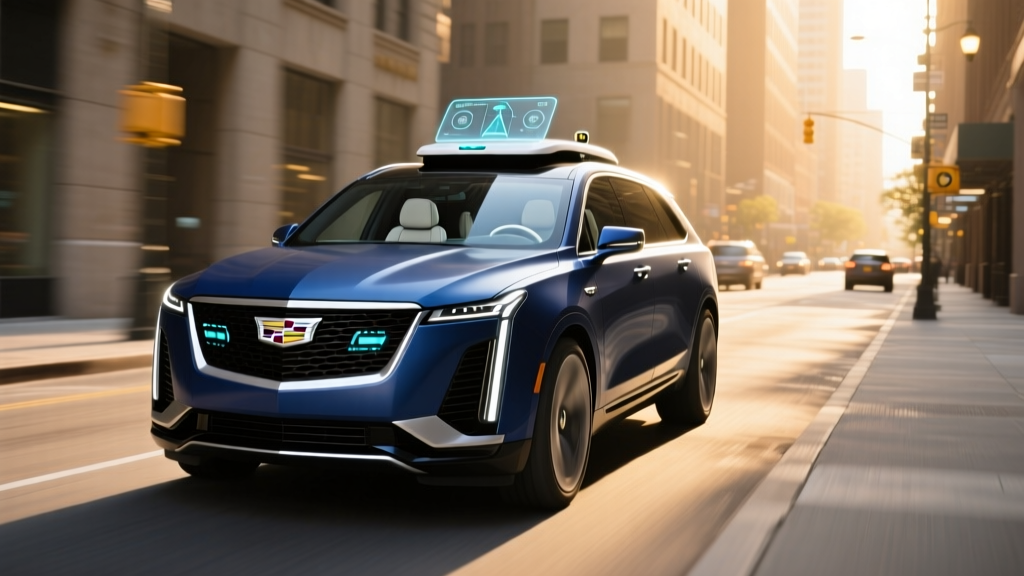
Ultra Cruise (available on Sport and Executive trims, expected to expand) extends hands-free capability beyond divided highways to include urban and suburban roads, covering what GM claims will eventually exceed 2 million miles of mapped roads. Ultra Cruise adds a roof-mounted LiDAR sensor (in addition to cameras and radar), enabling higher-fidelity environmental mapping and more complex intersection handling. However, even Ultra Cruise remains SAE Level 2 — your eyes must stay on the road, and your hands can be off the wheel but you must be ready to resume control within seconds.
Technology Stack Breakdown
| Sensor / System | Super Cruise | Ultra Cruise |
|---|---|---|
| Forward cameras | Yes (multi-lens) | Yes (multi-lens, higher res) |
| Long-range radar | Yes | Yes |
| Corner/side radar | Yes | Yes |
| Roof-mounted LiDAR | No | Yes |
| HD GPS + LiDAR map data | Yes | Yes (expanded coverage) |
| Driver-attention camera | Yes (IR eye-tracking) | Yes (IR eye-tracking) |
| Hands-free road coverage | ~750,000 mi (divided highways) | ~2,000,000 mi (incl. urban/suburban) |
| Automatic lane change | Driver-confirmed | Driver-confirmed |
The critical difference between this system and a true robotaxi like Waymo is geofencing and responsibility. Waymo's Level 4 vehicles operate without any human in the driver's seat but only within tightly defined geographic zones (currently parts of Phoenix, San Francisco, Los Angeles, and Austin). The Escalade IQ can operate on mapped roads across the entire continent — but only with a licensed, attentive driver behind the wheel. Neither approach is universally "better"; they solve different problems.
Escalade IQ by the Numbers: Range, Battery, Charging, and Price
Before evaluating the driving-assistance technology, the Escalade IQ's core EV specifications deserve scrutiny. This is a full-size luxury SUV with genuine long-distance capability.
| Specification | 2026 Escalade IQ |
|---|---|
| EPA Range (est.) | Up to 460 miles (Luxury 2WD); ~430 mi AWD variants |
| Battery | ~200+ kWh usable, Ultium NMC chemistry (double-stacked modules) |
| DC Fast Charging | Peak ~200 kW (800V architecture); 10–80% in ~35 min |
| Level 2 Charging | Up to 19.2 kW (adds ~52 mi/hr) |
| Horsepower | Up to 750 hp (AWD, Velocity mode) |
| 0–60 mph | ~4.7 seconds (AWD) |
| MPGe (combined) | ~89 MPGe (est., based on similar Ultium platforms) |
| Battery/Powertrain Warranty | 8 years / 100,000 miles |
| Starting MSRP | $129,990 (Luxury); ~$149,990 (Executive/Ultra Cruise) |
Federal Tax Credit Eligibility
Under current IRS §30D rules, the Escalade IQ faces a hard barrier: the federal EV tax credit caps at $80,000 MSRP for SUVs. At $129,990+, the Escalade IQ does not qualify for the $7,500 new clean vehicle credit. Buyer income limits ($300,000 MFJ / $150,000 single) and critical-mineral sourcing requirements are moot here — the MSRP cap alone disqualifies it. If you're considering this vehicle, plan your purchase without factoring in the federal incentive. Some states may offer separate luxury-EV incentives; check your local DMV or energy office for specifics.
Where Can You Use Ultra Cruise Right Now?
Unlike robotaxi services that are confined to specific cities, Super Cruise and Ultra Cruise work anywhere the road has been mapped — which, for Super Cruise, covers the vast majority of the U.S. interstate highway system and major Canadian highways.
| System | Coverage Area | Road Types | Availability (2026) |
|---|---|---|---|
| Super Cruise | U.S. + Canada (all 50 states where mapped) | Divided highways, freeways | Live — included on vehicle |
| Ultra Cruise | U.S. + Canada (expanding urban/suburban) | Highways + surface streets + some urban roads | Live on equipped trims; coverage expanding via OTA |
| Waymo (comparison) | Phoenix, SF, LA, Austin metro zones | Surface streets within geofence | Live — pay per ride |
The practical implication: if you're driving I-95 from Miami to New York, I-10 from LA to Jacksonville, or I-80 from Chicago to San Francisco, Super Cruise will handle the majority of those miles hands-free. Ultra Cruise extends this to the on-ramps, off-ramps, and connecting surface streets that Super Cruise would hand back to you. GM pushes coverage expansions via over-the-air updates, so the mapped road network grows each quarter.
To check whether a specific route is compatible, the Escalade IQ's infotainment system displays a Super Cruise/Ultra Cruise icon on the instrument cluster when you enter a mapped road. You can also preview compatible routes via the myCadillac app before a trip.
Safety Data: What We Know About Super Cruise and Ultra Cruise
GM has been more transparent than most automakers about real-world ADAS engagement data, though comprehensive independent crash-data analysis specific to Super Cruise remains limited compared to the depth of NHTSA's standing general order on automated driving systems.
Super Cruise / Ultra Cruise Safety Context
- Driver monitoring: The IR eye-tracking camera is one of the most robust in the industry. In IIHS testing of similar systems, GM's driver-attention system scored highest for keeping drivers engaged compared to camera-free steering-wheel-torque systems.
- Miles driven on Super Cruise: GM reported over 25 million cumulative hands-free miles driven across its Super Cruise fleet as of mid-2025, with the number growing as more vehicles (Lyriq, Optiq, Escalade IQ, Silverado EV) join the platform.
- NHTSA Standing General Order: Under NHTSA's mandatory crash-reporting rule for Level 2+ systems, GM has reported incidents involving Super Cruise. As of the latest public data, Super Cruise has not been linked to a fatal crash in which the system was actively engaged — though this is a limited dataset and absence of reported fatalities does not equal proof of zero risk.
- IIHS research finding: The Insurance Institute for Highway Safety has consistently found that systems with robust driver monitoring (like GM's camera-based approach) result in significantly less driver inattention than systems relying solely on steering-wheel torque sensors.
It's essential to distinguish this from robotaxi safety data. Waymo, for example, publishes peer-reviewed studies showing its Level 4 vehicles' crash rates versus human benchmarks across millions of fully driverless miles. The Escalade IQ's Ultra Cruise is a fundamentally different proposition — it's a tool that assists an engaged driver, not a replacement for one. The safety benefit comes from reducing fatigue on long highway stretches and adding a redundant layer of environmental awareness, not from removing the driver from the equation.
Current Limitations: What the Escalade IQ Cannot Do
No honest assessment of the Escalade IQ's self-driving-adjacent features is complete without a frank discussion of where the system disengages, struggles, or simply refuses to operate.
Hard Limitations
- Unmapped roads: If GM hasn't LiDAR-mapped the road, Super Cruise won't engage. Rural routes, newly constructed highways, and private roads are excluded until the next OTA map update.
- Weather: Heavy rain, snow, fog, or ice that obscures cameras or LiDAR will cause automatic disengagement. The system alerts you and requires immediate hands-on-wheel takeover. Ultra Cruise's roof-mounted LiDAR performs better in light precipitation than camera-only systems, but is not immune to sensor occlusion.
- Construction zones: While Ultra Cruise has improved construction-zone handling with its LiDAR, complex lane shifts, temporary barriers, and flaggers will still force disengagement in many scenarios.
- Complex intersections: Ultra Cruise handles many signalized intersections, but unprotected left turns across heavy traffic, multi-lane roundabouts, and non-standard junctions remain edge cases where the system may slow, alert, and hand control back.
- No point-to-point autonomy: You cannot enter a destination, recline your seat, and nap. The system assists with longitudinal and lateral control; you are driving the vehicle.
- Towing and heavy loads: Super Cruise/Ultra Cruise may restrict engagement or adjust following distances when towing. Check owner's manual for specific towing-mode limitations.
- Subscription requirement: Super Cruise includes a limited trial period (typically 3 years). After expiration, a paid OnStar/Super Cruise subscription is required to maintain hands-free functionality. Ultra Cruise pricing for post-trial continuation has not been publicly fixed for all trims as of early 2026.
Escalade IQ vs. True Robotaxis: Cost and Capability Comparison
Because searchers often conflate personal-vehicle ADAS with robotaxi services, here's a direct comparison to clarify what you're actually getting with each approach.
| Factor | Escalade IQ (Ultra Cruise) | Waymo One (Robotaxi) |
|---|---|---|
| SAE Level | Level 2 (driver required) | Level 4 (no driver in zone) |
| Geographic scope | Continental (mapped roads) | 4 metro areas, specific zones |
| Upfront cost | $129,990–$149,990+ MSRP | $0 (pay per ride) |
| Per-trip cost | Electricity (~$0.04–$0.06/mi home charging) | Comparable to Uber/Lyft ($1.50–$3.00/mi typical) |
| You can leave the driver's seat? | No | Yes (within service zone) |
| Weather handling | Disengages in heavy precipitation | Operates in moderate rain; limited in severe weather |
| Ownership | You own the vehicle | Fleet-owned, hail via app |
If you need a vehicle that drives you from a San Francisco apartment to SFO without any input, Waymo is the answer — but only if you live in that zone and don't need to leave it. If you need a luxury SUV that can cover 460 miles from Chicago to Denver with hands-free highway assistance while you remain in command, the Escalade IQ is the answer. These are not competing products; they're different solutions to different transportation needs.
Who Should Buy the Escalade IQ for Its Driving Tech?
Choose the Escalade IQ if:
- You regularly drive 200+ miles on interstates and want to reduce fatigue without surrendering control
- You need a full-size luxury SUV with three rows, genuine towing capability, and EV running costs
- You value the 460-mile range for road trips where DC fast-charging infrastructure may be sparse
- You want hands-free tech that works across the country, not just in one city
- Budget is not a primary constraint ($130K–$150K+ before options)
Look elsewhere if:
- You want a vehicle that drives itself without supervision (no consumer vehicle does this today)
- You primarily drive unmapped rural or back roads where Super Cruise won't engage
- You need federal tax-credit eligibility (MSRP cap disqualifies the Escalade IQ)
- You're looking for a robotaxi experience — use Waymo or Zoox in their service areas instead
Frequently Asked Questions
Is the Cadillac Escalade IQ truly self-driving?
No. The Escalade IQ features SAE Level 2 driver-assistance technology (Super Cruise and Ultra Cruise). It can steer, accelerate, and brake hands-free on mapped roads, but a licensed driver must remain attentive, seated in the driver's seat, and ready to take over at any time. It is not a Level 4 autonomous vehicle and cannot operate without a human driver.
How much does Ultra Cruise cost on the Escalade IQ?
Ultra Cruise is bundled into the higher trim levels (Sport and Executive), which start around $149,990. Super Cruise is standard on lower trims starting at $129,990. Both systems include a trial subscription period (typically 3 years), after which a paid OnStar plan is required for continued hands-free functionality. Exact post-trial subscription pricing varies — confirm with your dealer at purchase.
Can the Escalade IQ drive itself in the city?
Ultra Cruise can handle some urban and suburban surface streets that GM has mapped, but with significant caveats. Complex intersections, construction zones, and heavy precipitation will cause disengagement. Super Cruise (on lower trims) is limited to divided highways only. Neither system provides the point-to-point urban autonomy that a Level 4 robotaxi like Waymo offers within its geofenced zones.
What happens if I fall asleep with Ultra Cruise engaged?
The driver-attention camera monitors your eye gaze continuously. If it detects you're not looking at the road, it escalates through a series of alerts: a visual warning on the instrument cluster, an audible chime, a haptic pulse in the driver's seat, and finally, if you remain unresponsive, the system will slow the vehicle, activate hazard lights, and eventually bring the Escalade IQ to a stop. It will also contact OnStar for a welfare check and can dispatch emergency services if needed. You cannot sleep while the system is active.
Does the Escalade IQ qualify for the $7,500 federal EV tax credit?
No. Under IRS §30D rules, the federal new clean vehicle credit has an MSRP cap of $80,000 for SUVs. The Escalade IQ starts at $129,990, well above this threshold. Even if you meet income requirements and battery-sourcing criteria, the MSRP cap is an absolute disqualifier. Consult a tax professional for any applicable state-level incentives.
How does Super Cruise compare to Tesla's FSD (Supervised)?
Both are SAE Level 2 systems requiring driver engagement, but they take fundamentally different technical approaches. Super Cruise/Ultra Cruise relies on pre-mapped roads with LiDAR-derived HD maps, meaning it only works where mapped but tends to be smoother and more predictable on compatible roads. Tesla FSD (Supervised) uses a vision-only, real-time perception approach that theoretically works on any road but has shown more variability in behavior and a more extensive NHTSA investigation history. GM's camera-based driver monitoring is generally regarded by safety researchers as more effective at ensuring engagement than Tesla's steering-wheel-torque approach. Neither system is self-driving.
What's the real-world charging experience on road trips?
With its 800V architecture and ~200 kW peak DC fast-charging rate, the Escalade IQ can add roughly 150 miles of range in 15 minutes at a compatible high-power charger. However, the massive 200+ kWh battery means a full 10–80% session takes approximately 35 minutes — longer than smaller-battery EVs that charge at similar kW rates. Plan road-trip stops accordingly, and always precondition the battery via the navigation system before arriving at a DC fast charger to achieve peak charge speeds. The NMC chemistry charges more slowly above 80% SoC to preserve long-term battery health.