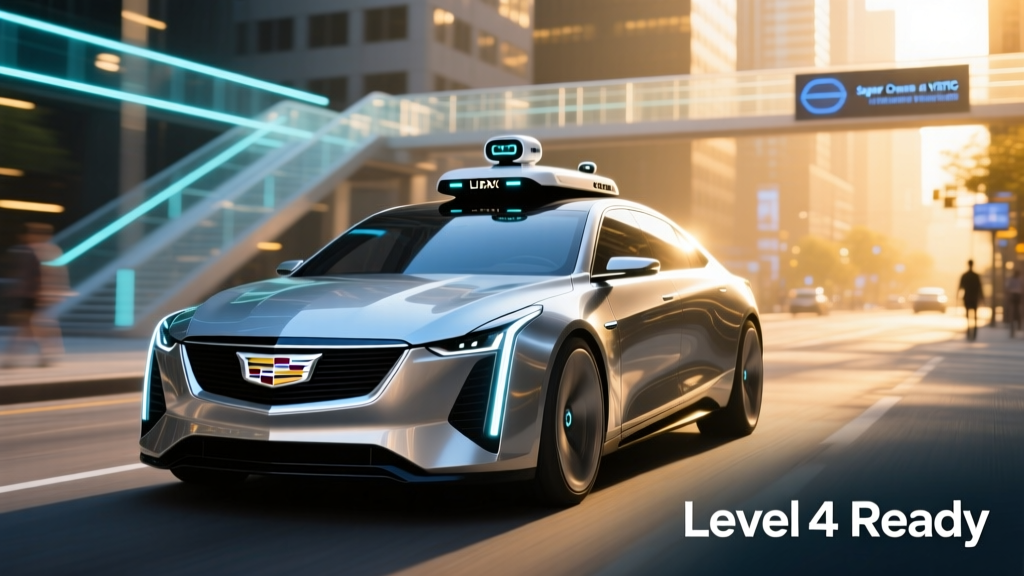
If you've searched for a Cadillac autonomous car, you've likely encountered a tangle of marketing language, concept-vehicle hype, and genuine technology that exists today. The reality is nuanced: Cadillac currently sells some of the most capable consumer driver-assistance systems on the market, but none of them are self-driving. Meanwhile, General Motors — Cadillac's parent company — has invested billions in Cruise, its robotaxi division, only to dramatically scale back operations after a serious 2023 incident in San Francisco.
This guide cuts through the noise. We'll explain exactly what Cadillac offers today (Super Cruise and the newer Ultra Cruise), where GM's Level 4 robotaxi ambitions stand in 2026, and what the data actually says about safety, availability, and cost. Whether you're shopping for a new Celestiq, considering a used CT5 with Super Cruise, or simply trying to understand the autonomous vehicle landscape, you'll leave with exact figures and honest assessments.
What Cadillac's Driver-Assist Systems Actually Do (SAE Levels Explained)
The single most important thing to understand about any Cadillac autonomous car feature is its SAE automation level. This isn't marketing — it's an engineering classification that tells you whether you can take your eyes off the road, take your hands off the wheel, or take a nap. Here's how Cadillac's current systems map to SAE definitions:
SAE Automation Levels for Cadillac Systems
| SAE Level | Definition | Cadillac System | Driver Responsibility |
|---|---|---|---|
| Level 0 | No automation | — | Full control |
| Level 1 | Single-axis assist (steering OR speed) | Adaptive Cruise / Lane Keep | Hands on, eyes on, full control |
| Level 2 | Combined steering + speed assist | Super Cruise | Eyes on road, hands off wheel (on approved roads) |
| Level 2+ | Level 2 with lane-change capability | Ultra Cruise | Eyes on road, hands off wheel (expanded roads) |
| Level 3 | Eyes off in limited conditions | Not offered | Must be ready to take over |
| Level 4 | No driver needed (geofenced areas) | Cruise Origin (discontinued 2024) | None — vehicle is driver |
| Level 5 | Full autonomy everywhere | Does not exist anywhere | None |
Source: SAE International J3016
The critical takeaway: every Cadillac you can buy today is a Level 2 vehicle at most. Super Cruise and Ultra Cruise are sophisticated driver-assistance systems, not autonomous cars. You must remain attentive, keep your eyes on the road (the system monitors this via an infrared camera on the steering column), and be prepared to take over instantly. This is fundamentally different from a Waymo robotaxi, which is a Level 4 vehicle with no steering wheel and no human driver.
Super Cruise: Where It Works, What It Costs, and How It Performs
Super Cruise launched on the 2018 Cadillac CT6 and has since expanded to most of the Cadillac lineup. It uses a combination of LiDAR-mapped HD road data, real-time cameras, radar, and GPS to enable hands-free driving on over 750,000 miles of pre-mapped divided highways across the United States and Canada.
How Super Cruise Works in Practice
When you enter a Super Cruise-compatible road (indicated by a white steering-wheel icon in the instrument cluster), you can activate the system and remove your hands from the wheel. The infrared driver-attention camera tracks your eye gaze — if you look away from the road for more than a few seconds, the system escalates warnings: green light bar turns red, audible chimes, seat vibration, and ultimately, the vehicle will slow to a stop and contact OnStar if you don't respond.
Super Cruise handles lane-keeping, adaptive cruise control, and speed-limit adjustments. However, it will not change lanes for you, navigate interchanges, or handle surface streets. When approaching a mapped-road boundary or an interchange, the system alerts you to retake the wheel.
Current Cadillac Models with Super Cruise (2025–2026)
| Model | Powertrain | Super Cruise Availability | Starting MSRP (with SC) |
|---|---|---|---|
| Cadillac CT5 | 2.0T / 3.0T Twin-Turbo | Available (Premium Luxury, Sport) | ~$47,000 |
| Cadillac CT5-V Blackwing | 6.2L Supercharged V8 | Available | ~$98,000 |
| Cadillac Escalade | 6.2L V8 / 3.0L Duramax | Standard on Premium Luxury+ | ~$92,000 |
| Cadillac Escalade IQ | BEV (200 kWh, Ultium) | Standard | ~$130,000 |
| Cadillac LYRIQ | BEV (102 kWh, Ultium) | Available (Tech Package) | ~$60,000 |
| Cadillac OPTIQ | BEV (Ultium) | Available | ~$55,000 |
| Cadillac VISTIQ | BEV (3-row, Ultium) | Standard | ~$78,000 |
| Cadillac Celestiq | BEV (111 kWh, hand-built) | Ultra Cruise standard | ~$340,000 |
Subscription cost: Super Cruise includes a 3-year trial. After that, the OnStar Super Cruise plan costs approximately $25/month or $250/year. Without an active subscription, the system will not function — a critical ownership cost that buyers frequently overlook.
Ultra Cruise: The Celestiq's Next-Generation System
The Cadillac Celestiq, GM's hand-built, $340,000+ ultra-luxury electric sedan, introduces Ultra Cruise — a more advanced system that expands hands-free coverage from highways to virtually all roads, including surface streets and residential areas. Ultra Cruise uses a more powerful sensor suite including additional LiDAR units and higher-resolution cameras.
However, Ultra Cruise remains a Level 2 system. The driver must remain attentive and ready to intervene. The expanded coverage means fewer hand-back alerts, not true autonomy. The Celestiq's production volume is extremely limited (fewer than 400 units planned annually), making Ultra Cruise a low-volume technology showcase rather than a mainstream product.
GM's Cruise Robotaxi: What Happened and Where It Stands in 2026
When people search for a "Cadillac autonomous car," they're often conflating Cadillac's consumer driver-assist systems with GM's Cruise robotaxi operation. Cruise was a Level 4 service — vehicles with no steering wheels, no human drivers, operating commercially in dense urban environments. It's important to understand this history because it directly shapes what's available today.
The October 2023 San Francisco Incident
On October 2, 2023, a Cruise robotaxi in San Francisco struck a pedestrian who had been thrown into its path by a human-driven vehicle. The Cruise vehicle braked but could not stop in time, then dragged the pedestrian approximately 20 feet while attempting to pull over. The incident, combined with concerns about Cruise's initial reporting to regulators, led to the California DMV suspending Cruise's deployment permit.
Within weeks, Cruise voluntarily paused all driverless operations nationwide. GM subsequently cut Cruise's budget by over $1 billion, laid off roughly 24% of its workforce, and shifted strategy from rapid expansion to a phased, safety-focused restart.
Cruise in 2026: A Dramatically Scaled-Back Operation
As of 2026, Cruise has resumed limited testing with human safety drivers in select cities. Fully driverless commercial service has not resumed at scale. The Cruise Origin — the purpose-built, steering-wheel-free robotaxi — was effectively canceled in mid-2024, with GM taking a write-down on the program. GM has stated it will integrate Cruise's autonomous driving technology into future personal vehicles, but no Level 4 consumer product has been announced with a production timeline.
Cruise Safety Data (Pre-Suspension, through Oct 2023)
- Total driverless miles: Approximately 2.5 million autonomous miles across San Francisco, Phoenix, and Austin
- Reported collisions: 82 incidents reported to NHTSA from 2022–2023, the majority low-speed and attributed to other road users
- Injury incidents: The October 2023 pedestrian-dragging event was the most serious; several other incidents involved minor contact with cyclists and pedestrians
- Disengagement rate: Cruise reported approximately 0.5 disengagements per 1,000 autonomous miles in its California DMV reports (higher than Waymo's reported rate)
- Regulatory action: California DMV suspended deployment permit; CPUC revoked driverless deployment permit
Sources: NHTSA Standing General Order, California DMV Autonomous Vehicle Reports
Where Can You Actually Use an Autonomous Cadillac or GM Robotaxi Today?
This is where the distinction between consumer driver-assist and robotaxi service becomes critical:
Service Availability Table
| Service | Type | Where Available | Status (2026) |
|---|---|---|---|
| Cadillac Super Cruise | Level 2 driver-assist (you own the car) | 750,000+ miles of divided highways across US and Canada | Active — available on new and used Cadillacs |
| Cadillac Ultra Cruise (Celestiq) | Level 2+ driver-assist (you own the car) | Millions of miles including surface streets (US/Canada) | Active — Celestiq owners only (~400/year) |
| Cruise Robotaxi (driverless) | Level 4 robotaxi (hail a ride) | Was: SF, Phoenix, Austin. Now: none commercially | Suspended — testing only with safety drivers |
| Waymo One (for comparison) | Level 4 robotaxi (hail a ride) | Phoenix, San Francisco, Los Angeles, Austin (expanding) | Active and commercially operational |
Bottom line: There is currently no Cadillac-branded robotaxi you can hail. If you want a Level 4 driverless ride today, Waymo One is the only commercially available service at meaningful scale in the United States. Cadillac's autonomous technology exists as driver-assist systems you purchase with the vehicle.
Super Cruise vs. Waymo: Pricing and Ownership Economics
Comparing a Cadillac with Super Cruise to a Waymo robotaxi is like comparing owning a boat to calling a water taxi — they solve different problems. But understanding the economics of each helps clarify what you're actually paying for.
| Cost Factor | Cadillac LYRIQ w/ Super Cruise | Waymo One (Phoenix) | Uber/Lyft (National Avg) |
|---|---|---|---|
| Upfront vehicle cost | ~$60,000 MSRP | $0 | $0 |
| Per-mile operating cost | ~$0.04–0.06/mi (electricity) | ~$1.50–2.50/mi | ~$1.50–3.00/mi |
| Subscription/service fee | $25/mo after 3-yr trial | Per-ride pricing | Per-ride pricing |
| Driver attention required | Yes — eyes on road | No — fully driverless | No — someone else drives |
| Typical 15-mile trip cost | ~$0.90 (electricity only) | ~$25–35 | ~$22–40 |
| Available everywhere? | Yes (vehicle goes anywhere) | No (geofenced zones only) | Most metro areas |
Super Cruise makes financial sense for frequent highway commuters who value reduced fatigue on long drives. A robotaxi makes sense for urban dwellers who don't own a car or need a ride in a specific geofenced area. These are complementary technologies, not competitors.
The Technology Stack: LiDAR, Cameras, and HD Maps
Understanding how Cadillac's systems work reveals both their strengths and their hard limitations.
Super Cruise Sensor Suite
- LiDAR pre-mapped road data: Super Cruise relies on centimeter-precision HD maps of every compatible road, created by LiDAR scanning vehicles. This is both its greatest strength (the system "knows" the road geometry ahead) and its greatest limitation (unmapped roads are simply unavailable).
- Forward-facing cameras: Multiple cameras detect lane markings, traffic signs, vehicles, and pedestrians.
- Long-range radar: Adaptive cruise control uses radar to maintain following distance and detect vehicles cutting in.
- GPS + inertial measurement: Determines vehicle position on the HD map.
- Driver-attention camera: Infrared camera on the steering column monitors eye gaze direction.
Why This Differs from Tesla's Approach
Tesla's Autopilot and FSD (Supervised) use a camera-only ("Tesla Vision") approach with no LiDAR, radar, or HD maps. This allows Tesla's system to operate on virtually any road, but it has a different failure profile — camera systems can struggle with low sun angles, faded lane markings, and unusual road geometries. Super Cruise's LiDAR-mapped approach is more constrained in coverage but generally more robust within its operating domain.
Neither approach is Level 4. Both require full driver attention.
Current Limitations: What a Cadillac Autonomous Car Cannot Do
Every honest assessment of Cadillac's driver-assist systems must address what they cannot handle. These aren't edge cases — they're routine driving scenarios:
Hard Limitations of Super Cruise / Ultra Cruise
- Weather: Super Cruise disables in heavy rain, snow, fog, and ice. The system will alert you to retake control and will not re-engage until conditions improve.
- Construction zones: Temporary lane shifts, barrel lines, and modified road geometry often confuse the system. Expect frequent disengagements.
- Unmapped roads: Any road not in GM's HD map database is unavailable. This includes most surface streets (except with Ultra Cruise on the Celestiq), rural roads, and recently built highways.
- Lane changes: Super Cruise does not perform automatic lane changes. The driver must signal, check mirrors, and execute lane changes manually.
- Interchanges and exits: The system will alert you well in advance of an upcoming exit or highway-to-highway interchange and require you to take over.
- Towing: Super Cruise is disabled when towing a trailer on most models (check your owner's manual — Escalade may allow limited towing with SC).
- City streets (Super Cruise only): Standard Super Cruise operates exclusively on divided, limited-access highways. Stoplights, cross traffic, and pedestrians are not in its operating domain.
- No hands-off, eyes-off: Even when the system is active, you must keep your eyes on the road. Reading your phone, turning around, or closing your eyes will trigger escalating warnings.
Regulatory Landscape: Who Approves Autonomous Vehicle Operations?
Autonomous vehicle regulation in the United States is a patchwork of federal and state authority:
- Federal (NHTSA): Sets vehicle safety standards (FMVSS) but does not currently have a comprehensive framework for certifying Level 4+ vehicles. NHTSA's Standing General Order requires all companies testing or deploying automated driving systems to report crashes within 24 hours.
- State DMVs: Issue permits for testing and deployment. California, Arizona, Texas, and Nevada have the most active AV regulatory frameworks. States can revoke permits (as California did with Cruise).
- State Public Utility Commissions: In some states (notably California), the PUC must approve commercial robotaxi fares and service areas.
- Local municipalities: Cities can restrict AV operations through local ordinances, speed limits, and geofencing requirements.
For consumer Level 2 systems like Super Cruise, the regulatory burden is lighter — these systems fall under existing ADAS regulations, and the driver retains full legal responsibility for the vehicle. No special permits or approvals are needed to use Super Cruise on public roads.
Is a True Cadillac Autonomous Car Coming?
GM has repeatedly stated its long-term vision of a "zero crashes, zero emissions, zero congestion" future, with autonomous driving technology as a core pillar. However, the Cruise setback has reset expectations significantly:
- No Level 3 Cadillac has been announced. Unlike Mercedes-Benz, which offers Level 3 "Drive Pilot" on the S-Class and EQS in limited US markets (Nevada, California), Cadillac has not pursued a Level 3 certification. Level 3 is legally complex because it shifts liability from driver to manufacturer during system operation.
- GM is integrating Cruise technology into personal vehicles, but no production timeline has been given for a consumer Level 4 Cadillac.
- The Celestiq's Ultra Cruise represents the most advanced consumer system Cadillac offers, but it remains Level 2+ with driver supervision required.
If a true Cadillac robotaxi or Level 4 personal vehicle arrives, it will likely be late this decade at the earliest. Buyers shopping today should evaluate Super Cruise and Ultra Cruise on their merits as driver-assist systems — which are genuinely excellent for reducing highway fatigue — rather than as steps toward imminent full autonomy.
Frequently Asked Questions
Is Super Cruise truly self-driving?
No. Super Cruise is an SAE Level 2 driver-assistance system. You must keep your eyes on the road at all times, and you are legally responsible for the vehicle. The system can steer, accelerate, and brake on compatible highways without your hands on the wheel, but it is not autonomous. Calling it "self-driving" is inaccurate and potentially dangerous.
How much does Super Cruise cost after the free trial?
After the included 3-year trial, Super Cruise requires an active OnStar Super Cruise plan at approximately $25/month or $250/year. Without this subscription, the system is completely non-functional — there is no way to use it without paying.
Can I use Super Cruise on any road?
No. Super Cruise operates only on pre-mapped, divided, limited-access highways. GM maintains a database of over 750,000 compatible miles in the US and Canada. Surface streets, rural roads, and unmapped highways are not available. Ultra Cruise on the Celestiq significantly expands coverage to include most surface streets, but still requires driver attention.
What happened to GM's Cruise robotaxi?
After a serious pedestrian incident in San Francisco in October 2023, Cruise suspended all driverless operations nationwide. GM cut the program's budget by over $1 billion, the Cruise Origin vehicle was canceled, and as of 2026, Cruise is conducting limited testing with safety drivers but has not resumed commercial driverless service. GM says it will integrate Cruise's technology into future personal vehicles.
Is a Cadillac with Super Cruise safer than a regular car?
GM's internal data and IIHS research suggest that Super Cruise reduces driver fatigue and may lower crash risk on compatible highways. However, comprehensive independent crash-avoidance data specific to Super Cruise is limited. The system's driver-attention monitoring is more rigorous than many competitors, which helps prevent over-reliance. Always treat it as an assist system, not a safety net.
How does Super Cruise compare to Tesla Autopilot or FSD?
Super Cruise works on fewer roads (mapped highways only vs. Tesla's virtually-anywhere approach) but is generally considered more robust and predictable within its operating domain. Tesla FSD (Supervised) can handle city streets and intersections but has a more variable performance record and requires the same Level 2 driver supervision. Both systems are Level 2 — neither is self-driving. Super Cruise's LiDAR-mapped approach trades coverage breadth for consistency; Tesla's camera-only approach trades consistency for coverage.
Will my Super Cruise Cadillac ever become fully autonomous through an OTA update?
There is no announced plan for this. The hardware in current Super Cruise vehicles was designed for Level 2 operation. Achieving Level 4 autonomy requires fundamentally different sensor suites, computing power, and regulatory certification. While GM may offer incremental improvements to Super Cruise via over-the-air updates (new road coverage, smoother lane-keeping), a jump to full autonomy on existing hardware is not realistic.