BYD Self-Driving: Separating Marketing From Reality
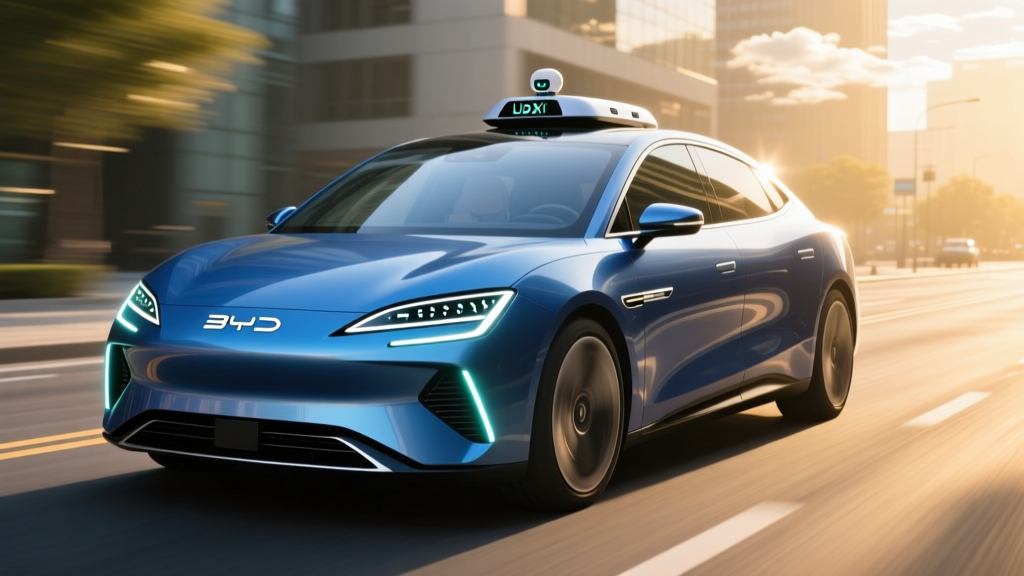
Search for "BYD self-driving" and you'll find a tangle of headlines, promotional videos, and speculative timelines. Here's the ground truth as of 2026: BYD does not operate a Level 4 robotaxi service anywhere in the world. What BYD does offer is an increasingly capable suite of Level 2 driver-assistance systems branded under the DiPilot umbrella — technology that requires continuous driver supervision and cannot operate without a human behind the wheel.
This distinction matters enormously. Conflating advanced driver-assist with true self-driving has led to real-world crashes, regulatory crackdowns, and consumer confusion across the entire EV industry. Below, we break down exactly what BYD's autonomous driving technology can do today, what it cannot, and how it compares to actual robotaxi platforms like Waymo and Baidu Apollo.
Where BYD's Autonomous Tech Actually Stands
BYD's driver-assistance strategy has evolved rapidly. The company's current-generation DiPilot systems are deployed across multiple model lines, with capability tiers that vary significantly by vehicle and trim:
| DiPilot Tier | SAE Level | Key Capabilities | Available On | Sensor Suite |
|---|---|---|---|---|
| DiPilot 10 | Level 2 | ACC, lane centering, AEB, blind-spot monitoring | Dolphin, Atto 3 base trims | 5 cameras, 5 radars, 12 ultrasonic |
| DiPilot 100 ("God's Eye") | Level 2+ | Highway NOA, auto lane change, on/off-ramp assist, smart parking | Seal, Han, Tang flagships | 11 cameras, 5 mmWave radars, 12 ultrasonic |
| DiPilot 300 | Level 2+ (urban) | City NOA (navigation on autopilot), traffic light recognition, urban intersection handling | Yangwang U8, select Denza models | 12 cameras, 5 mmWave radars, 1–3 lidar, 12 ultrasonic |
The critical term here is NOA (Navigation on Autopilot). When BYD says "city NOA" or "highway NOA," it means the car can follow a navigation route, manage lane changes, and handle merges — but only on pre-mapped roads and only with a fully attentive driver. This is the same operational category as Tesla's Autopilot with FSD (Supervised), GM's Super Cruise, and Ford's BlueCruise. None of these are self-driving.
The Technology Stack: Camera-Heavy With Lidar Options
BYD has taken a different architectural approach than Tesla's camera-only philosophy. The DiPilot 300 tier incorporates lidar sensors — typically roof-mounted units from suppliers like RoboSense or Hesai — to provide redundant depth perception that pure vision systems can struggle with in low light, heavy rain, or complex urban geometry.
- Cameras: 12 total (forward-facing 8MP, surround-view, cabin monitoring)
- Lidar: 1–3 units depending on model (150m–200m range, point cloud density ~1.5M points/sec)
- Millimeter-wave radar: 5 units (forward long-range + 4 corner radars for blind spot and cross-traffic)
- Ultrasonic sensors: 12 for close-range parking and low-speed obstacle detection
- Compute: NVIDIA DRIVE Orin SoC (254 TOPS) on higher trims; Horizon Robotics Journey 5 on mid-tier
- HD Maps: Required for City NOA — limits operation to pre-mapped corridors
The reliance on HD maps is a significant constraint. BYD's City NOA only functions on roads that have been pre-surveyed and mapped at high definition. As of early 2026, BYD has progressively expanded City NOA coverage across major Chinese cities, but it is not a universal "drive anywhere" system. If you leave the mapped zone, the system downgrades to basic lane-keep and adaptive cruise — or disengages entirely.
BYD vs. Actual Robotaxi Services: A Fundamental Difference
Understanding where BYD sits requires comparing it to genuine Level 4 robotaxi operations. The table below makes the distinction unambiguous:
| Attribute | BYD DiPilot (Consumer Vehicles) | Waymo One (Robotaxi) | Baidu Apollo Go (Robotaxi) |
|---|---|---|---|
| SAE Level | Level 2 (driver required) | Level 4 (no driver) | Level 4 (no driver) |
| Human in vehicle? | Yes — must supervise at all times | No — fully driverless | No — fully driverless (most rides) |
| Service model | You buy/lease the car | Per-ride hailing service | Per-ride hailing service |
| Geofenced? | HD-map dependent for NOA; basic ADAS anywhere | Yes — strict operational design domain | Yes — designated zones in approved cities |
| Where available (2026) | Globally where BYD sells vehicles (NOA China-primary) | Phoenix, San Francisco, Los Angeles, Austin (select zones) | Wuhan, Beijing, Shanghai, Chongqing, Shenzhen (zones) |
| Weather limitations | System degrades in heavy rain/snow; driver must take over | Moderate rain OK; heavy fog/snow = service pause | Moderate rain OK; severe weather = service pause |
| Cost to user | $35,000–$150,000+ vehicle MSRP | ~$1.00–$1.50/mile (comparable to Uber/Lyft) | Often subsidized; ¥4–¥15 per ride in China |
BYD is not competing in the robotaxi space directly. It is building advanced driver-assistance for privately owned vehicles. If you're searching for a "BYD self-driving car" you can hail without a driver, that product does not exist.
Safety Data: What We Know and What We Don't
What we can say with confidence:
- BYD vehicles equipped with DiPilot have earned strong passive-safety ratings. The Atto 3 (Yuan Plus) scored 5 stars in Euro NCAP testing, and the Seal achieved similar results.
- China's MIIT has approved BYD for L3 autonomous driving road tests in designated zones (Shenzhen, Shanghai), but L3 testing with conditional driver release is not the same as L4 commercial robotaxi deployment.
- BYD has not publicly reported disengagement rates (miles per human intervention) in the way California's DMV requires of companies testing autonomous vehicles in that state.
- There have been no widely documented Level 4 robotaxi incidents involving BYD — because BYD does not operate a Level 4 service.
Where You Can Use BYD's Most Advanced Driver-Assist Today
Geographic availability of BYD's top-tier DiPilot features is heavily concentrated in China, where the company has invested in HD mapping and regulatory approvals:
| Feature | China | Europe | Southeast Asia | Australia/NZ | United States |
|---|---|---|---|---|---|
| Highway NOA | ✅ Major expressways nationwide | ⚠️ Limited (regulatory homologation ongoing) | ❌ Not available | ❌ Not available | ❌ BYD not sold in US |
| City NOA | ✅ Expanding: Shenzhen, Shanghai, Beijing, Guangzhou, Chengdu, Hangzhou, and more (2026 coverage growing) | ❌ Not available | ❌ Not available | ❌ Not available | ❌ N/A |
| Smart Parking | ✅ Available | ✅ Available on select trims | ✅ Available on select trims | ✅ Available on select trims | ❌ N/A |
| Basic ADAS (ACC, LKA, AEB) | ✅ All DiPilot-equipped models | ✅ Standard on most trims | ✅ Standard on most trims | ✅ Standard on most trims | ❌ N/A |
For US readers: BYD does not currently sell passenger vehicles in the United States. US tariffs on Chinese-made EVs (currently 100% under Section 301) make near-term market entry economically unviable. You cannot buy a BYD with DiPilot in the US, and there is no announced timeline for passenger vehicle availability.
Current Limitations: What BYD's System Cannot Do
Every driver-assistance system has an operational design domain (ODD) — the specific conditions under which it can function. Here are the hard boundaries of BYD's DiPilot in 2026:
- No hands-off, eyes-off driving: DiPilot requires hands on or near the wheel and eyes on the road. Cabin monitoring cameras will issue warnings and eventually disengage the system if inattention is detected.
- HD map dependency for City NOA: If a road is not in BYD's HD map database, City NOA will not activate. Construction zones, newly built roads, and rural areas are common gaps.
- Weather degradation: Heavy rain, fog, snow, and ice reduce sensor effectiveness (especially lidar and cameras). The system will issue a takeover request and may limit or disable NOA features.
- Construction and temporary traffic control: Barrel lines, temporary lane shifts, and flaggers are edge cases that require immediate human intervention. DiPilot, like all Level 2 systems, cannot reliably interpret non-standard traffic scenarios.
- No operation outside designated markets: City NOA and Highway NOA require regional activation. A BYD Seal with DiPilot 100 purchased in China will not have City NOA functionality if shipped to a market where it's not approved.
- Speed envelope: Highway NOA typically operates up to 130 km/h (~81 mph). City NOA is designed for roads with speed limits up to 60–80 km/h.
- No valet or self-parking without driver present: Smart parking features require the driver to remain in or adjacent to the vehicle. This is not a remote-summon system like Tesla's Smart Summon.
The Regulatory Landscape: Who Approves What
Autonomous driving regulation varies dramatically by jurisdiction, and BYD's capabilities are shaped by where its vehicles are sold:
China: The Ministry of Industry and Information Technology (MIIT) has established a framework for L3 testing and conditional deployment in designated zones. BYD received L3 test plate authorization in Shenzhen in late 2023 and has since expanded testing. However, L3 conditional automation (where the manufacturer assumes liability under defined conditions) is still in limited pilot — not general consumer deployment. Consumer vehicles sold to the public remain L2.
European Union: UN Regulation 157 governs automated lane-keeping systems (ALKS) at up to 130 km/h, but activation requires type-approval that BYD is still pursuing for its European-market vehicles. EU NCAP requirements and GDPR constraints on cabin monitoring cameras add complexity.
United States: Not applicable — BYD passenger vehicles are not sold in the US. For context, NHTSA requires standing general orders for crash reporting involving Level 2+ systems, and companies like Tesla, GM, and Ford report disengagement and incident data under these orders.
Frequently Asked Questions
Is BYD self-driving a real thing I can use today?
No. BYD offers Level 2 driver-assistance (DiPilot), which can steer, accelerate, and brake on your behalf on compatible roads — but you must remain the active driver at all times. There is no BYD robotaxi service and no BYD vehicle you can buy that drives itself without supervision.
Where can I use BYD's most advanced autonomous features?
City NOA and Highway NOA are available primarily in China, covering major expressways and an expanding list of urban areas (Shenzhen, Shanghai, Beijing, Guangzhou, and others). In export markets (Europe, Southeast Asia, Australia), BYD vehicles offer basic ADAS (adaptive cruise, lane-keep, AEB) but not NOA functions.
How does BYD DiPilot compare to Tesla FSD?
Both are SAE Level 2 systems requiring driver supervision. Tesla's FSD (Supervised) uses a camera-only approach and operates without HD maps, giving it broader geographic coverage but arguably less redundancy in depth perception. BYD's DiPilot 300 uses lidar + cameras + radar with HD maps, providing sensor redundancy but limiting operation to mapped areas. Neither system is self-driving, and both have documented limitations in edge cases.
How safe are BYD's driver-assistance systems?
BYD vehicles have earned strong crash-test ratings (Euro NCAP 5-star), but the company has not published granular ADAS-specific safety data (disengagement rates, miles between interventions) comparable to what Waymo has released for its Level 4 robotaxi fleet. Independent, third-party testing of DiPilot's real-world intervention rates is limited.
Will BYD ever launch a Level 4 robotaxi?
BYD has invested in autonomous driving R&D and holds L3 test licenses in China. However, as of 2026, the company has not announced a commercial Level 4 robotaxi service. BYD's business model is centered on selling consumer vehicles, not operating mobility-as-a-service fleets. Any future robotaxi ambitions remain speculative.
Can I buy a BYD in the United States?
No. BYD does not sell passenger vehicles in the US market. A 100% tariff on Chinese-made EVs under Section 301 trade provisions makes near-term entry economically impractical. BYD does sell electric buses and commercial vehicles in the US, but these are not consumer products.