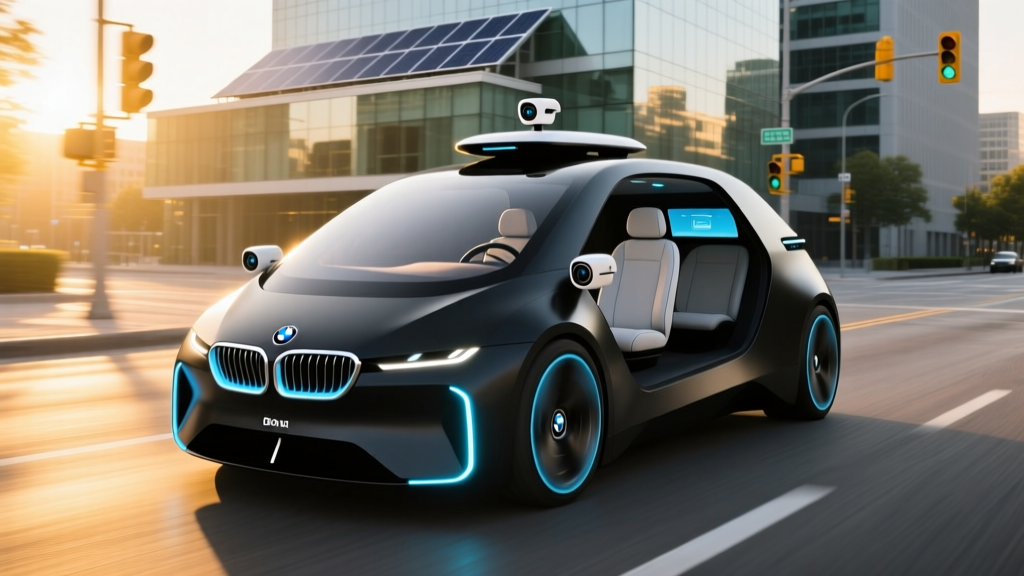
If you have searched for a BMW self-driving car expecting to climb into a 7 Series and take a nap on the freeway, the reality in 2026 is more nuanced — and more interesting. BMW offers some of the most advanced driver-assistance hardware in the luxury segment, and in select markets, it has certified a genuine hands-off, eyes-off Level 3 system. But a true driverless BMW robotaxi you can hail like a Waymo? That does not exist.
This guide dissects exactly what BMW's autonomous technology can do today, the SAE levels behind the marketing, where these systems are legal to use, and how BMW's approach compares to actual Level 4 robotaxi services operating in U.S. cities.
SAE Automation Levels: Where BMW Actually Sits
The biggest source of confusion in autonomous driving is the gap between marketing language and engineering reality. The SAE International J3016 standard defines six levels of driving automation. Understanding these levels is essential before evaluating any BMW system.
| SAE Level | Name | Who Drives? | BMW Availability (2026) |
|---|---|---|---|
| Level 0 | No Automation | Human does everything | Legacy models |
| Level 1 | Driver Assistance | Human + one assist (steering OR speed) | Active Cruise Control, Lane Keeping |
| Level 2 | Partial Automation | Human supervises; system steers AND manages speed | Driving Assistant Professional, Highway Assistant (hands-off, eyes-on) |
| Level 3 | Conditional Automation | System drives in specific conditions; human must take over when requested | Personal Pilot L3 (eyes-off, hands-off) — limited markets |
| Level 4 | High Automation | System drives in geofenced area; no human needed | Not available in consumer BMWs |
| Level 5 | Full Automation | System drives everywhere, all conditions | Does not exist for any production vehicle |
Critical distinction: BMW's most widely available system — the Driving Assistant Professional with Highway Assistant — is SAE Level 2. The driver must remain attentive and is legally responsible for the vehicle at all times. This is not a self-driving car. Only BMW's Personal Pilot L3 qualifies as conditional self-driving (Level 3), and it operates under strict limitations.
BMW's Current Autonomous Tech Stack
BMW's approach to autonomy differs fundamentally from Tesla's camera-centric philosophy and from the lidar-heavy stacks used by Waymo and Cruise. Here is what is actually under the sheet metal.
Level 2: Driving Assistant Professional with Highway Assistant
Available across the 2026 lineup — from the i4 and iX to the 7 Series and X5 — this system combines:
- Front-facing radar (long-range, up to ~300 meters) for adaptive cruise control and collision detection
- Multiple cameras (front stereo, surround-view) for lane detection, traffic sign recognition, and object classification
- Ultrasonic sensors for close-range parking assist
- Driver monitoring camera (infrared, mounted on the steering column) to verify eye attention
The Highway Assistant function allows hands-off driving at speeds up to 85 mph on divided highways, but requires the driver to keep their eyes on the road. The infrared camera tracks gaze direction; if you look away for more than a few seconds, the system issues escalating warnings and will eventually bring the car to a controlled stop.
Level 3: Personal Pilot L3
This is where BMW crosses into genuine conditional automation. The Personal Pilot L3 system, introduced on the 7 Series and subsequently expanded to the i7 and select other models, adds:
- Lidar sensors (supplied by Innoviz Technologies) providing high-resolution 3D point clouds up to ~250 meters
- Redundant steering and braking actuators so the car can stop safely even if one system fails
- Enhanced driver monitoring that permits the driver to look away from the road entirely
- High-definition maps for centimeter-level localization
When Level 3 is engaged, BMW assumes legal liability for accidents caused by the system — a major distinction from Level 2, where the driver bears all responsibility.
Technology Comparison: BMW vs. Robotaxi Stacks
| Attribute | BMW Level 2 (Highway Assistant) | BMW Level 3 (Personal Pilot L3) | Waymo Level 4 (Robotaxi) |
|---|---|---|---|
| Primary sensors | Cameras + radar | Cameras + radar + lidar + HD maps | Custom lidar + cameras + radar + HD maps |
| Driver monitoring | Eyes-on required | Eyes-off permitted (in zone) | No driver present |
| Operational domain | Divided highways, most weather | Specific highways, clear weather, ≤37 mph | |
| Liability | Driver | BMW (when L3 active) | Waymo |
| Geofencing | None (works on mapped highways) | Yes (specific highway sections) | Yes (city operational design domain) |
Where Can You Use BMW's Self-Driving Systems?
Availability varies sharply by system level and geography.
Level 2 (Highway Assistant) — U.S. Availability
The Driving Assistant Professional with Highway Assistant is legal and functional on limited-access divided highways in all 50 U.S. states. It is available as a standalone option (typically $1,700–$2,500 depending on model) or included in higher trims. There is no geofencing — it works wherever the lane markings and GPS signal are adequate.
Level 3 (Personal Pilot L3) — Global Availability
This is where the picture narrows considerably. As of early 2026:
| Region | Level 3 Status | Operational Conditions |
|---|---|---|
| Germany | ✅ Approved and available | Autobahn sections with physical median separation, ≤37 mph (60 km/h), clear weather, daytime |
| United States (Nevada) | ✅ Approved (limited deployment) | Specific highway segments, ≤37 mph, clear conditions |
| United States (California) | ⚠️ Testing / limited approval | Not broadly available to consumers |
| Rest of U.S. | ❌ Not approved | Level 3 not yet authorized by most state DMVs |
| China | ✅ Testing with select partners | Beijing and Shanghai pilot zones |
| UK / EU (non-Germany) | ⚠️ Pending regulatory alignment | Expected 2026–2027 rollout |
The 37 mph speed limit for Level 3 is the system's most significant practical constraint. It is designed for congested highway traffic — the exact scenario where drivers most want to disengage. On free-flowing Autobahn or open U.S. interstate, you are back to Level 2 hands-off/eyes-on.
How BMW's Systems Compare to Robotaxi Services
It is important to contextualize BMW's technology against actual Level 4 robotaxi services — because many consumers conflate the two.
| Attribute | BMW Personal Pilot L3 | Waymo One (Phoenix, SF, LA) | Cruise (Limited relaunch) |
|---|---|---|---|
| SAE Level | Level 3 (conditional) | Level 4 (geofenced driverless) | Level 4 (geofenced driverless) |
| Human in vehicle | Yes, must be ready to resume | No | No |
| Service type | Personal vehicle ownership | Rideshare / hail service | Rideshare / hail service |
| Speed range | Up to 37 mph (L3 active) | Up to ~65 mph in ODD | Up to ~45 mph in ODD |
| Weather operation | Clear weather only (L3) | Light rain OK; heavy rain/fog restricted | Similar weather limitations |
| Cost to user | ~$6,000 option on 7 Series | $0.99–$1.50/mile (comparable to Uber) | Pricing varies; promotional rates |
The fundamental difference: BMW sells you a car that can drive itself in narrow conditions. Waymo and Cruise sell you a ride in a car that drives itself across a broader (but geofenced) urban environment. Neither approach is "full self-driving" in the Level 5 sense.
Safety Data: What the Numbers Show
Autonomous driving safety claims demand hard data, not marketing. Here is what is available.
BMW Level 2 (Driving Assistant Professional)
BMW does not publish fleet-wide intervention or disengagement rates in the same format as California DMV-mandated reports (which apply to Level 4 testing). However, the IIHS has evaluated BMW's systems in its ongoing driver-assistance assessment program. BMW's Active Driving Assistant Pro has generally earned acceptable or good ratings in crash-avoidance tests, though IIHS has flagged that some systems allow extended hands-off periods without sufficient driver engagement monitoring.
BMW Level 3 (Personal Pilot L3)
As of early 2026, the deployed Level 3 fleet is relatively small — primarily in Germany and limited Nevada testing. BMW has stated publicly that the system has accumulated millions of test miles during development, but fleet-wide incident data for consumer L3 deployments is still emerging. The key safety guarantee is legal: when L3 is active and within its operational design domain, BMW accepts liability for system-caused incidents.
Context: Level 4 Robotaxi Safety Records
For comparison, Waymo reported in 2024 (via its safety publications) that its fleet had driven over 50 million fully autonomous miles across Phoenix, San Francisco, and Los Angeles, with a serious-injury crash rate significantly lower than human benchmarks in comparable urban environments. However, Cruise's October 2023 incident in San Francisco — where a pedestrian was dragged after being struck — demonstrates that Level 4 systems can still fail in edge cases, and regulatory consequences followed swiftly.
Pricing: BMW's Autonomous Tech vs. Robotaxi Rides
The economics of BMW self-driving technology versus hailing a robotaxi are fundamentally different — one is a capital purchase, the other a per-ride service.
| Cost Category | BMW Level 2 (Highway Assistant) | BMW Level 3 (Personal Pilot L3) | Waymo One (Phoenix/SF) |
|---|---|---|---|
| Upfront cost | ~$1,700–$2,500 option | ~$6,000 option (7 Series / i7) | $0 (no vehicle purchase) |
| Per-mile cost | Your electricity + depreciation | Your electricity + depreciation | ~$0.99–$1.50/mile |
| Typical 15-mile trip | ~$1.50–$3.00 (electricity) | ~$1.50–$3.00 (electricity) | ~$15–$23 |
| Monthly (600 mi) | ~$60–$120 | ~$60–$120 | ~$600–$900 |
| Annual insurance impact | Modest premium (driver liable) | Potential discount (BMW liable in L3) | N/A (included in fare) |
For frequent drivers, owning a BMW with Level 2 or Level 3 is dramatically cheaper per mile than robotaxi rides. But the robotaxi requires no vehicle purchase, no insurance, no charging, and no maintenance. The break-even point depends entirely on your mileage and whether you already need a personal vehicle.
Current Limitations and No-Go Scenarios
Every autonomous system has an Operational Design Domain (ODD) — the specific conditions under which it can function. Outside the ODD, the system will not engage or will request that the driver take over immediately.
BMW Level 2 (Highway Assistant) Limitations
- Construction zones: Faded or shifted lane markings can confuse the system; it may disengage without much warning
- Heavy rain / snow: Camera and radar degradation; system may limit speed or request takeover
- Unpaved or unmapped roads: System relies on clear lane markings and GPS
- Complex merges: Aggressive cut-ins or zipper merges may require driver intervention
- Driver attention: Eyes must remain on road; infrared monitoring will escalate warnings and stop the car if ignored
BMW Level 3 (Personal Pilot L3) Limitations
- Speed cap: Maximum 37 mph (60 km/h) — only useful in traffic congestion
- Road type: Only divided highways with physical median barriers; no surface streets
- Weather: Clear conditions only — rain, snow, fog, or heavy glare will prevent engagement
- Time of day: Initially limited to daytime operation in most markets
- Takeover requests: The system provides ~10 seconds of warning before the driver must resume control; if the driver does not respond, the car executes an emergency stop in-lane
- Geographic availability: Only approved on specific highway sections in Germany, Nevada, and limited other jurisdictions
What BMW Does NOT Offer
- No Level 4 driverless operation anywhere
- No city-street autonomous driving
- No robotaxi hail service
- No autonomous valet parking (beyond remote-controlled parking assist in tight spaces)
The Regulatory Landscape for BMW Autonomous Systems
Unlike robotaxi services, which must obtain operating permits from state and local authorities (e.g., the California Public Utilities Commission for Waymo), BMW's consumer systems navigate a different regulatory path.
Level 2 systems are classified as driver-assistance and face minimal regulatory hurdles — they are legal in all U.S. states as long as the driver remains responsible. The NHTSA monitors safety outcomes but does not pre-approve Level 2 features.
Level 3 systems require formal type-approval. In the EU, BMW's Personal Pilot L3 was certified under UN Regulation 157 (Automated Lane Keeping Systems), which sets the framework for conditional automation at speeds up to 60 km/h on divided highways. In the U.S., regulation is state-by-state: Nevada became the first state to approve BMW's L3 system, while California's DMV and CHP are still evaluating the framework for consumer L3 deployment.
This fragmented regulatory environment is why Level 3 BMWs are far more common in Germany than in the United States. Until federal or harmonized state-level standards emerge, U.S. BMW buyers outside Nevada will likely remain on Level 2 systems.
Frequently Asked Questions
Is a BMW self-driving car actually available to buy?
Yes and no. You can buy a BMW with Level 2 hands-off highway driving (Driving Assistant Professional) in every U.S. state. You can buy a BMW with Level 3 eyes-off conditional automation (Personal Pilot L3) in Germany and Nevada. You cannot buy a BMW that drives itself without a human present — that would be Level 4, which BMW does not offer in any consumer vehicle.
Can I sleep or watch a movie with BMW's self-driving system?
Only with the Level 3 Personal Pilot L3 system, and only under specific conditions: divided highway, traffic congestion below 37 mph, clear weather, and in a jurisdiction where L3 is approved (primarily Germany, limited Nevada). With the Level 2 Highway Assistant, you must keep your eyes on the road at all times. Watching a movie or sleeping is illegal and will trigger system disengagement.
How does BMW's autonomy compare to Tesla FSD?
Both are Level 2 systems in the U.S., meaning the driver must supervise at all times. BMW's Highway Assistant uses a camera-radar-lidar sensor fusion approach (on L3-equipped models) and enforces driver attention via infrared monitoring. Tesla's FSD (Supervised) relies on a camera-only vision system and has broader geographic coverage (it works on city streets, not just highways). Neither is "self-driving" in the legal sense. BMW's advantage is its certified Level 3 option (in approved markets) where BMW assumes liability — Tesla offers no equivalent.
What happens if the BMW Level 3 system encounters a problem?
The system issues a takeover request with approximately 10 seconds of lead time, using visual, audible, and haptic alerts. The driver must resume full control within that window. If the driver does not respond (e.g., medical emergency or inattention), the car activates hazard lights, gradually decelerates, and comes to a controlled stop in its current lane. It does not pull over to the shoulder autonomously.
Will BMW's autonomous features improve over time?
BMW delivers over-the-air (OTA) software updates that can enhance existing features and, in some cases, unlock new capabilities. However, hardware limitations (sensor count, compute platform) define the ceiling. A 2026 7 Series with the L3 hardware package may receive expanded operational domains via software (e.g., higher speed limits if regulations allow), but it will not suddenly become a Level 4 robotaxi.
Is BMW working on Level 4 or Level 5 autonomy?
BMW has invested in autonomy R&D through partnerships (including Mobileye and Qualcomm for future compute platforms) and has tested Level 4 prototypes. However, BMW has consistently stated that its near-term consumer strategy focuses on refining Level 2+ and Level 3 systems rather than pursuing a Level 4 robotaxi business model. The company views personal luxury mobility — not ride-hailing — as its core market.
Bottom Line: What a BMW Self-Driving Car Actually Means in 2026
A BMW with the Driving Assistant Professional offers genuinely excellent Level 2 highway cruising — comfortable, confident, and available nationwide. The Personal Pilot L3 system represents a real engineering achievement: certified conditional automation where BMW assumes legal liability, a claim almost no other automaker makes.
But neither system is a substitute for a Waymo robotaxi or a vision of full autonomy. BMW's self-driving technology is best understood as premium driver assistance with a clear liability boundary — not a replacement for the driver. If you want a car that handles congested highway drudgery while you check messages (in approved L3 zones), BMW's technology is among the best available. If you want a car that drives you home from a bar while you sleep, you will need to wait — or hail a Waymo.