What Blind Spot Warning Actually Does on the Road
Blind spot warning (BSW) — sometimes called blind spot monitoring (BSM) or blind spot detection — uses sensors to scan the lanes immediately beside and slightly behind your vehicle. When a car, truck, or motorcycle enters the zone your side mirrors can't easily cover, the system triggers a visual alert, typically an LED icon embedded in or near the side mirror housing. Many systems escalate to an audible chime or a steering-wheel vibration if you activate your turn signal while a vehicle occupies that zone.
On modern EVs from Tesla, Hyundai, Ford, Rivian, BMW, and others, BSW is increasingly bundled into broader advanced driver-assistance suites (ADAS). It works in concert with rear cross-traffic alert (RCTA), lane-keep assist, and sometimes even active blind spot intervention — where the car applies gentle corrective steering or braking to prevent a lane change into an occupied lane.
The feature targets one of the most common crash scenarios: the lane-change sideswipe. The National Highway Traffic Safety Administration (NHTSA) estimates that lane-change and merging crashes account for roughly 8–9% of all reported collisions, and the Insurance Institute for Highway Safety (IIHS) has found that blind spot monitoring reduces lane-change crash rates by approximately 14%.
Blind spot warning is classified as an SAE Level 1 feature when it only provides alerts. When paired with active steering intervention (blind spot assist/intervention), it contributes to a Level 2 system. In all cases, the driver must remain fully engaged — hands on the wheel, eyes on the road, making all lane-change decisions. No consumer vehicle sold in 2026 is self-driving in the SAE Level 4/5 sense.
The Hardware: Radar vs. Camera vs. Ultrasonic
Not all blind spot warning systems are built the same. The underlying sensor technology determines detection range, reliability in poor weather, and whether the system can track fast-approaching vehicles two lanes over.
| Sensor Type | Typical Detection Range | Weather Resilience | Used By (Examples) |
|---|---|---|---|
| Rear-corner radar (24 GHz or 77 GHz) | Up to ~230 ft (70 m) rearward | Excellent — penetrates rain, fog, snow | Hyundai, Ford, BMW, Rivian, Toyota, Honda |
| Side-repeater cameras | Visual range ~150 ft | Poor — degraded by rain, dirt, glare | Tesla (camera-only since removing radar in 2021–2022) |
| Ultrasonic (short-range) | ~10–16 ft (3–5 m) | Moderate — affected by ice/snow buildup | Used mainly for parking assist, not BSW primary |
Radar-based systems dominate the market for good reason. A pair of rear-corner radar modules mounted behind the bumper fascia can detect vehicles approaching at high speed from well behind your car — critical for highway driving where a fast-approaching vehicle in your blind zone may not be visible in your mirror for several seconds. The 77 GHz radar band, now standard on most new EVs, offers better resolution than older 24 GHz units and can distinguish between a motorcycle and a semi-truck.
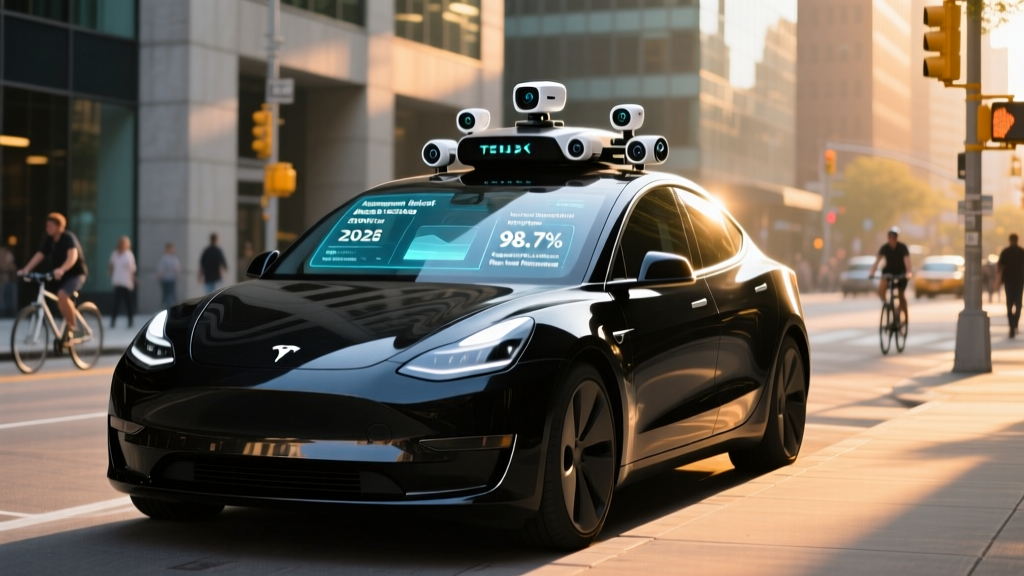
Camera-based systems, most notably Tesla's vision-only approach, rely on the vehicle's side-repeater and B-pillar cameras feeding data to a neural network. Tesla's BSW implementation displays a red or yellow rendering of the detected vehicle on the instrument screen. In our experience, camera-based BSW performs well in clear daylight but can struggle in heavy rain, direct sun glare at certain angles, and when camera lenses accumulate road grime — a common issue in winter driving conditions.
How Every Major EV Brand Names Blind Spot Warning
One of the most confusing aspects of shopping for ADAS features is that every automaker invents its own branding. Here's a translation guide for the 2026 model year:
| Brand | Feature Name | Active Intervention? | Availability |
|---|---|---|---|
| Tesla | Blind Spot Warning / Blind Spot Camera | No (alert + camera view only) | Standard on all models |
| Hyundai / Kia / Genesis | Blind-Spot Collision-Avoidance Assist (BCA) | Yes — active braking/steering | Standard on most EV trims (Ioniq 5, EV6, GV60) |
| Ford | BLIS (Blind Spot Information System) with Cross-Traffic Alert | Yes — on equipped trims | Standard on Lariat+ (F-150 Lightning), Select+ (Mustang Mach-E) |
| Rivian | Blind Spot Warning | Yes (Lane Change Assist on R1T/R1S quad-motor) | Standard on all Adventure/Ascend trims |
| BMW | Active Blind Spot Detection | Yes — steering intervention | Standard on i4, i5, i7; part of Driving Assistant Professional on iX |
| Mercedes-Benz | Active Blind Spot Assist | Yes — braking + steering | Standard on EQE, EQS; part of Driver Assistance Package on EQB |
| Toyota | Blind Spot Monitor (BSM) with Rear Cross-Traffic Alert | Limited (alert-focused) | Standard on bZ4X Limited; optional on XLE |
| Honda | Blind Spot Information (BSI) System | Alert only on most trims | Standard on Prologue Touring/Elite |
The distinction between alert-only and active intervention matters significantly. Alert-only systems (like Tesla's current implementation) flash a mirror icon or dashboard indicator and leave the decision entirely to you. Active systems — branded as "collision-avoidance assist" or "active blind spot assist" — can apply individual wheel braking or add steering torque to nudge you back into your lane if you signal and begin to merge into an occupied lane. In IIHS testing, vehicles with active blind spot intervention show measurably better crash-avoidance outcomes than alert-only systems.
Real-World Limitations: When Blind Spot Warning Fails You
No BSW system in any 2026 production vehicle can reliably detect every hazard. Drivers must continue performing physical head checks before lane changes. The system is a supplement — not a replacement — for visual confirmation.
After thousands of miles of real-world driving across multiple EV platforms, these are the failure modes we consistently encounter:
Speed Differential Blind Spots
Most radar-based BSW systems define their detection zone as roughly one lane width to either side, extending from the B-pillar rearward about 10–15 feet beyond the rear bumper. A fast-approaching motorcycle or sports car traveling 30+ mph faster than your vehicle may enter and exit this zone in under two seconds — sometimes faster than the system's alert latency. This is particularly dangerous on multi-lane highways with speed differentials common in the left lane.
Weather and Sensor Obstruction
Rear-corner radar modules are mounted behind the bumper cover and generally handle rain and fog well. However, heavy wet snow packed against the bumper can attenuate the signal, causing the system to display a "sensor blocked" warning and disable BSW entirely. Camera-based systems (Tesla) are more vulnerable: water droplets on the side-repeater camera lens can cause false positives or missed detections. We've observed Tesla's BSW fail to register a vehicle in heavy rain on I-95, while the same scenario triggered correctly in dry conditions.
Stationary and Slow-Moving Objects
BSW systems are engineered to detect moving vehicles in adjacent lanes. A parked car, a construction barrier, or a cyclist stopped at a light in your blind zone may not trigger an alert. This is by design — filtering out stationary objects prevents constant false alarms — but it means BSW provides zero protection against dooring hazards or stationary obstacles during low-speed urban lane changes.
Trailer and Cargo Interference
If you're towing with an F-150 Lightning (max tow: 10,000 lbs) or Rivian R1T (11,000 lbs), the trailer blocks the rear-corner radar field of view. Ford's Pro Trailer Backup Assist and Rivian's tow mode partially compensate by adjusting detection algorithms, but BSW effectiveness is substantially reduced with any trailer attached. Always verify your system's tow-mode behavior before relying on it while hauling.
Lane Width and Road Geometry
On narrow urban streets, tight construction zones, or roads with non-standard lane widths, the detection zone may overlap with vehicles that are legitimately in their own lane but appear dangerously close. This generates false positives that train drivers to ignore the alert — a well-documented behavioral risk called "alert fatigue."
Cost: What You'll Pay for Blind Spot Warning in 2026
The good news for EV buyers: blind spot warning is included as standard equipment on the majority of 2026 EVs at no additional cost and no subscription. Unlike Tesla's Full Self-Driving (Supervised) — which costs $8,000 as a one-time purchase or $99/month as of 2026 — BSW is a baseline ADAS feature that automakers bundle into their safety suites.
| Brand / System | Cost Structure | Notes |
|---|---|---|
| Tesla (BSW + Blind Spot Camera) | Included (no subscription) | Part of standard Autopilot; FSD not required |
| Hyundai / Kia (BCA) | Included on SEL+ / Wind+ trims and above | No subscription; base SE trims may lack it |
| Ford (BLIS) | Included on Select and above (Mach-E) | Part of Ford Co-Pilot360 Assist 2.0; no subscription |
| Rivian (BSW + Lane Change Assist) | Included on all trims | Software updates via OTA; no subscription tier |
| BMW (Active Blind Spot Detection) | Included on i4/i5/i7 standard | No subscription; part of Driving Assistant package |
| Mercedes-Benz (Active Blind Spot Assist) | Included on EQE/EQS; package on EQB | No subscription required for core functionality |
| Toyota (BSM on bZ4X) | Included on Limited; optional on XLE | Part of Toyota Safety Sense 3.0 suite |
The key takeaway: you do not need to pay for a premium ADAS subscription to get blind spot warning on any major EV in 2026. However, you do need to pay attention to trim levels. Base trims of some models — the Hyundai Ioniq 5 SE Standard Range, the Toyota bZ4X XLE without the convenience package, and certain entry-level VW ID.4 configurations — may ship without BSW. Always verify the feature on the window sticker or manufacturer build sheet before purchasing.
Blind Spot Warning vs. Full ADAS Suites: Where It Fits
BSW occupies a specific niche within the broader ADAS ecosystem. Here's how it compares to related lane-change features:
- Blind Spot Warning (BSW): Alerts you to vehicles in adjacent lanes. No steering or braking action. SAE Level 1.
- Blind Spot Intervention / Collision-Avoidance Assist: Alerts + active braking or steering to prevent a merge into an occupied lane. SAE Level 1–2.
- Rear Cross-Traffic Alert (RCTA): Scans laterally behind the vehicle when reversing out of a parking space. Complements BSW but covers a different scenario.
- Lane Centering + Lane Change Assist: Systems like Hyundai's Highway Driving Assist 2 or BMW's Active Lane Change (part of Driving Assistant Professional) can execute a lane change with driver confirmation — turn signal activation triggers the car to check blind spots, verify clear space, and steer into the adjacent lane. Still Level 2: driver must confirm and supervise.
- Tesla FSD (Supervised) Auto Lane Change: When enabled, the car initiates lane changes on highways without a turn-signal prompt. The driver must still monitor and can cancel at any time. Still Level 2 — not autonomous.
For most buyers, BSW with active intervention represents the best cost-to-safety ratio. It's standard or low-cost on most EV trims, doesn't require a subscription, and addresses a genuine real-world crash risk without overpromising capability.
Which 2026 EVs Offer the Best Blind Spot Warning Implementation?
Based on our testing across sensor reliability, detection range, false-positive rates, and intervention smoothness, here's how the top contenders stack up:
Best radar-based system: Hyundai Ioniq 5 / Kia EV6 (BCA). The 77 GHz rear-corner radar provides reliable detection in heavy rain, and the active steering intervention is firm enough to prevent a bad merge without being jarring. Standard on SEL and above ($44,000+ MSRP for Ioniq 5 SEL AWD).
Best integration with ADAS suite: BMW i5 (Active Blind Spot Detection + Driving Assistant Professional). The system communicates seamlessly with lane-keeping and adaptive cruise, and the steering intervention feels natural rather than abrupt. The i5 eDrive40 starts at $67,100 MSRP with BSW standard.
Best for towing: Ford F-150 Lightning (BLIS with trailer coverage). When properly configured through the SYNC system, BLIS extends its detection zone to account for the trailer's length — a feature most competitors lack. Available on Lariat ($65,000+ MSRP) and above.
Best camera-based system: Tesla Model 3 Highland / Model Y Juniper. While camera-only BSW has inherent weather limitations, Tesla's blind spot camera feature — which displays a live camera feed on the touchscreen when you signal — provides a wider field of view than any mirror icon. Included on all trims at no extra cost.
Frequently Asked Questions
Can blind spot warning prevent all lane-change crashes?
No. BSW reduces lane-change crash rates by roughly 14% according to IIHS data, but it cannot detect every hazard — particularly fast-approaching motorcycles, stationary objects, cyclists, or vehicles in heavy rain/snow on camera-based systems. A physical head check remains essential before every lane change.
Is blind spot warning the same as Tesla's Autopilot or FSD?
No. BSW is a standalone alert feature included on all Tesla vehicles at no extra cost. Autopilot (standard) adds lane centering and adaptive cruise control. Full Self-Driving (Supervised), which costs $8,000 or $99/month, adds features like auto lane change and traffic-light recognition. All remain SAE Level 2 — the driver must stay fully engaged.
Does blind spot warning work at low city speeds?
Yes, but with caveats. Most systems activate above approximately 6–10 mph and are optimized for highway-speed lane changes. At very low speeds, the detection zone may be less useful, and the system typically won't detect cyclists or pedestrians in your blind spot — that's what rear cross-traffic alert and 360-degree camera systems are designed for.
Will my blind spot warning system get better over time?
Possibly, depending on the brand. Tesla, Rivian, Ford, and BMW all deliver over-the-air (OTA) software updates that can refine detection algorithms, reduce false positives, and occasionally add new features. However, OTA updates cannot change the physical sensor hardware — a camera-only system will always have different weather limitations than a radar-based one.
Do I need to recalibrate blind spot sensors after a repair?
Yes. If your EV has been in a rear-end collision or the rear bumper cover has been replaced, the radar modules or camera alignment may need recalibration. This typically costs $150–$400 at a dealer or certified body shop. Driving with misaligned BSW sensors can cause false alerts or missed detections — always verify calibration after bodywork.
Are there any EVs where blind spot warning requires a subscription?
As of 2026, no major automaker charges a subscription specifically for blind spot warning. Some brands (BMW, Mercedes-Benz) have explored subscription models for heated seats or advanced ADAS suites, but BSW remains a standard or package-included safety feature across the industry. The NHTSA continues to monitor ADAS accessibility, and proposed regulations may further restrict paywalling safety features.