The Blind Spot Meaning Every EV Buyer Needs to Understand
If you've ever changed lanes on a highway and felt that split-second jolt of panic when a car appears out of nowhere beside you, you've experienced a blind spot firsthand. The blind spot meaning in automotive terms is straightforward: it's the area alongside and slightly behind your vehicle that isn't visible through the rearview or side mirrors without turning your head. In a traditional sedan, those zones can hide an entire vehicle. In a modern electric vehicle packed with sensors, cameras, and radar, the blind spot meaning has evolved from a passive danger zone into an actively monitored space — but only if you understand what the technology actually does and where it falls short.
For EV shoppers evaluating vehicles like the Tesla Model Y, Hyundai Ioniq 5, Ford Mustang Mach-E, or Rivian R1S, blind spot monitoring (BSM) is just one layer of a broader Advanced Driver Assistance System (ADAS) suite. This guide breaks down exactly how these systems detect vehicles in your blind spots, what they can and cannot do, how much they cost, and why no consumer system on the market today replaces an attentive driver.
How Blind Spot Monitoring Actually Works: Sensors, Radar, and Cameras
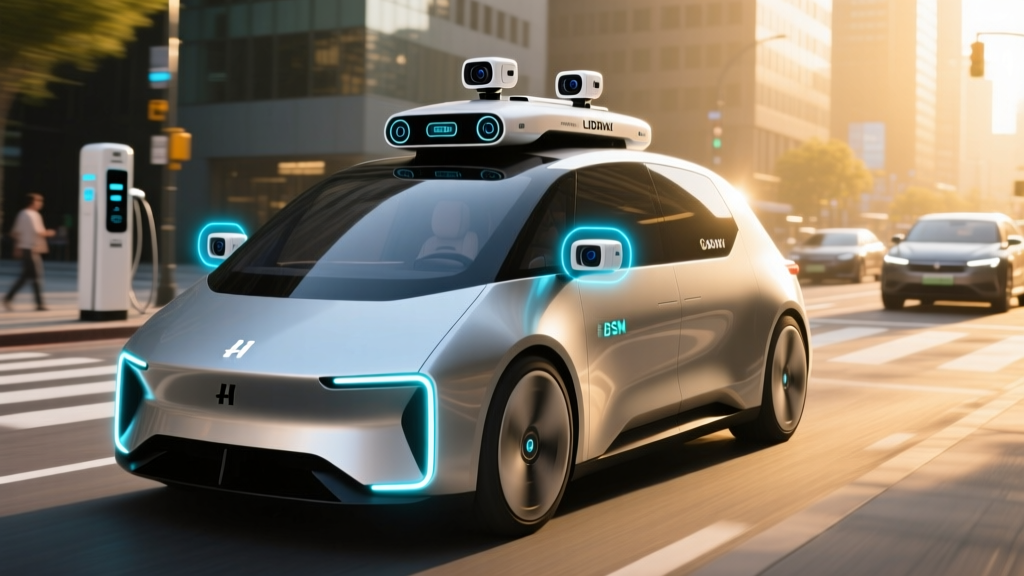
Modern blind spot monitoring systems rely on one or more of three detection technologies. Understanding which your EV uses matters because each has distinct strengths and failure modes.
| Technology | How It Works | Strengths | Limitations |
|---|---|---|---|
| Millimeter-wave radar | Emits 76–79 GHz radio waves from rear-corner modules; measures reflected signal to detect objects up to ~70 meters back | Works in rain, fog, darkness, and snow; reliable distance/speed measurement | Can miss stationary narrow objects (poles, motorcycles at certain angles); higher hardware cost |
| Ultrasonic sensors | Short-range sound pulses (~0.2–5 meters) typically used for parking assist, sometimes extended for low-speed BSM | Low cost, precise at close range | Too short-range for highway-speed blind spot detection; not used as primary BSM in most modern EVs |
| Camera-based vision | Side-mounted or fender cameras feed image to an AI model that classifies vehicles, cyclists, and pedestrians | Rich classification data (can distinguish truck vs. bicycle); enables visual display on center screen | Degraded by heavy rain, lens dirt, direct sun glare, snow accumulation; requires clean lenses |
Most 2025–2026 EVs use radar as the primary blind spot detection layer because it performs consistently regardless of lighting or weather. Camera systems are increasingly layered on top for classification and visual confirmation — Tesla's vision-only approach on the Model Y and Model 3 is the notable exception, relying entirely on cameras without radar.
When a vehicle enters the monitored zone (typically extending from the side mirror rearward about 10 feet and spanning one lane over), the system triggers a visual indicator — usually an amber icon embedded in or near the side mirror. If you activate your turn signal while a vehicle is detected, most systems escalate to an audible chime or steering wheel vibration.
Blind spot monitoring is classified as an SAE Level 1 feature (warning only) or Level 2 when paired with active steering intervention (Blind Spot Collision Avoidance). In either case, you remain fully responsible for driving. The system assists — it does not replace your judgment. Only Level 4 services like Waymo operate without a human driver. For a full breakdown of SAE automation levels, see the SAE J3016 standard.
Brand-by-Brand: What Each Automaker Calls Blind Spot Assist
Automakers brand their ADAS suites differently, and blind spot features get bundled under various marketing names. Here's what's available across popular 2025–2026 EVs and which trims include the technology.
| Brand | ADAS Suite Name | Blind Spot Feature Name | Standard / Optional | Active Steering Intervention? |
|---|---|---|---|---|
| Tesla (Model Y/3) | Autopilot / FSD (Supervised) | Blind Spot Camera + Warning | Standard (warning); FSD adds camera view on signal | No (steering nudge via Lane Departure Avoidance) |
| Hyundai (Ioniq 5/6) | Hyundai SmartSense | Blind-Spot Collision-Avoidance Assist (BCA) | Standard on SEL and above | Yes — applies brake on opposite-side wheel |
| Kia (EV6/EV9) | Highway Driving Assist | Blind-Spot Collision-Avoidance Assist | Standard on most trims | Yes |
| Ford (Mach-E/F-150 Lightning) | Ford Co-Pilot360 | BLIS (Blind Spot Information System) with Cross-Traffic Alert | Standard on all trims | Available on higher trims (Evasive Steering Assist) |
| Rivian (R1S/R1T) | Rivian Driver+ | Blind Spot Warning | Standard on all Adventure/Ascend trims | Limited — primarily warning-based |
| BMW (i4/iX) | Driving Assistant Professional | Active Blind Spot Detection | Standard on most 2025+ trims | Yes — active steering correction |
| Mercedes (EQE/EQS) | Driver Assistance Package | Active Blind Spot Assist | Standard on Premium Plus and above | Yes — can apply single-side braking |
A key distinction: Blind Spot Warning (BSW) only alerts you. Blind Spot Collision Avoidance (BCA) or Active Blind Spot Assist can apply corrective braking or steering input to prevent a lane-change collision. The latter is significantly more valuable in real-world driving but costs more and is not available on every trim.
Real-World Capabilities and Honest Limitations
In controlled testing and daily driving, modern BSM systems catch the vast majority of vehicles in adjacent lanes. The Insurance Institute for Highway Safety (IIHS) has found that blind spot monitoring reduces lane-change crash rates by approximately 14% and lane-change crash injuries by 23%. Those are meaningful numbers — but they also reveal that the systems are far from perfect.
- Motorcycles and bicycles: Narrow profiles can fall below radar detection thresholds or be misclassified by camera systems. Always do a physical head check.
- Fast-approaching vehicles: A car approaching rapidly from 3+ lanes back may not register until it's already in your blind zone — too late for comfortable reaction.
- Heavy rain and road spray: Radar generally handles this well, but camera-based systems (Tesla) can struggle when lenses are obscured.
- Snow and ice buildup: Rear-corner radar modules behind the bumper fascia can be blocked by packed snow. Most systems will display a "sensor blocked" warning — heed it.
- Trailer towing: Extended vehicle length changes the blind zone geometry. Most systems are not calibrated for trailer configurations unless specifically configured (Ford's Pro Trailer system is one exception).
- Guardrails and barriers: Continuous metal barriers can generate radar reflections that cause false positives, especially in construction zones.
- Stationary objects: BSM is designed to track moving vehicles. It will not reliably warn you about a parked car, debris, or a pedestrian in your blind zone.
For Tesla owners specifically: the vision-only approach means your side cameras must be clean. In winter driving or after highway bug accumulation, wipe the fender-mounted cameras — a 30-second task that materially restores detection reliability. Radar-equipped vehicles from Hyundai, Ford, and BMW don't have this particular vulnerability.
Cost Breakdown: What You'll Actually Pay
Blind spot monitoring pricing varies dramatically depending on whether it's bundled into a standard safety suite, packaged as an upgrade, or tied to a subscription-based ADAS platform.
| Brand/Model | BSM Included Standard? | Upgrade Package Cost | Subscription Required? |
|---|---|---|---|
| Tesla Model Y | Yes — basic blind spot warning standard | FSD (Supervised): $8,000 one-time or $99/month | FSD adds enhanced camera views; basic BSW needs no subscription |
| Hyundai Ioniq 5 | Yes — BCA standard on SEL ($46,700 MSRP) and above | N/A on most trims | No |
| Ford Mustang Mach-E | Yes — BLIS standard on all trims | BlueCruise hands-free adds $2,100 or $75/month (doesn't enhance BSM specifically) | No for BSM; yes for BlueCruise |
| BMW i4 | Yes on most trims | Driving Assistant Professional: ~$1,700 (adds active steering) | No |
| Rivian R1S | Yes — standard on all current trims | N/A | No |
| Mercedes EQE | Yes on Premium Plus ($76,050+) trims | Included in Driver Assistance Package on lower trims (~$2,500) | No |
The takeaway: basic blind spot warning is increasingly standard equipment on EVs priced above $40,000. Active collision avoidance (steering or braking intervention) may require stepping up a trim level or adding a package. Subscription-based systems like Tesla's FSD or Ford's BlueCruise don't meaningfully upgrade blind spot detection itself — they add highway lane-centering and hands-free capability, which is a separate ADAS layer.
Blind Spot Assist vs. Full ADAS: Where It Fits in the Safety Stack
Blind spot monitoring doesn't operate in isolation. In a well-integrated ADAS suite, it works alongside several complementary features:
- Rear Cross-Traffic Alert (RCTA): Uses the same rear-corner radar to detect vehicles approaching from the sides when reversing out of a parking space. Virtually always bundled with BSM.
- Lane Keeping Assist (LKA): Can coordinate with BSM — if you signal a lane change and BSM detects a vehicle, some systems (Hyundai BCA, BMW Active Blind Spot) will apply counter-steering torque to keep you in your lane.
- Adaptive Cruise Control (ACC): Forward-facing radar that manages following distance. When combined with lane centering, this forms the core of Level 2 highway driving assist.
- Safe Exit Assist: Uses BSM radar to warn rear passengers opening doors into the path of approaching cyclists or vehicles. Standard on Hyundai/Kia EVs, optional elsewhere.
The integration matters. A vehicle with BSM alone is meaningfully safer than one without. A vehicle with BSM + LKA + RCTA + Safe Exit Assist creates overlapping safety nets that address the most common lane-change and parking-lot collision scenarios.
Frequently Asked Questions
What is the blind spot meaning in simple terms?
Your blind spot is the area alongside and behind your vehicle — roughly from your rear shoulder back about 10–15 feet in the adjacent lane — that you cannot see in your rearview or side mirrors without physically turning your head. Every vehicle has them; larger vehicles like the Rivian R1S or Ford F-150 Lightning have bigger ones.
Is blind spot monitoring the same as self-driving?
No. Blind spot monitoring is an SAE Level 1 (warning) or Level 2 (active intervention with driver supervision) feature. You must remain fully engaged, keep your hands on the wheel, and make your own lane-change decisions. No consumer vehicle sold in 2025–2026 is self-driving. Level 4 autonomous operation is limited to geofenced robotaxi services like Waymo in select cities.
Do I still need to do a head check with BSM?
Yes. BSM systems are designed to track vehicles in adjacent lanes but can miss motorcycles, bicycles, fast-approaching cars from far back, and stationary objects. A quick over-the-shoulder glance remains the gold standard. Think of BSM as a backup confirmation, not a replacement for situational awareness.
Does Tesla's camera-only BSM work as well as radar-based systems?
In clear conditions, Tesla's vision-based blind spot detection performs comparably to radar systems. In heavy rain, fog, or when side cameras are dirty, radar-based systems (Hyundai, Ford, BMW) maintain more consistent detection. Tesla's camera view on the center screen when signaling is a useful visual aid, but the detection reliability depends on camera cleanliness.
Can I add blind spot monitoring aftermarket?
Aftermarket BSM kits exist ($200–$600 plus installation), but they lack the deep integration with steering, braking, and turn-signal systems that factory-installed BSM provides. For a new EV purchase, we strongly recommend choosing a trim with factory BSM rather than retrofitting. The NHTSA recommends factory-integrated ADAS for optimal safety performance.
Which EV has the best blind spot system in 2025–2026?
Hyundai/Kia's Blind-Spot Collision-Avoidance Assist stands out because it's standard on mid-range trims (not locked behind premium packages), includes active braking intervention, and pairs with Safe Exit Assist for rear-passenger protection. BMW's Active Blind Spot Detection with steering correction is also excellent but requires the Driving Assistant Professional package. For value and standardization, the Hyundai Ioniq 5 SEL and Kia EV6 deliver the most complete blind spot safety without upselling.