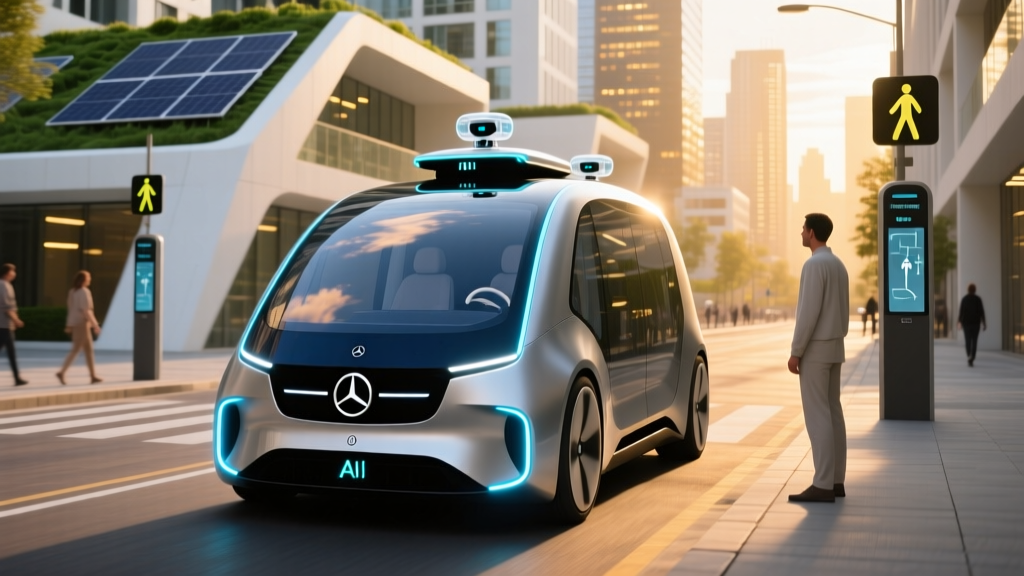
Mercedes-Benz has carved a distinct path in the autonomous-driving race. While Tesla pushes camera-only Full Self-Driving at SAE Level 2, and Waymo operates Level 4 robotaxis without steering wheels, Mercedes became the first automaker to receive government-approved Level 3 conditional autonomy for production vehicles sold in the United States. If you've been searching for a benz autonomous car, the answer in 2026 is nuanced: you can buy a car that legally drives itself under specific conditions, but you cannot hail a driverless Mercedes robotaxi on any public street today.
This guide breaks down exactly what Mercedes-Benz autonomous technology delivers right now, where it works, what it costs, and how it compares to true robotaxi services from Waymo and Cruise.
SAE Automation Levels: Where Mercedes-Benz Actually Sits
Before evaluating any autonomous vehicle, you need the SAE International automation framework. Mercedes-Benz currently sells vehicles at two levels and is developing toward a third.
| SAE Level | Name | Driver Role | Mercedes-Benz Status |
|---|---|---|---|
| Level 2 | Partial Automation | Must supervise at all times, hands on or eyes on | Active — Driver Assistance Package (all models) |
| Level 3 | Conditional Automation | Can disengage (eyes off) under defined conditions; must take over when requested | Active — DRIVE PILOT on EQS & S-Class (approved in NV, CA) |
| Level 4 | High Automation | No driver needed within geofenced operational design domain | In development — no consumer or robotaxi deployment as of 2026 |
| Level 5 | Full Automation | No driver needed anywhere | Not achieved by any production vehicle globally |
DRIVE PILOT: The Benz Autonomous Car You Can Buy Today
Mercedes-Benz DRIVE PILOT is the brand's flagship autonomous-driving system and the first SAE Level 3 system approved for U.S. production vehicles. Here's what it actually does and where it works.
Approved Operational Design Domain (ODD)
DRIVE PILOT activates only when all of the following conditions are met simultaneously:
- Speed: 0–40 mph (60 km/h) — designed for congested highway traffic
- Road type: Divided highways with physical median barriers, pre-mapped by Mercedes HD mapping
- Weather: Clear to light rain; system disengages in heavy rain, snow, fog, or ice
- Lighting: Daytime operation only (no nighttime activation as of 2026)
- Driver state: Driver must be seated, belted, eyes detected by interior camera (though you may look at the central screen for approved apps)
- Following distance: A lead vehicle must be detected ahead
When all conditions are satisfied and you press the DRIVE PILOT button on the steering wheel, the system assumes full longitudinal and lateral control. You are legally permitted to watch streaming video, browse the web on the MBUX infotainment screen, or read — activities that would constitute distracted driving under Level 2 systems. If the system encounters a situation beyond its capability, it issues a takeover request with approximately 10 seconds of warning. If you fail to respond, the vehicle performs a controlled stop in its lane with hazard lights activated.
Vehicles Equipped with DRIVE PILOT
| Model | Powertrain | Drive Pilot Price (add-on) | Base MSRP | EPA Range / MPG |
|---|---|---|---|---|
| EQS 580 Sedan | BEV — 107.8 kWh (NMC) | $2,500 (annual subscription after trial) | $127,350 | EPA 345 mi; real-world ~290–310 mi highway |
| S-Class S 500 4MATIC | Mild-hybrid I6 | $2,500 (annual subscription after trial) | $118,900 | EPA 23 MPG combined |
| S-Class S 580 4MATIC | Mild-hybrid V8 | $2,500 (annual subscription after trial) | $130,750 | EPA 21 MPG combined |
As of 2026, DRIVE PILOT is approved for use on specific highway segments in Nevada (primarily I-15, US-93, and portions of the Las Vegas freeway network) and California (select freeway corridors in the Bay Area and greater Los Angeles, as certified by the California DMV). Mercedes maintains a geofenced map of approved roads, and the system will not activate outside these boundaries regardless of whether conditions appear suitable.
Mercedes-Benz Robotaxi Ambitions: Partnership Landscape
Mercedes-Benz does not operate its own robotaxi fleet. Instead, the company has pursued strategic partnerships to develop Level 4 autonomous mobility services.
The Waymo Partnership (Announced 2024–2025)
In late 2024, Mercedes-Benz and Alphabet's Waymo announced a collaboration to integrate Waymo's 6th-generation Waymo Driver hardware into future Mercedes-Benz vehicles purpose-built for robotaxi service. Key details as of early 2026:
- Vehicle platform: A dedicated robotaxi variant based on Mercedes van architecture (details on exact model not yet finalized)
- Integration timeline: Pilot vehicles expected on public roads in 2026–2027; commercial deployment timeline unannounced
- Operational model: Waymo would operate the fleet using its existing Waymo One platform; Mercedes would manufacture and supply vehicles
- Geographic scope: Initial deployment targeted for U.S. Sun Belt cities where Waymo already operates
The Bosch Collaboration
Mercedes-Benz and Bosch have jointly developed automated parking and valet systems (SAE Level 4, but limited to parking structures at speeds under 10 mph). Automated valet parking is available at select parking garages in Germany and is being piloted at Los Angeles International Airport (LAX). This is narrow-scope autonomy — the vehicle navigates a mapped garage without a driver, but it does not drive on public roads.
Technology Stack: Sensors, Compute, and Mapping
DRIVE PILOT uses a redundant sensor suite that differs significantly from Tesla's camera-only approach. Mercedes has chosen a "belt and suspenders" philosophy prioritizing sensor redundancy over cost minimization.
| Component | Specification | Purpose |
|---|---|---|
| LiDAR | 1 long-range + 4 short-range units | 3D environment mapping, object detection to ~200m |
| Cameras | Multiple stereo and surround cameras | Lane detection, traffic sign recognition, driver monitoring |
| Radar | Multi-mode radar array (front + rear) | Vehicle speed/distance measurement, all-weather fallback |
| Ultrasonic sensors | 12 sensors around vehicle perimeter | Near-field obstacle detection, cut-in vehicle awareness |
| HD Map | Centimeter-precision pre-scanned road maps | Geofencing, lane-level positioning, route validation |
| Compute | Redundant NVIDIA-based processing units | Real-time sensor fusion, failover if primary unit faults |
| Rear-window camera | Dedicated rear-view sensor | Monitoring approaching emergency vehicles |
| Moisture sensors | Windshield and road-surface moisture detection | Weather ODD validation — disables system in heavy rain |
This LiDAR-heavy approach contrasts with Tesla's vision-only FSD stack. Mercedes argues that LiDAR provides essential depth perception and redundancy that cameras alone cannot deliver, especially in the edge cases (tunnel exits, construction zones, emergency vehicles) where Level 3 liability shifts to the manufacturer.
Service Availability: Where Can You Use It?
| Region | System | Status | Approved Roads |
|---|---|---|---|
| Nevada, USA | DRIVE PILOT (Level 3) | Active — available for purchase | I-15, US-93, Las Vegas freeway corridors (~80 miles of mapped highway) |
| California, USA | DRIVE PILOT (Level 3) | Active — DMV deployment permit granted | Select Bay Area and LA freeway segments (expanding gradually) |
| Germany | DRIVE PILOT (Level 3) | Active — first market approved (2022) | Autobahn segments, up to 60 km/h (~37 mph), ~13,191 km of approved highway |
| All other U.S. states | DRIVE PILOT | Not approved — hardware present but software-locked | N/A |
| Any city, USA | Mercedes robotaxi (Level 4) | Not operational | N/A — partnership with Waymo in pilot phase |
Where can I use this robotaxi service right now? There is no Mercedes-Benz robotaxi service. The closest you can get is purchasing an EQS or S-Class with DRIVE PILOT and using Level 3 autonomy on approved Nevada or California highway segments during daytime congestion. For a true driverless ride, you need Waymo One (Phoenix, San Francisco, Los Angeles, Austin) or other Level 4 operators.
Cost Breakdown: DRIVE PILOT vs. Robotaxi vs. Rideshare
Comparing the economics requires separating three distinct products: owning a Level 3 Mercedes, hailing a Level 4 Waymo robotaxi, and calling a conventional Uber or Lyft.
| Option | Upfront Cost | Per-Trip / Ongoing Cost | Autonomy Level | Availability |
|---|---|---|---|---|
| Mercedes EQS 580 + DRIVE PILOT | ~$130,000 MSRP | $2,500/yr subscription (after initial trial); plus insurance, electricity, depreciation | Level 3 (eyes off, hands off — congested highways only) | NV, CA approved roads |
| Waymo One robotaxi | $0 | ~$0.90–$1.40/mile (comparable to UberX; surge pricing applies) | Level 4 (no driver in vehicle) | Phoenix, SF, LA, Austin metro areas |
| UberX / Lyft | $0 | ~$1.00–$1.80/mile (varies by market and demand) | Level 0 (human driver) | Nationwide |
How much does it cost vs Uber/Lyft? A Waymo robotaxi ride typically costs within 10–15% of an equivalent UberX fare in the same market, sometimes cheaper during off-peak hours and sometimes more during surges. Mercedes DRIVE PILOT is not a per-ride service — it's a $2,500 annual feature subscription on a $130,000+ vehicle. The value proposition is personal convenience in traffic, not per-mile savings.
Safety Record: What the Data Actually Shows
Safety data for autonomous systems requires careful sourcing. Here's what is documented as of early 2026.
- Mercedes-Benz has reported zero at-fault collisions while DRIVE PILOT was actively engaged in Level 3 mode across all markets (Germany, Nevada, California) since commercial launch.
- Total accumulated Level 3 miles driven have not been publicly disclosed in a single aggregate figure, but Mercedes has confirmed millions of test miles during validation and thousands of customer miles since deployment.
- Under Level 3, Mercedes-Benz assumes legal liability for accidents that occur while DRIVE PILOT is engaged and operating within its approved ODD — a significant distinction from Level 2 systems where the driver bears all liability.
- The system's conservative ODD (low speed, mapped roads, daytime, fair weather) is deliberately designed to minimize exposure to high-risk scenarios.
Sources: Mercedes-Benz Group AG safety disclosures; NHTSA Standing General Order on ADS crash reporting.
How safe are robotaxis (real data)? For Level 4 robotaxis broadly, Waymo reported in its 2024 safety data publication that its fleet had driven over 25 million autonomous miles on public roads with a fatal crash rate and serious-injury rate significantly below human benchmarks in comparable urban environments. However, robotaxis have also been involved in incidents — Cruise's October 2023 pedestrian-dragging incident in San Francisco led to a statewide suspension and fleet grounding, illustrating that Level 4 autonomy, while statistically safer on a per-mile basis, is not infallible. The NHTSA Standing General Order requires all ADS-equipped vehicles to report crashes, and this data is publicly searchable.
Regulatory Landscape: Who Approves What
Autonomous vehicle regulation in the United States operates at both federal and state levels, creating a patchwork that directly affects where you can use a benz autonomous car.
- Federal (NHTSA): Sets vehicle safety standards (FMVSS) and collects crash data via Standing General Order. Does not currently "approve" ADS features for consumer sale — that authority falls to states.
- Nevada: First state to approve Mercedes DRIVE PILOT for consumer use (2022). The Nevada DMV certifies the system's ODD and requires manufacturer liability acceptance.
- California: The California DMV issues deployment permits for autonomous vehicles. Mercedes received approval for DRIVE PILOT consumer deployment following extensive testing and documentation requirements. Separate from the California Public Utilities Commission (CPUC), which regulates robotaxi commercial passenger service (Waymo, Cruise permits).
- Germany (international reference): The German Federal Motor Transport Authority (KBA) approved DRIVE PILOT under UN Regulation 157 (ALKS — Automated Lane Keeping Systems), making it the first internationally certified Level 3 system.
- Other U.S. states: As of 2026, no other states have approved DRIVE PILOT for consumer use. Mercedes has indicated interest in expanding to additional states but must pursue individual regulatory approvals.
Current Limitations: What a Benz Autonomous Car Cannot Do
Understanding the boundaries is essential for realistic expectations.
- Speed ceiling of 40 mph: DRIVE PILOT only operates in traffic congestion. The moment traffic clears and speeds exceed 40 mph, the system requests takeover. This is not a highway-cruising autopilot — it is a traffic-jam chauffeur.
- No nighttime operation: The system disables after dusk. Evening commutes require full manual driving or Level 2 Active Distance Assist.
- Weather fragility: Heavy rain, snow, fog, or ice triggers immediate disengagement. The moisture sensors on the windshield and road surface are highly sensitive by design.
- Mapped roads only: If your commute takes you off the pre-mapped HD highway segments, DRIVE PILOT will not activate — even if the road looks identical to an approved segment.
- Construction zones: Temporary lane shifts, barrel lines, and construction barriers often exceed the system's ODD. Expect takeover requests in any active work zone.
- Emergency vehicles: The rear-window camera monitors for approaching emergency vehicles. When one is detected, the system issues a takeover request so the driver can pull over. It does not autonomously yield to emergency vehicles.
- 10-second takeover window: When the system reaches its limit, you have approximately 10 seconds to resume full control. If you are distracted (even by an approved activity like watching video), you must be able to re-engage immediately. Failure to respond triggers an automated controlled stop — which itself carries risk on a live freeway.
- No lane changes: DRIVE PILOT maintains the current lane. It does not execute autonomous lane changes, merges, or exits.
- Geographic lock: A Mercedes EQS with DRIVE PILOT purchased in Nevada cannot use Level 3 features if driven to Arizona, Utah, or any other state. The system is software-locked to approved jurisdictions.
Is This Truly Self-Driving or Driver-Assist?
The honest answer depends on your definition.
DRIVE PILOT is not driver-assist in the way that Tesla Autopilot, Mercedes Active Distance Assist, or GM Super Cruise are. Those are Level 2 systems where you must remain engaged and liable. Under DRIVE PILOT's approved conditions, Mercedes-Benz assumes legal liability, you can legally look away from the road, and the system handles all driving tasks. That is genuine conditional self-driving — SAE Level 3.
But DRIVE PILOT is also not a robotaxi. You cannot summon the car from a parking lot, leave the driver's seat, or use it on city streets. A human must be present, belted, and ready to resume control within 10 seconds. The system's narrow ODD (under 40 mph, mapped highways, daytime, good weather) means that on most drives, you will use Level 3 for only a fraction of your trip.
If your goal is to be driven door-to-door without any human involvement, you need a Level 4 robotaxi (Waymo, Zoox) — and those are available only in a handful of U.S. metro areas, in vehicles you cannot purchase.
Frequently Asked Questions
Where can I use a Mercedes-Benz autonomous car right now?
You can use DRIVE PILOT (Level 3) on approved highway segments in Nevada and California during daytime, in congested traffic under 40 mph, in fair weather. There is no Mercedes-Benz robotaxi service available to hail in any city.
How much does Mercedes DRIVE PILOT cost?
DRIVE PILOT is available as an option on the EQS 580 Sedan (starting ~$127,350 MSRP) and S-Class S 500/S 580 (starting ~$118,900–$130,750 MSRP). The feature itself carries a subscription cost of approximately $2,500 per year after an initial trial period. Pricing is subject to change; confirm with your dealer.
Is Mercedes DRIVE PILOT safer than a human driver?
Mercedes reports zero at-fault collisions with DRIVE PILOT engaged. The system's extremely conservative operating envelope (low speed, mapped roads, daytime, clear weather) limits exposure to high-risk scenarios. However, total accumulated customer miles are still relatively low compared to human-driving benchmarks. Mercedes assumes legal liability when the system is engaged, which is a meaningful accountability commitment.
Can I use DRIVE PILOT at night or in the rain?
No. DRIVE PILOT is restricted to daytime operation in clear to light rain conditions. Heavy rain, nighttime driving, snow, and fog all prevent activation.
Will Mercedes ever offer a Level 4 robotaxi I can hail?
Mercedes-Benz has partnered with Waymo to develop a purpose-built robotaxi vehicle, but no commercial service is operational as of 2026. Pilot vehicles are expected on roads in 2026–2027, with commercial deployment timelines unannounced. If it launches, it would operate under the Waymo One platform, not a Mercedes-branded app.
Does the EQS with DRIVE PILOT qualify for the federal EV tax credit?
The IRS §30D clean vehicle credit has an MSRP cap of $55,000 for sedans. The EQS 580 (MSRP ~$127,350) far exceeds this cap and does not qualify for the $7,500 federal credit. Buyers should consult a tax professional regarding any applicable state incentives or point-of-sale transfer options for other electrified Mercedes models that may fall within the cap.
What happens if I don't respond to a DRIVE PILOT takeover request?
If you fail to resume control within approximately 10 seconds of a takeover request, the vehicle activates hazard lights, performs a controlled deceleration, and comes to a complete stop in its current lane. Emergency services are contacted automatically via the Mercedes-Benz emergency call system. This is a last-resort safety measure — stopping in a freeway lane carries inherent risk, which is why the system issues escalating audio, visual, and haptic warnings before reaching this point.
Sources: Mercedes-Benz Group AG — DRIVE PILOT; NHTSA Automated Vehicles Safety; IRS §30D Clean Vehicle Credit.