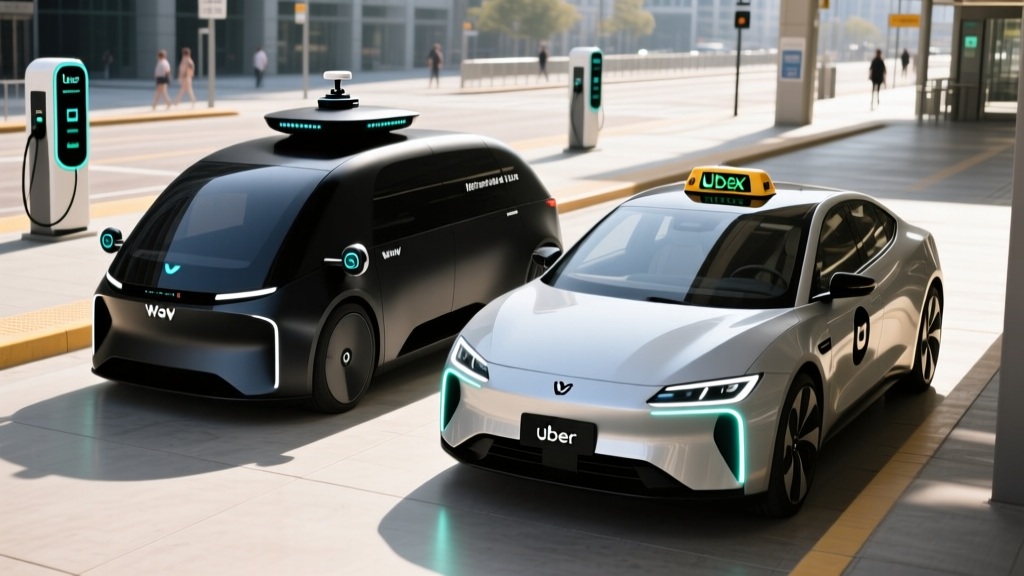
If you have ridden in a Waymo vehicle in Phoenix or San Francisco, you already know the experience is surreal: a steering wheel that turns by itself, a screen tracing your route in real time, and zero human behind the wheel. The benefits of a self-driving car are no longer theoretical — they are measurable in millions of paid trips, documented safety statistics, and per-mile pricing that competes with traditional rideshare. But separating genuine Level 4 autonomy from marketing-driven driver-assist hype remains the single biggest challenge for consumers evaluating this technology.
This guide breaks down exactly what self-driving car services deliver today, where you can use them, what they cost, and — critically — what they still cannot do.
What Qualifies as a Self-Driving Car? Understanding SAE Levels
Before assessing benefits, we need precision on terminology. The Society of Automotive Engineers (SAE) defines six levels of driving automation, and conflating them is the most common error in mainstream coverage.
| Level | Name | Who Drives | Example (2026) |
|---|---|---|---|
| 0 | No Automation | Human | Any car without driver-assist |
| 1 | Driver Assistance | Human (system assists steering OR speed) | Adaptive cruise control |
| 2 | Partial Automation | Human (must supervise at all times) | Tesla Autopilot / FSD Supervised, GM Super Cruise, Ford BlueCruise |
| 3 | Conditional Automation | System in defined conditions; human must take over on request | Mercedes DRIVE PILOT (limited markets, ≤40 mph traffic jams) |
| 4 | High Automation | System (no human needed, but within geofenced area) | Waymo One, Zoox, Baidu Apollo Go |
| 5 | Full Automation | System (everywhere, all conditions) | Does not exist commercially as of 2026 |
The critical distinction: When we discuss the benefits of a self-driving car in this article, we mean Level 4 robotaxis — vehicles with no driver present, operating commercially. Tesla FSD, despite its name, remains SAE Level 2: the driver is legally and practically responsible at all times. NHTSA classifies these differently, and so should you.
Where Can I Use a Robotaxi Service Right Now?
As of early 2026, fully driverless commercial robotaxi services operate in a handful of US metro areas, with expansion proceeding city-by-city under state regulatory approval.
| Service | Operator | Live Cities | Hours | Vehicle |
|---|---|---|---|---|
| Waymo One | Waymo (Alphabet) | Phoenix, San Francisco, Los Angeles, Austin | 24/7 in most markets | Jaguar I-PACE (Gen 6 sensor suite), Hyundai Ioniq 5 (expanding) |
| Zoox | Amazon/Zoox | Limited Las Vegas, San Francisco (pilot areas) | Limited hours | Zoox purpose-built carriage (no steering wheel) |
| Baidu Apollo Go | Baidu | Wuhan, Beijing, Chongqing, Shenzhen (China) | 24/7 in Wuhan | Various Gen 6 vehicles |
| Cruise | GM/Cruise | Suspended US commercial operations; limited supervised testing only | N/A | Chevrolet Bolt EV / Origin (paused) |
Waymo remains the only US operator running large-scale, 24/7, fully driverless commercial service across multiple cities. Zoox has begun limited paid rides in defined zones but is not yet at Waymo's scale. Cruise, once a major competitor, has not resumed commercial driverless operations following its October 2023 incident in San Francisco and subsequent permit suspension by California regulators.
Outside the US: Baidu's Apollo Go operates the world's largest robotaxi fleet by ride volume, concentrated in Chinese metro areas. Motional (Hyundai/Aptiv JV) has announced plans but not launched a paid US driverless service as of this writing.
How Much Does a Robotaxi Cost vs Uber or Lyft?
Pricing is dynamic — robotaxi fares fluctuate by time, distance, and demand, much like Uber and Lyft. Based on rider-reported fares and published promotional rates in Phoenix and San Francisco:
| Service | Typical Fare (5 mi) | Surge Frequency | Tips Expected? |
|---|---|---|---|
| Waymo One | $10–$16 | Low (promotional pricing common) | No (in-app optional, not expected) |
| UberX | $12–$20 | Moderate (rush hour, events) | Yes (15–20% typical) |
| Lyft | $11–$19 | Moderate | Yes (15–20% typical) |
| Uber Comfort / Lyft XL | $18–$30 | Moderate–High | Yes |
Key cost observations:
- Waymo fares are frequently competitive with or slightly below UberX, especially during promotional periods where rides have been offered as low as $5 for short trips.
- No tipping is expected (though the app allows it). For a 5-mile ride, this saves $2–$4 vs traditional rideshare.
- Surge pricing exists but has been less aggressive than Uber/Lyft surge in practice — Waymo manages demand partly through wait-time extensions rather than extreme fare multipliers.
- Airport routes (e.g., Phoenix Sky Harbor, which Waymo serves) carry premiums but remain competitive with taxi flat rates.
How Safe Are Robotaxis? The Real Data
Safety is the most scrutinized — and most legitimately debated — aspect of autonomous vehicles. Here is what the data shows, rather than what headlines suggest.
Waymo Safety Data (Published & Reported)
- Cumulative fully autonomous miles driven: Over 30 million driverless miles as of late 2025 (Waymo).
- Insurance claim comparison: A study by Swiss Re, analyzing over 7 million miles of Waymo data, found a 76% reduction in property damage liability claim frequency and a 92% reduction in bodily injury claim frequency compared to human-driver benchmarks in comparable geographies.
- At-fault collisions: Waymo vehicles have been involved in minor contact incidents (typically low-speed, sideswipe, or rear-end events where the Waymo was struck). No confirmed at-fault pedestrian or cyclist fatalities in driverless operation as of this writing.
- NHTSA Standing General Order: Waymo reports all Level 4 incidents under NHTSA's crash-reporting mandate. Data is publicly aggregated at nhtsa.gov.
Context that matters:
- Cruise's October 2023 incident — where a pedestrian already struck by a human driver was dragged under a Cruise vehicle — is the single most consequential robotaxi safety event in US history. It led to Cruise's California permit suspension, a nationwide operational pause, executive departures, and ultimately GM's decision to wind down Cruise operations. This incident demonstrates that while robotaxis avoid many human-error crashes, edge cases involving complex multi-actor scenarios remain a core engineering challenge.
- Comparison baseline: US human drivers experience roughly 1.35 fatalities per 100 million vehicle miles (IIHS). Robotaxi fleets have not accumulated enough driverless miles to produce statistically equivalent fatality-rate confidence intervals — so "safer than humans" claims, while directionally supported by insurance data, remain early.
- Minor incidents are common: Robotaxis occasionally stop unexpectedly, block traffic, or make overly conservative maneuvers. These are rarely dangerous but can frustrate other road users. San Francisco and Phoenix fire departments have documented dozens of incidents where robotaxis interfered with emergency response.
Technology Stack: How Robotaxis Actually See the Road
Understanding the sensor stack is essential to understanding the benefits — and limits — of the technology.
Waymo Gen 6 (Current Production Fleet)
- LiDAR: Multiple roof- and bumper-mounted units providing 360° 3D point clouds out to ~500 meters. LiDAR is the backbone for precise object detection and distance measurement independent of lighting.
- Cameras: High-resolution visible-light cameras for lane markings, traffic signals, signage, and object classification.
- Radar: Imaging radar for velocity measurement of moving objects and operation in rain/fog where cameras degrade.
- Audio detection: External microphones to detect emergency vehicle sirens and localize their direction.
- HD mapping: Centimeter-accurate pre-built maps of every operational road, updated continuously. The vehicle localizes against this map in real time.
- Compute: Custom Waymo-designed compute platform handling sensor fusion, prediction, and planning at high frequency.
Tesla FSD (For Comparison — Level 2, Not a Robotaxi)
- Camera-only: 8 external cameras, no LiDAR, no radar (on current production vehicles).
- Neural-net based: End-to-end neural network for perception, planning, and control.
- No HD map dependency: Operates on any road, anywhere — but requires continuous human supervision.
The LiDAR vs. camera-only debate is central to understanding why Waymo and Tesla take fundamentally different approaches. Waymo's sensor redundancy (LiDAR + camera + radar) provides overlapping detection modalities, which is critical when operating without a human who can intervene when one sensor fails. Tesla's camera-only approach is lower-cost and more scalable but depends entirely on vision-based inference — and, crucially, on a human driver to catch errors.
Regulatory Landscape: Who Approves Robotaxi Operations?
Robotaxi deployment in the US is governed by a patchwork of state and local regulations — there is no single federal "robotaxi license."
- California (CPUC & DMV): The California Public Utilities Commission (CPUC) issues permits for commercial passenger service; the DMV issues testing and deployment permits. Both must approve. California remains the most active regulatory environment.
- Arizona: Permissive regulatory stance. The state requires minimal approval for autonomous vehicle testing and commercial operation, which is why Phoenix was Waymo's first commercial market.
- Texas: Austin has become a key expansion market. State law permits autonomous vehicles with a licensed operator responsible for compliance.
- Federal (NHTSA): NHTSA sets vehicle safety standards (FMVSS) and collects crash data via the Standing General Order. NHTSA does not currently approve or certify autonomous driving systems for deployment — this is a state-level function.
- Nevada: Has an autonomous vehicle testing framework; Zoox has operated limited services in Las Vegas under state authorization.
Notable regulatory trend: Post-Cruise-incident, several cities and states have tightened oversight. San Francisco officials have pushed for more transparency and incident reporting. The regulatory environment in 2026 is meaningfully more cautious than in 2022–2023.
Current Limitations: What Robotaxis Still Cannot Do
The benefits of a self-driving car are real but bounded. Honest assessment requires naming the constraints:
- Geofencing: Robotaxis operate only within pre-mapped, approved zones. You cannot hail a Waymo to drive from San Francisco to Lake Tahoe. The service simply does not exist outside its operational design domain (ODD).
- Weather: Heavy rain, fog, snow, and ice degrade sensor performance. Waymo has improved wet-weather operation in Phoenix and SF, but severe weather still triggers service suspensions or conservative driving behavior. Snow cities remain unserved.
- Construction zones: Dynamic lane shifts, temporary barriers, and flaggers remain challenging. Robotaxis may stop, reroute, or request remote assistance.
- Complex emergency scenes: Active firefighting, police-directed traffic, and multi-vehicle accident scenes with human responders on foot are scenarios where robotaxis struggle to interpret intent and may block access.
- Rural and unmapped roads: No commercial robotaxi operates on rural highways, dirt roads, or roads not included in their HD maps.
- Pickup/dropoff precision: While improving, robotaxis sometimes stop slightly away from the exact requested address, requiring the rider to walk a short distance.
- No intercity travel: These are urban mobility services, not highway road-trip replacements.
What a Level 4 robotaxi does NOT do: Operate outside its geofenced zone, handle all weather conditions, navigate unmapped construction zones, or serve as a replacement for a personal vehicle on long-distance trips. If you need to drive from Los Angeles to San Diego, a robotaxi is not an option — you need a human-driven vehicle or a Level 2 driver-assist system with your full attention.
The Practical Benefits: Where Self-Driving Cars Deliver Today
With limitations clearly stated, the genuine benefits of a self-driving car in current robotaxi form include:
- Mobility for non-drivers: Elderly, visually impaired, and disabled individuals who cannot drive gain independent transportation. This is arguably the most profound societal benefit, and rider testimonials from Phoenix and SF consistently cite it.
- No impaired driving: A robotaxi never drives drunk, drowsy, or distracted. It does not text, eat, or look away from the road.
- Consistent rule-following: Robotaxis do not speed (or do so minimally), do not run red lights, and always yield to pedestrians at crosswalks. This consistency reduces a category of crashes caused by aggressive human driving.
- Predictable pricing: No tip pressure, less surge volatility, and transparent upfront pricing.
- Privacy: No conversation with a driver. For many riders, this is a meaningful comfort benefit.
- 24/7 availability: In served areas, Waymo operates around the clock — including 3 AM airport runs when human rideshare drivers are scarce.
Frequently Asked Questions
Is Tesla FSD a self-driving car?
No. Tesla Full Self-Driving (Supervised) is an SAE Level 2 driver-assist system. The driver must remain attentive, hands on or near the wheel, and is legally responsible for all driving decisions. It does not qualify as a self-driving car. Waymo and Zoox operate Level 4 vehicles with no driver present — a fundamentally different technology category.
Can I buy a self-driving car for personal use?
Not in any meaningful sense. Mercedes-Benz DRIVE PILOT (Level 3) is available in limited markets (Germany, parts of California and Nevada) for specific highway traffic-jam scenarios at speeds under 40 mph. No consumer vehicle sold in the US in 2026 offers Level 4 autonomy for personal ownership. The robotaxi model — fleet-owned, service-operated — is the current path to Level 4.
How do I hail a Waymo?
Download the Waymo One app (iOS/Android), create an account, and request a ride within a served city. The app shows the vehicle's approach, license plate, and exact pickup point. You unlock the vehicle via the app when it arrives. The experience is nearly identical to Uber/Lyft, minus the driver interaction.
Are robotaxis wheelchair accessible?
Waymo has deployed a limited number of wheelchair-accessible vehicles (WAVs) in Phoenix, but availability is not universal. Zoox's purpose-built vehicle includes accessibility features but operates in limited areas. This remains an area where robotaxi services lag behind ADA-compliant traditional paratransit and rideshare WAV options.
What happens if a robotaxi gets into an accident?
The operating company (Waymo, Zoox, etc.) carries commercial insurance and is liable for incidents during autonomous operation. Riders are not at fault. The vehicle's sensor data is preserved and reported to NHTSA under the Standing General Order. Post-incident, the fleet may receive software updates to prevent recurrence.
Will robotaxis replace Uber and Lyft drivers?
Not at scale by 2026, and likely not for many years. Robotaxi deployment is geographically limited, capital-intensive, and requires regulatory approval city by city. Uber and Lyft continue to grow their human-driver networks. The long-term economic model — where robotaxi unit economics undercut human drivers — is plausible but depends on massive fleet scaling, sensor cost reduction, and regulatory expansion that has not yet occurred.
The benefits of a self-driving car are no longer speculative: they are measurable in safety data, rider experience, and per-mile cost. But they are also geographically concentrated, technologically bounded, and regulatory-dependent. If you live in Phoenix, San Francisco, Los Angeles, or Austin, a robotaxi is a practical, safe, and often cost-competitive transportation option today. If you live anywhere else, the self-driving future is still approaching — and understanding exactly what Level 4 can and cannot do will help you evaluate it honestly when it arrives.