When analysts and EV enthusiasts search for baidu apollo go robotaxi fleet size 2023 vehicles, they're looking for a concrete snapshot of the world's largest commercial robotaxi operation. Unlike the driver-assist features available on consumer vehicles, Apollo Go operates at SAE Level 4 — meaning no human driver is behind the wheel in its approved zones. As of early 2026, Baidu's fleet and service footprint have expanded well beyond its 2023 baseline, but understanding that 2023 inflection point is essential for tracking the trajectory of autonomous ride-hailing globally.
This guide breaks down exactly where Apollo Go operates, what the technology stack looks like, how pricing compares to traditional rideshare, what the safety data actually shows, and where the service still hits hard limits.
SAE Automation Level: What Apollo Go Actually Is
SAE Level 4 — High Automation (Geofenced Driverless)
Baidu Apollo Go is a Level 4 robotaxi service. The vehicle handles all driving tasks — steering, braking, acceleration, navigation, and hazard response — without any human intervention within its defined Operational Design Domain (ODD). There is no driver in the front seat. This is fundamentally different from Level 2 consumer systems like Tesla Autopilot, GM Super Cruise, or Ford BlueCruise, which require continuous driver supervision and are not "self-driving."
| Level | Name | Who Drives | Example |
|---|---|---|---|
| Level 2 | Partial Automation | Human (must supervise at all times) | Tesla Autopilot/FSD Supervised, BlueCruise, Super Cruise |
| Level 3 | Conditional Automation | System (in narrow conditions), human on standby | Mercedes Drive Pilot (limited markets, ≤40 mph) |
| Level 4 | High Automation | System (within geofenced ODD), no human needed | Baidu Apollo Go, Waymo One, Zoox |
| Level 5 | Full Automation | System (all conditions, all locations) | Does not exist commercially |
The distinction matters because regulatory frameworks, insurance models, and liability structures differ entirely between Level 2 and Level 4. When you step into an Apollo Go vehicle, you are a passenger — not a backup driver.
Fleet Size and the 2023 Growth Trajectory
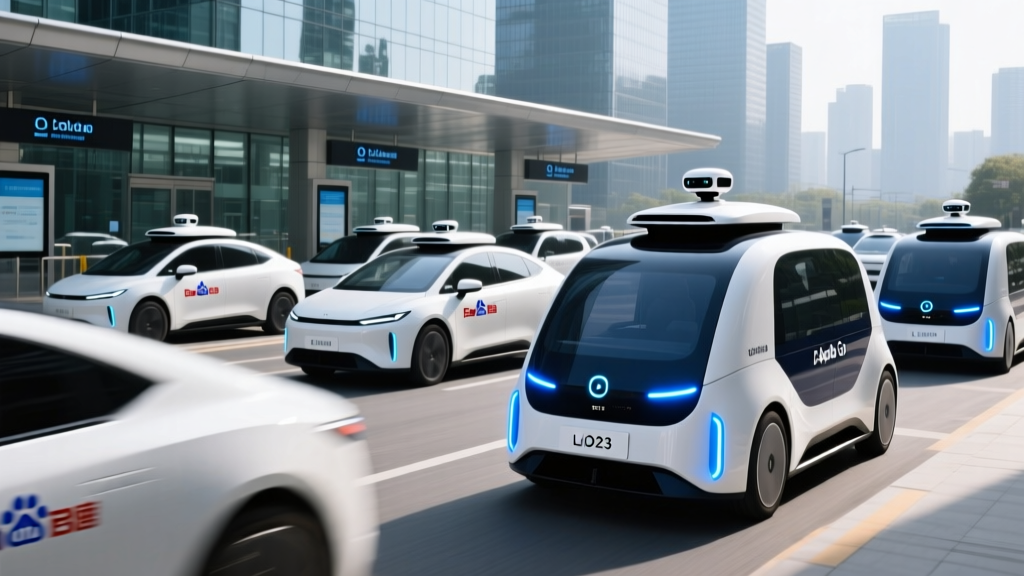
The search interest around baidu apollo go robotaxi fleet size 2023 vehicles reflects a pivotal year for the service. In 2023, Baidu scaled its operational fleet past approximately 1,000+ robotaxis deployed across multiple Chinese cities, with the heaviest concentration in Wuhan. By the end of 2023, Baidu reported cumulative ride orders exceeding 8 million since the service's inception, with quarterly order volumes accelerating sharply.
For context, here is how Apollo Go's fleet scaled over key milestones:
| Period | Approximate Active Fleet | Cumulative Rides | Key Cities |
|---|---|---|---|
| End of 2022 | ~500 vehicles | ~2 million | Beijing, Shanghai, Guangzhou, Wuhan (limited) |
| Mid-2023 | ~700–800 vehicles | ~4.5 million | Wuhan scaling, Chongqing added |
| End of 2023 | ~1,000+ vehicles | ~8 million | Wuhan dominant, 10+ cities with some presence |
| Mid-2025 | ~1,500+ (estimated) | ~15+ million | Wuhan fully driverless at scale, expansion ongoing |
| Early 2026 | Continued expansion | Growing | New city approvals pending |
The 6th-generation Apollo Go vehicle (the RT6, based on a purpose-built electric platform) was designed to bring per-unit vehicle cost down to approximately ¥250,000 (~$35,000 USD), a critical threshold for fleet economics. Earlier generations relied on retrofitted production EVs with added sensor suites that pushed per-vehicle costs well above ¥500,000.
Where Can You Use Apollo Go Right Now?
| City | Service Type | Operating Hours | Geofence Coverage |
|---|---|---|---|
| Wuhan | Fully driverless (no in-car safety operator) | 24/7 in core zones | Largest coverage area — hundreds of sq km across multiple districts |
| Beijing (Yizhuang) | Fully driverless in approved zones | Extended hours, zone-dependent | Beijing E-Town economic development zone, expanding |
| Shanghai (Jiading) | Driverless in designated areas | Daytime/evening hours | Jiading district test zone |
| Guangzhou | Driverless in approved corridors | Daytime hours | Nansha and select zones |
| Chongqing | Driverless (approved 2022–2023) | Daytime hours | Yongchuan district |
| Shenzhen | Limited commercial operations | Varies | Select zones under permit |
Wuhan is the anchor market. It is where Apollo Go achieved the largest fully driverless commercial deployment in the world, with hundreds of vehicles operating without any human in the front seat. For most users outside China, Apollo Go is not accessible — the service operates exclusively within Chinese municipal boundaries under local autonomous-vehicle permits.
International expansion has been discussed but no live commercial service exists outside mainland China as of early 2026.
Pricing: Apollo Go vs. Uber and Didi
One of Baidu's strategic decisions has been aggressive introductory pricing to build ridership habit. In Wuhan, a typical Apollo Go ride of 5–10 km has been priced in the range of ¥10–¥25 (~$1.40–$3.50 USD) after promotional discounts, significantly undercutting comparable Didi (China's dominant rideshare) fares.
| Service | Typical Fare (CNY) | Approximate USD | Notes |
|---|---|---|---|
| Baidu Apollo Go | ¥10–25 (promo rates common) | $1.40–$3.50 | Heavy subsidies; standard fares higher |
| Didi Express | ¥18–35 | $2.50–$5.00 | Standard rideshare, human driver |
| Didi Premier | ¥30–55 | $4.20–$7.70 | Higher-tier vehicle |
| Traditional Taxi | ¥15–30 | $2.10–$4.20 | Metered, varies by city |
Important context: Apollo Go's current pricing is heavily subsidized. Baidu has acknowledged that the service is not yet profitable on a per-ride basis at these price points. The company's stated goal is to reach unit economics parity with human-driven rideshare as fleet costs decline (via the RT6 platform) and utilization rates increase. For comparison, Waymo in the U.S. (Phoenix, San Francisco, Los Angeles) typically prices rides comparably to Uber/Lyft — rarely at steep discounts.
How to Use Apollo Go
Riders in supported Chinese cities book Apollo Go through the Apollo Go app (萝卜快跑 in Chinese) or through a mini-program within the Baidu Maps app. The process mirrors standard rideshare:
- Enter pickup and drop-off locations (both must fall within the geofenced service area).
- The app confirms availability and provides an estimated fare and wait time.
- Upon vehicle arrival, the rider verifies their identity (typically via phone number or QR code on the vehicle's exterior screen).
- Doors unlock automatically. The rider selects their destination on the rear-seat screen and confirms departure.
- The vehicle navigates autonomously to the destination. A remote monitoring team oversees fleet operations but does not control the vehicle in real time under normal conditions.
- Payment is processed automatically via the linked account.
The in-vehicle experience includes a rear-seat display showing the vehicle's perception of surrounding traffic, pedestrians, and obstacles in real time — a transparency feature designed to build rider confidence.
Safety Record: What the Data Shows
Cumulative autonomous driving distance: Baidu's Apollo platform (including testing and commercial operations) surpassed 100 million kilometers (~62 million miles) of autonomous driving by late 2024, with the majority accumulated in urban environments.
Disengagement rates: Baidu publishes periodic safety reports. In its Beijing testing operations, reported disengagements (instances where a safety operator or remote monitor must intervene) have trended downward, reaching rates below 0.1 interventions per 1,000 km in mature operational zones. However, exact methodology and reporting standards differ from California DMV disengagement reports, making direct cross-company comparisons difficult.
Collision data: Apollo Go vehicles have been involved in minor incidents typical of dense urban driving (low-speed contact, being rear-ended by human drivers). As of early 2026, there have been no widely reported fatalities attributed to Apollo Go robotaxi operations. For ongoing safety data, refer to reports from NHTSA (for U.S. AV context) and Chinese municipal transport authorities.
It's worth noting that safety data for Chinese robotaxi operations is not reported through the same public frameworks as U.S. operators (who file with state DMVs and NHTSA). Baidu publishes its own safety white papers, and Chinese municipal regulators oversee operations, but independent third-party auditing is less transparent than, for example, California DMV disengagement filings from Waymo and Cruise.
Technology Stack: Sensors, Compute, and Geofencing
Apollo Go vehicles use a multi-sensor fusion approach — fundamentally different from Tesla's camera-only strategy for FSD. The stack includes:
- LiDAR: Roof-mounted and bumper-mounted LiDAR units (typically 1–5 per vehicle depending on generation) providing 360° 3D point-cloud mapping up to 200+ meters. The RT6 generation uses next-generation solid-state/hybrid LiDAR for cost reduction.
- Cameras: Multiple high-resolution cameras (8–12) for lane detection, traffic-sign recognition, pedestrian classification, and signal-light reading.
- Millimeter-wave radar: Forward and corner radars for velocity detection of surrounding objects, particularly in low-visibility conditions.
- Ultrasonic sensors: Short-range proximity detection for low-speed maneuvering and parking.
- HD Maps: Pre-built centimeter-accuracy maps of every operational zone. The vehicle localizes itself against these maps in real time using LiDAR and GNSS/IMU data.
- Onboard compute: Custom NVIDIA-based or Baidu-designed computing platforms delivering hundreds of TOPS (trillions of operations per second) for real-time perception and planning.
| Generation | LiDAR Units | Cameras | Radar | Approx. Vehicle Cost |
|---|---|---|---|---|
| 5th Gen (retrofit EV) | 4–5 mechanical/hybrid | 8–12 | 5+ | ¥480,000+ (~$67,000) |
| 6th Gen (RT6, purpose-built) | 1–2 solid-state/hybrid + supplementary | 8–12 | 5+ | ~¥250,000 (~$35,000) |
The reliance on HD maps and geofencing means Apollo Go can only operate on roads that have been pre-mapped and approved by regulators. This is both a safety advantage (the system "knows" every intersection, speed limit, and lane configuration in advance) and a scaling limitation (every new neighborhood requires surveying, mapping, and regulatory approval before service can begin).
Regulatory Landscape
Robotaxi operations in China are governed by a patchwork of municipal and national regulations rather than a single federal framework comparable to U.S. NHTSA oversight. Key regulatory dynamics include:
- Municipal permits: Each city (Beijing, Shanghai, Wuhan, etc.) issues its own autonomous-vehicle testing and commercial-operation permits through local intelligent connected vehicle (ICV) demonstration zones. Baidu must apply separately in each jurisdiction.
- Phased approval: Cities typically require a progression: testing with safety driver → testing without safety driver → commercial operation with safety driver → fully driverless commercial operation. Wuhan was the first city to grant large-scale fully driverless commercial permits.
- National guidelines: China's Ministry of Industry and Information Technology (MIIT) and Ministry of Transport have issued national-level guidelines for connected and autonomous vehicles, but enforcement and permitting remain largely local.
- Data and mapping regulations: China's strict geospatial-data laws require that HD mapping be conducted by licensed Chinese entities, and mapping data cannot leave the country. This creates a structural barrier to any foreign operator entering the Chinese market and limits Baidu's ability to export its mapping stack directly.
For U.S. readers accustomed to the California DMV and NHTSA framework, the Chinese system is more decentralized at the city level but more directive at the national level in terms of technology and data sovereignty requirements.
Current Limitations: Where Apollo Go Cannot Go
Despite its scale, Apollo Go faces hard operational constraints:
- Geofencing: The service only operates within pre-mapped, pre-approved zones. If your destination falls outside the geofence, the app will not allow the booking. Expanding the geofence requires new mapping, testing, and regulatory approval.
- Weather degradation: Heavy rain, fog, and snow degrade LiDAR and camera performance. In severe weather conditions, Apollo Go may reduce speed, increase following distance, or in extreme cases suspend service in affected zones. Wuhan's hot, humid summers with heavy rain events are a real-world stress test.
- Construction zones: Unexpected road closures, lane shifts, or construction barriers that don't match the HD map require the system to either reroute or, in some cases, request remote assistance. The vehicle will pull over safely if it cannot resolve the situation.
- Complex unprotected turns: In dense, chaotic Chinese urban traffic (scooters, pedestrians, delivery vehicles merging unpredictably), Apollo Go tends to be highly conservative — sometimes to the point of causing delays. This is a safety-first design choice but can frustrate riders accustomed to aggressive human drivers.
- No highway operations (most zones): Apollo Go primarily operates on urban surface streets. Highway-capable autonomous driving in a commercial robotaxi context remains limited in most approved zones.
- No international availability: The service is exclusively available in mainland China. There is no Apollo Go robotaxi service in the U.S., Europe, or other markets as of early 2026.
Apollo Go vs. Waymo: A Quick Global Comparison
| Attribute | Baidu Apollo Go | Waymo One |
|---|---|---|
| Primary Market | China (Wuhan, Beijing, Shanghai, others) | U.S. (Phoenix, San Francisco, Los Angeles, Austin) |
| SAE Level | Level 4 | Level 4 |
| Approximate Fleet (2025) | 1,500+ (est.) | 1,000+ (est.) |
| Sensor Approach | LiDAR + camera + radar + HD maps | LiDAR + camera + radar + HD maps |
| Typical Ride Cost | ¥10–25 ($1.40–$3.50, subsidized) | $8–$20 (market-rate, comparable to Uber) |
| Cumulative Autonomous Miles | 62M+ miles (100M+ km) | 50M+ miles (publicly reported) |
| International Expansion | None (China only) | None (U.S. only) |
Frequently Asked Questions
Is Baidu Apollo Go truly self-driving or just driver-assist?
Apollo Go is SAE Level 4 — truly driverless within its approved geofenced zones. There is no human driver in the vehicle. This is categorically different from Level 2 systems like Tesla FSD Supervised, which require the human driver to remain attentive and ready to take over at all times. Apollo Go handles all driving tasks autonomously; a remote operations center monitors the fleet but does not actively drive vehicles under normal conditions.
How much does an Apollo Go ride cost compared to Uber or Didi?
In Wuhan, a typical 5–10 km Apollo Go ride costs ¥10–25 ($1.40–$3.50 USD) after promotional discounts, which is roughly 30–50% cheaper than a comparable Didi Express ride (¥18–35). However, these prices are heavily subsidized by Baidu to drive adoption. Standard (non-promotional) fares are higher, and long-term pricing will need to increase as subsidies are reduced to achieve profitability.
How safe are Apollo Go robotaxis?
Baidu reports over 100 million kilometers (62M+ miles) of cumulative autonomous driving across its Apollo platform. Disengagement rates in mature zones have fallen below 0.1 per 1,000 km. As of early 2026, no fatalities have been publicly attributed to Apollo Go commercial operations. Minor low-speed incidents do occur, consistent with dense urban driving. Independent third-party safety auditing is less transparent in China than in U.S. markets. For global AV safety context, see IIHS and NHTSA resources.
Where can I ride an Apollo Go robotaxi?
Apollo Go operates in multiple Chinese cities, with Wuhan being the largest and most mature market (fully driverless, 24/7 in core zones, hundreds of square kilometers of coverage). Other cities include Beijing (Yizhuang district), Shanghai (Jiading), Guangzhou, Chongqing, and Shenzhen — each with varying levels of service and operating hours. The service is not available outside mainland China.
What are the main limitations of Apollo Go?
Key limitations include strict geofencing (pickup/dropoff must be within pre-mapped zones), degraded performance in heavy rain or fog, conservative driving behavior in chaotic traffic that can cause delays, inability to handle unmapped construction zones without remote assistance, and no availability outside China. Highway-capable robotaxi service remains limited in most zones.
How does Apollo Go's fleet size compare to Waymo's?
As of 2025–2026 estimates, Baidu Apollo Go operates approximately 1,500+ vehicles across China, while Waymo operates approximately 1,000+ vehicles across U.S. cities. Both fleets are growing. Apollo Go's larger fleet reflects its heavier concentration in Wuhan, where it achieved high-density deployment to prove unit economics. Exact fleet counts for both companies fluctuate and are not always publicly disclosed in real time.
The Bottom Line
The search for baidu apollo go robotaxi fleet size 2023 vehicles points to a service that crossed a critical mass threshold in 2023 — moving from pilot-scale to genuine commercial scale with 1,000+ vehicles and millions of completed rides. By 2026, Apollo Go remains the world's largest Level 4 robotaxi service by fleet size and ride volume, anchored by Wuhan's unprecedented fully driverless deployment.
For EV and autonomous-vehicle observers, Apollo Go demonstrates that Level 4 robotaxi economics are approaching viability — but only with purpose-built low-cost vehicles (the RT6 at ~$35,000), dense urban geofencing, and a regulatory environment that permits rapid scaling. The service is not without real limitations (weather, geofence rigidity, no international access), and its subsidized pricing will not last indefinitely. But as a proof point for what Level 4 autonomy looks like at city scale, Apollo Go is the most data-rich example on the planet.