Quick Verdict: Autosteer Handles Highways, FSD Adds Complexity
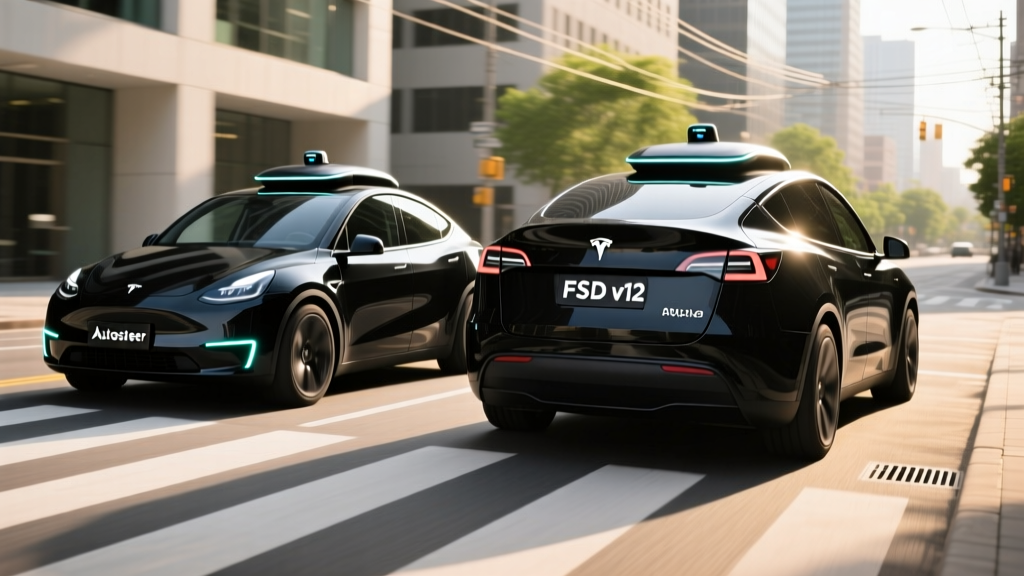
If you own or are shopping for a Tesla, you will encounter two driver-assist tiers: Autosteer (bundled with Basic Autopilot) and Full Self-Driving (Supervised), commonly called FSD. Both are SAE Level 2 systems requiring constant driver attention. Neither makes the car autonomous. The real question is whether FSD's added capabilities — city-street navigation, traffic-light recognition, and automated lane changes — justify its cost for your driving routine.
For highway commuters covering predictable routes, Autosteer delivers 80% of the benefit at zero extra cost. FSD targets drivers who want the car to manage complex surface-street routing, but its real-world performance still demands active supervision and occasionally intervenes with abrupt corrections.
What Autosteer and FSD Actually Do
Understanding the technical distinction between these two systems prevents costly misexpectations at purchase.
| Feature | Autosteer (Basic Autopilot) | Full Self-Driving (Supervised) |
|---|---|---|
| Lane centering | Yes — marked highways | Yes — highways + surface streets |
| Adaptive cruise control | Yes | Yes |
| Automatic lane changes | No (driver-initiated only) | Yes — with confirmation or auto mode |
| Navigation-guided routing | No | Yes — follows nav route on/off highway |
| Traffic light & stop sign control | No | Yes — detects and responds |
| Smart Summon (parking lot) | No | Yes (Actually Smart Summon) |
| Autopark | No | Yes |
| Sensor suite | Tesla Vision (cameras only) | Tesla Vision (cameras only, AI-dependent) |
Autosteer combines lane-centering steering with Traffic-Aware Cruise Control. It keeps the car centered in a clearly marked lane and matches the speed of traffic ahead. It works best on divided highways with well-maintained lane markings and moderate curves. The system uses Tesla's camera-only "Tesla Vision" architecture — eight exterior cameras feeding a neural network running on the onboard Hardware 4 (HW4) computer.
Full Self-Driving (Supervised) layers on Navigate on Autopilot (highway on/off-ramp routing), auto lane changes, traffic-light and stop-sign recognition, and city-street steering. FSD attempts to drive a navigation route from origin to destination, including surface streets with intersections, turns, and unprotected lefts. Tesla's AI training pipeline processes billions of miles of fleet data to refine the neural network, but the system remains a supervised Level 2 feature.
SAE Automation Level: Both Are Level 2
Per SAE International's J3016 standard, both Autosteer and FSD (Supervised) are Level 2 — Partial Driving Automation. The system controls steering and acceleration simultaneously, but the driver must remain fully engaged, monitor the environment, and be prepared to take over instantly. No current Tesla feature qualifies as Level 3 (conditional automation) or Level 4 (high automation). Only purpose-built robotaxi fleets like Waymo operate at Level 4 in geofenced areas.
Cost Breakdown: Included, One-Time, or Subscription
Tesla's pricing structure for driver-assist features has shifted multiple times. As of the 2026 model year, here is where things stand:
| Feature | Cost | Availability |
|---|---|---|
| Basic Autopilot (includes Autosteer + TACC) | Included — $0 | Standard on all new Tesla vehicles |
| FSD (Supervised) — Monthly Subscription | $99/month | Available on all Tesla vehicles with HW3 or HW4 |
| FSD (Supervised) — One-Time Purchase | $8,000 | Available at purchase or post-delivery |
Historically, Tesla priced FSD at $10,000, $12,000, and even $15,000 for a permanent license. The reduction to $8,000 and the $99/month subscription option reflect both competitive pressure and a strategic push to grow the subscription base. The subscription model makes sense for drivers who want to test FSD for a few months before committing, or who only need it for road-trip seasons.
Important caveat: FSD transfers with the vehicle if you sell it — but only if purchased outright. A subscription ends when you cancel and does not transfer. If you buy a used Tesla, verify whether FSD was permanently purchased or is merely a lapsed subscription.
Which Tesla Models Include Autosteer and FSD?
Every new Tesla sold in the United States — Model 3, Model Y, Model S, Model X, and the refreshed Cybertruck — ships with Basic Autopilot (Autosteer + Traffic-Aware Cruise Control) as standard equipment. There is no trim-level restriction on the base system.
FSD (Supervised) is available as an upgrade on all current-production models equipped with Hardware 3 (HW3) or Hardware 4 (HW4). Vehicles built before approximately April 2019 with older Hardware 2.5 or earlier are not eligible for FSD and cannot be upgraded without a hardware retrofit (which Tesla has offered selectively). Most 2021 and newer vehicles have HW3; 2023+ refreshed Model 3 and Model Y, plus current Model S/X, carry HW4.
Enhanced Autopilot — a mid-tier option that previously included Navigate on Autopilot, Auto Lane Change, Autopark, and Summon — has been effectively folded into FSD or discontinued as a standalone package for new orders in most markets as of 2025.
Real-World Capabilities and Limitations
Marketing descriptions paint an optimistic picture. Actual daily use reveals a more nuanced reality that every prospective FSD subscriber should understand.
Where Autosteer Excels
Autosteer performs reliably on well-marked, divided highways in clear weather. Lane centering is confident on interstates with fresh striping, and Traffic-Aware Cruise Control smoothly manages stop-and-go congestion. On a 200-mile highway commute, Autosteer reduces driver fatigue substantially by handling micro-steering corrections and speed modulation. It is genuinely useful and represents the strongest value proposition in Tesla's driver-assist lineup.
Where FSD Adds Value — and Where It Struggles
FSD's Navigate on Autopilot handles highway interchanges and on-ramps competently in most conditions. Auto lane changes are generally smooth, though the system occasionally hesitates at merge points in dense traffic, requiring driver intervention.
City-street FSD remains the most variable element. The system can navigate four-way stops, recognize traffic lights, and execute protected left turns. However, edge cases appear regularly:
- Construction zones: Cones, shifted lanes, and temporary barriers frequently confuse the vision system. Expect disengagements.
- Faded or conflicting lane markings: Old markings visible beneath new ones cause the system to center on phantom lanes.
- Unprotected left turns: FSD may hesitate excessively or, conversely, initiate a turn with insufficient gap judgment in heavy cross-traffic.
- Weather degradation: Heavy rain, fog, snow, and direct sun glare reduce camera performance. Tesla Vision lacks radar or lidar redundancy, so precipitation on the camera lenses forces the system to restrict or disable itself.
- Complex intersections: Multi-lane roundabouts, offset intersections, and non-standard signal configurations remain challenging.
What Autosteer and FSD Do NOT Do
- Neither system drives autonomously. You are the driver. You are legally responsible for every action the vehicle takes while these features are active.
- Neither system detects all obstacles. Stationary objects, cross-traffic at speed, and partially obscured pedestrians may not trigger braking.
- Neither system operates safely in all weather. Snow, ice, heavy rain, and fog degrade camera-based perception with no radar fallback.
- Neither system replaces attentive driving. Tesla's cabin camera monitors eye gaze and will issue escalating warnings, eventually disabling Autosteer for the remainder of the trip if you fail to respond.
According to NHTSA guidance on Level 2 systems, the driver must maintain situational awareness at all times. Over-reliance on driver-assist features has been a contributing factor in multiple investigated collisions.
How Tesla's Systems Compare to Competitors
Tesla is not the only automaker offering advanced Level 2 driver-assist. Understanding where Autosteer and FSD sit in the competitive landscape informs your purchase decision.
| System | Automaker | Hands-Free? | Highway | City Streets | Cost |
|---|---|---|---|---|---|
| Autosteer (Basic Autopilot) | Tesla | No (hands-on torque) | Yes | No | Included |
| FSD (Supervised) | Tesla | No (hands-on, gaze monitored) | Yes | Yes (supervised) | $8,000 or $99/mo |
| Super Cruise | GM (Cadillac, Chevy) | Yes (on mapped highways) | Yes | No | Included on select trims; ~$2,500 option |
| BlueCruise | Ford / Lincoln | Yes (on mapped highways) | Yes | No | $2,100 for 2 years, then $750/yr or included on higher trims |
| ProPILOT Assist 2.0 | Nissan | Yes (on mapped highways) | Yes | No | Included on select trims |
| Toyota Safety Sense (TSS 3.0) | Toyota | No | Yes (lane centering + ACC) | No | Standard on most models |
GM Super Cruise and Ford BlueCruise offer true hands-free driving on pre-mapped divided highways — something Tesla's Autosteer does not permit. Super Cruise covers over 750,000 miles of mapped roads in North America and uses a driver-facing camera to verify attention. The trade-off: these systems do not attempt city-street navigation. They are highway-only tools executed with high polish.
FSD's ambition is broader — it tries to handle any road — but this breadth introduces variability. If your primary need is hands-free highway cruising, Super Cruise or BlueCruise may deliver a more consistent, confidence-inspiring experience than FSD on surface streets. If you want a system that attempts full point-to-point routing and you accept the supervision burden, FSD is the only consumer option that tries.
Is FSD Worth the Money? A Decision Framework
The answer depends entirely on your driving patterns and tolerance for system imperfection.
Choose Autosteer Only (Skip FSD) If:
- Your driving is predominantly highway commuting on well-marked interstates
- You prefer to stay fully engaged and handle lane changes yourself
- You are unwilling to pay $99/month or $8,000 for features that still require supervision
- You live in an area with frequent snow, fog, or construction zones where FSD city performance degrades
- You plan to keep the vehicle under 3 years (subscription ROI is low; resale premium for FSD is uncertain)
Consider FSD (Subscription First) If:
- You drive 20,000+ miles annually across a mix of highway and surface streets
- You want to evaluate the system on your actual routes before committing $8,000
- You are interested in Smart Summon for tight parking situations
- You accept that FSD is a convenience feature, not a replacement for your attention
- You are a technology enthusiast who values being on the latest software build
The subscription model at $99/month is the rational starting point. Subscribe for three months, use FSD daily on your real routes, and evaluate whether it genuinely reduces your cognitive load or adds stress through unpredictable behavior. If the system disengages more often than it assists on your commute, cancel and save $1,188 annually.
Safety Data and Regulatory Context
Tesla publishes quarterly Vehicle Safety Reports claiming that vehicles driven with Autopilot active record fewer crashes per million miles than those driven without. However, these reports do not isolate Autosteer from FSD, do not account for the type of roads driven (highway vs. urban), and are not independently verified by NHTSA or the IIHS.
NHTSA has issued multiple Standing General Orders requiring Tesla and other automakers to report crashes involving Level 2 and higher automation. Tesla has also faced NHTSA investigations into Autopilot/FSD behavior near emergency vehicles and in low-visibility conditions. As of early 2026, no regulatory body has certified FSD as anything beyond a Level 2 driver-assist system.
The Insurance Institute for Highway Safety (IIHS) has repeatedly found that partial automation systems do not demonstrably improve safety outcomes and may increase risk through driver complacency. Their research recommends robust driver-monitoring requirements — which Tesla's cabin camera provides, though enforcement strictness varies by software version.
Frequently Asked Questions
Is Tesla FSD actually self-driving?
No. The "(Supervised)" designation in Tesla's official branding is deliberate. FSD is an SAE Level 2 system. The driver must remain fully attentive, keep hands available for immediate takeover, and is legally responsible for all vehicle actions. No Tesla sold to consumers is autonomous. Only Level 4 robotaxi services like Waymo operate without a human driver — and only in geofenced urban zones.
Can I add FSD to my Tesla after delivery?
Yes, provided your vehicle has Hardware 3 (HW3) or Hardware 4 (HW4). You can subscribe at $99/month or purchase the permanent license for $8,000 through the Tesla app. Vehicles with older hardware (HW2.5 or earlier) are not eligible.
Does Autosteer work without lane markings?
Autosteer requires clearly visible lane markings to function. On unmarked rural roads or in snow-covered conditions where markings are obscured, the system will alert you and disengage. FSD's city-street mode attempts to infer lane position from road edges and surrounding vehicles, but performance is significantly less reliable than on marked roads.
Will FSD transfer if I sell my Tesla?
A permanently purchased FSD license stays with the vehicle and transfers to the new owner, which may marginally improve resale value. A monthly subscription does not transfer — it is tied to your Tesla account and ends upon cancellation. Tesla has occasionally offered limited-time FSD transfer promotions for trade-ins toward new vehicles, but these are not guaranteed.
How does Tesla Vision compare to systems with lidar or radar?
Tesla removed radar from its sensor suite starting in 2021 and ultrasonic sensors in 2022–2023, relying entirely on camera-based perception (Tesla Vision). Competitors like GM Super Cruise, Ford BlueCruise, and Mercedes Drive Pilot use a combination of cameras, radar, and in some cases lidar. The camera-only approach reduces hardware cost but eliminates sensor redundancy — a notable disadvantage in heavy rain, fog, or scenarios where a single camera is blinded by direct sunlight.
What happens if I ignore Autosteer warnings?
Tesla's system issues escalating alerts — visual, then audible, then a steering-wheel shake — if it detects inattention via the cabin camera or lack of steering torque. After repeated ignored warnings, Autosteer disables for the remainder of that drive cycle. You must stop the vehicle and shift into Park to re-enable it. Persistent inattention can result in a temporary "Autosteer suspension" requiring a set number of consecutive attentive drives to lift.