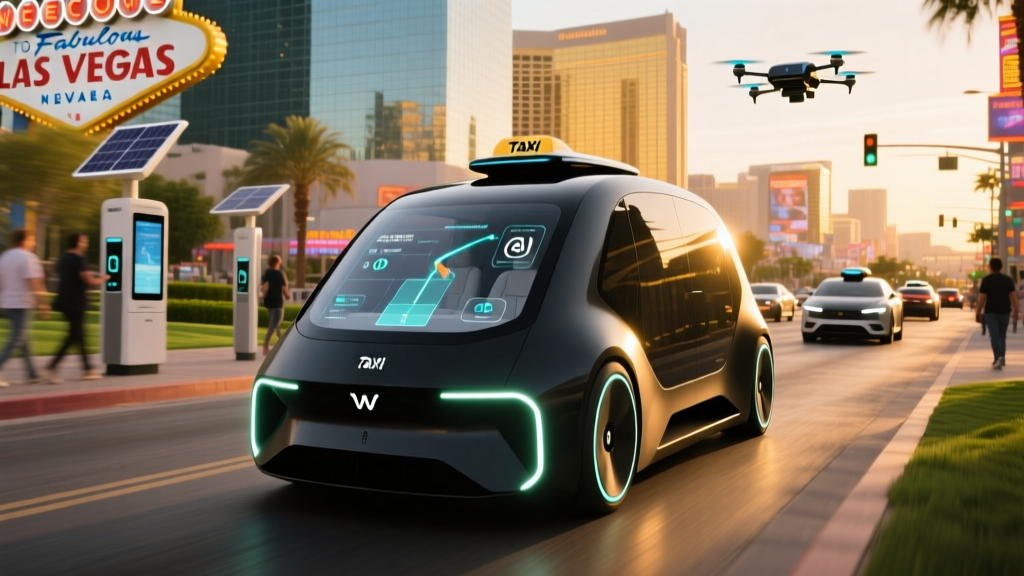
If you have visited the Las Vegas Strip in the past year, you have likely spotted a white Hyundai Ioniq 5 or a Jaguar I-PACE crawling along Harbor Boulevard with no one behind the wheel. Las Vegas has quietly become one of the most active robotaxi testing and deployment zones in the United States, rivaling San Francisco and Phoenix for autonomous vehicle density. But hype and reality diverge quickly when you try to actually summon one.
This guide cuts through the marketing to tell you exactly which autonomous vehicle Las Vegas services are operational right now, what they cost, how safe they really are, and where the technology still falls short. No speculation about 2030 — just the current state of driverless rides on the Strip and beyond.
SAE Automation Levels: What "Self-Driving" Actually Means in Vegas
Before evaluating any robotaxi service, you need to understand the SAE International automation framework. Consumer vehicles like Tesla's FSD (Supervised) or GM's Super Cruise operate at Level 2 — the driver must remain engaged and responsible. Robotaxis operating in Las Vegas without a human behind the wheel are classified as Level 4: fully driverless within a defined operational design domain (ODD), meaning specific geofenced areas under specific conditions.
| Level | Name | Who Drives? | Example |
|---|---|---|---|
| 0 | No Automation | Human | Any conventional car |
| 1 | Driver Assistance | Human (with help) | Adaptive cruise control |
| 2 | Partial Automation | Human (must supervise) | Tesla FSD, BlueCruise |
| 3 | Conditional Automation | System (human on standby) | Mercedes Drive Pilot (limited) |
| 4 | High Automation | System (no human needed in ODD) | Waymo, Motional robotaxis |
| 5 | Full Automation | System (everywhere) | Does not exist yet |
Las Vegas robotaxis operate at Level 4 — fully driverless within geofenced zones. No Level 5 system exists anywhere in the world.
Which Robotaxi Services Operate in Las Vegas Right Now?
As of early 2026, two primary Level 4 robotaxi platforms have an active presence in the Las Vegas area, though their availability differs significantly:
| Service | Vehicle | Status | Service Area | Access |
|---|---|---|---|---|
| Waymo | Jaguar I-PACE (Gen 6 sensor suite) | Active — rider-only trips | Expanded geofence covering Strip corridor, downtown, and parts of Summerlin (~80+ sq mi) | Waymo One app (waitlist may apply) |
| Motional (Hyundai/Aptiv JV) | Hyundai Ioniq 5 (lidar/camera/radar) | Active — limited public rides via Lyft | Strip corridor and immediate surroundings (~15 sq mi core zone) | Lyft app (select "Autonomous" when available) |
| Zoox (Amazon) | Zoox purpose-built carriage | Testing — employee/invite-only | Limited downtown test zone | Not publicly available |
Waymo has the largest operational footprint in Las Vegas. After beginning testing in 2023 and expanding through 2024-2025, Waymo's Las Vegas geofence now covers most of the tourist corridor from Mandalay Bay north to the Strat, extending into residential areas. You can hail a ride through the Waymo One app, though availability depends on fleet density and demand — expect longer wait times during peak evening hours on the Strip.
Motional takes a different approach by integrating with Lyft's existing platform. When you request a ride on Lyft within Motional's zone, you may be matched with a driverless Ioniq 5. However, availability is inconsistent — Motional runs a smaller fleet, and not every ride request within the zone will be served by an autonomous vehicle. Motional paused some operations in late 2023 for a safety review but resumed Las Vegas service with updated software in 2024.
How Much Does a Robotaxi Cost vs. Uber and Lyft?
One of the most common questions from Vegas visitors: will skipping the human driver save you money? The short answer is not yet. Robotaxi pricing is currently competitive with — but not significantly cheaper than — standard rideshare.
| Route (Approximate) | Waymo | Motional (via Lyft) | UberX | Lyft Standard |
|---|---|---|---|---|
| McCarran Airport → Bellagio (5 mi) | $18–$26 | $16–$24 | $15–$22 | $14–$21 |
| Mandalay Bay → Fremont St (7 mi) | $22–$32 | $20–$28 | $18–$26 | $17–$25 |
| Short Strip hop (2 mi) | $10–$15 | $9–$14 | $9–$13 | $8–$12 |
| Surge pricing? | Limited surge | Follows Lyft surge | Yes, significant | Yes, significant |
Waymo's pricing advantage emerges during surge periods. While Uber and Lyft can spike 2-3x during New Year's Eve, EDC, or Formula 1 weekend, Waymo's algorithm uses more moderate dynamic pricing — typically capping at 1.25-1.5x. On a busy Saturday night when UberX quotes $45 for a 3-mile trip, Waymo might charge $22. That is where the savings materialize.
Neither Waymo nor Motional currently offers pooled or shared rides in Las Vegas. You get the entire vehicle. Tipping is not expected (there is no driver), though both apps allow optional gratuities for the "service."
The Safety Record: What the Data Actually Shows
Safety is the single most important question for anyone considering a robotaxi. Here is what we know from reported data, regulatory filings, and NHTSA Standing General Order crash reports:
- Waymo national fleet: Over 10 million fully driverless miles completed across Phoenix, San Francisco, Los Angeles, and Las Vegas combined.
- Waymo injury-causing crash rate: Approximately 85% lower than human benchmark for police-reported injury crashes (per Waymo's published analysis, peer-reviewed by the Swiss Re research partnership).
- Motional: Smaller operational fleet; zero reported serious-injury incidents in Las Vegas driverless operations as of late 2025.
- Contact incidents: Both services have reported minor low-speed contact events (typically under 5 mph, often with stationary objects or during complex construction-zone navigation). These are reportable to NHTSA.
- No fatalities have been attributed to Waymo or Motional Level 4 robotaxi operations in Las Vegas.
Sources: NHTSA Standing General Order reports, California DMV disengagement data (for cross-reference), company safety reports. Las Vegas-specific data is less granular than California DMV disclosures.
The context matters: Las Vegas roads feature heavy pedestrian traffic, frequent construction zones, event-driven congestion, and aggressive human drivers. Robotaxis handle the vast majority of these scenarios without incident, but they also take more conservative approaches — sometimes braking abruptly or pausing at complex intersections in ways that frustrate human drivers behind them.
It is worth noting that IIHS research on consumer Level 2 systems (a different category from Level 4 robotaxis) shows mixed results on safety, underscoring that the supervised vs. unsupervised distinction is critical. A Level 4 Waymo vehicle with redundant sensor suites and remote-assistance capability operates under fundamentally different safety parameters than a Level 2 Tesla on Autopilot with a potentially inattentive driver.
Under the Hood: The Technology Stack Powering Vegas Robotaxis
Waymo Gen 6 Sensor Suite (Jaguar I-PACE)
- LiDAR: Multiple custom-built units providing 360° 3D point-cloud mapping, effective to ~500 meters
- Cameras: High-resolution external cameras for traffic-light state detection, signage reading, and object classification
- Radar: Short- and long-range radar for velocity detection of surrounding vehicles, functional in rain and fog
- Audio detection: External microphones to detect emergency vehicle sirens
- Compute: Custom Waymo Driver platform with redundant processing channels
Motional Sensor Suite (Hyundai Ioniq 5)
- LiDAR: Roof-mounted and corner-mounted units (HMC/Aptiv custom), 360° coverage
- Cameras: Multi-camera array for lane detection, traffic signals, and pedestrian tracking
- Radar: Multiple radar units for redundancy in low-visibility conditions
- HD Maps: Pre-mapped routes with centimeter-level precision, updated regularly
- Remote assistance: Fleet operators available to guide vehicles through novel scenarios (not remote driving — route-level guidance)
Both platforms rely on HD pre-mapping and geofencing. The vehicles do not navigate to arbitrary GPS coordinates — they operate within meticulously mapped zones where every lane, crosswalk, speed limit, and traffic signal is cataloged. When you request a ride, the app only allows pickup and dropoff at designated virtual stops within this geofenced area. This is a Level 4 constraint: the system works exceptionally well within its domain but cannot operate outside it.
The camera-only approach (famously pursued by Tesla for its FSD system) is notably absent from Level 4 robotaxis. Every operational driverless taxi service in Las Vegas uses lidar as a core sensor. The redundancy of lidar + camera + radar provides safety margins that camera-only systems have not yet demonstrated at Level 4.
Regulatory Landscape: Who Approves Robotaxis in Nevada?
Nevada was actually the first US state to pass legislation enabling autonomous vehicle testing and operation, signing AB 511 back in 2011. The regulatory framework has evolved since then:
- Nevada DMV issues autonomous vehicle testing permits and tracks operational data. Companies must maintain minimum insurance coverage ($5 million for testing, higher for commercial deployment).
- Nevada Office of the Governor — GOAV (Governor's Office of Autonomous Vehicles) coordinates state-level AV policy and liaises with local jurisdictions.
- Clark County and City of Las Vegas manage local permitting for commercial operations, including pickup/dropoff zone designations on public roads.
- NHTSA (federal) mandates crash reporting through the Standing General Order for all Level 2+ and Level 4 systems involved in incidents.
Unlike California, where the DMV and CPUC both regulate different aspects of robotaxi operations with extensive public data disclosure, Nevada's reporting requirements are less granular. This means less public data is available specifically for Las Vegas operations compared to San Francisco or Phoenix. Companies report to NHTSA at the federal level for crash incidents, but mile-by-mile operational metrics are not as transparently published.
Current Limitations: What Robotaxis in Vegas Still Cannot Do
- Geofencing: You cannot ride to Red Rock Canyon, Lake Mead, or the airport from outside the geofence. Trips must originate AND terminate within the mapped zone.
- Heavy weather: While Las Vegas rarely sees snow, monsoon-season dust storms and heavy rain can trigger service suspensions. Both Waymo and Motional will pause operations when sensor visibility drops below safety thresholds.
- Construction zones: Major roadwork with shifted lanes or temporary barriers can cause the vehicle to stop and wait for remote assistance, adding significant time to your trip.
- Event chaos: During peak EDC or New Year's Eve pedestrian gridlock, services may reduce availability or shrink their operational zone to avoid unmapped crowd scenarios.
- No highway driving (Motional): Motional's current Las Vegas ODD is limited to surface streets. Waymo has begun limited highway-capable routing in some markets but Las Vegas highway segments remain restricted.
- Accessibility: Current vehicles require passengers to enter and exit independently. Wheelchair-accessible robotaxis are not yet available in Las Vegas.
- Minors and pets: Unaccompanied minors cannot ride. Service animals are permitted; pets are generally not (check current app policies).
The practical implication: robotaxis are excellent for point-to-point trips within the tourist corridor on a normal Tuesday afternoon. They are less reliable for your NYE bar crawl or a spontaneous trip to Valley of Fire. Plan accordingly.
Is This Truly Self-Driving or Just Advanced Driver-Assist?
This distinction is non-negotiable and frequently confused in media coverage:
Waymo and Motional robotaxis in Las Vegas are Level 4 — truly driverless. There is no human in the driver's seat. There is no steering wheel being monitored. The vehicle makes all driving decisions independently within its operational domain. A remote fleet operator can provide route-level guidance if the vehicle encounters a scenario it cannot resolve, but that operator is not "driving" the car in real time.
By contrast, a Tesla using FSD (Supervised) on the Las Vegas Strip is a Level 2 system. The driver is legally responsible, must keep hands near the wheel (or eyes on the road, depending on the monitoring system), and must be prepared to take over instantly. If a Tesla on FSD crashes, the human driver is liable. If a Waymo robotaxi crashes, Waymo (as the operator) bears responsibility.
This is not a semantic difference — it is a fundamental legal and engineering distinction. Level 4 systems are designed with the assumption that no human will intervene, which means they require far more sensor redundancy, fail-safe computing, and remote-assistance infrastructure than any Level 2 consumer vehicle.
Practical Tips for Riding a Robotaxi in Las Vegas
- Download both apps before your trip. Waymo One and Lyft (for Motional) should be installed and accounts created before you arrive. Waymo may have a waitlist for new users in Las Vegas.
- Set realistic time expectations. Robotaxis drive conservatively. A trip that takes 12 minutes in an Uber may take 15-18 minutes in a Waymo due to cautious merging and extended stops at complex intersections.
- Use designated pickup zones. The app will guide you to specific virtual stops — often hotel driveways or designated curbside areas. You cannot flag one down on the sidewalk.
- Check availability during your visit dates. Fleet sizes fluctuate, and both companies occasionally pull vehicles for software updates or maintenance campaigns.
- Rate your ride and report issues. Both platforms have in-app feedback. Reporting aggressive braking or routing issues helps improve the system.
Frequently Asked Questions
Where can I use an autonomous vehicle in Las Vegas right now?
Waymo operates across an ~80+ square-mile geofenced zone covering the Strip corridor from Mandalay Bay to the Strat, downtown Las Vegas, and portions of Summerlin. Motional covers a smaller zone focused on the central Strip corridor, accessible through the Lyft app. Both require trips to start and end within their respective zones.
How much does a robotaxi ride cost compared to Uber or Lyft?
Base pricing is comparable — typically $10-$32 depending on distance. The real savings come during surge events: Waymo's dynamic pricing caps are more moderate than Uber/Lyft surge multipliers, making robotaxis significantly cheaper during peak demand periods like holidays and major conventions.
How safe are robotaxis — is there real data?
Waymo reports over 10 million driverless miles nationally with injury-causing crash rates approximately 85% lower than the human benchmark (per their Swiss Re partnership analysis). No fatalities have been recorded in Las Vegas robotaxi operations. Both services report minor low-speed contact incidents to NHTSA as required. The data supports that Level 4 robotaxis are at least as safe as, and likely safer than, human drivers within their operational domains.
What are the current limitations of Las Vegas robotaxis?
Key limitations include geofencing (no trips outside the mapped zone), service suspension during dust storms or heavy rain, delays in active construction zones, reduced availability during mega-events, no wheelchair-accessible vehicles, and no unaccompanied minors. Highway routing is limited or unavailable depending on the service.
Is a Las Vegas robotaxi truly self-driving, or is there a human driver?
Waymo and Motional robotaxis operating in Las Vegas are SAE Level 4 — fully driverless with no human in the vehicle. This is fundamentally different from Level 2 driver-assist systems like Tesla FSD or GM Super Cruise, which require an attentive human driver at all times. Remote fleet operators provide guidance during edge cases but do not drive the vehicle in real time.
Can I take a robotaxi from McCarran Airport?
Airport pickup availability depends on current agreements between the airport authority and each operator. Waymo has been expanding airport access in several markets — check the Waymo One app for current McCarran (Harry Reid International) availability, as this has been progressively enabled but may have specific designated pickup areas.
Autonomous vehicle operations and service areas change frequently. Verify current availability through the Waymo One and Lyft apps before planning trips around robotaxi access. Safety data cited reflects the most recent publicly available reports as of early 2026. For regulatory details, consult the NHTSA automated vehicles page and Nevada DMV autonomous vehicle division.