The "Autonomous Tesla" Question: What You Can Actually Buy vs. What You Can't
Search for "autonomous Tesla" and you'll find a tangle of marketing language, YouTube demos, and investor hype. As of 2026, the reality is more specific: Tesla sells Full Self-Driving (Supervised), a Level 2 driver-assistance system that requires your full attention at all times. Tesla does not operate a driverless robotaxi service available to the public. Meanwhile, true Level 4 robotaxis from Waymo, Zoox, and others are carrying paying passengers without anyone behind the wheel — but only in a handful of geofenced cities.
This guide untangles the terminology, the technology, and the data so you know exactly what exists today, what's announced, and what remains aspirational.
SAE Automation Levels — The Critical Distinction
| SAE Level | Definition | Example |
|---|---|---|
| Level 2 | System controls steering + acceleration/braking; driver must supervise at all times | Tesla Autopilot, FSD (Supervised), GM Super Cruise, Ford BlueCruise |
| Level 3 | System drives in defined conditions; driver must take over when requested | Mercedes Drive Pilot (limited markets/conditions) |
| Level 4 | Fully driverless in a defined operational domain; no human intervention needed within that domain | Waymo One, Zoox (geofenced city areas) |
| Level 5 | Fully driverless everywhere, all conditions | Does not exist commercially |
Source: SAE International J3016
The takeaway: when Tesla's FSD is engaged, you are the driver. When a Waymo pulls up in Phoenix, there is no driver. These are fundamentally different products with fundamentally different safety responsibilities.
Tesla FSD (Supervised): What It Is and What It Costs
Full Self-Driving (Supervised) is Tesla's highest-tier driver-assistance package, available as a one-time purchase or monthly subscription on all current Tesla models (Model 3, Model Y, Model S, Model X, and the refreshed Cybertruck). Despite the name, FSD is an SAE Level 2 system. The "Supervised" qualifier, which Tesla added to the product name, is a legal acknowledgment that a licensed driver must remain attentive, hands available, and ready to intervene at any moment.
FSD Pricing (2026)
- One-time purchase: $8,000 (added to vehicle MSRP)
- Monthly subscription: $99/month
- Included hardware: Tesla's current-generation AI hardware suite (cameras only — no lidar, no radar on new vehicles)
What FSD (Supervised) Actually Does
- Navigates on- and off-ramps on divided highways
- Changes lanes based on navigation route
- Responds to traffic lights and stop signs in city driving
- Handles left and right turns at intersections
- Manages roundabouts and multi-lane urban roads
In practice, FSD handles the majority of a typical commute without intervention — but "majority" is not "all." Construction zones, faded lane markings, unusual road geometries, emergency vehicles, and complex unprotected left turns still regularly require the driver to take over. Tesla's own owner's manual states the driver is responsible for all vehicle actions at all times.
True Robotaxi Services: Where Driverless Rides Actually Operate
If you're looking for a ride with nobody in the driver's seat, you need a Level 4 robotaxi. As of early 2026, these services are operational in specific US cities under state regulatory approval:
| Service | Operator | Live Cities | Hours | Vehicle |
|---|---|---|---|---|
| Waymo One | Alphabet/Waymo | Phoenix, San Francisco, Los Angeles, Austin | 24/7 in most areas | Jaguar I-PACE, Zeekr RT (newer fleet) |
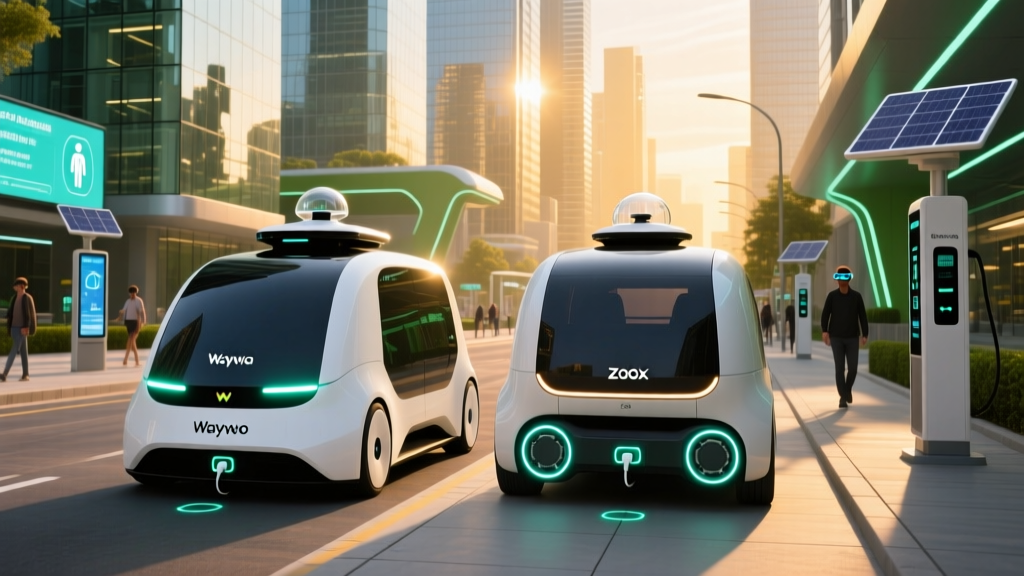
| Zoox | Amazon/Zoox | Las Vegas (limited), Foster City CA (testing) | Limited hours | Zoox purpose-built carriage |
| Cruise | GM/Cruise | Operations suspended; phased relaunch planned Phoenix/Dallas | N/A | Chevrolet Bolt EUV, Origin (delayed) |
| Tesla Robotaxi | Tesla | Not operational — announced concept only | N/A | Cybercab (announced, not in production) |
Where can you hail a driverless ride right now? Phoenix (metro-wide via Waymo One), San Francisco (most neighborhoods), Los Angeles (expanding zones), and Austin (limited Waymo service). If you don't live in or visit one of these cities, Level 4 robotaxi service is not yet available to you.
Robotaxi Pricing: How Does It Compare to Uber and Lyft?
For cities where Waymo One is live, pricing is competitive with — and sometimes slightly below — comparable UberX or Lyft rides. Here's a typical comparison based on reported fares:
| Service | Base Fare | Per Mile | Per Minute | Est. 5-mi / 15-min Trip |
|---|---|---|---|---|
| Waymo One | ~$3.00 | ~$1.15 | ~$0.25 | ~$12–14 |
| UberX | ~$2.50 | ~$1.30 | ~$0.30 | ~$13–16 |
| Lyft | ~$2.50 | ~$1.25 | ~$0.28 | ~$13–15 |
Waymo frequently offers promotional pricing for first-time riders, and surge pricing is generally less aggressive than Uber/Lyft during peak demand. However, robotaxi availability is limited to geofenced zones — you can't take a Waymo from San Francisco to Napa, for example. For longer or intercity trips, rideshare or a personal vehicle remains the only option.
Technology Stack: Camera-Only vs. Lidar + Sensor Fusion
The divide between Tesla's approach and the rest of the autonomous vehicle industry is one of the most consequential engineering bets in modern automotive history.
Tesla — Vision Only (Camera)
- Sensors: 8 surround cameras (current hardware), no lidar, no radar (removed from new vehicles since 2022)
- Processing: Tesla-designed FSD computer (dual SoC), neural networks trained on fleet driving data
- Mapping: Lane-level map data generated from fleet, not pre-built HD maps
- Philosophy: "If humans can drive with just eyes, so can AI" — generalizes to any road without pre-mapping
- Limitation: Camera performance degrades in heavy rain, fog, direct sun glare, and darkness without street lighting
Waymo / Zoox — Sensor Fusion (Lidar + Camera + Radar)
- Sensors: Roof-mounted lidar array (360° 3D point cloud), multiple cameras, short- and long-range radar
- Processing: Custom compute platform fusing all sensor inputs in real time
- Mapping: Pre-built centimeter-accurate HD maps of every operational road
- Philosophy: Redundancy — if one sensor type fails or degrades, others compensate
- Limitation: Requires pre-mapping; cannot operate outside geofenced, mapped areas. Higher per-vehicle hardware cost
Neither approach has "won" yet. Tesla's vision system scales cheaply across millions of vehicles but hasn't achieved unsupervised reliability. Waymo's sensor stack is more robust in edge cases but costs tens of thousands of dollars per vehicle and requires laborious city-by-city mapping.
Safety Data: What the Numbers Actually Show
Safety is the most contested — and most important — question in autonomous driving. Here's what we know from reported data:
Robotaxi & FSD Safety Data Points
- Waymo: Over 50 million fully driverless miles completed as of late 2025. Waymo's published safety report claims a 85% reduction in injury-causing crash rates compared to human benchmarks in comparable urban environments.
- Tesla FSD (Supervised): Tesla's quarterly Vehicle Safety Report states approximately 1 crash per 4–5 million miles with FSD engaged. However, this data is self-reported, not independently audited, and includes only crashes where airbags deployed or significant damage occurred. The NHTSA has opened multiple investigations into FSD-related incidents, including crashes involving stationary emergency vehicles.
- Cruise: Following a serious October 2023 incident in San Francisco (a pedestrian dragged after being struck by a human-driven vehicle, then run over by a Cruise robotaxi), Cruise's California permit was suspended. The company suspended all nationwide operations and is in a phased restart process as of 2025–2026.
- Human benchmark: US fatality rate is approximately 1.35 deaths per 100 million vehicle miles (NHTSA FARS data). Injury-crash rates are roughly 50–80 per 100 million miles depending on urban/rural mix.
How safe are robotaxis — honestly? Waymo's data suggests its Level 4 fleet is at least as safe as, and likely safer than, the average human driver in its operational cities — particularly for injury-causing crashes. But the sample, while large, is still limited to specific geographies and conditions. Tesla's FSD data, while impressive on paper, reflects a supervised system where the human driver is the final safety backstop. Direct comparison between supervised Level 2 and unsupervised Level 4 data is methodologically problematic.
Regulatory Landscape: Who Decides Where Robotaxis Can Operate?
Autonomous vehicle regulation in the US is a patchwork of state and federal authority:
- Federal (NHTSA): Sets vehicle safety standards (FMVSS) but has not yet established a comprehensive regulatory framework for driverless vehicles. NHTSA investigates crashes and can issue recalls — including over-the-air software recalls for ADAS systems.
- State DMVs and Public Utility Commissions: States control where robotaxis can operate commercially. California's CPUC and DMV jointly regulate testing and commercial deployment permits. Arizona has taken a permissive approach, enabling Waymo's Phoenix operations with minimal restriction. Texas allows operations under a state licensing framework.
- Local governments: Cities can impose additional restrictions — San Francisco's Board of Supervisors has at times pushed to limit robotaxi expansion zones and hours.
There is no single federal "robotaxi license." Each operator must secure approvals state-by-state and sometimes city-by-city. This is why Waymo operates in four cities while Tesla's announced "Cybercab" cannot legally carry paying passengers without a driver anywhere in the US until it secures equivalent approvals — a process that will take years, not months.
Current Limitations: What Robotaxis and FSD Cannot Do
⚠ Critical Limitations — Level 2 (Tesla FSD) and Level 4 (Robotaxis)
Tesla FSD (Supervised) — Level 2 Limitations
- Driver is always responsible. You can be ticketed, cited, or held liable for crashes while FSD is engaged.
- Weather degradation. Heavy rain, snow, fog, and ice significantly reduce camera effectiveness. FSD may disengage without warning.
- Construction zones. Temporary lane shifts, cones, and flaggers are handled inconsistently.
- Edge cases. Unprotected left turns across multi-lane traffic, unusual intersections, and poorly marked rural roads require frequent takeovers.
- Not a robotaxi. FSD cannot drive you somewhere while you sleep, read, or are incapacitated. It is not "self-driving."
Level 4 Robotaxis (Waymo, Zoox) — Operational Limitations
- Geofenced. Cannot operate outside pre-mapped zones. No airport-to-suburb trips if the route exits the geofence.
- Weather constraints. Waymo limits operations during heavy fog, torrential rain, or snow. Vehicles may pull over and wait.
- No highway driving (most services). Waymo operates on surface streets and limited-access roads up to ~65 mph, but does not handle long interstate routes.
- Accessibility. Not all robotaxi vehicles can accommodate wheelchairs or mobility devices without advance arrangement.
- Limited cities. If you don't live in Phoenix, SF, LA, or Austin, you cannot use a Level 4 robotaxi today.
Tesla's "Cybercab" and Robotaxi Ambitions: Announced vs. Available
Tesla unveiled the Cybercab concept in late 2024 — a two-seat, steering-wheel-free vehicle designed for autonomous ride-hailing. Key announced details:
- Design: Two-passenger coupe with no steering wheel or pedals
- Projected cost: Under $30,000 MSRP (if/when produced)
- Charging: Wireless inductive charging (no plug-in required)
- Timeline: Tesla has stated production could begin "before 2027" — a target that remains unconfirmed and preliminary
Critical context: The Cybercab is an announced concept. It is not in production, not available for purchase, and not approved for driverless operation on any public road. Tesla would need to: (1) manufacture the vehicle at scale, (2) demonstrate unsupervised driving reliability to regulators, and (3) obtain commercial robotaxi permits in each target state. Based on the Cruise and Waymo regulatory timelines, this is a multi-year process at minimum.
Separately, Tesla has discussed enabling a "Tesla Network" where current FSD-equipped owners could add their personal vehicles to a ride-hailing fleet. This, too, is announced but not available, and faces significant regulatory, insurance, and liability hurdles.
Decision Framework: Should You Buy FSD, Wait for Robotaxis, or Use What's Available?
Choose Based on Your Situation
- Buy Tesla FSD (Supervised) if: You want the most capable Level 2 driver-assist on the market today, you commute on well-marked roads, you understand you must remain the attentive driver, and you value over-the-air improvements over time. Budget $8,000 upfront or $99/month.
- Use Waymo One if: You live in or frequently visit Phoenix, San Francisco, Los Angeles, or Austin and want a genuinely driverless experience for urban trips. Download the Waymo app and hail a ride — no purchase required.
- Wait on the Cybercab / Tesla Robotaxi if: You're hoping for an affordable personal autonomous vehicle or a Tesla ride-hailing network. This is announced but not available, with no confirmed production date and no regulatory approval.
- Stick with standard Autopilot if: You want solid highway lane-keeping and adaptive cruise without paying the FSD premium. Tesla's base Autopilot is included on all new vehicles and handles highway driving competently.
Frequently Asked Questions
Is Tesla FSD truly self-driving?
No. Tesla FSD (Supervised) is an SAE Level 2 driver-assistance system. The driver must remain attentive, keep hands available, and is legally responsible for the vehicle at all times. It is not autonomous and not a robotaxi.
Where can I ride in a real driverless robotaxi right now?
Waymo One operates fully driverless rides in Phoenix, San Francisco, Los Angeles, and Austin. Zoox has limited operations in Las Vegas. Service is geofenced — you must be within the approved zone.
How much does a Waymo robotaxi ride cost compared to Uber?
Typical Waymo fares are comparable to or slightly below UberX for the same route. A 5-mile urban trip typically costs $12–14 on Waymo vs. $13–16 on UberX, though pricing varies by demand and city.
Has a robotaxi ever been in a serious crash?
Yes. Cruise was involved in a serious incident in San Francisco in October 2023 that led to its California permit suspension and a nationwide operations pause. Waymo vehicles have been involved in minor collisions but its published data shows lower injury-crash rates than human benchmarks. All autonomous driving carries risk — the question is whether that risk is lower than human driving.
When will Tesla's Cybercab robotaxi be available?
Tesla has announced the Cybercab concept with a target of production "before 2027," but this is preliminary. The vehicle is not in production, not available for purchase, and has no regulatory approval for driverless operation. Treat any specific launch date as speculative.
Can I use Tesla FSD in bad weather?
Tesla advises reduced reliance on FSD in heavy rain, snow, fog, or icy conditions. Camera-based systems degrade when lenses are obscured. FSD may issue a takeover request or disengage — you must be ready to assume full control immediately.
Does FSD improve my Tesla's resale value?
Historically, FSD transfers have been rare and the used-EV market has not consistently reflected the $8,000 purchase price. Tesla occasionally allows FSD transfer between vehicles as a promotional offer, but this is not guaranteed. Treat FSD as a use-it-now feature, not an investment.
Sources: NHTSA, SAE International J3016, Waymo Safety Report, Tesla Vehicle Safety Reports. Regulatory and service availability data current as of early 2026; verify with official sources before making purchase or travel decisions.