Toyota's Autonomous Driving Strategy: Two Parallel Tracks
When enthusiasts search for "autonomous driving Toyota," they often encounter a confusing mix of press releases about Woven City, the Arene operating system, and Lexus LS sedans navigating Tokyo streets. The confusion is understandable: Toyota is simultaneously pursuing two fundamentally different autonomy strategies, and conflating them leads to unrealistic expectations.
Track one is consumer driver-assist — Toyota Safety Sense 3.0 and the Lexus Teammate system, both firmly SAE Level 2. These require constant driver supervision. Track two is Level 4 robotaxi research led by Woven by Toyota, primarily operating in controlled environments in Japan and limited pilot zones. Neither is a commercially available, hail-from-your-phone robotaxi service in the United States today.
This guide separates Toyota's production-ready ADAS technology from its autonomous research programs, provides concrete data on what's actually deployed, and explains the realistic timeline for when a Toyota robotaxi might reach consumers.
SAE Automation Levels: Where Toyota Tech Actually Sits
The most common mistake in autonomous driving coverage is blurring the line between Level 2 and Level 4. Toyota's portfolio spans multiple levels, and buyers need to know exactly what each system can and cannot do.
| SAE Level | Toyota System | Vehicle Availability | Driver Required? | Status |
|---|---|---|---|---|
| Level 2 | Toyota Safety Sense 3.0 (TSS 3.0) | Most 2025-2026 Toyota/Lexus models | Yes — full attention | Production / on sale |
| Level 2+ | Lexus Teammate (Advanced Drive) | Lexus LS, LX (select markets) | Yes — hands-on or eyes-on | Production / limited markets |
| Level 3 | None currently offered | N/A | N/A | Not deployed |
| Level 4 | Woven by Toyota research fleet | Modified Lexus RX, Toyota Sienna prototypes | No (in geofenced zones) | Testing / pilot programs |
| Level 5 | None (industry-wide) | N/A | N/A | Does not exist |
The distinction matters enormously for liability and expectations. A 2026 Toyota Camry with TSS 3.0 provides adaptive cruise control, lane centering, and automatic emergency braking. It is not self-driving. The driver bears full legal responsibility at all times. Only the Woven by Toyota Level 4 research vehicles operate without a human driver, and only inside strictly defined geofences.
Woven by Toyota: The Level 4 Robotaxi Program
Woven by Toyota (formerly Woven Planet, rebranded in 2023) is Toyota's autonomous driving and software subsidiary, headquartered in Tokyo with engineering offices in Silicon Valley. It is the entity responsible for Toyota's Level 4 ambitions.
Technology Stack
Woven's robotaxi prototypes use a sensor-fusion approach — a deliberate contrast to Tesla's camera-only strategy:
- LiDAR: Multiple roof- and bumper-mounted units (typically Hesai or Velodyne-class) providing 360° point-cloud mapping to ~200 meters
- Cameras: 8-12 high-resolution units for object classification, traffic-light recognition, and lane detection
- Radar: Short- and long-range radar for adverse weather redundancy
- HD Maps: Centimeter-precision pre-mapped routes within geofenced zones
- Compute: Custom NVIDIA-based processing stack running the Arene OS middleware
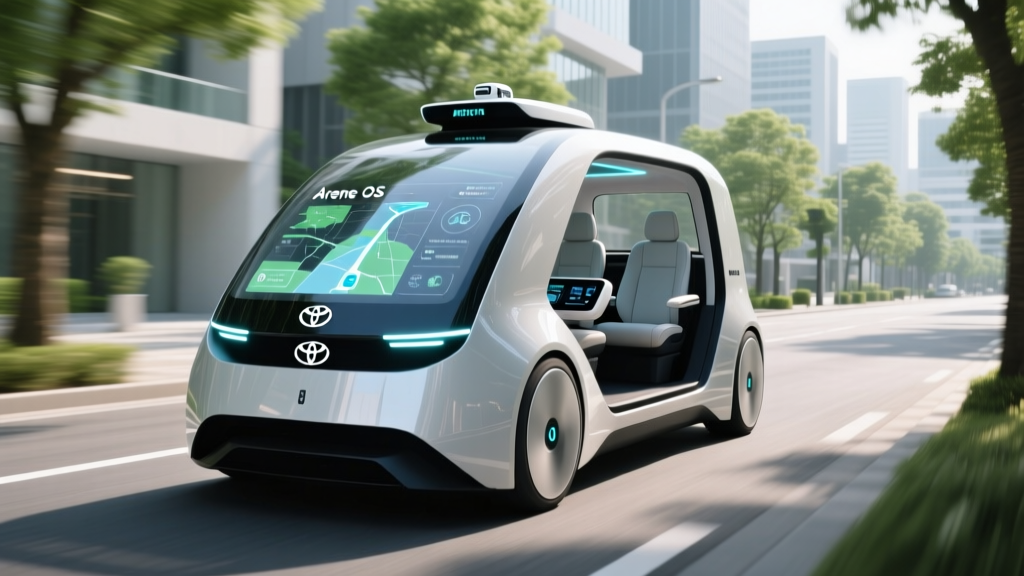
Arene OS: Toyota's in-house vehicle operating system, announced in 2021 and progressively deployed. Arene is designed as a software-defined vehicle platform — think of it as Toyota's answer to Tesla's vertically integrated software stack. By 2026, Arene underpins over-the-air updates and ADAS features in production vehicles, and serves as the middleware layer for Woven's Level 4 prototypes. It is not, however, a consumer-facing robotaxi app.
Where Woven Robotaxis Operate
| Location | Type | Public Access? | Notes |
|---|---|---|---|
| Woven City, Susono, Japan | Living laboratory / closed campus | No — employees and invited residents only | Purpose-built prototype city near Mt. Fuji; ~2,000 residents planned |
| Tokyo waterfront (Odaiba / Toyosu) | Public-road pilot | Limited — invited participants | Modified Lexus RX prototypes; safety operator present in some runs |
| Shimizu, Shizuoka Prefecture | Rural/suburban road testing | No | Testing edge cases in low-infrastructure environments |
| United States | No active public robotaxi service | No | Woven America (Silicon Valley) conducts R&D; no US robotaxi deployment as of 2026 |
Where can I use a Toyota robotaxi right now? The honest answer: you cannot hail a Toyota robotaxi as a paying customer anywhere in the world as of 2026. Woven by Toyota's Level 4 vehicles operate in invitation-only pilot programs in Japan. There is no public app, no fare structure, and no US service. If you see headlines about "Toyota robotaxis," they refer to research demonstrations, not commercial operations.
Toyota Safety Sense 3.0: What You Can Actually Buy
While Level 4 remains in testing, Toyota's production ADAS suite — Toyota Safety Sense 3.0 — is standard on nearly every 2025-2026 Toyota and Lexus model. TSS 3.0 includes:
- Pre-Collision System with Pedestrian Detection (PCS w/PD)
- Full-Speed Range Dynamic Radar Cruise Control (DRCC)
- Lane Departure Alert with Steering Assist (LDA w/SA)
- Lane Tracing Assist (LTA)
- Automatic High Beams (AHB)
- Road Sign Assist (RSA)
- Proactive Driving Assist (PDA) — gentle braking/steering for obstacles
These are Level 2 systems. They assist the driver but do not replace them. The National Highway Traffic Safety Administration (NHTSA) explicitly warns that Level 2 features require continuous driver engagement. Toyota's owner manuals state this clearly: the driver is responsible for safe operation at all times.
Lexus Teammate (Advanced Drive)
On select Lexus models (LS sedan, LX SUV in Japan and limited markets), the Teammate system offers a more advanced Level 2+ experience: hands-off driving in specific highway traffic-jam conditions (below ~25 mph / 40 km/h), with the driver required to remain eyes-on and ready to resume control. This is comparable to GM's Super Cruise or Ford's BlueCruise in capability — not Level 4 autonomy.
Safety Data: What We Know About Toyota's Autonomous Programs
Production ADAS (TSS 3.0): Toyota's Level 2 systems have contributed to strong IIHS Top Safety Pick ratings across the Toyota lineup. The Pre-Collision System and Dynamic Radar Cruise Control are well-validated in NHTSA crash-avoidance testing. These are mature, widely deployed systems with millions of real-world miles.
Woven Level 4 prototypes: Toyota does not publicly report cumulative autonomous miles driven, disengagement rates, or intervention frequency for its Woven fleet — a notable contrast to Waymo, which periodically publishes safety transparency reports. Based on available information through 2026, Woven's test fleet has operated on public roads in Japan under supervised conditions, but total mileage figures are not disclosed. No publicly reported serious incidents involving Woven Level 4 prototypes have appeared in major news outlets, but absence of reports is not equivalent to validated safety data.
How safe are Toyota's autonomous vehicles? For TSS 3.0, the safety record is strong and well-documented through IIHS and NHTSA crash testing. For Woven's Level 4 prototypes, the honest answer is that insufficient public data exists to make a definitive comparison with Waymo (which has logged over 30 million driverless miles) or Cruise. Toyota's approach has been more conservative and less transparent than its American robotaxi competitors.
How Toyota's Approach Compares to Active Robotaxi Services
For context, here is how Toyota/Woven's current posture compares to the robotaxi services that are actually operational in 2026:
| Attribute | Waymo (Alphabet) | Zoox (Amazon) | Woven by Toyota |
|---|---|---|---|
| SAE Level | Level 4 | Level 4 | Level 4 (testing) |
| Public commercial service? | Yes — Phoenix, SF, LA, Austin | Yes — limited Las Vegas, SF Bay Area | No |
| US availability | Multiple cities | Limited | None |
| Sensor approach | LiDAR + camera + radar | LiDAR + camera + radar | LiDAR + camera + radar |
| Public miles (driverless) | 30+ million | Not disclosed (smaller fleet) | Not disclosed |
| Pricing model | Per-ride (comparable to Uber/Lyft) | Free pilot / not yet priced | N/A |
| Regulatory approval | CPUC + state DMVs | Nevada, California permits | Japan MLIT permits |
How much does a Toyota robotaxi cost vs Uber/Lyft? There is no Toyota robotaxi fare to compare. Waymo's pricing in active markets generally mirrors Uber/Lyft base fares (roughly $1.00-$2.50 per mile depending on city and demand), sometimes with promotional discounts. Until Woven launches a commercial service, pricing is speculative.
Current Limitations of Toyota's Autonomous Technology
Woven Level 4 Prototypes
- Geofence-restricted: Operate only on pre-mapped routes in approved zones; cannot handle arbitrary point-to-point navigation
- Weather sensitivity: Heavy rain, snow, and fog degrade LiDAR and camera performance; testing has been concentrated in mild Japanese climates
- No commercial availability: No public ride-hailing app, no fare system, no US presence
- Limited edge-case data: Compared to Waymo's 30+ million driverless miles across diverse US cities, Woven's exposure to complex urban edge cases (construction zones, erratic pedestrians, emergency vehicles) is less validated publicly
- Safety operator dependency: Some test runs still carry a human safety operator, meaning true Level 4 (no human in the loop) is not consistently achieved
Toyota Safety Sense 3.0 (Consumer Vehicles)
- Not self-driving: Requires continuous driver attention; lane centering can disengage on faded markings or sharp curves
- No hands-off guarantee: Unlike GM Super Cruise on mapped highways, TSS does not offer conditional hands-free operation in the US market
- Limited to structured roads: DRCC and LTA function best on well-marked highways; performance degrades in construction zones or unmapped rural roads
- Cold-weather sensor issues: Front radar and camera can be obstructed by ice, snow, or road salt buildup — a real-world limitation for northern-climate drivers
Regulatory Landscape: Who Approves Toyota's Autonomous Operations?
In Japan, autonomous driving testing and deployment fall under the Ministry of Land, Infrastructure, Transport and Tourism (MLIT). Japan passed Level 3 conditional automation regulations in 2020 (allowing the Honda Legend to offer limited Level 3 in traffic jams), but Level 4 commercial operations remain in pilot stages. Woven's test permits are issued by MLIT and local prefectural authorities.
In the United States, robotaxi operations require approval from state-level regulators — typically the Department of Motor Vehicles (DMV) for testing permits and the Public Utilities Commission (PUC/CPUC) for commercial fare-charging. At the federal level, NHTSA oversees vehicle safety standards but does not directly approve autonomous driving operations. Toyota/Woven has no active US robotaxi permits as of 2026.
This regulatory fragmentation means that even if Woven perfects its Level 4 system in Japan, launching in the US would require separate state-by-state approval processes — a multi-year undertaking.
Toyota's Realistic Autonomy Timeline
Toyota has historically been more cautious than competitors in autonomy timelines. CEO Koji Sato has emphasized a "software-defined vehicle" strategy with Arene OS, but the company has not committed to a specific date for commercial robotaxi deployment. Based on current trajectory:
- 2026-2027: Continued Level 4 testing in Japan; possible expansion of pilot programs to additional Japanese cities; Arene OS deployment in more production vehicles
- 2028-2030 (estimated): Potential limited commercial robotaxi service in Japan, likely in partnership with local mobility providers
- US deployment: No announced timeline; would require regulatory approvals, US-specific mapping, and fleet operations infrastructure — realistically 2030+ at earliest
Toyota's approach prioritizes incremental safety validation over rapid deployment — a contrast to Waymo's aggressive commercial expansion. Whether this caution results in a safer eventual product or a missed market window remains an open question.
Frequently Asked Questions
Is Toyota Safety Sense self-driving?
No. Toyota Safety Sense 3.0 is an SAE Level 2 driver-assistance system. It provides adaptive cruise control, lane centering, and automatic emergency braking, but the driver must remain fully attentive and in control at all times. It does not navigate autonomously.
Can I ride in a Toyota robotaxi today?
No. Woven by Toyota's Level 4 prototype vehicles operate in invitation-only pilot programs in Japan (primarily Tokyo and Woven City near Mt. Fuji). There is no public ride-hailing service, no app, and no US availability as of 2026.
What is Arene OS and when will I see it?
Arene is Toyota's in-house vehicle operating system for software-defined vehicles. It powers over-the-air updates, ADAS features, and infotainment in newer Toyota/Lexus models. By 2026, Arene is deployed in select vehicles and serves as the middleware for Woven's Level 4 prototypes. Expect broader rollout across the Toyota lineup through 2027-2028.
How does Toyota's autonomy compare to Tesla FSD?
Both are Level 2 driver-assist systems requiring full driver supervision. Tesla's FSD (Supervised) offers more aggressive urban navigation features but has drawn scrutiny from NHTSA for safety incidents. Toyota's TSS 3.0 is more conservative — fewer automated features, but also fewer reported incidents. Neither is self-driving.
Will Toyota ever launch a commercial robotaxi service?
Woven by Toyota is clearly working toward Level 4 commercialization, but no public timeline has been announced. Japan is the most likely initial market. US deployment would require significant regulatory, mapping, and operational groundwork — realistically not before 2030.
What sensors does Toyota use for autonomous driving?
Woven's Level 4 prototypes use a sensor-fusion approach: multiple LiDAR units, 8-12 cameras, short- and long-range radar, and HD pre-mapped routes. This contrasts with Tesla's camera-only approach and aligns with Waymo and Zoox. Production TSS 3.0 vehicles use a front camera and millimeter-wave radar.