Autonomy in 2026: Sorting Reality From Hype
If you search for autonomous driving headlines today, you will find a tangle of conflicting claims. Tesla says its vehicles are nearly self-driving. Waymo is quietly completing tens of thousands of paid rides per week. Cruise is rebuilding after a catastrophic 2023 incident. Zoox is testing a vehicle with no steering wheel. The current state of autonomous driving technology in 2026 is not a single story — it is several parallel tracks moving at very different speeds.
This guide separates what is commercially available right now from what is still in testing, explains the critical SAE automation levels, and gives you the data to evaluate whether a robotaxi is a realistic part of your transportation routine.
SAE Automation Levels: The Framework That Matters
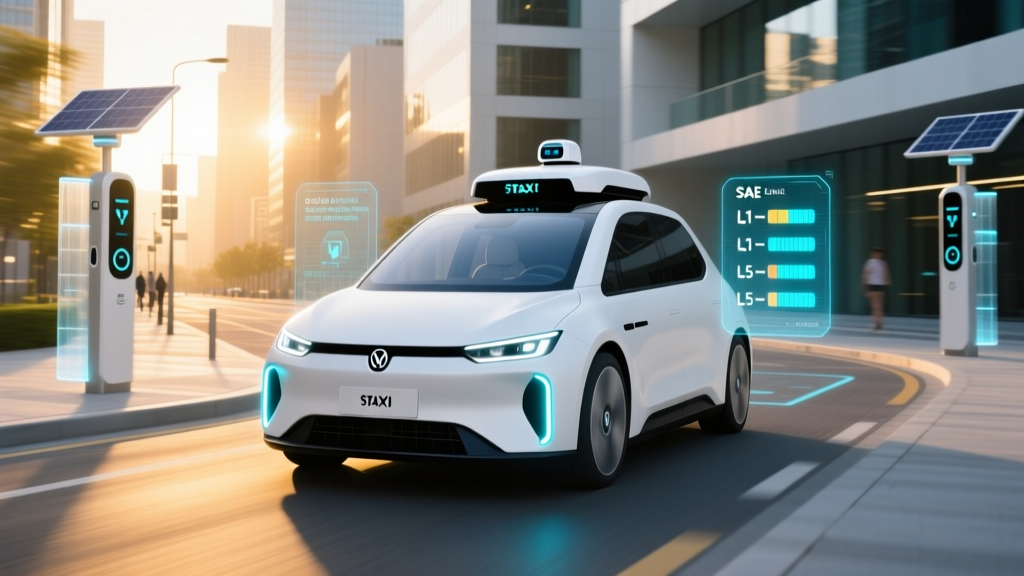
The Society of Automotive Engineers defines six levels of driving automation. Understanding these is non-negotiable if you want to evaluate any autonomous claim honestly.
| Level | Name | Who Drives | Examples in 2026 |
|---|---|---|---|
| 0 | No Automation | Human | Legacy vehicles |
| 1 | Driver Assistance | Human | Adaptive cruise, lane-keep |
| 2 | Partial Automation | Human (must supervise) | Tesla Autopilot/FSD Supervised, GM Super Cruise, Ford BlueCruise |
| 3 | Conditional Automation | System (human on standby) | Mercedes Drive Pilot (limited markets) |
| 4 | High Automation | System (no human needed in ODD) | Waymo One, Zoox (geofenced areas) |
| 5 | Full Automation | System (anywhere, any condition) | Does not exist commercially |
The single most important distinction: Level 2 is not self-driving. Tesla's Full Self-Driving (Supervised) system, despite its name, requires the driver to remain fully attentive and is legally a Level 2 driver-assist feature. The NHTSA has been explicit about this distinction. Only Level 4 robotaxi services operating in geofenced zones — currently Waymo and Zoox — qualify as genuinely driverless in their approved areas.
Where Robotaxi Services Actually Operate Today
Availability is narrow and geofenced. You cannot hail a robotaxi in most American cities. Here is where commercial, fare-charging service exists as of early 2026:
| Service | Cities (Commercial) | Hours | Vehicle |
|---|---|---|---|
| Waymo One | Phoenix metro, San Francisco, Los Angeles, Austin (partial) | 24/7 in Phoenix/SF; limited hours elsewhere | Jaguar I-PACE (Gen 6 sensor suite) |
| Zoox | Las Vegas (Strip corridor), Foster City CA (limited) | Limited hours | Zoox purpose-built vehicle (no steering wheel) |
| Cruise | Phoenix (relaunched limited), Houston (testing) | Daytime only, safety operator present | Chevrolet Bolt EV / Origin (testing) |
| Baidu Apollo Go | Wuhan, Beijing, Chongqing (China) | Extended hours | Various (Apollo RT6) |
Note what is missing: New York City, Chicago, Seattle, Miami, and most of the country remain without any commercial robotaxi option. Expansion announcements are frequent — live service is not. Always verify on the operator's app before assuming availability in your area.
How to Use a Robotaxi and What It Costs
Using Waymo One — the most widely available option — is nearly identical to Uber or Lyft. Download the app, enter your destination, and a driverless Jaguar I-PACE arrives. No human is in the front seat. The ride is monitored remotely, and you can speak to a support agent via in-car screen at any time.
| Service | Typical Fare | Surge Pricing | Tips |
|---|---|---|---|
| Waymo One | $12–$18 | Rare; occasional demand pricing | Not expected (in-app option) |
| UberX | $14–$22 | Frequent during peak hours | 15–20% customary |
| Lyft Standard | $13–$21 | Frequent during peak hours | 15–20% customary |
On a per-ride basis, Waymo is often competitive with or slightly cheaper than UberX, especially when surge pricing hits rideshare. Waymo has also offered aggressive introductory credits in new markets to build ridership. For frequent users in Phoenix or San Francisco, the economics can favor robotaxis — though availability radius limits how often you can actually use them.
Safety Record: What the Data Actually Shows
This is the area most distorted by both hype and fear-mongering. Here are the verifiable data points:
Waymo has published peer-reviewed analysis covering over 7.1 million fully driverless miles across Phoenix, San Francisco, and Los Angeles. Compared to human-driver benchmarks in the same cities, Waymo vehicles showed:
• 85% reduction in injury-causing crash involvement
• 57% reduction in any-reported crash involvement
• Contact rates with other vehicles significantly below human baselines
Source: Waymo safety report, NHTSA AV data portal
However, context matters. Robotaxi fleets operate in geofenced, mapped urban environments, avoid severe weather, and travel at lower average speeds than highway traffic. They are not tested against the full spectrum of driving scenarios humans face.
The Cruise October 2023 incident in San Francisco — where a pedestrian was struck by a human-driven vehicle, thrown into a Cruise robotaxi's path, and then dragged — resulted in California DMV suspending Cruise's permit and triggered a nationwide pullback. Cruise has since relaunched in limited form with safety operators. This incident underscored that edge cases (multi-party collisions, unusual pedestrian trajectories) remain the hardest challenges for autonomous systems.
The Insurance Institute for Highway Safety (IIHS) has called for more standardized crash and intervention reporting, noting that current self-reported data from operators makes apples-to-apples comparison difficult.
Technology Stack: How Robotaxis Actually See the Road
There is no single approach. The industry has split into distinct sensor philosophies:
Waymo (sensor fusion, lidar-heavy): The sixth-generation Waymo Driver uses a combination of lidar, cameras, and radar. Roof-mounted and side-mounted lidar units create a real-time 3D point cloud, cameras handle traffic-light and sign recognition, and radar provides redundancy in poor visibility. This stack is expensive — estimated at over $100,000 per vehicle in sensor hardware alone — but provides overlapping redundancy.
Tesla FSD (vision-only): Tesla removed radar and ultrasonic sensors, relying entirely on cameras processed by its custom FSD chip and neural networks. This approach is far cheaper and scales across Tesla's consumer fleet, but remains Level 2 and requires driver supervision. Tesla has not deployed a commercial driverless service.
Zoox (purpose-built vehicle): Zoox's custom vehicle has no steering wheel and is designed from the ground up for autonomous operation, with symmetrical sensor arrays covering 360 degrees. This eliminates the retrofitting compromises of adapting a production car.
Geofencing is a critical enabling technology. Waymo and Zoox vehicles operate only within pre-mapped, high-definition zones that have been driven thousands of times. The vehicle's software knows every lane, curb, and signal in its operating domain. When a robotaxi approaches the boundary of its geofence, it will refuse the ride or request remote guidance.
The Regulatory Landscape
Autonomous vehicle regulation in the US is fragmented. There is no comprehensive federal framework for deploying driverless vehicles at scale. Instead:
- NHTSA sets vehicle safety standards and requires crash reporting from AV operators (Standing General Order, 2021, updated since).
- State DMVs and PUCs issue the actual operating permits. California's CPUC and DMV have been the most active regulators; Arizona has taken a permissive approach; New York requires a safety operator.
- Local governments often negotiate operational agreements covering curb access, parking, and emergency response protocols.
This patchwork means a service can be fully commercial in Phoenix and effectively banned in Manhattan. Any company claiming "nationwide availability" is either misleading or referring to Level 2 driver-assist — which is not the same thing.
Current Limitations: What Robotaxis Cannot Do
Honest assessment requires naming the boundaries clearly:
- Weather: Heavy rain, snow, fog, and ice degrade sensor performance. Waymo and Zoox limit or suspend service in adverse conditions — precisely when human drivers need help most.
- Geofence boundaries: You cannot take a robotaxi from San Francisco to Sacramento. Rides that cross the operational zone are refused.
- Construction zones: Temporary lane shifts, missing lane markings, and unusual traffic-control setups remain challenging. Remote assistance is often required.
- Airport and highway access: Some airport routes are now approved (Phoenix Sky Harbor, SFO), but many are not. Highway merging at 70+ mph is handled, but complex multi-lane interchanges still generate conservative, sometimes erratic driving behavior.
- Emergency vehicles: While systems detect sirens and pull over, edge cases involving multiple emergency vehicles or unusual staging patterns can cause extended stops.
- Accessibility: Current robotaxi fleets (Jaguar I-PACE, Chevy Bolt) are not wheelchair-accessible. This is a significant gap that purpose-built vehicles like Zoox and the Cruise Origin aim to address.
Is This Truly Self-Driving? The Honest Answer
For Level 4 robotaxi services operating inside their geofence, in fair weather, on mapped roads: yes, they are genuinely driverless. No human is in the vehicle, and no human intervention is expected or possible from inside the car.
For consumer vehicles marketed with "Autopilot," "Full Self-Driving," "Super Cruise," or "BlueCruise": no, these are not self-driving. They are Level 2 systems that require continuous driver attention. The vehicle may handle steering and speed on highways impressively well, but the human driver remains legally and physically responsible. Confusing these two categories is the most common and dangerous misunderstanding in the autonomous vehicle conversation.
Level 5 — a vehicle that can drive anywhere, in any condition, with no human involvement — does not exist commercially, and no credible operator has announced a timeline for it. Anyone selling you on "Level 5 is two years away" has been saying that for a decade.
Frequently Asked Questions
Where can I use a robotaxi service right now?
Commercially, without a safety operator: Phoenix, San Francisco, Los Angeles (Waymo), and Las Vegas (Zoox, limited). Cruise operates with safety drivers in select markets. Most US cities have zero robotaxi availability.
How much does a robotaxi cost compared to Uber or Lyft?
Roughly comparable. A 5-mile Waymo ride typically costs $12–$18, versus $14–$22 for UberX before tip and surge. Robotaxis rarely surge, which can make them cheaper during peak demand.
How safe are robotaxis — what does the real data show?
Waymo's published data on 7.1+ million driverless miles shows significantly lower injury-crash involvement than human benchmarks in the same cities. However, robotaxis operate in constrained environments (mapped, geofenced, fair weather), so direct comparison to all human driving is imperfect.
What are the current limitations of autonomous vehicles?
Weather (rain, snow, fog), geofence boundaries, construction zones, limited airport access, and lack of wheelchair accessibility remain real constraints. Service can be suspended at any time.
Is Tesla FSD self-driving?
No. Tesla's Full Self-Driving (Supervised) is a Level 2 driver-assist system. The driver must remain attentive, hands ready, and is legally responsible for the vehicle at all times. It is not a robotaxi and does not operate without a driver.