Why Autonomous Driving Radar Still Anchors the Robotaxi Sensor Stack
Strip away the marketing gloss around self-driving taxis, and you find a hardware argument: how does a vehicle perceive the world reliably enough to operate without a human driver? The answer in 2026 remains a multi-sensor fusion stack, and autonomous driving radar is one of its most load-bearing components. Unlike camera-only systems that struggle in low light, or lidar that can scatter in heavy rain, radar penetrates fog, rain, snow, and darkness to detect the velocity and distance of objects hundreds of meters away. It is the sensor that keeps working when conditions degrade — and for Level 4 robotaxi operators running commercial services, that reliability is non-negotiable.
This guide breaks down how radar fits into the broader technology stack powering today's operational robotaxi fleets, where you can actually hail one, what it costs, and what the safety data says. We'll also be precise about what these systems can and cannot do — because the gap between a Level 4 geofenced robotaxi and a Level 2 driver-assist feature like Tesla FSD (Supervised) is enormous, and conflating them helps no one making a transportation decision.
SAE Automation Levels: Where Robotaxis Actually Sit
Before evaluating any autonomous service, you need the SAE International automation framework. Robotaxis and consumer driver-assist systems occupy fundamentally different tiers:
| SAE Level | Name | Who Drives? | Examples |
|---|---|---|---|
| Level 2 | Partial Automation | Human (must monitor constantly) | Tesla Autopilot / FSD (Supervised), GM Super Cruise, Ford BlueCruise |
| Level 3 | Conditional Automation | System in narrow conditions; human must take over on request | Mercedes DRIVE PILOT (limited markets/speeds) |
| Level 4 | High Automation | System fully, no human needed — within geofence | Waymo One, Zoox (limited areas), Cruise (limited restart) |
| Level 5 | Full Automation | System everywhere, all conditions | Does not exist commercially as of 2026 |
Every operational robotaxi you can hail today is Level 4: fully driverless within a defined operational design domain (ODD). The vehicle handles all driving tasks in its approved zone. If it encounters a scenario it cannot handle, it executes a minimal-risk maneuver (pull over, stop) rather than handing control to a passenger. This is categorically different from Level 2 systems where the human is legally and operationally the driver at all times.
The Robotaxi Tech Stack: Radar, Lidar, Cameras, and Fusion
Modern Level 4 robotaxis don't rely on a single sensor type. They fuse data from multiple modalities, each compensating for the others' weaknesses. Here's how autonomous driving radar fits into the hierarchy:
Autonomous Driving Radar (Typically 4D Imaging Radar)
Modern robotaxis use 4D imaging radar operating in the 77 GHz band. Unlike legacy radar that detected range and velocity, 4D radar adds azimuth and elevation resolution, producing a point-cloud-like output that can distinguish a pedestrian from a guardrail. Radar's core advantages:
- Velocity measurement: Doppler radar directly measures relative speed of objects — no inference needed
- All-weather performance: Functions in rain, fog, snow, and total darkness where cameras and lidar degrade
- Long range: Detects vehicles 200–300 meters ahead, critical for highway-speed planning
- Low cost and durability: Solid-state units with no moving parts, typically $50–$200 per unit at scale
Lidar (Light Detection and Ranging)
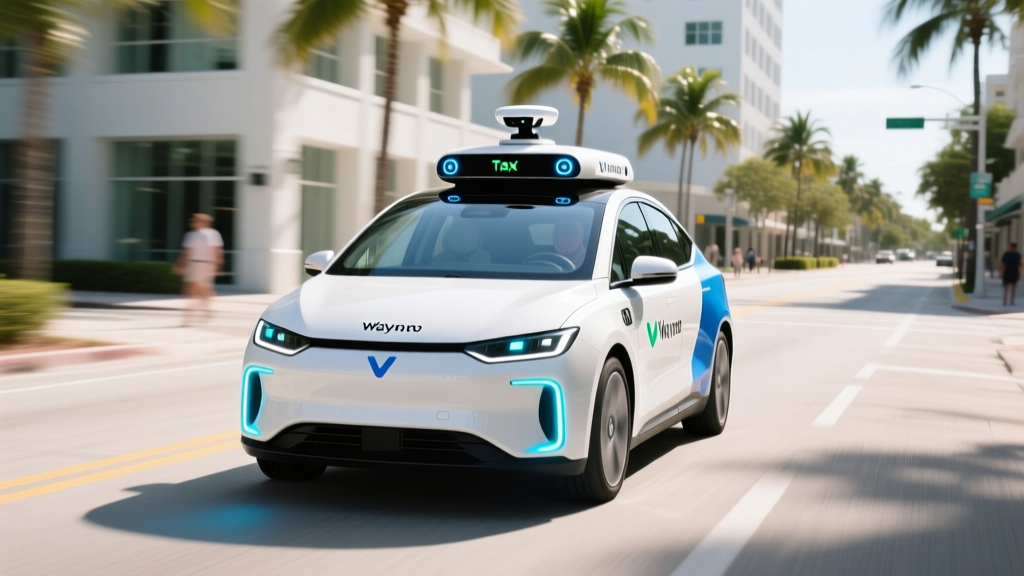
Lidar fires laser pulses to build a high-resolution 3D map of surroundings. It excels at precise spatial mapping and object classification at medium range (up to ~250m) but can struggle in heavy precipitation and is more expensive ($1,000–$5,000+ per unit). Waymo's 6th-generation vehicle uses a custom lidar suite alongside radar.
Cameras
High-resolution cameras handle lane detection, traffic light/signal recognition, and semantic understanding (reading signs, classifying objects). They're cheap but fail in glare, darkness, and occlusion. Tesla's camera-only approach for FSD remains Level 2 — no camera-only system has achieved Level 4 commercial deployment.
Sensor Fusion and Compute
Raw sensor data is fused in real time by high-throughput compute platforms (NVIDIA DRIVE Orin/Thor, Qualcomm Ride, or custom silicon) running perception, prediction, and planning algorithms. The output: a unified world model that the planning stack uses to navigate.
The industry consensus in 2026 is clear: Level 4 robotaxis require redundant sensing. Autonomous driving radar provides the all-weather, all-lighting safety net that neither lidar nor cameras can independently deliver. Waymo, Zoox, and Motional all deploy radar as part of their production stacks.
Where You Can Actually Hail a Robotaxi Right Now
Despite years of expansion promises, Level 4 robotaxi service remains geographically concentrated. Here is the current operational landscape:
| Operator | Service Name | Live Cities (2026) | Hours | Vehicle |
|---|---|---|---|---|
| Waymo | Waymo One | Phoenix (metro), San Francisco, Los Angeles, Austin (limited) | 24/7 in Phoenix & SF | Jaguar I-PACE (Gen 5/6), Hyundai Ioniq 5 (Gen 6 rollout) |
| Zoox | Zoox Ride | Las Vegas (Strip corridor), Foster City, CA (employees/limited public) | Limited hours | Zoox purpose-built vehicle (no steering wheel) |
| Cruise | Cruise (limited restart) | Phoenix, Dallas (phased restart post-2023 suspension) | Limited hours, safety driver present initially | Chevrolet Bolt EV, Chevrolet Blazer EV (Origin paused) |
| Baidu Apollo | Apollo Go | Wuhan, Beijing, Shanghai, Chongqing (China — largest global fleet) | Extended hours | Various (RT6 purpose-built) |
Critical context: Waymo is the only US operator running fully driverless, 24/7 commercial service at scale. Zoox's purpose-built vehicle has begun limited public rides. Cruise is in a cautious, phased restart with safety drivers in some vehicles after its October 2023 San Francisco incident led to a California DMV permit suspension. Expansion announcements (new cities, new states) should always be verified against actual ride availability in the app — announced service is not live service.
Robotaxi Pricing vs. Uber and Lyft: The Real Numbers
Robotaxi pricing in 2026 is designed to compete with rideshare, but the economics vary significantly by market and time of day:
| Scenario (Phoenix, ~5 miles) | Waymo One | UberX | Lyft |
|---|---|---|---|
| Midday, standard demand | $9–$13 | $11–$16 | $10–$15 |
| Evening peak (5–7 PM) | $12–$18 | $16–$28 (surge) | $14–$25 (surge) |
| Late night (11 PM–2 AM) | $10–$15 | $14–$22 | $13–$20 |
| Wait time (typical) | 3–8 minutes | 2–6 minutes | 2–7 minutes |
Waymo's pricing advantage is most pronounced during surge periods when human-driver rideshare prices spike. Robotaxi fares don't surge in the traditional sense because there's no driver supply constraint — the constraint is fleet size. However, during peak demand, wait times increase rather than prices. Waymo also offers Waymo One membership pricing and has periodically run promotional discounts in new markets to drive adoption.
For comparison context: a 5-mile UberX ride in Phoenix averaged $13.50 in early 2026 without surge. Robotaxi pricing is broadly competitive but not dramatically cheaper — the long-term cost advantage is projected to come as fleets scale and per-vehicle hardware costs decline.
Robotaxi Safety: What the Data Actually Shows
Safety is the most contested question in autonomous driving, and the data is improving but still incomplete. Here's what we know from reported figures:
Waymo Safety Data (through 2025 reporting)
- Total autonomous miles driven: Over 50 million fully driverless miles (cumulative across all markets)
- At-fault collision rate: Waymo's published analysis (peer-reviewed with NHTSA data comparison) showed an 85% reduction in at-fault injury-causing crashes per million miles compared to the human driving benchmark in its operating cities
- Contact rate: Approximately 0.4 police-reported crashes per million autonomous miles, vs. the human baseline of ~2.5 per million miles in comparable urban environments
- Most incidents: Low-speed, other-party-at-fault (rear-ended at stoplights, sideswiped in parking areas)
Cruise 2023 Incident Context
In October 2023, a Cruise vehicle in San Francisco struck a pedestrian who had been thrown into its path by a human-driven car, then dragged the pedestrian approximately 20 feet while pulling to the curb. The incident — and Cruise's incomplete disclosure to regulators — led to California DMV permit suspension, a nationwide pause, CEO resignation, and a phased restart with safety drivers. This remains the most significant robotaxi safety event in US history and illustrates the regulatory risk.
Limitations of Safety Data
Robotaxi safety statistics carry important caveats: they operate in geofenced, mapped areas often chosen for lower complexity; they don't operate in severe weather; and the total miles driven, while growing, remain a fraction of the trillions of human-driven miles that form the comparison baseline. IIHS has noted that more standardized, mandatory reporting would improve public confidence.
The honest assessment: the available data suggests Level 4 robotaxis in their operational domains are performing at or above human safety benchmarks for comparable urban driving, but the sample size relative to total transportation activity is still limited, and edge-case failures (the Cruise incident) demonstrate that the technology is not infallible.
Regulatory Landscape: Who Approves Robotaxi Operations
Robotaxi deployment in the US operates under a patchwork of state and federal authority:
- NHTSA (federal): Sets vehicle safety standards (FMVSS) and investigates defects. NHTSA issued a Standing General Order requiring crash reporting for vehicles with Level 2+ and above automation. However, NHTSA does not "approve" autonomous driving software.
- State DMVs and PUCs: The actual gatekeepers. California's DMV issues testing and deployment permits; the California Public Utilities Commission (CPUC) authorizes commercial passenger service. Arizona takes a permissive approach with minimal state oversight. Texas has its own framework. Each state sets its own rules for whether safety drivers are required, whether commercial fares can be charged, and what reporting is mandatory.
- Local municipalities: Cities can impose additional restrictions on operating hours, zones, and fleet sizes. San Francisco's Board of Supervisors attempted to limit robotaxi expansion before the Cruise incident.
This fragmented regulatory environment means expansion is slow and state-by-state. There is no federal "autonomous vehicle license" — a Waymo vehicle legal in Phoenix requires separate California permits to operate in San Francisco.
Current Limitations: What Robotaxis Cannot Do
Level 4 robotaxis are impressive within their operational design domain, but that domain has hard boundaries. Understanding these limitations is essential for anyone evaluating the service:
Weather Restrictions
- Heavy rain, snow, and dense fog degrade lidar and camera performance. Most operators reduce service or suspend operations during severe weather events.
- Autonomous driving radar continues functioning in these conditions, but the overall perception stack may not meet the safety threshold for driverless operation if other sensors are compromised.
- Waymo has improved rain handling in Phoenix and SF, but a significant Bay Area atmospheric river or monsoon downpour will still trigger service reductions.
Geofencing
- Robotaxis operate only within pre-mapped, approved zones. Request a ride outside the geofence and the app simply won't let you.
- Expansion happens block by block, neighborhood by neighborhood. Phoenix's geofence covers most of the metro, but SF and LA have more constrained boundaries.
- Airport service is limited — Waymo began PHX airport rides in 2024, but SFO and LAX access has been slower to materialize due to regulatory and mapping complexity.
Edge Cases and No-Go Scenarios
- Construction zones: Rapidly changing lane configurations, temporary signage, and flaggers challenge the perception stack. Vehicles may pull over and request remote assistance.
- Unprotected left turns in heavy traffic: Some operators restrict certain complex maneuvers or routes.
- Emergency vehicles: Detecting and appropriately yielding to approaching emergency vehicles remains a challenging scenario; multiple incidents have been reported.
- Unpaved roads, parking garages, and private property: Generally outside the ODD.
Passenger Limitations
- No car seats or special accommodations for infants in most services.
- Accessibility: Waymo has begun WAV (wheelchair-accessible vehicle) pilots, but the Jaguar I-PACE fleet is largely standard configuration.
- Unaccompanied minors are not permitted.
Autonomous Driving Radar: The Road Ahead
The radar component of robotaxi stacks is itself evolving rapidly. Next-generation 4D imaging radar from suppliers like Continental, ZF, and startups like Arbe Robotics and Uhnder is closing the resolution gap with lidar at a fraction of the cost. By 2027–2028, some analysts project that high-resolution imaging radar could reduce the number of lidar units required per vehicle, lowering the per-vehicle sensor cost from $20,000+ toward $10,000 or below — a critical factor for fleet profitability.
However, no major robotaxi operator has signaled a move to radar-only or radar-plus-camera stacks for Level 4 service. The redundancy argument — multiple independent sensing modalities — remains the engineering consensus for safety-critical driverless operation. Autonomous driving radar is essential, but it is one leg of a three-legged stool.
Frequently Asked Questions
Where can I use a robotaxi service right now?
The largest operational US service is Waymo One, available in Phoenix, San Francisco, Los Angeles, and limited areas of Austin. Zoox operates limited rides in Las Vegas. Cruise is in a phased restart in Phoenix and Dallas with safety drivers. Outside the US, Baidu's Apollo Go operates the world's largest fleet across multiple Chinese cities including Wuhan and Beijing.
How much does a robotaxi ride cost vs. Uber or Lyft?
Robotaxi fares are broadly competitive with standard rideshare pricing — roughly $9–$18 for a typical 5-mile urban ride depending on market and time of day. The biggest advantage appears during surge pricing: robotaxi fares don't spike the way Uber and Lyft do when driver supply drops. Wait times are typically 3–8 minutes in active service zones.
How safe are robotaxis based on real data?
Waymo's published and peer-reviewed data indicates an approximately 85% reduction in at-fault injury-causing crashes per million miles compared to human driving benchmarks in comparable urban environments, across over 50 million driverless miles. However, total robotaxi miles remain a small fraction of overall transportation activity, and edge-case incidents (like the 2023 Cruise pedestrian event) demonstrate the technology is not infallible. Mandatory standardized reporting would improve public data quality.
What are the current limitations of robotaxi service?
Key limitations include geofenced service areas (you can't ride outside approved zones), reduced or suspended service during severe weather (heavy rain, snow, fog), difficulty with construction zones and complex intersections, limited airport access, no car seats or unaccompanied minors, and constrained wheelchair accessibility. The technology works well within its designed operational domain but cannot yet handle all driving scenarios.
Is a robotaxi truly self-driving, or is it like Tesla Autopilot?
Robotaxis from Waymo, Zoox, and similar operators are SAE Level 4 — fully driverless within their operational domain, with no human in the driver's seat and no expectation of human intervention. This is fundamentally different from Tesla Autopilot, FSD (Supervised), GM Super Cruise, or Ford BlueCruise, which are all SAE Level 2 driver-assist systems requiring continuous human supervision. Conflating the two is inaccurate and potentially dangerous: Level 2 systems are not self-driving, and the human driver remains legally responsible.
Does autonomous driving radar work in bad weather?
Yes — this is radar's primary advantage over lidar and cameras. 77 GHz automotive radar penetrates rain, fog, snow, and darkness effectively. However, a robotaxi's overall safety depends on the entire sensor suite. If lidar and cameras are degraded enough that the fusion stack cannot meet its safety threshold, the vehicle may reduce speed, reroute, or suspend service — even though the radar itself is still functioning normally.
Can I hail a robotaxi at the airport?
Limited. Waymo began offering rides to and from Phoenix Sky Harbor (PHX) in 2024, but major hubs like SFO and LAX have been slower to add robotaxi service due to regulatory complexity, dense traffic patterns, and mapping challenges. Always check the app for your specific airport — availability changes as geofences expand.