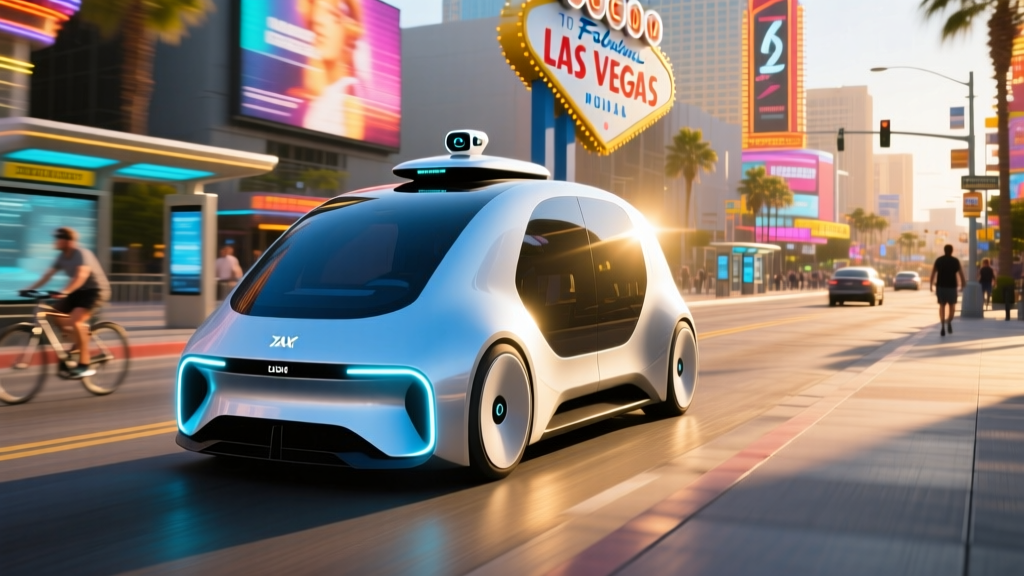
Las Vegas is one of the most active proving grounds for driverless technology in the United States. Tourists and residents alike have become accustomed to spotting sensor-laden vehicles navigating the Strip, downtown Fremont Street corridors, and suburban arteries. But the phrase "autonomous cars Las Vegas" covers a wide spectrum — from fully driverless Level 4 robotaxis you can hail today, to Level 2 driver-assist systems in consumer EVs that still demand your full attention behind the wheel.
This guide breaks down exactly which robotaxi services are operational in Las Vegas right now, what they cost, how safe they are according to public incident data, and where the hard boundaries of the technology remain. If you're planning a trip or evaluating whether to hail a driverless ride, these are the numbers and nuances that matter.
Is This Truly Self-Driving? Understanding SAE Autonomy Levels
The most common source of confusion in the autonomous-vehicle conversation is the gap between what a consumer EV like a Tesla with FSD (Supervised) does and what a Waymo robotaxi does. Both involve computers controlling steering and speed, but the regulatory and practical differences are enormous.
| SAE Level | Name | Who Drives | Example in Las Vegas |
|---|---|---|---|
| Level 0 | No Automation | Human | Any conventional car without ADAS |
| Level 1 | Driver Assistance | Human (system assists one axis) | Adaptive cruise control or lane-keep |
| Level 2 | Partial Automation | Human (must supervise at all times) | Tesla Autopilot/FSD Supervised, GM Super Cruise, Ford BlueCruise |
| Level 3 | Conditional Automation | System (human must take over on request) | Mercedes Drive Pilot (limited markets, not in Vegas robotaxi fleets) |
| Level 4 | High Automation | System (no human driver needed in geofenced area) | Waymo One robotaxis operating in Las Vegas |
| Level 5 | Full Automation | System (all conditions, no geofence) | Does not exist commercially anywhere |
Where Can I Use a Robotaxi in Las Vegas Right Now?
As of early 2026, Waymo is the primary provider of fully driverless robotaxi rides in the Las Vegas metropolitan area. The company expanded its Waymo One service here after extensive testing that began in 2023, and the operational zone has grown incrementally since launch.
| Provider | Service Status | Operational Zone | Hours |
|---|---|---|---|
| Waymo One | Live — open to public via app | Las Vegas Strip corridor, Harry Reid International Airport, downtown Las Vegas, portions of Summerlin and Henderson | 24/7 |
| Motional (Hyundai/Aptiv JV) | Testing — limited rider program | Strip and select surface streets (via Ioniq 5 robotaxi fleet) | Limited hours |
| Zoox (Amazon) | Testing — no public ride-hail yet | Select Las Vegas roads for validation | N/A |
| Cruise (GM) | Suspended / gradual re-entry | No active Las Vegas commercial service as of 2026 | N/A |
The Waymo One geofenced zone covers roughly 50+ square miles of the Las Vegas valley. That includes the major resort corridor along Las Vegas Boulevard, airport pickups and drop-offs, the Convention Center, and expanding suburban coverage. You cannot hail a Waymo to destinations outside the geofence — the app simply won't let you set a pickup or drop-off beyond the boundary.
To use the service, download the Waymo One app, create an account, and request a ride just as you would with Uber or Lyft. The vehicle that arrives is a Jaguar I-PACE equipped with Waymo's fifth-generation sensor suite — and the driver's seat is empty.
How Much Does a Robotaxi Cost vs Uber and Lyft?
Pricing is one of the most practical questions for first-time riders. Waymo One in Las Vegas uses dynamic pricing similar to rideshare platforms, but with some structural differences worth understanding.
| Service | Base Fare Range | Per-Mile Rate | Estimated Total | Surge Pricing |
|---|---|---|---|---|
| Waymo One | $3.50–$5.00 | $1.25–$1.75/mi | $10–$16 | Yes (demand-based) |
| UberX | $2.50–$4.00 | $1.10–$1.50/mi | $9–$14 | Yes (surge) |
| Lyft Standard | $2.50–$4.00 | $1.00–$1.40/mi | $8–$13 | Yes (prime time) |
In practice, Waymo rides tend to be price-competitive with UberX and Lyft — sometimes slightly higher during low-demand periods, sometimes lower when rideshare surge pricing kicks in during major conventions or weekend nights. Waymo does not have a human driver to tip, which removes a $2–$5 variable from the transaction. The company also periodically offers promotional credits for new riders.
For longer trips — say, from the Strip to Red Rock Canyon or Lake Mead — the service won't be available if the destination falls outside the geofence. This is where traditional rideshare still holds an advantage: a human driver can go anywhere.
How Safe Are Robotaxis? Real Data from Las Vegas and Beyond
Safety is the question that dominates every robotaxi discussion, and it deserves a data-driven answer rather than marketing claims or anecdotal fear.
- Waymo's fleet has logged over 30 million fully autonomous miles across all U.S. markets (Phoenix, San Francisco, Los Angeles, Las Vegas) as of late 2025.
- Waymo's reported at-fault crash rate in its operating cities is approximately 85% lower than the human benchmark for comparable urban driving, per the company's published safety analysis reviewed by the National Highway Traffic Safety Administration (NHTSA).
- In California, Waymo's disengagement (human-safety-driver intervention) rate during testing phases was approximately 1 intervention per 175,000+ autonomous miles — a figure that improved year over year. Las Vegas driverless operations do not have a safety driver present.
- Waymo files incident reports with NHTSA under the Standing General Order for ADS-equipped vehicles. These are publicly searchable.
The data paints a picture of a system that performs well in its designed operational domain — predictable urban and suburban roads with clear lane markings and moderate weather. The incidents that have drawn public scrutiny in other cities (San Francisco, in particular) have largely involved edge cases: construction zones with inconsistent signage, emergency vehicles stopped at unusual angles, and interactions with pedestrians behaving unpredictably.
Las Vegas presents a unique environment: high pedestrian volumes on the Strip, frequent special events, and 24-hour traffic patterns. Waymo's decision to operate here 24/7 is a significant vote of confidence in the system's ability to handle nighttime driving — a scenario where camera-only systems face challenges but lidar-based stacks (like Waymo's) maintain performance.
For comparison context, the human driving fatality rate in Nevada is approximately 1.1 deaths per 100 million vehicle miles (IIHS fatality statistics). Robotaxi services have not recorded a passenger fatality in the United States. The bar, however, is rightly higher for autonomous systems: the public and regulators expect machine-driven vehicles to be not just as safe as humans, but meaningfully safer.
Under the Hood: The Technology Stack Powering Vegas Robotaxis
The vehicles you see navigating Las Vegas Boulevard without a driver rely on a multi-sensor fusion approach — a deliberate architectural choice that differs from Tesla's camera-only FSD strategy.
Waymo's Sensor Suite (5th Generation, Jaguar I-PACE Platform)
- Lidar: Multiple roof-mounted and side-mounted lidar units providing 360-degree 3D point-cloud mapping. Lidar is active illumination — it works identically in daylight, darkness, and glare. Range: up to ~500 meters for object detection.
- Cameras: High-resolution camera array for traffic-light state detection, sign reading, lane-marking identification, and object classification (pedestrian vs. cyclist vs. vehicle).
- Radar: Forward and corner radars for velocity detection of other moving objects, particularly useful in rain or fog where lidar and camera performance degrade.
- Audio detection: External microphones to detect emergency-vehicle sirens and trigger appropriate pull-over behavior.
- HD Maps + Geofencing: Waymo pre-maps every road in its operational domain at centimeter-level precision. The vehicle knows the exact location of every curb, lane boundary, and traffic signal before it arrives. This is why the service cannot simply expand to unmapped areas — the geofence is both a safety boundary and a technical requirement.
The Jaguar I-PACE used by Waymo is itself an EV with a 90 kWh battery pack, producing 394 horsepower and an EPA-estimated 234 miles of range. In robotaxi duty, the vehicle returns to a depot for charging when battery levels drop, and the sensor suite draws additional power from the traction battery — estimated at 0.5–1.0 kW continuous draw for computing and sensors.
Regulatory Landscape: Who Approves Robotaxis in Nevada?
Nevada was actually the first U.S. state to pass legislation authorizing autonomous vehicle testing and operation, with AB 511 (2011) and subsequent regulations. The state's framework is relatively permissive compared to some jurisdictions, which is part of why Las Vegas attracted multiple AV companies.
Key regulatory facts:
- Nevada DMV: Issues autonomous vehicle testing permits and tracks testing activity. Companies must demonstrate insurance coverage and meet safety requirements.
- NHTSA (federal): Sets vehicle safety standards and requires incident reporting under the Standing General Order for all ADS-equipped vehicles. NHTSA does not currently "approve" robotaxi services — it oversees vehicle-level safety compliance and investigates defects.
- Local jurisdictions: Clark County and the City of Las Vegas have authority over road-use permits, pickup/drop-off zones, and coordination with emergency services. The Las Vegas Convention and Visitors Authority (LVCVA) has also been involved in facilitating Strip-area operations.
- Insurance: Nevada requires autonomous vehicle operators to carry a minimum of $5 million in liability insurance — significantly higher than personal auto minimums.
The regulatory environment remains in flux. Proposed federal legislation for a unified AV framework has stalled repeatedly in Congress, leaving a patchwork of state-level rules. For riders, the practical implication is that robotaxi availability, service boundaries, and pricing are all shaped by these local regulatory decisions.
Current Limitations: What Robotaxis Still Cannot Do
Despite impressive capabilities, Level 4 robotaxis in Las Vegas face hard constraints that every potential rider should understand.
- Geofence boundary: You cannot ride to destinations outside the mapped operational zone. Red Rock Canyon, Valley of Fire, and most rural destinations are inaccessible via robotaxi.
- Heavy rain and flash flooding: Las Vegas monsoon-season storms can overwhelm lidar and radar perception. Waymo vehicles may pause service or reroute during severe weather events.
- Construction zones: Major roadwork with shifted lanes, temporary barriers, and missing lane markings can confuse the system. Waymo has improved construction-zone handling but may still choose to pull over and wait for remote-assistance guidance.
- No highway operations (limited): Most robotaxi geofences in Las Vegas focus on surface streets and the Strip. Interstate freeway driving (I-15, US-95) at 70+ mph is generally not part of the current Level 4 operational design domain for ride-hail services.
- Pets and unusual cargo: Service animals are accommodated, but policies on pets and oversized items vary. There is no driver to exercise discretion.
- Accessibility: Waymo's Jaguar I-PACE fleet is not wheelchair-accessible. Paratransit-equivalent service remains unavailable via robotaxi.
- Remote assistance latency: When a vehicle encounters an unfamiliar scenario, it may contact a remote human operator for guidance. This can result in the vehicle sitting stationary for 30–90 seconds, which can be disconcerting in traffic.
These limitations are not unique to Las Vegas — they apply to every Level 4 robotaxi service operating in the United States today. The technology is real, and it works within its design envelope. That envelope is simply narrower than most people assume when they hear "self-driving."
Frequently Asked Questions About Autonomous Cars in Las Vegas
Can I hail a driverless robotaxi from the Las Vegas airport?
Yes. Waymo One supports pickups and drop-offs at Harry Reid International Airport (LAS). Follow the app's directions to the designated rideshare pickup area. Expect a wait time of 3–8 minutes during normal demand periods, longer during peak travel times or major conventions.
Is Tesla's Full Self-Driving the same as a Waymo robotaxi?
No. Tesla FSD (Supervised) is an SAE Level 2 driver-assistance system. It requires a licensed, attentive driver in the seat at all times. The driver is legally responsible for the vehicle. Waymo's robotaxi is SAE Level 4 — no driver is present, and Waymo bears operational responsibility. The two are different categories of product, regulated differently, with different safety and liability profiles.
How much does a Waymo ride cost on the Las Vegas Strip?
A typical 2–4 mile ride along the Strip costs between $8 and $16 depending on demand, time of day, and exact distance. This is broadly comparable to UberX and Lyft pricing in the same corridor. Waymo occasionally offers promotional pricing for first-time riders.
Are robotaxis safe at night in Las Vegas?
Waymo operates 24/7 in Las Vegas, and its lidar-based sensor suite does not degrade in darkness the way human vision does. The system's nighttime safety record in its operating cities has not shown a disproportionate incident rate versus daytime, according to publicly filed data. That said, nighttime pedestrian behavior on the Strip — jaywalking, intoxication, unpredictable movement — presents edge cases that the system must handle cautiously, which sometimes means slower, more conservative driving.
What happens if the robotaxi gets confused or stuck?
Waymo vehicles can contact a remote-assistance operator who reviews the vehicle's sensor data and provides guidance. The vehicle will typically pull to the side of the road during this process. In rare cases, the vehicle may stop in a travel lane briefly. If you feel unsafe, the in-app support and in-vehicle intercom allow you to communicate with Waymo's operations team in real time.
Will more robotaxi services launch in Las Vegas?
Motional (the Hyundai/Aptiv joint venture) has been testing its Ioniq 5-based robotaxi on Las Vegas streets and has conducted limited rider programs, but has not launched a public commercial service as of early 2026. Zoox (Amazon's AV subsidiary) has tested in the city but has not announced a public ride-hail launch date. Expansion timelines depend on regulatory approvals, safety validation, and business-case economics — none of which can be predicted with certainty.