If you have searched for an autonomous car Las Vegas experience, you are not alone. The Strip and surrounding corridors have become one of the most active proving grounds for driverless ride-hail services in the United States. But availability is uneven, the technology differs by operator, and the gap between marketing and reality matters when you are stepping into a vehicle with nobody behind the wheel.
This guide breaks down exactly which robotaxi services operate in the Las Vegas metro area as of early 2026, what they cost compared to Uber and Lyft, how their safety records stack up with real data, and what you need to know before hailing one.
Is a Las Vegas Robotaxi Truly Self-Driving?
The short answer: it depends on which service you hail. Las Vegas hosts two fundamentally different categories of autonomous vehicles, and conflating them is the most common mistake shoppers make.
SAE Automation Levels at a Glance
| SAE Level | Classification | Who Drives? | Las Vegas Example |
|---|---|---|---|
| Level 2 | Driver Assistance | Human — hands on or eyes on at all times | Tesla Autopilot / FSD (Supervised), GM Super Cruise |
| Level 3 | Conditional Automation | System in narrow conditions; human must take over on request | Mercedes Drive Pilot (limited markets, not ride-hail) |
| Level 4 | High Automation | System — no human driver needed within geofence | Waymo One, Motional (Hyundai/IVECO partnership) |
| Level 5 | Full Automation | System — everywhere, all conditions | Does not exist commercially anywhere |
Robotaxi services like Waymo One and Motional operate at SAE Level 4. There is no driver in the vehicle — no steering wheel intervention, no safety operator behind the wheel. The system handles all driving tasks within its approved geofenced zone.
This is categorically different from Tesla's Full Self-Driving (Supervised), which remains a Level 2 driver-assist system requiring continuous human engagement, despite the "FSD" name. If you see a Tesla navigating Las Vegas traffic autonomously, a licensed driver is still legally responsible.
Where Can I Use a Robotaxi in Las Vegas Right Now?
Not every corner of the valley is covered. Robotaxi services operate within geofenced boundaries approved by the Nevada Department of Motor Vehicles and local authorities. Here is the current landscape:
Las Vegas Robotaxi Service Map — Early 2026
| Service | Vehicle Platform | Operational Zone | Hours | Access |
|---|---|---|---|---|
| Waymo One | Jaguar I-PACE (custom 5th-gen sensor suite) | The Strip corridor, Harry Reid International Airport (LAS), downtown Las Vegas, portions of Summerlin and Henderson | 24/7 | Open to public via Waymo app |
| Motional | Hyundai Ioniq 5 robotaxi (lidar + camera) | The Strip, Convention Center loop, downtown core | Limited hours; expanding | Via Lyft app integration + Motional app |
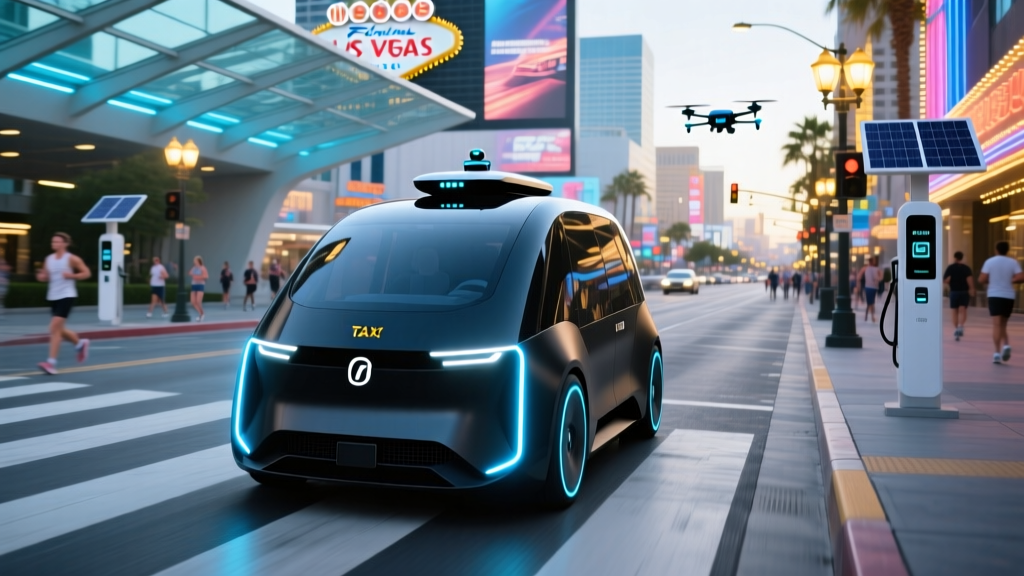
Key geographic note: Neither service currently covers suburban areas like North Las Vegas, Boulder City, or the far western valley. If your trip originates or terminates outside the geofence, the app will not allow you to book the ride. The Las Vegas Strip itself, from Mandalay Bay to the Strat, is well-covered by both operators.
Harry Reid International Airport access is a significant differentiator. Waymo's airport service allows arrivals to hail a driverless ride directly from the terminal — a first for the city and a major convenience over traditional rideshare staging lots.
How Much Does a Las Vegas Robotaxi Cost vs. Uber and Lyft?
Pricing is the question every first-time rider asks. Robotaxi fares in Las Vegas are structured to compete directly with UberX and Lyft standard rides, though surge dynamics differ.
Estimated Fare Comparison — Strip to Airport (~4 miles)
| Service | Base Fare Range | Surge Behavior | Tipping |
|---|---|---|---|
| Waymo One | $10–$16 | Moderate; algorithm-managed, generally less aggressive than Uber surge | Not expected (no driver) |
| Motional (via Lyft) | $11–$18 | Follows Lyft pricing framework | Not expected |
| UberX | $12–$22 | High during peak convention/event times | Customary 15–20% |
| Lyft Standard | $11–$20 | Similar to Uber; peak pricing during CES, F1, etc. | Customary 15–20% |
When you factor in the eliminated tip, a Waymo ride from the Strip to the airport can cost 20–35% less than an UberX with tip during non-surge periods. During major events like CES or the Las Vegas Grand Prix, robotaxi pricing tends to hold steadier than human-driven rideshare surge, though wait times increase significantly.
How to book: Download the Waymo app (for Waymo One) or request a Motional vehicle through the Lyft app by selecting the autonomous ride option when available in your area. Payment is handled in-app, linked to a credit card on file.
How Safe Are Robotaxis? Real Data, Not Marketing
Safety is the most scrutinized dimension of autonomous vehicle deployment, and Las Vegas has been a focal point for both operations and incident analysis.
Robotaxi Safety Record — What the Numbers Show
- Waymo (national, through late 2025): Over 30 million fully driverless miles completed across Phoenix, San Francisco, Los Angeles, and Las Vegas. Waymo's published safety data indicates a 85% reduction in injury-causing crash involvement compared to human benchmarks in comparable urban environments.
- Motional: Millions of autonomous miles logged in Las Vegas, Boston, and Los Angeles. Motional's safety record in Las Vegas has been comparatively clean, with no widely reported serious-injury incidents in the geofenced Strip corridor as of early 2026.
- NHTSA Standing General Order: All Level 4 operators must report crashes involving their ADS-equipped vehicles to the National Highway Traffic Safety Administration. This public database provides the most comprehensive incident tracking available.
Context matters. Robotaxis operate at lower average speeds in urban corridors (typically 25–45 mph), avoid highways in most geofences, and have 360-degree sensor coverage that does not fatigue, text, or drive impaired. However, they have demonstrated challenges with certain edge cases — construction zones with altered lane markings, erratic human pedestrian behavior, and emergency vehicles approaching from unexpected angles.
The most honest framing: robotaxis in Las Vegas have compiled a safety record that is competitive with or better than human drivers in equivalent urban settings, but the sample size remains smaller and the operational domain narrower.
Under the Hood: The Technology Stack Powering Vegas Robotaxis
Understanding the sensor suite helps explain both the capabilities and the limitations of these vehicles.
Sensor and Compute Architecture
| Component | Waymo (5th-Gen) | Motional (Ioniq 5 Robotaxi) |
|---|---|---|
| Lidar | Custom-designed spinning and fixed lidar units; roof-mounted + corner units | Multiple solid-state lidar units (roof + bumper integrated) |
| Cameras | 29+ cameras providing 360° coverage, including long-range telephoto | 12+ cameras covering 360° surround view |
| Radar | 6 radar units for velocity detection and all-weather performance | 5 radar units |
| Compute | Custom Waymo compute platform; redundant systems | NVIDIA DRIVE-based compute; redundant fail-operational architecture |
| HD Mapping | Pre-scanned centimeter-level maps; real-time localization | HD maps with real-time sensor fusion overlay |
A critical distinction: both Waymo and Motional use lidar as a primary sensor, unlike Tesla's camera-only approach for its Level 2 FSD system. Lidar provides direct depth measurement independent of lighting conditions — a significant advantage for nighttime operation on the brightly lit but visually chaotic Strip.
Both systems rely on geofencing: pre-mapped zones where the HD maps, sensor calibration, and operational design domain (ODD) have been validated. The vehicle will not operate autonomously outside this zone. This is why Level 4 autonomy can exist today — it solves a bounded problem rather than the open-ended challenge of Level 5.
The Regulatory Framework: Who Approves Robotaxis in Nevada?
Nevada was one of the first states to legislate autonomous vehicle testing and deployment, and its framework remains one of the more permissive in the country.
- Nevada DMV — Autonomous Vehicle Division: Issues testing and deployment permits. Operators must demonstrate safety validation, insurance coverage, and incident-reporting protocols before receiving a deployment license.
- Nevada Legislature (AB 511, 2011 and subsequent amendments): Established the legal framework allowing driverless vehicles on public roads without a human operator present — a prerequisite for Level 4 commercial service.
- NHTSA (Federal): Oversees vehicle safety standards and the Standing General Order requiring crash reporting. Federal motor vehicle safety standards (FMVSS) currently assume a human driver, creating regulatory friction for vehicles without steering wheels (like Zoox's purpose-built robotaxi, which received a specific exemption).
- Clark County and City of Las Vegas: Local jurisdictions coordinate on road-use agreements, pickup/dropoff zones, and traffic-management integration.
The result: Nevada's regulatory environment has made Las Vegas one of the fastest cities for robotaxi deployment approvals, though operators still must clear significant safety-validation hurdles before expanding their geofences.
Current Limitations: What Robotaxis in Las Vegas Cannot Do
Before you book, understand the real-world boundaries:
Operational Constraints
- Geofence boundaries: Trips that start or end outside the approved zone are unavailable. Suburban destinations, Red Rock Canyon, and Lake Mead are not reachable.
- Weather limitations: While Las Vegas rarely sees heavy rain, monsoon-season downpours (July–September) can trigger service suspensions. Lidar and camera performance degrades in heavy precipitation. Neither service operates in zero-visibility conditions.
- Construction zones: Major roadwork with altered lane configurations can cause the vehicle to pull over and request remote assistance, adding minutes to your trip.
- No highway driving (limited): Most geofenced routes use surface streets and the Strip corridor. Interstate 15 travel between cities is generally not part of the operational domain, though some freeway segments within the geofence may be used.
- Accessibility: Current Waymo Jaguar I-PACE vehicles are SUVs requiring step-up entry. Wheelchair-accessible vehicles are in pilot phases but not broadly available in Las Vegas as of early 2026.
- Passenger capacity: Typically 1–3 riders per vehicle, with no option for XL or group rides.
- Pets and cargo: Service animals are accommodated; pets and oversized luggage may not be permitted.
The honest assessment: a Las Vegas robotaxi is excellent for point-to-point trips within the core tourist and business corridor. It is not a replacement for a rental car if you plan to explore beyond the valley.
Las Vegas Robotaxi FAQ
Can I hail a Waymo directly on the Las Vegas Strip?
Yes. Waymo One operates along the Strip corridor and allows street-side pickup at most major hotel and casino entrances. Open the Waymo app, set your destination, and the vehicle will navigate to a designated pickup point near your location.
Is there a human driver in the Waymo or Motional vehicle?
No. Both Waymo One and Motional operate SAE Level 4 vehicles with no driver present. The front driver's seat is empty. A remote operations team monitors the fleet and can assist the vehicle if it encounters an unresolvable scenario.
How does robotaxi pricing compare during major Las Vegas events?
During conventions (CES, SEMA), the F1 Grand Prix, or New Year's Eve, Uber and Lyft surge pricing can push a Strip-to-airport ride above $35–$50. Robotaxi fares tend to be more stable, though wait times extend considerably — expect 10–20 minutes during peak demand versus 3–7 minutes on a normal evening.
What happens if the robotaxi encounters a situation it cannot handle?
The vehicle will pull to a safe stop and connect to a remote operations specialist who can assess the situation and either guide the vehicle through it or dispatch roadside assistance. You are never stranded without support.
Are Las Vegas robotaxis safe at night?
Yes. The lidar and infrared-capable sensor suites do not depend on visible light. Nighttime operation on the well-lit Strip is one of the stronger use cases for the technology. Waymo operates 24/7 in Las Vegas.
Can I use a robotaxi to get to the Las Vegas airport?
Yes. Waymo One supports trips to and from Harry Reid International Airport (LAS). Motional airport service availability varies — check the Lyft app for current coverage.
How does this compare to Tesla's Full Self-Driving in Las Vegas?
Tesla FSD (Supervised) is an SAE Level 2 driver-assist system. A licensed human driver must remain attentive and ready to take over at all times. It is not a ride-hail service — you cannot summon a driverless Tesla to pick you up. Waymo and Motional are Level 4: no driver, no human intervention required within their geofenced zones.
Bottom Line: Who Should Ride a Robotaxi in Las Vegas?
If your trip stays within the Strip, downtown, or airport corridor, a robotaxi is a practical, competitively priced, and genuinely novel transportation option. The technology has matured past the novelty phase — these are working commercial services moving thousands of passengers daily in Las Vegas.
The limitations are real but manageable: geofence boundaries, weather sensitivity during monsoon season, and reduced capacity. For visitors staying on or near the Strip who need airport transfers, dinner reservations, or convention-center commutes, a Level 4 robotaxi is often the most cost-effective and reliable option available.
For suburban exploration, day trips to Red Rock or the Hoover Dam, or group travel, stick with a rental car or traditional rideshare. The autonomous future is here in Las Vegas — just within carefully defined boundaries.