The Aurora Self-Driving Truck: Where Level 4 Freight Stands Today
Aurora Innovation's driverless semi-truck program — built around the Aurora Driver platform — has transitioned from testing to commercial operations on Texas highways. Unlike the consumer-facing robotaxi services operated by Waymo or Cruise, Aurora targets Class 8 freight hauling, partnering with Volvo Trucks and PACCAR (Kenworth/Peterbilt) to deploy autonomous 18-wheelers on hub-to-hub routes. If you've searched for "aurora self driving truck" hoping to understand whether this technology is live, where it runs, and how safe it actually is, this guide covers the verified facts as of early 2026.
Before diving into specifics, it's essential to draw a hard line between what Aurora does and the driver-assist features you find in passenger EVs.
SAE Automation Level: Level 4 (High Automation)
Aurora's self-driving truck operates at SAE Level 4 within its defined operational design domain (ODD). This means the vehicle handles all driving tasks — steering, braking, lane changes, merging, highway navigation — without any human driver present in the cab on approved routes. This is fundamentally different from SAE Level 2 systems like Tesla Autopilot, Ford BlueCruise, or GM Super Cruise, which require a licensed, attentive driver ready to take over at any moment. Aurora's trucks do not have a driver in the vehicle during commercial driverless operations.
Source: SAE International J3016
Where Aurora's Self-Driving Trucks Operate Right Now
Aurora's commercial driverless operations are geographically concentrated in Texas, where regulatory conditions, highway infrastructure, and freight demand align. The company's launch corridor connects major distribution hubs along Interstate 45 and surrounding routes.
| Corridor | Key Cities/Hubs | Highway | Status | Partner Carrier |
|---|---|---|---|---|
| Dallas–Houston | Dallas (Wilmer) ↔ Houston (Katy) | I-45 | Driverless commercial operations | Continental, Werner, U.S. Xpress |
| Dallas–San Antonio | Dallas ↔ San Antonio | I-35 | Driverless commercial operations | Werner |
| Dallas–Laredo (expansion) | Dallas ↔ Laredo | I-35 South | Announced / mapping phase | TBD |
| Phoenix–Dallas (future) | Phoenix ↔ Dallas | I-10 | Planned expansion | TBD |
Aurora's approach is strictly hub-to-hub: the autonomous truck picks up a loaded trailer at a freight terminal near the highway, drives the highway portion autonomously, and delivers the trailer to a terminal at the destination. Human drivers handle the first and last mile — navigating surface streets, loading docks, and complex urban environments where the ODD does not extend.
This is not a consumer service. You cannot hail an Aurora truck. The company sells autonomous trucking as a transportation-as-a-service model to freight carriers and logistics companies. Per-mile pricing for carriers is competitive with human-driven long-haul rates, though Aurora has not published a public consumer-facing price sheet. The value proposition for carriers centers on utilization: an autonomous truck can operate nearly 20 hours per day (versus the 11-hour federal driving limit for human truckers under FMCSA hours-of-service rules), dramatically improving asset productivity on high-volume corridors.
The Technology Stack: Lidar, Cameras, and the Aurora Driver
Aurora's sensor suite is fundamentally different from Tesla's camera-only FSD approach. The Aurora Driver relies on a multi-modal sensor stack designed for the specific demands of an 80,000-pound vehicle traveling at highway speeds with 40+ seconds of stopping distance.
Core Sensor Hardware (Aurora Driver Platform)
- FirstLight Lidar — Aurora's proprietary frequency-modulated continuous-wave (FMCW) lidar, providing long-range 3D perception beyond 400 meters. FMCW lidar measures both distance and velocity of objects directly, unlike traditional time-of-flight lidar, giving the system earlier detection of fast-approaching vehicles and debris.
- Camera array — Multiple high-resolution cameras covering 360° around the truck, used for lane detection, traffic sign recognition, and object classification.
- Radar — Forward and side-facing radar units for redundancy in adverse weather and to track object velocity at range.
- High-definition maps — Centimeter-precision maps of every approved route, updated continuously, providing the system with advance knowledge of lane geometry, merge points, and infrastructure.
- Redundant compute and actuation — Dual-redundant computing platforms and redundant steering/braking actuators ensure the truck can stop safely if any single system fails.
The FMCW lidar is Aurora's key hardware differentiator. Traditional lidar (time-of-flight) sends out laser pulses and measures how long they take to return. FMCW lidar instead uses a continuous, frequency-modulated beam that encodes velocity information in the returning signal — essentially giving the truck a direct speed measurement for every point in its point cloud. At 70 mph on I-45, knowing that a vehicle 300 meters ahead is decelerating, versus stationary, is a critical safety advantage that camera-only systems must infer computationally.
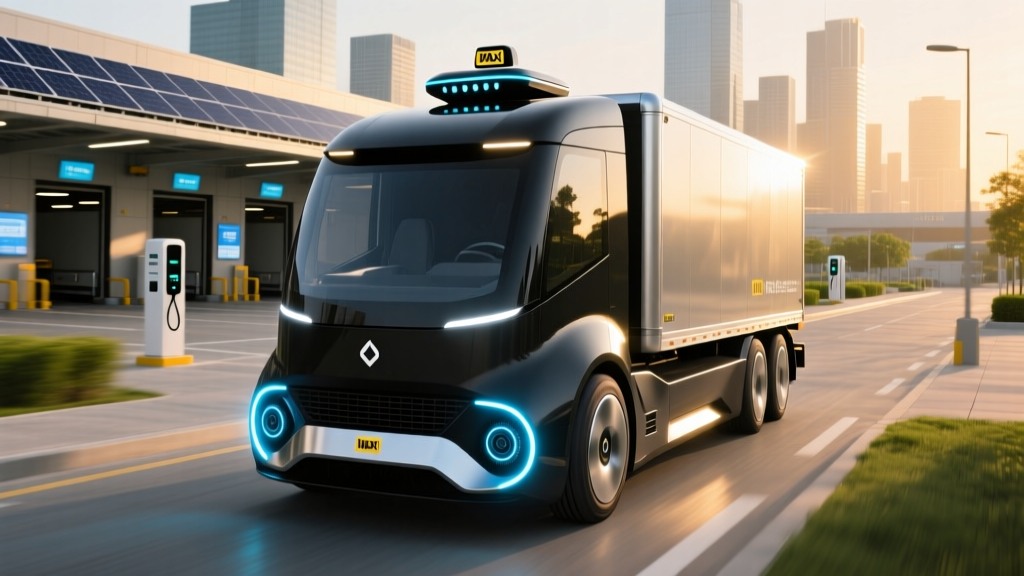
The truck platform itself is based on the Volvo VNL 860 (Aurora's launch vehicle) and the PACCAR Integrated Autonomous Vehicle Platform, both purpose-built with redundant electrical systems, air brake redundancy, and Aurora's sensor suite integrated at the factory rather than retrofitted.
Safety Record: What the Data Actually Shows
Aurora publishes safety data through its quarterly reports and regulatory filings. As with all autonomous vehicle operators, interpreting this data requires context — these trucks operate on well-mapped, limited-access highways in favorable weather, which is a fundamentally simpler environment than urban robotaxi operations.
Aurora Safety Data (Cumulative Through Late 2025)
- Total autonomous miles driven: Over 8 million miles across testing and commercial operations (combined Aurora Driver fleet, including passenger vehicles and trucks)
- Driverless commercial miles: Approximately 1.5+ million miles on Texas hub-to-hub routes (driverless operations began commercially in late 2024)
- At-fault collisions: Aurora reports zero at-fault collisions during driverless commercial operations on Texas highways through its most recent public disclosures
- Disengagement rate: Not directly comparable to California DMV disengagement reports (Aurora does not test in California). Internal metrics show intervention rates declining each quarter as the system matures.
- NHTSA Standing General Order: Aurora reports incidents as required under NHTSA's Standing General Order for ADS-equipped vehicles
For context, the IIHS reports that large trucks are involved in approximately 1.5 fatal crashes per 100 million vehicle miles traveled nationally. Aurora's safety case rests on the argument that eliminating human factors — fatigue, distraction, impairment, which account for the majority of truck crashes — should reduce this rate substantially. The company's highway-only ODD avoids the complex intersection and pedestrian scenarios that have challenged urban robotaxis.
It's worth noting that the total driverless commercial mileage, while growing, is still a statistically small sample compared to the billions of miles driven by human truckers annually. Definitive safety superiority claims require more accumulated data.
Regulatory Landscape: Who Approves Autonomous Trucks?
Autonomous trucking in the United States operates under a patchwork of state and federal regulations, with no single unified framework:
- Federal (NHTSA/FMCSA): The National Highway Traffic Safety Administration sets vehicle safety standards (FMVSS). The Federal Motor Carrier Safety Administration regulates commercial trucking operations, including hours-of-service rules. FMCSA has granted Aurora and other ADS developers exemptions from certain requirements (like the mandate for a human driver) for commercial operations.
- Texas: Texas passed autonomous vehicle legislation (HB 3573, 2021) that explicitly permits ADS-equipped commercial vehicles to operate without a human driver, provided the vehicle is registered and insured. Texas is Aurora's primary operating state precisely because of this regulatory clarity.
- Arizona: Arizona has permissive AV regulations and is a planned expansion corridor for Aurora.
- Restrictive states: Several states, including California, have more restrictive frameworks for autonomous commercial vehicles. California's DMV requires testing permits, and the CPUC and CHP have separate approval processes for commercial operations. Aurora does not currently operate driverless trucks in California.
The regulatory environment remains fluid. The National Transportation Safety Board (NTSB) investigates autonomous vehicle incidents and issues safety recommendations, but does not directly regulate operations. Industry groups like the American Trucking Associations have advocated for federal preemption to create uniform rules, but as of 2026, state-by-state regulation remains the reality.
Current Limitations: What the Aurora Truck Cannot Do
Level 4 autonomy within a defined ODD is a significant achievement, but it comes with hard boundaries. Aurora's self-driving truck has explicit limitations that define where and when it can operate:
- Weather restrictions: The Aurora Driver does not operate in heavy rain, fog, snow, or ice. When weather sensors detect conditions beyond the system's capability, the truck either delays departure, pulls over to a safe location, or the route is rescheduled. Texas's generally mild climate is one reason it was chosen as the launch state.
- Geofenced routes only: The truck operates exclusively on pre-mapped highway segments. It cannot deviate to an alternate route due to an unexpected closure without human remote assistance or re-routing approval. Surface streets, loading docks, and non-mapped roads are outside the ODD.
- Hub-to-hub only: Aurora does not handle first-mile or last-mile driving. Human truckers pick up and deliver trailers at freight terminals adjacent to highways.
- No urban or construction-zone autonomy: Active construction zones with shifted lanes, temporary barriers, or flaggers may exceed the system's capability. Aurora maps construction zones in advance and may restrict operations through complex zones until mapping is updated.
- Remote assistance, not remote driving: Aurora employs remote specialists who can provide the vehicle with guidance at decision points (e.g., confirming it's safe to proceed past an unusual obstacle). These specialists do not steer or brake the truck remotely — the onboard system retains full control of vehicle dynamics.
- Speed and road-type restrictions: The system operates on limited-access divided highways at posted speeds up to 75 mph. It does not handle two-lane rural roads, roundabouts, or unpaved surfaces.
These limitations mean that Aurora's system is not a replacement for all trucking. It's a replacement for the specific, high-volume, long-distance highway segments that make up the majority of long-haul freight miles — the portion of the job that is most monotonous, most associated with driver fatigue, and most difficult to staff given the trucking industry's chronic driver shortage.
How Aurora Compares to Other Autonomous Truck Programs
| Company | SAE Level | Primary Corridor | Truck Platform | Commercial Status |
|---|---|---|---|---|
| Aurora | Level 4 | Texas (I-45, I-35) | Volvo VNL, PACCAR | Driverless commercial operations active |
| Waymo Via | Level 4 | Texas, Arizona | Various (Class 8) | Testing / limited commercial |
| Kodiak Robotics | Level 4 | Texas (I-35, I-10) | International LT, Spartan | Commercial freight deliveries (with safety driver transitioning to driverless) |
| Gatik | Level 4 | Texas, Arkansas, multiple states | Box trucks (Class 3-7) | Driverless commercial operations (middle-mile B2B) |
| Tesla Semi | Level 2 (driver-assist) | N/A (owner-operated) | Tesla Semi | Production; Enhanced Autopilot available (driver required) |
Note that Tesla's Semi, despite its advanced driver-assist capabilities, remains a Level 2 vehicle requiring an engaged human driver. The Tesla Semi's Autopilot and potential future FSD features are categorically different from Aurora's Level 4 driverless operations — one assists a driver, the other eliminates the driver position entirely on approved routes.
What Aurora's Self-Driving Truck Means for EV Freight
Aurora's current truck platforms — the Volvo VNL and PACCAR vehicles — are diesel-powered Class 8 trucks. The Aurora Driver platform is designed to be powertrain-agnostic, meaning it can integrate with battery-electric or hydrogen fuel cell trucks as they become commercially viable for long-haul routes. Volvo's upcoming VNL Electric and PACCAR's electric platforms are potential future hosts for the Aurora Driver.
The convergence of autonomous driving and electric freight is not immediate. Current battery-electric Class 8 trucks (like the Tesla Semi, Volvo VNR Electric, and Freightliner eCascadia) have ranges of 150–500 miles depending on the model and battery configuration — viable for regional haul but challenging for the 400+ mile hub-to-hub routes Aurora operates. As battery energy density improves and megawatt charging infrastructure (the MCS standard) deploys along freight corridors, electric autonomous trucks become feasible, potentially combining Aurora's 20-hour utilization advantage with zero tailpipe emissions.
Frequently Asked Questions
Can I ride in or hail an Aurora self-driving truck?
No. Aurora's service is a business-to-business freight transportation platform. The company contracts with carriers and shippers to move cargo autonomously. There is no consumer ride-hailing component, and no passengers ride in the truck during driverless operations.
Is the Aurora self-driving truck truly driverless?
Yes, on approved Texas highway routes. The truck operates at SAE Level 4 with no human driver in the cab. Remote specialists provide guidance at decision points but do not directly control the vehicle's steering or braking.
How many Aurora trucks are on the road?
Aurora has not published an exact fleet count for its driverless commercial operations. The company has been scaling its fleet throughout 2025 and into 2026, with dozens of trucks operating across its Texas corridors. The fleet includes both safety-driver testing vehicles and fully driverless commercial units.
What happens if the Aurora truck encounters an emergency?
The Aurora Driver is designed with redundant systems — dual compute, redundant braking, and redundant steering. If a critical fault is detected, the truck is programmed to execute a minimal risk condition (MRC), which typically means safely pulling to the shoulder and stopping. Remote specialists are notified and can provide guidance or dispatch roadside assistance.
Does Aurora's self-driving truck operate in bad weather?
No. The system has operational limits for rain, fog, snow, and ice. Routes may be delayed or rescheduled when weather exceeds the Aurora Driver's validated capabilities. This is a deliberate safety constraint of the Level 4 ODD.
How does Aurora's technology compare to Tesla Semi's Autopilot?
They are fundamentally different categories. The Tesla Semi uses Autopilot or FSD (Supervised), which are SAE Level 2 driver-assist systems requiring an attentive human driver at all times. Aurora's truck is SAE Level 4 — no driver is present on approved routes. Aurora uses lidar, radar, cameras, and HD maps; Tesla uses a camera-only approach. They solve different problems: Tesla assists a driver; Aurora replaces the driver on specific highway segments.
Will autonomous trucks eliminate trucker jobs?
Aurora's hub-to-hub model is designed to automate the highway portion of long-haul routes, which are the hardest to staff. Human drivers still handle first-mile and last-mile segments, local delivery, and routes outside the geofenced ODD. The trucking industry currently faces a structural driver shortage estimated at 78,000+ drivers by the American Trucking Associations. Aurora positions its technology as a supplement to, not a wholesale replacement of, the trucking workforce — enabling existing drivers to focus on local routes and return home nightly rather than spending weeks on the road.